



Technical Guides
We are committed to providing high-quality, sustainable, and efficient chemical solutions to help our customers maintain a leading position in complex market environments.

Technical Guides
We are committed to providing high-quality, sustainable, and efficient chemical solutions to help our customers maintain a leading position in complex market environments.

Practical Chemical Knowledge For Safer Operations And Better Industrial Applications
Chemical products are widely used across manufacturing, water treatment, agriculture, pharmaceuticals, coatings, mining, and many other industrial sectors. However, improper storage, transportation, handling, or product selection may directly affect product stability, operational safety, and production efficiency.
Our Technical Guides section provides practical industry-oriented knowledge to help customers better understand chemical products, reduce operational risks, and improve application performance in real production environments.
Product Storage & Transportation
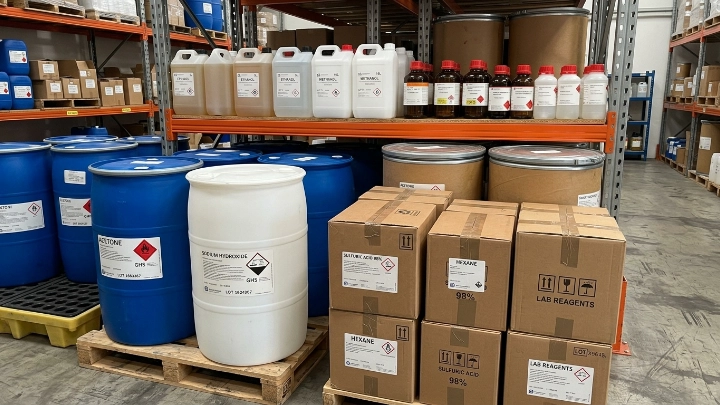
Many industrial chemicals are sensitive to humidity, sunlight, temperature fluctuation, and air exposure during storage and transportation. For example, hygroscopic powder chemicals may absorb moisture and form hard agglomerates during warehousing, while some liquid products may experience concentration instability under prolonged high-temperature transportation.
Improper stacking methods may also damage packaging pressure resistance, increasing leakage risks during container shipping and long-distance export logistics. Certain corrosive chemicals additionally require compatible packaging materials, since metal containers may react with acidic products over time.
Chemical Safety & Handling
In industrial environments, many operational risks come from incorrect handling procedures rather than the chemical itself. For example, adding water directly into concentrated acids may rapidly release heat and cause splashing, while mixing incompatible chemicals may generate toxic gases or unexpected reactions.
Some powdered chemicals may also create airborne dust during unloading and feeding processes, increasing inhalation risks or even causing combustible dust hazards in poorly ventilated environments.
Product Principles & Applications

Different chemicals perform differently depending on concentration, purity, pH conditions, reaction temperature, and formulation compatibility. In many industrial applications, understanding the working principle behind a chemical is often more important than simply increasing dosage.
For example, some water treatment chemicals rely on charge neutralization and flocculation mechanisms rather than direct chemical reactions, while certain additives in coatings or construction materials mainly function by improving dispersion, adhesion, or reaction stability.
Product Selection & Sourcing Tips
Selecting chemicals only by purity or price may lead to unstable production performance and unnecessary procurement costs. In many industrial applications, particle size, viscosity, dissolution speed, concentration range, and compatibility with existing systems are often equally important.
For example, liquid products may reduce dust generation and simplify feeding systems, while powder products are often more suitable for long-term storage and lower transportation costs. Similarly, higher purity is not always necessary if the target application does not require ultra-low impurity control.
Explore More Technical Resources
Our Technical Guides section is continuously updated with practical articles, industrial insights, and application-oriented chemical knowledge to support manufacturers, distributors, procurement teams, and industrial users worldwide.


