If you are looking for a bulk calcium formate supplier , price is only one part of the decision. Buyers also need steady purity , reliable lead times , packaging that holds up in transit , and paperwork that fits production and compliance needs.
That matters for construction formulators , feed manufacturers , and distributors serving more than one market .
Calcium formate is used in a few different industries because it is useful in production , handling , and finished-product performance . In dry-mix mortars and tile adhesives, it acts as a setting accelerator. In animal nutrition, it is used in feed applications where acidification and preservation matter. In procurement, buyers now pay close attention to supply reliability, technical data, and logistics support.
This article covers what calcium formate is used for, what is changing in the market, and how to judge a bulk supplier.
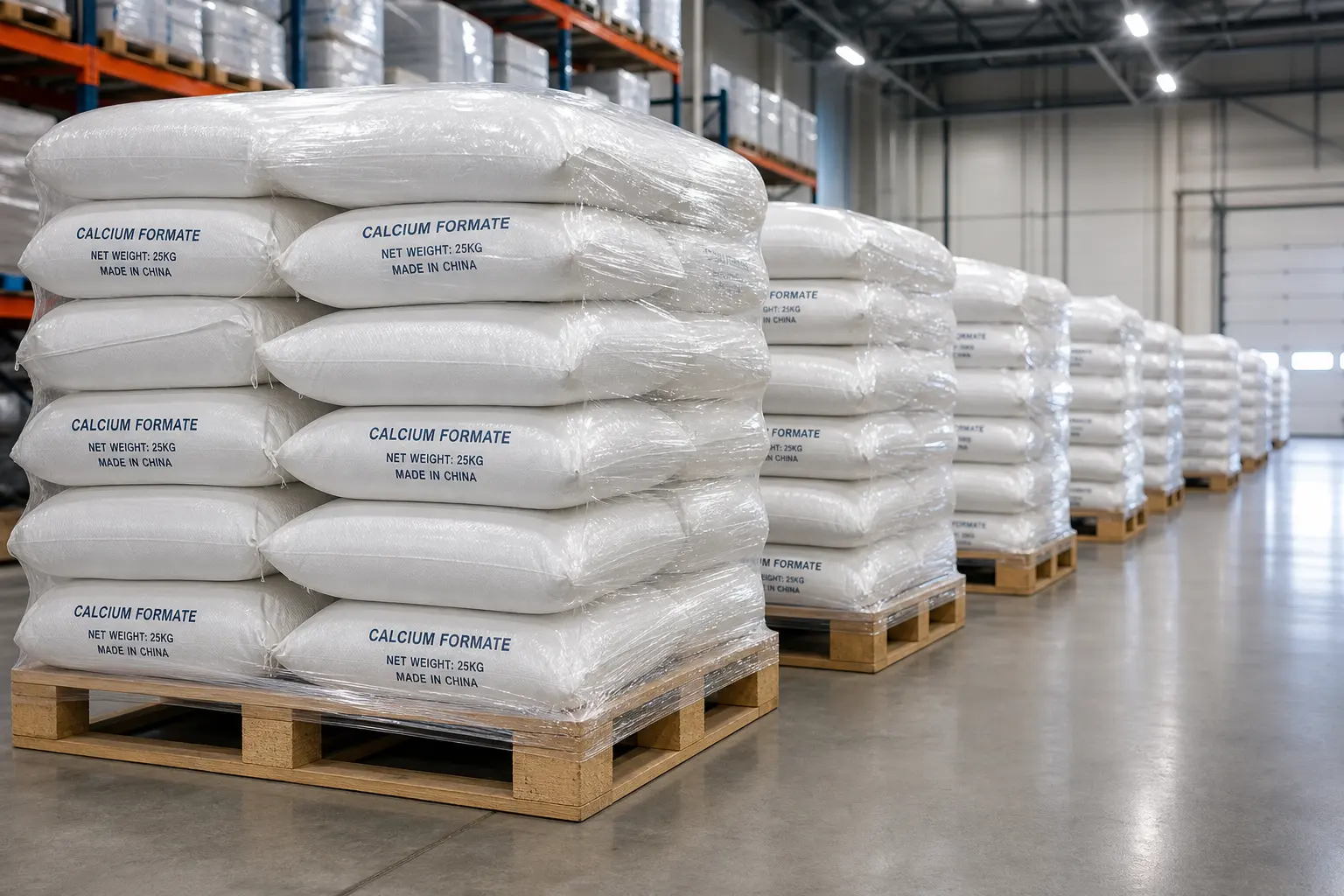
— Bulk calcium formate packed in white woven sacks on pallets inside a clean warehouse, with visible labels and shrink wrap.
📌 本文看点
01
What calcium formate is
02
Why demand stays steady
03
Common uses and buying criteria
01
CALCIUM FORMATE
What is calcium formate?
Calcium formate is the calcium salt of formic acid . It is usually a white crystalline powder or granule and stores well when kept dry. Because it works in both construction and feed formulations , it is widely traded in bulk.
Different uses call for different grades , particle sizes , and purity levels . Choosing the right calcium formate bulk supplier is not just a buying decision. It is also a technical one .
Common product details buyers check
- Purity or assay
- Moisture content
- Particle size distribution
- Insoluble matter
- Packaging format
- Batch consistency
- Shelf life and storage guidance
If a supplier cannot document these items clearly, procurement risk goes up. In bulk sourcing, small differences can affect mixing, product quality, and line efficiency.
02
DEMAND
Why demand stays steady
Calcium formate remains in demand because it is versatile . Buying patterns vary by region, but a few trends are shaping purchases in 2025.
Construction is still the biggest driver
Dry-mix mortars, tile adhesives, grouts, and similar cement-based products use large volumes of calcium formate. Manufacturers value it because it can improve early setting and help shorten production or application cycles.
That matters in a market where contractors, distributors, and project owners all want faster turnaround. A formulation that sets predictably is easier to sell and easier to use.
Feed use supports repeat buying
Calcium formate is also used in animal feed formulations, where consistency and compliance matter. Feed buyers usually care more about documentation , traceability , and impurity control because the ingredient sits inside a regulated supply chain.
That is why the strongest bulk suppliers are often the ones that can serve both industrial and feed-grade needs.
Buyers are more cautious about supply
Recent buying behavior across chemicals and ingredients shows a stronger focus on supply continuity. Many buyers look past unit price and ask whether the supplier can keep product moving, handle demand spikes, and avoid delays. For calcium formate, that often means working with vendors that can support long-term contracts, repeat orders, and flexible shipment sizes.
03
APPLICATIONS
Common uses for bulk calcium formate
A good supplier should understand how the product is used, not only how it is shipped. That helps match the right grade , package , and delivery plan to the application.
Construction materials
In construction chemicals, calcium formate is often used in dry-mix mortars , tile adhesives , grouts , self-leveling compounds, repair mortars, and cement-based formulations. In these products, buyers usually want good dispersibility, stable storage, and repeatable performance.
The wrong particle size or too much moisture can affect mixing and product stability.
Feed and nutrition-related uses
In feed production, calcium formate may be used in formulations where acidification and preservation matter. Buyers in this segment usually focus on grade suitability, safety documentation, traceability, contaminant control, and packaging hygiene.
Because feed applications are sensitive, many procurement teams ask for tighter specifications and more complete certificates of analysis than industrial buyers do.
Industrial and specialty uses
In some markets, calcium formate is also used in specialty chemical processes and selected industrial formulations. In those cases, the supplier needs to handle custom requirements, technical documents, and export logistics.
04
BUYER PRIORITIES
What buyers want now
01 Steady supply in a difficult logistics environment Freight swings, port congestion, and regional disruptions have made consistency more valuable. A bulk calcium formate supplier with warehouse coverage and several shipping options can reduce the chance of a production stoppage.
02 Clear documents and traceability Many buyers now expect Certificate of Analysis , Material Safety Data Sheet , batch number tracking, country of origin details, and packaging and storage guidance. This matters most in international trade and regulated applications.
03 Packaging that fits the order Bulk buyers do not always want the same format. Depending on the order and end use, suppliers may offer 25 kg bags, 500 kg jumbo bags, 1,000 kg bulk bags, custom palletization, and container loading support. For distributors and OEMs, packaging flexibility can save time in the warehouse and at the dock.
04 Technical help, not only sales support Industrial buyers increasingly want suppliers who can answer formulation questions. Even a small issue like flowability or moisture sensitivity can affect the final product. A supplier that understands the material can help reduce trial-and-error costs.
— Procurement team reviewing calcium formate specification sheets beside stacked bulk bags in a distribution center.
05
EVALUATION
How to evaluate a bulk calcium formate supplier
Suppliers do not all offer the same level of consistency. Before placing a wholesale order, check a few practical points.
Product consistency
Ask whether the supplier can hold assay, particle size, and moisture within a narrow range from batch to batch. That is one of the biggest factors in repeat purchasing.
Manufacturing and quality control
A reliable supplier should be able to explain how the product is tested, packed, and inspected before shipment. Buyers should look for a clear quality process, not vague promises.
Export experience
If you import calcium formate, the supplier should understand customs paperwork, container loading, shipping schedules, and destination rules. Experienced exporters usually create fewer delays and fewer hidden costs.
Production capacity and stock
A low quote does not help if the supplier cannot ship on time. Check whether they can handle large-volume orders, repeat monthly shipments, peak-season demand, and emergency replenishment.
Response time
In bulk procurement, speed matters. Slow replies can delay planning and create uncertainty in the supply chain. The best suppliers send clear updates on stock, lead time, and documents.
Commercial flexibility
Look for suppliers who can support trial orders, annual contracts, mixed container shipments, private-label or distributor programs, and custom documentation needs. That flexibility is useful for buyers who serve more than one end market.
06
SPECIFICATIONS
What specifications matter most
When comparing quotes, it is easy to focus only on unit price. For calcium formate, the specification sheet often tells you more.
Points to compare
- Purity level
- Moisture percentage
- Particle size
- Bulk density
- Insoluble residue
- Appearance
- Shelf stability
- Packaging integrity
Different uses care about different things. A construction buyer may focus on performance and flowability. A feed buyer may care more about safety and traceability.
Ask for batch consistency
One common issue in bulk chemicals is lot-to-lot variation. Even when product looks the same, small changes in moisture or particle size can affect performance. Ask the supplier how they control consistency over time.
Request samples before large orders
A sample is more than a formality. It lets you check solubility or dispersion, flow behavior, compatibility with your formulation, storage performance, and packaging quality.
For high-volume contracts, sample testing can save money later.
07
LOGISTICS
Bulk packaging and logistics
Bulk sourcing is as much about logistics as it is about product quality. Good packaging and shipping can reduce waste, improve handling, and lower landed cost.
Common packaging formats
- Small bags for resale or lab use
- Woven sacks for standard distribution
- Jumbo bags for industrial users
- Palletized loads for easier warehouse handling
The right format depends on your process, storage space, and unloading equipment.
Storage and handling
Calcium formate should be kept in a dry, well-ventilated place away from moisture. Buyers should confirm that the packaging protects against humidity during transit and storage. That is especially important for long-distance shipping and coastal routes.
Freight planning
For overseas buyers, landed cost is affected by container availability, packing density, port handling, destination duties, inland trucking, and delivery schedule. A strong supplier helps manage these points instead of pushing them all onto the buyer.
08
RELATIONSHIP
Why buyers stay with one supplier
Many procurement teams start with a single shipment and later move to a longer-term relationship. That usually happens when the supplier proves dependable in a few areas.
“A dependable bulk calcium formate supplier reduces procurement risk and makes planning easier.”
Long-term value often comes from
- Predictable product quality
- Faster reordering
- Better planning support
- Fewer claims or rejects
- More stable pricing discussions
- Better production continuity
For manufacturers, that can matter more than a short-term discount. A dependable bulk calcium formate supplier reduces procurement risk and makes planning easier.
09
RISK CONTROL
How to lower sourcing risk
If you are comparing suppliers, use a simple checklist.
Practical buyer checklist
- Confirm grade suitability for your application
- Review the specification sheet and COA
- Ask about production capacity
- Verify packaging and loading options
- Check delivery lead times
- Request sample testing
- Review export documentation capability
- Clarify payment and contract terms
- Ask about storage recommendations
This helps you avoid quality drift, shipment delays, and packaging damage.
10
BUYER PROFILE
Who should source bulk calcium formate?
Bulk calcium formate is a good fit for buyers who need repeat volume and steady quality.
- Construction chemical manufacturers
- Dry-mix mortar producers
- Tile adhesive formulators
- Feed additive distributors
- Industrial chemical traders
- Private-label importers
- Regional wholesalers
If your business depends on steady supply and repeatable quality, bulk sourcing is usually more efficient than spot buying.
Finding the right bulk calcium formate supplier is not just about placing an order. It means balancing quality , documentation , logistics , and application knowledge.
In 2025, the best suppliers are the ones that can offer steady supply, clear specifications, flexible packaging, and responsive service.
Whether you are sourcing for construction, feed, or industrial use, start by checking supplier consistency, asking for documents, and testing product performance before scaling up. That lowers risk and helps you build a supply chain that can support growth.