



Anhydrous Sodium Acetate for Leather Tanning: Improve Dyeing Uniformity
By Vanchorsc
2026-09-22Related Posts
Custom Packaging Solutions from an Anhydrous Sodium Acetate Supplier in China
2026-09-23

Application Trends in Anhydrous Sodium Acetate for Special Chemical Manufacturing
2026-09-23
Anhydrous Sodium Acetate for Leather Tanning: Improve Dyeing Uniformity
2026-09-22

Formic Acid 85% for Textile Dyeing: Industrial Applications, Technical Benefits and Future Trends
2026-09-22
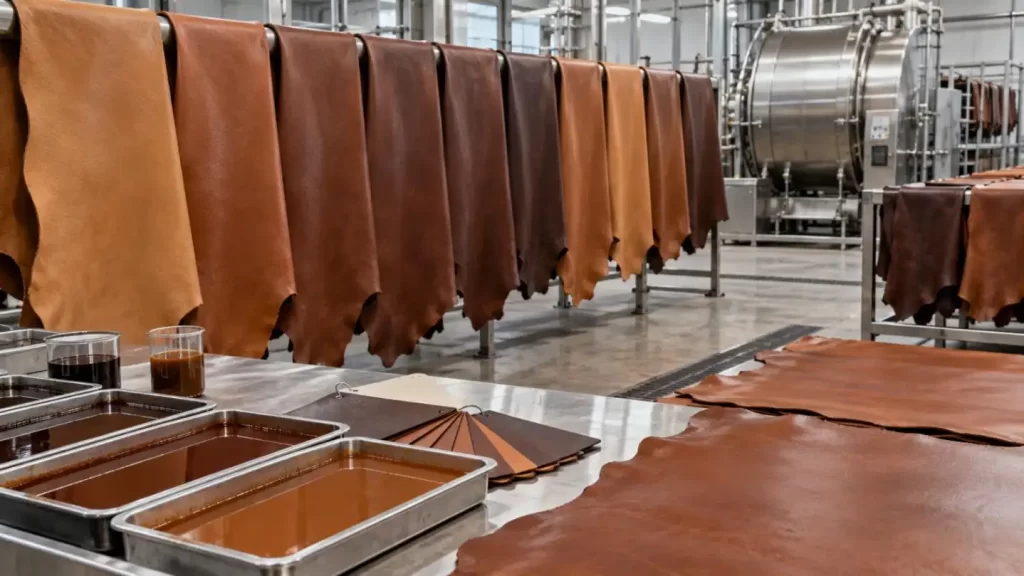
Color consistency is a major quality indicator for footwear leather, automotive leather, furniture leather, and other finished leather. Even in finished leather, inconsistent color is rarely from the dyes used. Chemical tanning, changes in pH and the accuracy of chemical dosing, as well as the structure of the hide can affect dye fixation and penetration.
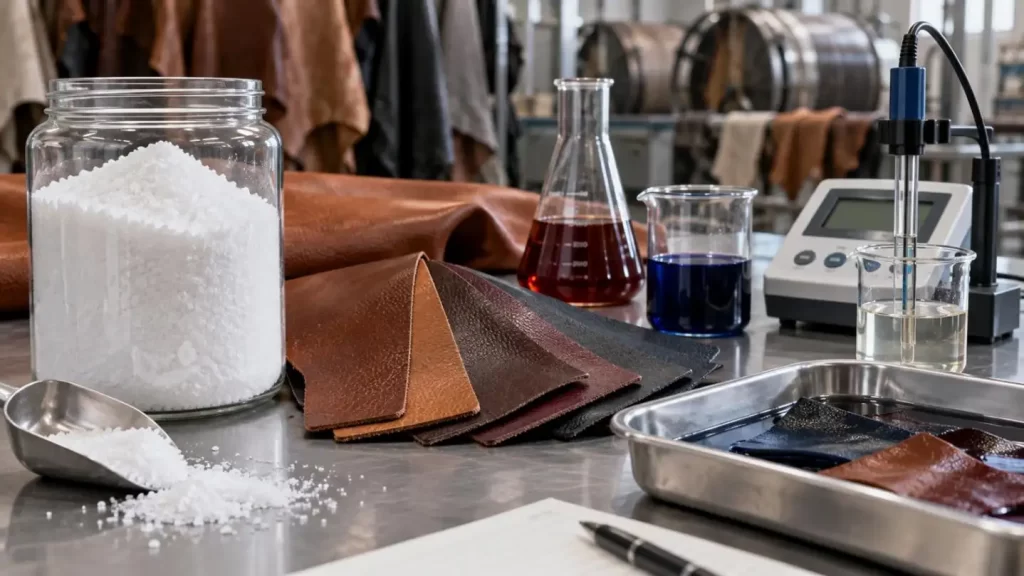
Anhydrous sodium acetate helps to maintain pH value equilibrium in leather processing and dyeing stages of the leather processing buffer system. Rapid changes in dye bath pH result in deb Successive layers form differently and consequently uneven dyeing, variation in color, and reduction in resistance to laundering.
Sodium acetate of consistent quality for industrial use is the objective of Vanchor as a chemical supplier. The Anhydrous Sodium Acetate of Vanchor has been guaranteed to have the specifications of CAS 127-09-3 and CH₃COONa. It is a white, crystalline powder of purity in the range of 99% to 101% for the industrial requirement.
Why Leather Dyeing Uniformity Depends on Chemical Balance
As a natural material with varied fiber densities and complex protein structures, leather often results in color variation despite the same chemistry being used by the same tannery.
Common challenges of dyeing include:
•Uneven dye uptake between the grains and inner layers
•Different shades appear in different production batches
•Inadequate rubbing and wet clarity
•Excess dye consumption with no improvement in the appearance
•Lack of ability to dye materials efficiently
There is a common belief that you can correct problems in dyeing by using greater quantities of dyes to achieve more depth in color. However, the addition of more dye merely increases the cost of the operation with no advantage if the pH of the dye bath is not controlled.
For this reason, many tanneries focus on improving process stability through controlled buffering systems.
How Anhydrous Sodium Acetate for Leather Tanning Enables Stable Dye Absorption
In the context of pH buffering, Anhydrous Sodium Acetate for Leather Tanning utilizes acetic acid and sodium hydroxide. Forming sodium acetate helps create a system of acetate which controls pH fluctuations in the range of formulation.
During the tanning and dyeing of leather, stable pH allows for:
•Predictable dye absorption
•Reduced pH disparities within the fibers of leather
•Consistent batch-to-batch color
•Compatibility of the chemistry of tanning and the chemistry of dyeing
The relationship is expressed as:
Anhydrous Sodium Acetate Quality -> Buffer Performance -> pH Stability -> Dye Penetration -> Color Uniformity -> Color Fastness
The aim is not to increase alkalinity, but to create a controlled environment in which chemical reactions occur in a consistent manner.
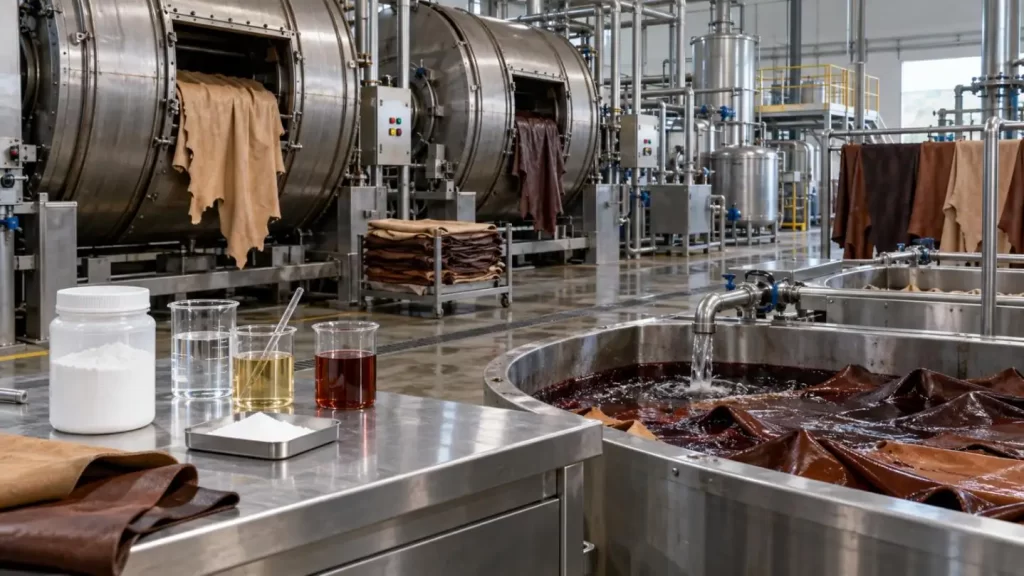
Key Parameters That Determine Performance in Leather Applications
When considering Anhydrous Sodium Acetate for Leather Tanning, tanneries must review all the technical specifications instead of considering only price.
| Parameter | Importance in Leather Processing | Production Impact |
| Purity | Determines active sodium acetate content | Improves process control |
| Moisture Content | Influences actual chemical concentration | Affects formulation calculation |
| Buffer Capacity | Controls resistance to pH changes | Supports stable dye absorption |
| Solubility | Determines mixing efficiency | Prevents uneven distribution |
| Batch Consistency | Ensures repeatable results | Reduces shade variation |
| Storage Stability | Maintains chemical properties | Protects long-term quality |
For industrial applications, Vanchor supplies Anhydrous Sodium Acetate with 99%-101% specification range, enabling customers to maintain constant formulation calculations and production control.
Anhydrous Sodium Acetate vs. Other pH Control Methods for Leather Dyeing
Depending on the production design, the chemical methods employed by different tanneries may differ.
| Solution | Advantages | Considerations |
| Anhydrous Sodium Acetate | Buffering is controlled, suitable dosage, good solubility | Suitable process matching is required |
| Sodium Bicarbonate | Economical | pH adjustment may not be gradual |
| Sodium Formate | Used in certain tanning systems | Different chemical behavior |
| Strong Alkali Agents | Fast pH adjustment | Rapid chemical change is more likely |
The correct methodology depends on the type of leather, the dyeing system, the tanning method, and the quality required.
A stable buffering system is usually preferred when production requires:
•Repeated color matching
•Large batch consistency
•Reduced rework rates
•Better process predictability
Choosing Between Anhydrous and Hydrated Sodium Acetate
Sodium acetate is available mainly in anhydrous and trihydrate forms. The difference is the presence of crystal water.
| Type | Characteristics | Application Consideration |
| Anhydrous Sodium Acetate | No crystal water, higher active content by weight | Suitable for precise industrial dosing |
| Sodium Acetate Trihydrate | Contains three water molecules | Requires adjustment in formulation calculations |
For leather chemical applications where dosage accuracy and moisture control are important, Anhydrous Sodium Acetate for Leather Tanning provides a practical option for process engineers.
Application Differences Across Leather Types
Differences in Leather Types Create Variations on Needed Care for Color Control.
| Leather Type | Primary Concern | Focus of Process |
| Upper Leather (Shoes) | Appearance of Leather | Dye Penetration |
| Leather (Automotive) | Stringent Color Matching | Repeatability of Batch |
| Leather (Furniture) | Large Surface Area | Dye Distribution |
| Leather (Specialty) | Customized Shades | Chemical Variability |
Successfully dyeing leather requires the prudent combination of processes such as the sodium acetate tanning process, the application of color along with finishing processes.
Quality Checks Before Purchase of Anhydrous Sodium Acetate.
When sourcing leather chemicals globally, strong documentation and quality control is essential.
Buyer due diligence prior to bulk purchases should verify the following:
•COA (Certificate of Analysis)
•Purity and moisture specifications
•Batch traceability
•Packaging protection
•Storage recommendations
•Export supply capability
Vanchor works with industrial customers to supply sodium acetate for buffering and stabilizing formulations.
Building More Consistent Leather Color Production With Vanchor
Integrating a reliable source of Anhydrous Sodium Acetate for Leather Tanning would help leather tanneries improve pH control and consistency of dyeing as well as reduce variability.
Vanchor offers sodium acetate designed for industrial use including leather manufacturers, with technical specifications and global supply support, for solutions to improve leather dyeing consistency and evaluate sodium acetate grades.
FAQs
Q1. What is the function of Anhydrous Sodium Acetate for Leather Tanning?
Anhydrous Sodium Acetate for Leather Tanning can be used as a pH buffer in leather processing. As a pH buffer, Anhydrous Sodium Acetate for Leather Tanning can help improve the absorption of dyes, achieve more consistent and uniform coloration, and eliminate variations in batches of leather.
Q2. How does Anhydrous Sodium Acetate promote the uniformity of leather dyeing?
Sodium acetate solutions offered by Vanchor can help maintain a stable chemical environment. Anhydrous Sodium Acetate for Leather Tanning controls the rapid fluctuations in pH and helps dyes react with leather fibers more consistently in an uniform manner to help achieve even color development.
Q3. Why should anhydrous grade sodium acetate be selected for leather applications?
For leather applications, anhydrous Sodium Acetate is preferred because of the absence of crystal water, which allows for precise dosage calculations, compared to hydrated sodium acetate. This is of importance for leather applications needing precise pH of processing solutions for consistent and repeatable results from processing.
Q4. What specification should leather manufacturers consider when purchasing sodium acetate?
The leather processor must evaluate the following in sodium acetate:
•Purity
•Moisture content
•Appearance
•Solubility
•Batch uniformity
•COA
•Packaging
These factors have a direct impact on formulation and process.
Q5. What purity level of Anhydrous Sodium Acetate does Vanchor provide?
Vanchor can offer Anhydrous Sodium Acetate, within specifications of 99%-101% to ensure consistent performance of the chemical in an industrial setting.


Contact Us
In This Article
Related Posts
Custom Packaging Solutions from an Anhydrous Sodium Acetate Supplier in China
2026-09-23
Application Trends in Anhydrous Sodium Acetate for Special Chemical Manufacturing
2026-09-23
Anhydrous Sodium Acetate for Leather Tanning: Improve Dyeing Uniformity
2026-09-22
Formic Acid 85% for Textile Dyeing: Industrial Applications, Technical Benefits and Future Trends
2026-09-22


