



Formic Acid Supplier China: Quality, Applications, and Global Purchasing Guide
By vanchor
2026-07-21Related Posts
Custom Packaging Solutions from an Anhydrous Sodium Acetate Supplier in China
2026-09-23
Application Trends in Anhydrous Sodium Acetate for Special Chemical Manufacturing
2026-09-23
Anhydrous Sodium Acetate for Leather Tanning: Improve Dyeing Uniformity
2026-09-22
Formic Acid 85% for Textile Dyeing: Industrial Applications, Technical Benefits and Future Trends
2026-09-22
A good Formic Acid Supplier China can offer industrial buyers a competitive price, several concentrations, custom packaging, comprehensive export paperwork and a reliable international shipment service. China is a well-established manufacturing base, with a sophisticated export system, and is a key source of formic acid for application in leather, textiles, rubber, animal feed, chemicals production, agriculture, cleaning products, and oilfield.
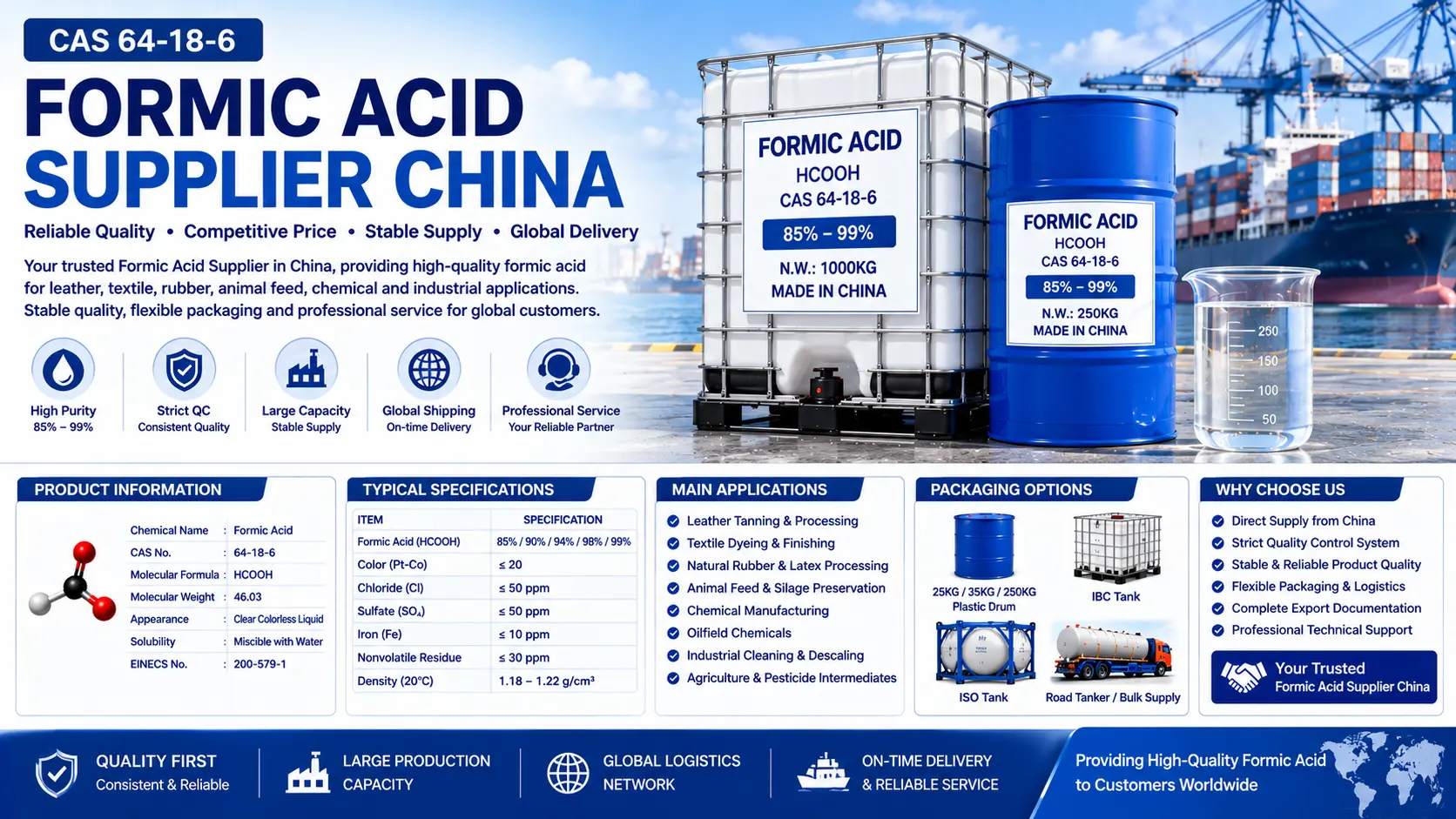
But it's important to not choose a supplier for price alone. The concentration of the product, chloride, sulfate, iron, color, nonvolatile residue, packaging compatibility, production capacity, export experience and batch consistency all can affect the final purchasing outcome.
What Is Formic Acid?
Formic acid is the simplest carboxylic acid. Its chemical formula is HCOOH, and its CAS number is 64-18-6. It is normally supplied as a clear, colorless liquid with a strong, penetrating odor.
Typical product information includes:
- Chemical name: Formic Acid
- CAS number: 64-18-6
- Molecular formula: HCOOH
- Molecular weight: approximately 46.03
- Appearance: Clear, colorless liquid
- Solubility: Miscible with water
- EINECS number: 200-579-1
Commercial formic acid is commonly available in concentrations such as 85%, 90%, 94%, 98%, and 99%. The correct grade depends on the application, process requirements, impurity limits, handling equipment, and purchasing budget.
Why Source Formic Acid from China?
China is a major producer and exporter of industrial chemicals. Buyers sourcing formic acid from China may benefit from:
- Large production capacity
- Competitive manufacturing costs
- Multiple concentration options
- Flexible packaging
- Private-label services
- Bulk liquid supply
- Established port logistics
- Experienced export teams
- Customized documentation
- Stable repeat-order support
These advantages can help international buyers improve procurement efficiency and reduce supply-chain costs.
However, the quality and service levels of suppliers can vary. Buyers should carefully evaluate whether the company is a direct manufacturer, an exporter, a distributor, or a trading company.
Main Applications of Formic Acid
Leather Tanning and Processing
Formic acid is widely used in leather pickling, tanning, dyeing, and pH-control operations.
It may support:
- Controlled acidification
- Improved penetration of tanning chemicals
- Better dye fixation
- More uniform processing
- Stable batch performance
- Improved finished-leather quality
Leather manufacturers should pay attention to concentration, iron, color, chloride, and batch consistency.
Textile Dyeing and Finishing
In textile processing, formic acid may be used for pH adjustment, neutralization, dye fixation, and selected finishing operations.
Potential functions include:
- Adjusting dye-bath acidity
- Supporting color development
- Neutralizing alkaline residues
- Improving process control
- Supporting finishing formulations
The correct dosage depends on the fiber, dye type, process temperature, water quality, and target pH.
Natural Rubber and Latex Processing
Formic acid is commonly used as a coagulant in natural rubber and latex processing.
It can help:
- Coagulate latex
- Separate rubber solids
- Control pH
- Improve processing consistency
- Support stable production
Rubber manufacturers generally require a stable acid concentration and low impurity levels.
Animal Feed and Silage Preservation
Formic acid may be used in animal-feed acidification, silage preservation, and grain-storage systems.
Potential benefits include:
- Lowering feed pH
- Supporting preservation
- Reducing unwanted microbial activity
- Improving storage stability
- Supporting feed hygiene
Feed applications must comply with applicable local regulations and approved-use requirements.
Chemical Manufacturing
Formic acid is used as a raw material, reagent, or intermediate in the production of:
- Formate salts
- Sodium formate
- Potassium formate
- Pharmaceuticals
- Agrochemicals
- Dyes and pigments
- Specialty chemicals
- Cleaning chemicals
Chemical manufacturers often require tighter impurity control because product variation may affect reaction efficiency, yield, color, and final quality.
Oilfield Applications
Formic acid may be incorporated into selected oilfield formulations and operations, including:
- Well stimulation
- Acidizing
- Scale removal
- pH adjustment
- Equipment cleaning
- Specialty fluid systems
Oilfield users should evaluate corrosion, concentration, impurity control, and material compatibility before use.
Industrial Cleaning
Formic acid may be used in selected cleaning and descaling products.
Potential applications include:
- Mineral-deposit removal
- Industrial equipment cleaning
- Metal-surface treatment
- Process-system cleaning
- Cleaning chemical formulations
The complete formulation should be tested for effectiveness, corrosion, surface compatibility, and worker safety.
Common Formic Acid Grades
Formic Acid 85%
Formic acid 85% is widely used in general industrial applications.
Potential advantages include:
- Broad availability
- Competitive cost
- Practical handling
- Suitability for leather, rubber, textiles, and chemical processing
- Good balance between concentration and usability
Formic Acid 90%
The 90% grade provides higher active content while remaining suitable for many industrial processes.
Formic Acid 94%
Formic acid 94% may be selected for applications requiring:
- Higher concentration
- Lower water content
- Improved transport efficiency
- More accurate process control
Formic Acid 98% and 99%
Higher grades may be preferred for:
- Chemical synthesis
- Specialty formulations
- High-purity manufacturing
- Processes requiring lower water content
- More accurate dosing
Higher concentrations require careful storage, transfer, and equipment selection.
Important Quality Specifications
A professional Formic Acid Supplier China should provide a detailed technical specification.
Important indicators include:
- Formic acid concentration
- Color
- Chloride
- Sulfate
- Iron
- Nonvolatile residue
- Density
- Appearance
- Water content
- Reducing substances
Concentration
The concentration affects:
- Active acid content
- Dosing accuracy
- Transportation efficiency
- Process performance
- Storage requirements
- Total purchasing cost
Buyers should confirm the minimum concentration, acceptable tolerance, and test method.
Color
Formic acid is normally clear and colorless.
Unexpected discoloration may indicate:
- Metal contamination
- Storage degradation
- Packaging problems
- Process impurities
- Cross-contamination
Color limits may be especially important in textile, leather, pharmaceutical, and specialty chemical applications.
Chloride and Sulfate
Chloride and sulfate may affect:
- Corrosion
- Reaction performance
- Equipment life
- Product purity
- Final product appearance
Buyers should define acceptable limits according to the intended application.
Iron Content
Excessive iron may contribute to:
- Yellowing
- Color variation
- Chemical instability
- Equipment deposits
- Finished-product defects
Low iron is often preferred for leather, textile, pharmaceutical, and specialty chemical processes.
Nonvolatile Residue
Nonvolatile residue represents material remaining after the volatile acid and water evaporate.
Excessive residue may cause:
- Equipment deposits
- Product contamination
- Filtration problems
- Reduced purity
- Unwanted solids
A low residue specification is generally preferred for sensitive applications.
Manufacturer vs. Trading Company
When sourcing formic acid from China, buyers should determine whether the supplier is:
- A direct manufacturer
- A manufacturer with an export department
- An authorized distributor
- A chemical trading company
- A general export company
A direct manufacturer may provide stronger control over concentration, impurities, production planning, and customization.
A professional trading company may provide broader sourcing options, flexible mixed orders, and export coordination.
The best choice depends on order volume, technical requirements, documentation needs, and purchasing strategy.
How to Verify a Chinese Supplier
Check Company Registration
Buyers should confirm:
- Legal company name
- Business license
- Registered address
- Business scope
- Export qualifications
- Company operating history
Review Factory Information
Request information about:
- Production lines
- Monthly capacity
- Storage tanks
- Laboratory equipment
- Packaging lines
- Quality-control procedures
- Export ports
- Main markets
Request Recent Certificates of Analysis
COAs from several batches can help buyers evaluate product consistency.
Test a Representative Sample
A sample should be tested for:
- Concentration
- Density
- Color
- Chloride
- Sulfate
- Iron
- Nonvolatile residue
- Application performance
Arrange a Factory Audit
For large or long-term orders, buyers may arrange:
- On-site audits
- Video inspections
- Third-party factory inspections
- Pre-shipment sampling
- Loading supervision
Production and Quality Control
A professional supplier or manufacturer should maintain controls throughout production.
Typical stages may include:
- Raw-material inspection
- Reaction monitoring
- Concentration adjustment
- Purification
- Filtration
- Finished-product testing
- Storage-tank inspection
- Packaging inspection
- Batch coding
- Final release
Stable production procedures help maintain consistent concentration and impurity levels.
Laboratory Testing
The factory laboratory may test:
- Formic acid concentration
- Density
- Color
- Chloride
- Sulfate
- Iron
- Nonvolatile residue
- Appearance
- Customer-specific parameters
Testing instruments should be calibrated, and each batch should be traceable.
Packaging Options
Formic acid requires packaging compatible with corrosive liquid chemicals.
Common options include:
- 25 kg plastic drums
- 35 kg plastic drums
- 250 kg HDPE drums
- IBC tanks
- ISO tanks
- Road tankers
- Customized bulk delivery
The correct packaging depends on concentration, order quantity, transportation regulations, and receiving equipment.
Drum Packaging
Plastic drums may be suitable for:
- Smaller orders
- Trial purchases
- Regional distribution
- Customers without bulk storage
- Controlled batch handling
Drums should be chemically compatible, securely sealed, and clearly labeled.
IBC Tank Packaging
IBC tanks may provide:
- Efficient forklift handling
- Easier pumping
- Medium-volume supply
- Reduced manual transfer
- Improved warehouse organization
The tank body, valve, seal, and gasket must be compatible with formic acid.
ISO Tank and Bulk Supply
ISO tanks and road tankers may be suitable for high-volume customers.
Buyers should evaluate:
- Tank compatibility
- Previous cargo
- Cleaning certification
- Valve condition
- Tank rental
- Detention charges
- Unloading procedures
- Storage capacity
Bulk delivery may reduce packaging cost but requires suitable tanks, pumps, hoses, and trained personnel.
Storage Requirements
Formic acid should be stored in a cool, ventilated area in compatible, tightly closed containers.
The product should be kept away from:
- Heat
- Direct sunlight
- Alkalis
- Strong oxidizing agents
- Incompatible metals
- Contamination
- Damaged containers
- Uncontrolled moisture
Storage tanks and transfer equipment should be selected according to acid concentration and operating conditions.
Handling and Safety
Formic acid is corrosive and should be handled carefully.
Suitable protective equipment may include:
- Chemical-resistant gloves
- Safety goggles
- Face protection
- Protective clothing
- Suitable respiratory protection where required
Facilities should provide:
- Ventilation
- Emergency showers
- Eyewash stations
- Spill-control equipment
- Trained personnel
- Clearly marked storage areas
Workers should review the safety data sheet before handling the product.
Export Documentation
A professional Formic Acid Supplier China should provide:
- Technical data sheet
- Safety data sheet
- Certificate of analysis
- Commercial invoice
- Packing list
- Certificate of origin
- Bill of lading
- Customs declaration documents
- Inspection reports when required
The product name, concentration, net weight, batch number, consignee details, and packaging should be consistent across all documents.
Shipping and Logistics
International formic acid shipments require experienced logistics management.
Shipping factors may include:
- Chemical classification
- Packaging type
- Container compatibility
- Loading port
- Destination port
- Route
- Freight availability
- Weight limits
- Customs procedures
- Destination regulations
A professional exporter should inspect packaging and containers before loading.
Common Incoterms
Chinese formic acid suppliers may quote under:
- EXW
- FCA
- FOB
- CFR
- CIF
- DAP
Buyers should compare quotations using the same Incoterm.
A low EXW price may exclude inland transport, export customs, port handling, ocean freight, insurance, and destination charges.
Price Factors
Formic acid prices in China may be influenced by:
- Raw-material costs
- Energy prices
- Product concentration
- Impurity requirements
- Order quantity
- Packaging
- Exchange rates
- Freight costs
- Seasonal demand
- Destination requirements
Buyers should compare the price based on active formic acid content and total landed cost.
How to Request an Accurate Quotation
A complete inquiry should include:
- Required concentration
- Maximum chloride
- Maximum sulfate
- Maximum iron
- Color requirement
- Order quantity
- Packaging
- Destination port
- Incoterm
- Delivery schedule
- Documentation requirements
- Intended application
For example:
“Please quote 25 metric tons of formic acid 85%, packed in 250 kg HDPE drums, CIF Rotterdam, including TDS, SDS, and batch-specific COA.”
Detailed inquiries allow suppliers to provide more accurate pricing.
Total Procurement Cost
The total cost includes more than the quoted product price.
Buyers should consider:
- Active formic acid content
- Packaging
- Inland transportation
- Hazardous-chemical freight
- Port charges
- Tank rental
- Customs clearance
- Import duties
- Local delivery
- Storage
- Handling
- Inspection
- Operational risk
A slightly higher quotation may provide better value if the supplier offers stronger quality control, safer packaging, accurate documents, and reliable delivery.
Common Sourcing Risks
Potential risks include:
- Incorrect concentration
- Excessive chloride
- High iron
- Discoloration
- Poor packaging
- Leakage
- Incomplete documents
- Delayed shipment
- Batch inconsistency
- Poor complaint handling
These risks can be reduced through clear specifications, sample approval, third-party inspection, and batch-specific COAs.
Benefits of Long-Term Cooperation
Long-term cooperation with a dependable supplier may provide:
- Stable product specifications
- Better production planning
- Faster documentation
- Customized packaging
- More predictable pricing
- Reliable delivery schedules
- Improved technical communication
- Faster complaint resolution
- Better supply continuity
For regular industrial buyers, stable quality and supply reliability may be more important than short-term price reductions.
Questions to Ask Before Ordering
Buyers should confirm:
- Are you a manufacturer or trading company?
- Which concentrations are available?
- What are the chloride and sulfate limits?
- What is the iron specification?
- What is the color limit?
- Can recent COAs be provided?
- Is a representative sample available?
- What packaging options are offered?
- What is the monthly production capacity?
- What is the standard lead time?
- Can private labeling be provided?
- Can bulk tanker supply be arranged?
- Which export documents are included?
- Can third-party inspection be arranged?
Conclusion
When selecting a Formic Acid Supplier China, the selection process should consider the concentration, impurity control, production capacity, packaging, safety management, documentation, export experience, and delivery reliability.
China provides competitive manufacturing capacity, flexible manufacturing, and the globally mature logistics system for formic acid application in leather, textiles, rubber, animal feed, chemical processing, agriculture, cleaning and oilfield.
Buyers are advised to check with the supplier, the full technical specification, a sample to test, batch certificates and packaging and shipping requirements before ordering.
A reliable Chinese supplier should offer consistent concentration, regulated impurities, secure packing, comprehensive export paperworks, prompt technical assistance, and prompt shipment all over the world.


Contact Us
In This Article
Related Posts
Custom Packaging Solutions from an Anhydrous Sodium Acetate Supplier in China
2026-09-23
Application Trends in Anhydrous Sodium Acetate for Special Chemical Manufacturing
2026-09-23
Anhydrous Sodium Acetate for Leather Tanning: Improve Dyeing Uniformity
2026-09-22
Formic Acid 85% for Textile Dyeing: Industrial Applications, Technical Benefits and Future Trends
2026-09-22


