



Industrial Sodium Formate: Properties, Applications, and Purchasing Guide
By vanchor
2026-07-22Related Posts
Custom Packaging Solutions from an Anhydrous Sodium Acetate Supplier in China
2026-09-23

Application Trends in Anhydrous Sodium Acetate for Special Chemical Manufacturing
2026-09-23

Anhydrous Sodium Acetate for Leather Tanning: Improve Dyeing Uniformity
2026-09-22

Formic Acid 85% for Textile Dyeing: Industrial Applications, Technical Benefits and Future Trends
2026-09-22
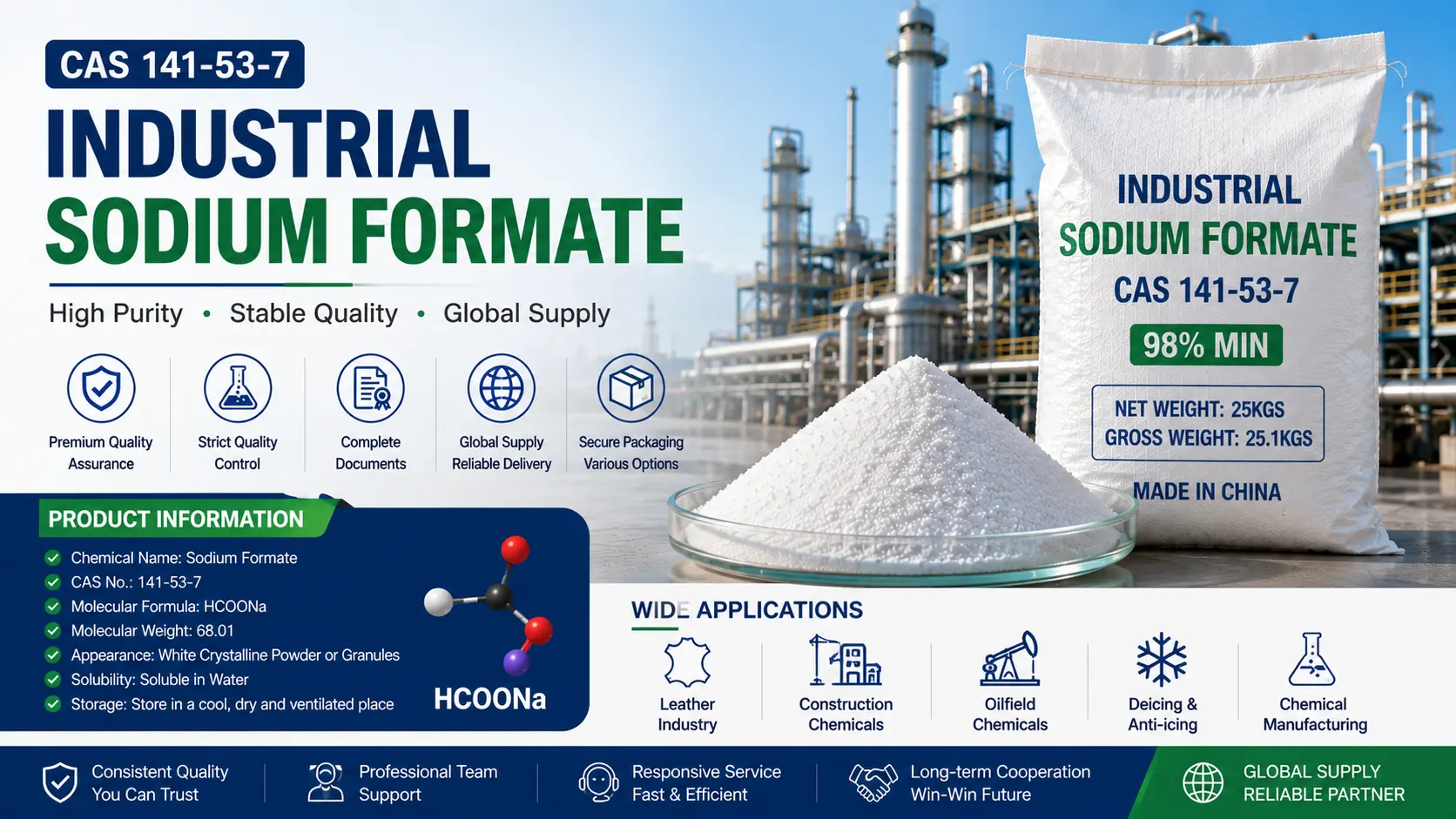
Industrial Sodium Formate is a raw material of chemical which is mainly used in leather processing, oilfield fluids, construction chemicals, deicing chemicals, chemical manufacturing. It is appreciated because of its good solubility in water, chemical stability, functional characteristics and is available in various grades of purity.
When selecting the correct industrial sodium formate, there are a number of factors that should be considered, such as price, for manufacturers, distributors, and international buyers. Production performance and efficiency of procurement can be impacted by product assay, moisture, insoluble matter, packaging, batch consistency, and supplier reliability.
What Is Industrial Sodium Formate?
Sodium formate is the sodium salt of formic acid. Its chemical formula is HCOONa, and its CAS number is 141-53-7. It is normally supplied as a white crystalline powder or granule and dissolves readily in water.
Industrial sodium formate is available in different grades depending on the manufacturing process and intended application. Common commercial grades include 92%, 95%, and 98% sodium formate.
Typical product information includes:
- Chemical name: Sodium Formate
- CAS number: 141-53-7
- Molecular formula: HCOONa
- Molecular weight: approximately 68.01
- Appearance: White crystalline powder or granules
- Solubility: Soluble in water
- EINECS number: 205-488-0
Buyers should confirm the complete specification through the supplier’s technical data sheet and certificate of analysis.
Important Quality Specifications
Industrial sodium formate quality should not be evaluated only by the main assay. Several other indicators may affect its performance in industrial processes.
Common specification items include:
- Sodium formate content
- Moisture
- Water-insoluble matter
- Chloride content
- Iron content
- pH value
- Particle size
- Bulk density
- Appearance
- Color
Different applications may require different quality limits. Leather manufacturers may focus on solubility and batch consistency, while oilfield customers may require tighter control of insoluble matter, chloride, and iron.
Construction chemical producers may pay closer attention to moisture, particle size, and compatibility with cement-based formulations.
Main Applications of Industrial Sodium Formate
Leather Processing
Industrial sodium formate is commonly used in leather tanning, dyeing, and related processing stages. It can help regulate acidity and support more uniform penetration of processing chemicals.
Consistent quality is important because variations in moisture, purity, or insoluble matter may affect leather color, softness, surface appearance, and production efficiency.
Leather manufacturers should test sodium formate under their own production conditions. The recommended dosage may vary according to the type of hide, water quality, tanning chemicals, equipment, and desired product characteristics.
Construction Chemicals
Sodium formate can be used in cement-based products, dry-mix mortar, concrete admixtures, grout, tile adhesives, and other construction formulations.
Depending on the formulation, it may support setting control, low-temperature performance, or production stability. However, its effectiveness depends on several factors, including:
- Cement composition
- Environmental temperature
- Water-to-cement ratio
- Other chemical additives
- Sodium formate dosage
- Required setting time
Laboratory testing and small-scale production trials should be completed before commercial use.
Oilfield Fluids
Industrial sodium formate can be used in selected drilling, completion, and workover fluid systems. Formate-based fluids may provide useful density, thermal stability, and compatibility characteristics under specific operating conditions.
Oilfield buyers usually require detailed quality control because impurities may affect fluid properties, equipment performance, and operational reliability.
Important indicators for oilfield applications may include:
- Sodium formate content
- Chloride level
- Iron content
- Water-insoluble matter
- Moisture
- Solution density
A reliable supplier should provide batch-specific certificates and maintain complete quality traceability.
Deicing and Anti-Icing Products
Sodium formate may be used in selected deicing and anti-icing formulations. Its high water solubility and freezing-point reduction properties make it suitable for certain road, airport, and industrial applications.
The final product should be evaluated for:
- Low-temperature performance
- Corrosion characteristics
- Surface compatibility
- Environmental requirements
- Application rate
- Local regulations
Buyers should test the complete formulation under actual operating conditions before large-scale use.
Chemical Manufacturing
Industrial sodium formate may serve as a raw material or intermediate in the production of formic acid, sodium hydrosulfite, oxalic acid, and other chemicals.
For chemical manufacturers, consistent composition is essential because changes in purity, moisture, and impurities may influence reaction efficiency, production yield, process stability, and final product quality.
A stable supply of sodium formate can help manufacturers maintain predictable production conditions.
Industrial Sodium Formate Grades
Sodium Formate 98%
The 98% grade is suitable for applications requiring higher purity and tighter impurity control. It may be preferred in chemical manufacturing, selected oilfield formulations, and industrial processes where product consistency is especially important.
Sodium Formate 92%
The 92% grade offers a practical balance between cost and performance. It is commonly used in general industrial applications where extremely high purity is not required.
Customized Specifications
Some suppliers can provide customized requirements for:
- Moisture
- Particle size
- Chloride content
- Iron content
- Packaging
- Labeling
- Palletization
Customers should provide complete technical requirements before requesting a formal quotation.
Packaging Options
Industrial sodium formate is commonly packed in moisture-resistant bags suitable for storage and international transportation.
Typical packaging options include:
- 25 kg woven bags with polyethylene liners
- 25 kg paper-plastic composite bags
- 500 kg bulk bags
- 1,000 kg jumbo bags
- Palletized export packaging
- Customized private-label bags
The packaging should protect the product from humidity, rain, contamination, tearing, and handling damage.
For international shipments, buyers should confirm the following details in advance:
- Bag material
- Net weight
- Pallet type
- Wrapping method
- Container loading quantity
- Labeling requirements
- Destination-country regulations
Storage and Handling
Industrial sodium formate should be stored in a cool, dry, and well-ventilated warehouse. The original packaging should remain sealed until the material is required.
The product should be protected from:
- Rain
- Moisture
- Strong acids
- Contamination
- Damaged packaging
- Direct water exposure
- Excessive humidity
Workers should follow standard chemical handling procedures and review the safety data sheet before use.
Suitable gloves, safety glasses, protective clothing, and dust-control measures may be required depending on workplace conditions.
How to Choose a Reliable Supplier
Review the Technical Data
A professional supplier should provide a detailed technical data sheet containing clear specifications and testing methods.
General descriptions such as “industrial grade” are not sufficient without measurable quality limits.
Request a Certificate of Analysis
The certificate of analysis should correspond to the actual production batch and include tested values for the main quality indicators.
Comparing several batch certificates can help buyers evaluate long-term consistency.
Test a Representative Sample
Sample testing allows customers to verify appearance, solubility, moisture, purity, and application performance.
Laboratory evaluation should be followed by a small production trial when possible.
Confirm Production Capacity
Buyers should ask about monthly output, inventory availability, standard lead time, raw material supply, and the supplier’s ability to support repeat orders.
Evaluate Export Experience
International chemical shipments require accurate documents and professional logistics coordination.
Common export documents include:
- Commercial invoice
- Packing list
- Certificate of analysis
- Safety data sheet
- Technical data sheet
- Certificate of origin
- Bill of lading
- Customs declaration documents
An experienced supplier can help reduce customs delays and shipping risks.
Total Procurement Cost
The lowest product quotation does not always represent the lowest total purchasing cost. Buyers should also consider:
- Packaging expenses
- Inland transportation
- Ocean freight
- Port charges
- Customs clearance
- Import duties
- Inspection fees
- Storage costs
- Quality risks
- Potential production losses
Stable quality and dependable delivery may provide better long-term value than a lower-priced product with inconsistent specifications.
Conclusion
Industrial Sodium Formate is an essential chemical material, which is applied to leather processing, construction chemicals, oilfield fluids, deicing formulation, etc., chemical manufacturing industry. It is based on the purity, moisture, control of impurities, particle size, packaging, and consistency of batch.
Buyers should determine the grade to buy, read the technical specification, ask for a current certificate of analysis and obtain a sample to test prior to purchase of the material. A reliable supplier should offer a stable quality, full documentation, appropriate packaging, technical assistance, and international delivery.
With the right product grade and an expert supplier, industrial buyers can minimize risk in their procurement process, create greater consistency in production, and keep a more streamlined chemical supply chain.


Contact Us
Related Posts
Custom Packaging Solutions from an Anhydrous Sodium Acetate Supplier in China
2026-09-23
Application Trends in Anhydrous Sodium Acetate for Special Chemical Manufacturing
2026-09-23
Anhydrous Sodium Acetate for Leather Tanning: Improve Dyeing Uniformity
2026-09-22
Formic Acid 85% for Textile Dyeing: Industrial Applications, Technical Benefits and Future Trends
2026-09-22


