



Potassium Formate Drilling Fluid: Benefits, Applications, and Selection Guide
By vanchor
2026-07-22Related Posts
Custom Packaging Solutions from an Anhydrous Sodium Acetate Supplier in China
2026-09-23

Application Trends in Anhydrous Sodium Acetate for Special Chemical Manufacturing
2026-09-23

Anhydrous Sodium Acetate for Leather Tanning: Improve Dyeing Uniformity
2026-09-22

Formic Acid 85% for Textile Dyeing: Industrial Applications, Technical Benefits and Future Trends
2026-09-22
Potassium Formate Drilling Fluid is well applicable in the operations that are challenging in the oilfields, and high density brine, low solids, shale stability, thermal performance and formation damage reduction are important. Potassium formate has a high solubility in water and can be used in drilling, completion, work over and drill in fluids for difficult well situations.
When it comes to choosing the right potassium formate product, there are more factors to consider than just the concentration or cost for drilling contractors, oilfield service companies, mud engineers, chemical distributors and procurement teams. In addition to the above, various factors can influence the performance of the product in the field: chloride, iron, insoluble matter, density, crystallization temperature, product form, packaging and batch consistency.
What Is Potassium Formate?
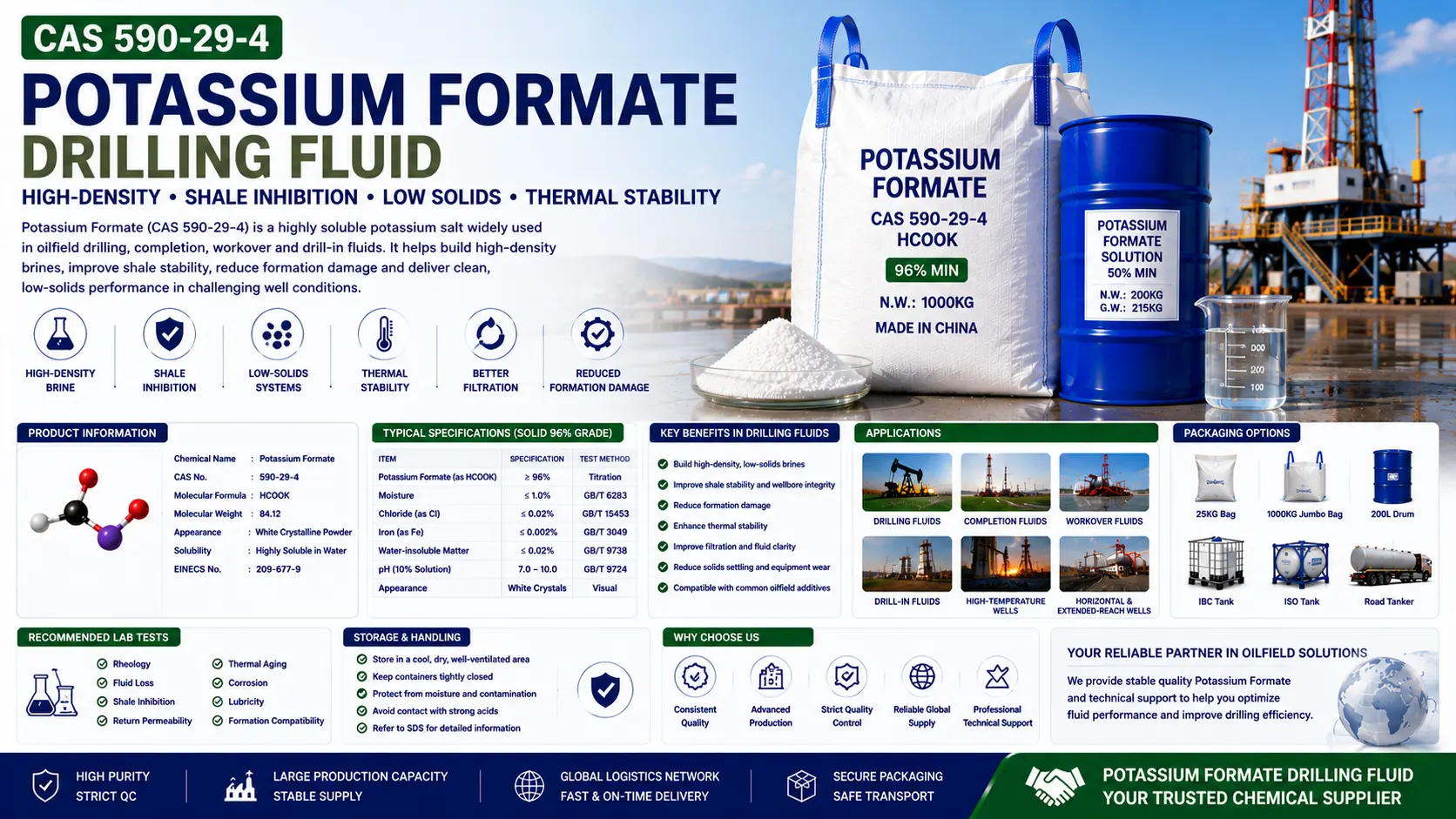
Potassium formate is the potassium salt of formic acid. Its chemical formula is HCOOK, and its CAS number is 590-29-4. It is commonly supplied as a white crystalline solid or a clear concentrated aqueous solution.
Typical product information includes:
- Chemical name: Potassium Formate
- CAS number: 590-29-4
- Molecular formula: HCOOK
- Molecular weight: approximately 84.12
- Appearance: White crystalline solid or clear solution
- Solubility: Highly soluble in water
- EINECS number: 209-677-9
Commercial products may include solid grades such as 96% or 98%, along with liquid solutions in different concentrations. The correct form depends on the target fluid density, storage system, operating temperature, and field equipment.
Why Potassium Formate Is Used in Drilling Fluids
Oilfield fluids must maintain stable performance under varying pressure, temperature, contamination, and formation conditions.
Potassium formate may be selected because it can support:
- High-density brine preparation
- Low-solids fluid systems
- Shale inhibition
- Improved thermal stability
- Clear-fluid characteristics
- Reduced solids settling
- Better filtration
- Lower formation-damage risk
- Compatibility with selected polymers
- Flexible density adjustment
The final performance depends on the complete fluid formulation and should be verified through laboratory and field testing.
High-Density Brine Preparation
Potassium formate can be dissolved in water to prepare concentrated brines with adjustable density.
This can help fluid engineers manage hydrostatic pressure without depending entirely on suspended weighting materials.
Potential advantages include:
- Reduced solids loading
- Cleaner fluid systems
- More stable density
- Easier filtration
- Lower abrasion
- Reduced settling risk
The target density should be calculated according to well pressure, temperature, and safety requirements.
Prepared brine should be tested before field use.
Shale Inhibition
Potassium ions may help reduce hydration and swelling in reactive shale formations.
In selected water-based drilling systems, potassium formate can contribute to shale stability by:
- Reducing water uptake
- Limiting clay swelling
- Improving cuttings integrity
- Supporting wellbore stability
- Reducing dispersion
- Improving solids control
The inhibition effect depends on potassium concentration, formation mineralogy, salinity, polymer package, and exposure time.
Shale-recovery, dispersion, and swelling tests should be completed before field deployment.
Low-Solids Performance
Because potassium formate dissolves in water, it can help formulate fluids with lower suspended-solids content.
High solids may contribute to:
- Excessive viscosity
- Abrasive equipment wear
- Poor filtration
- Settling
- Increased torque and drag
- Formation damage
A low-solids Potassium Formate Drilling Fluid may improve fluid cleanliness and support more efficient circulation.
However, the complete system may still contain polymers, bridging agents, and other performance additives.
Thermal Stability
High-temperature wells can degrade polymers and destabilize conventional fluid systems.
Potassium formate brines may provide a stable base fluid for selected high-temperature formulations.
Potential benefits include:
- Better fluid-property retention
- Improved polymer stability in suitable systems
- More predictable density
- Reduced solids-related instability
- Improved high-temperature filtration
High-temperature, high-pressure testing should be carried out under conditions that reflect the expected well environment.
Drilling Fluid Applications
Potassium formate may be used in selected water-based drilling systems for:
- Reactive shale formations
- High-angle wells
- Horizontal wells
- High-temperature wells
- Low-solids drilling programs
- Sensitive reservoirs
- Extended-reach drilling
- Underbalanced or specialized operations
The fluid design should consider rheology, filtration, lubrication, inhibition, contamination tolerance, and well-control requirements.
Completion Fluids
Potassium formate brines may be used as clear completion fluids where operators require hydrostatic pressure with minimal suspended solids.
Potential advantages include:
- Adjustable density
- Clear-brine properties
- Low solids
- Easier filtration
- Reduced solids-related formation damage
- Compatibility with selected completion additives
Before use, the fluid should be evaluated for:
- Formation compatibility
- Corrosion
- Scale tendency
- Elastomer compatibility
- Fluid loss
- Thermal stability
- Crystallization risk
Workover Fluids
Workover operations require fluids that can control well pressure and support repair or maintenance activities.
Potassium formate may be considered where operators need:
- Stable brine density
- Clean-fluid performance
- Low solids
- Reduced filtration problems
- Good thermal performance
- Flexible field preparation
The fluid should be compatible with downhole tools, metals, seals, and formation fluids.
Drill-In Fluids
Drill-in fluids are used while drilling through productive formations and are designed to minimize reservoir damage.
Potassium formate can be used in selected drill-in systems because it supports low-solids, high-density formulations.
Recommended tests may include:
- Return permeability
- Filter-cake quality
- Fluid loss
- Rheology
- Breaker compatibility
- Thermal aging
- Contamination tolerance
- Formation-damage evaluation
A properly designed system should create a removable filter cake while limiting invasion into the reservoir.
Important Quality Specifications
Oilfield buyers should review the full potassium formate specification.
Important indicators include:
- Potassium formate content
- Solution concentration
- Density
- Chloride content
- Iron content
- Water-insoluble matter
- pH value
- Appearance
- Color
- Crystallization temperature
- Moisture for solid products
Why Chloride Control Matters
Chloride may influence corrosion behavior in high-temperature and high-pressure environments.
Excessive chloride may contribute to:
- Increased corrosion
- Higher inhibitor demand
- Equipment damage
- Reduced service life
- Compatibility problems
Buyers should define acceptable chloride limits according to metallurgy, temperature, pressure, and the corrosion-control program.
Iron Content
Iron may affect:
- Fluid color
- Brine clarity
- Scale tendency
- Chemical stability
- Corrosion behavior
- Compatibility with selected additives
Low iron is often preferred for clear brine systems.
Water-Insoluble Matter
Low insoluble matter is important because excessive residue may cause:
- Filter blockage
- Tank deposits
- Pipeline contamination
- Increased solids loading
- Formation damage
- Equipment wear
Batch-specific test values should be provided on the certificate of analysis.
Density and Concentration
For liquid potassium formate, density is commonly used to verify concentration.
Buyers should confirm:
- Concentration by weight
- Density at a stated temperature
- Test method
- Crystallization temperature
- Recommended storage range
Density changes with temperature, so measurements should be compared under the same conditions.
Crystallization Temperature
Concentrated potassium formate solutions can crystallize if stored below the recommended temperature.
Crystallization may cause:
- Blocked pipelines
- Pumping problems
- Valve obstruction
- Uneven concentration
- Tank deposits
- Field delays
The selected concentration should match expected storage and operating temperatures.
Insulation, heating, or recirculation may be needed in cold environments.
Solid vs. Liquid Potassium Formate
Solid Potassium Formate
Solid product may offer:
- Higher active-content transportation
- Lower water-shipping cost
- Flexible on-site concentration
- Easier long-term storage
However, it requires dissolving, mixing, and filtration equipment.
Liquid Potassium Formate
Liquid product may offer:
- Faster pumping and dosing
- No on-site powder dissolution
- Reduced dust
- Stable concentration
- Easier automated handling
The best option depends on field logistics, storage capacity, water availability, and operating procedures.
Brine Preparation
A general preparation process may include:
- Inspecting and cleaning the mixing tank
- Adding clean water
- Starting controlled agitation
- Adding solid potassium formate gradually or transferring liquid concentrate
- Allowing complete mixing
- Measuring density and concentration
- Adjusting the formulation
- Adding compatible polymers and additives
- Filtering the final fluid
- Completing laboratory checks before use
Actual procedures should be developed by qualified drilling-fluid personnel.
Recommended Laboratory Testing
Before field deployment, a Potassium Formate Drilling Fluid may be evaluated for:
- Density
- Rheology
- Fluid loss
- pH
- Thermal aging
- Shale inhibition
- Lubricity
- Solids tolerance
- Filtration
- Corrosion
- Scale tendency
- Elastomer compatibility
- Formation compatibility
- Return permeability
The test program should reflect actual downhole conditions.
Polymer Compatibility
Potassium formate may be used with selected:
- Viscosifiers
- Fluid-loss additives
- Shale inhibitors
- Lubricants
- Corrosion inhibitors
- Bridging agents
- Oxygen scavengers
- Biocides
Not every polymer or additive performs the same way in concentrated brine.
Compatibility and thermal-aging tests are essential.
Corrosion Control
Although formate brines can support specialized oilfield systems, corrosion control must still be evaluated.
Important factors include:
- Temperature
- Oxygen contamination
- Chloride
- pH
- Metal type
- Flow velocity
- Fluid concentration
- Corrosion inhibitor
Laboratory corrosion testing should use representative metallurgy and operating conditions.
Packaging Options
Solid potassium formate may be supplied in:
- 25 kg bags
- 500 kg bulk bags
- 1,000 kg jumbo bags
- Palletized packaging
- Customized labels
Liquid potassium formate may be supplied in:
- 200-liter drums
- IBC tanks
- ISO tanks
- Road tankers
- Bulk delivery systems
Packaging should be compatible with the concentration and field-handling requirements.
Storage and Handling
Solid material should be kept dry and protected from damaged packaging and contamination.
Liquid potassium formate should be stored in clean, compatible tanks within the recommended temperature range.
The product should be protected from:
- Strong acids
- Contamination
- Extreme cold
- Incorrect dilution
- Unclean transfer equipment
- Incompatible materials
Workers should follow the safety data sheet and use appropriate personal protective equipment.
How to Choose a Supplier
Review the Full Specification
The supplier should provide clear limits for concentration, chloride, iron, insoluble matter, density, and crystallization temperature.
Request Batch-Specific COAs
The certificate of analysis should match the actual shipment batch.
Test a Representative Sample
Sample testing should include both raw-material analysis and complete-fluid evaluation.
Confirm Production Capacity
Oilfield projects may require large, time-sensitive deliveries. Buyers should confirm:
- Monthly production capacity
- Available inventory
- Standard lead time
- Emergency supply capability
- Repeat-order support
- Solid and liquid availability
Review Quality Traceability
Every shipment should be traceable through batch numbers, production records, laboratory results, retained samples, and loading documents.
Evaluate Export Experience
International suppliers should understand chemical packaging, ISO tank loading, customs procedures, freight coordination, and destination requirements.
Required Documents
A professional supplier should be able to provide:
- Technical data sheet
- Safety data sheet
- Certificate of analysis
- Commercial invoice
- Packing list
- Certificate of origin
- Bill of lading
- Customs declaration documents
- Inspection reports when required
All documents should use consistent product names, CAS numbers, concentrations, weights, and batch information.
Total Procurement Cost
The lowest product quotation may not provide the lowest operating cost.
Oilfield buyers should consider:
- Active potassium formate content
- Packaging
- Freight
- ISO tank charges
- Storage
- Heating or insulation
- Mixing
- Filtration
- Corrosion control
- Field treatment
- Delivery reliability
- Operational risk
A consistent product with controlled impurities may reduce mixing delays, filtration problems, corrosion, and field downtime.
Questions to Ask Before Ordering
Buyers should confirm:
- Is the product solid or liquid?
- What purity grades or concentrations are available?
- What are the chloride and iron limits?
- What is the density?
- What is the crystallization temperature?
- Can recent batch COAs be provided?
- Is a sample available?
- What packaging options are offered?
- What is the monthly production capacity?
- What is the standard lead time?
- Can project-specific labeling be supported?
- Which export documents are included?
- Can third-party inspection be arranged?
Conclusion
Potassium Formate Drilling Fluid may be used in some drilling, completion, workover and drill-in (DI) applications to enable the preparation of high-density brine, low-solids performance, shale inhibition, thermal stability, improved filtration, and reduced formation damage.
It is influenced by the following product characteristics: concentration, density, chloride, iron, insoluble matter, crystallization behavior, polymer compatibility, and overall fluid design.
Buyers are advised to read the full specification, obtain quality documents of the batch, sample test and laboratory evaluation of the specimen in the well conditions.
A reliable supplier should be able to offer a range of products that are of consistent quality, have controlled impurities, can be supplied as solid or liquid, and are securely packaged, have full documentation and offer technical support that is responsive, and offer reliable global delivery.


Contact Us
In This Article
Related Posts
Custom Packaging Solutions from an Anhydrous Sodium Acetate Supplier in China
2026-09-23
Application Trends in Anhydrous Sodium Acetate for Special Chemical Manufacturing
2026-09-23
Anhydrous Sodium Acetate for Leather Tanning: Improve Dyeing Uniformity
2026-09-22
Formic Acid 85% for Textile Dyeing: Industrial Applications, Technical Benefits and Future Trends
2026-09-22


