



Potassium Formate for Airport Deicing: Performance, Applications, and Purchasing Guide
By vanchor
2026-07-22Related Posts
Custom Packaging Solutions from an Anhydrous Sodium Acetate Supplier in China
2026-09-23
Application Trends in Anhydrous Sodium Acetate for Special Chemical Manufacturing
2026-09-23
Anhydrous Sodium Acetate for Leather Tanning: Improve Dyeing Uniformity
2026-09-22
Formic Acid 85% for Textile Dyeing: Industrial Applications, Technical Benefits and Future Trends
2026-09-22
Potassium Formate for Airport Deicing is used in winter-maintenance programs where quick ice control, low-temperature performance, liquid application, and good surface treatment are imperative. It is a standard component of deicing and anti-icing mixtures for airport runways, taxiways, aprons, service roads, airport cargo areas, and other airport surfaces that are subject to snow, frost, freezing rain and compacted ice.
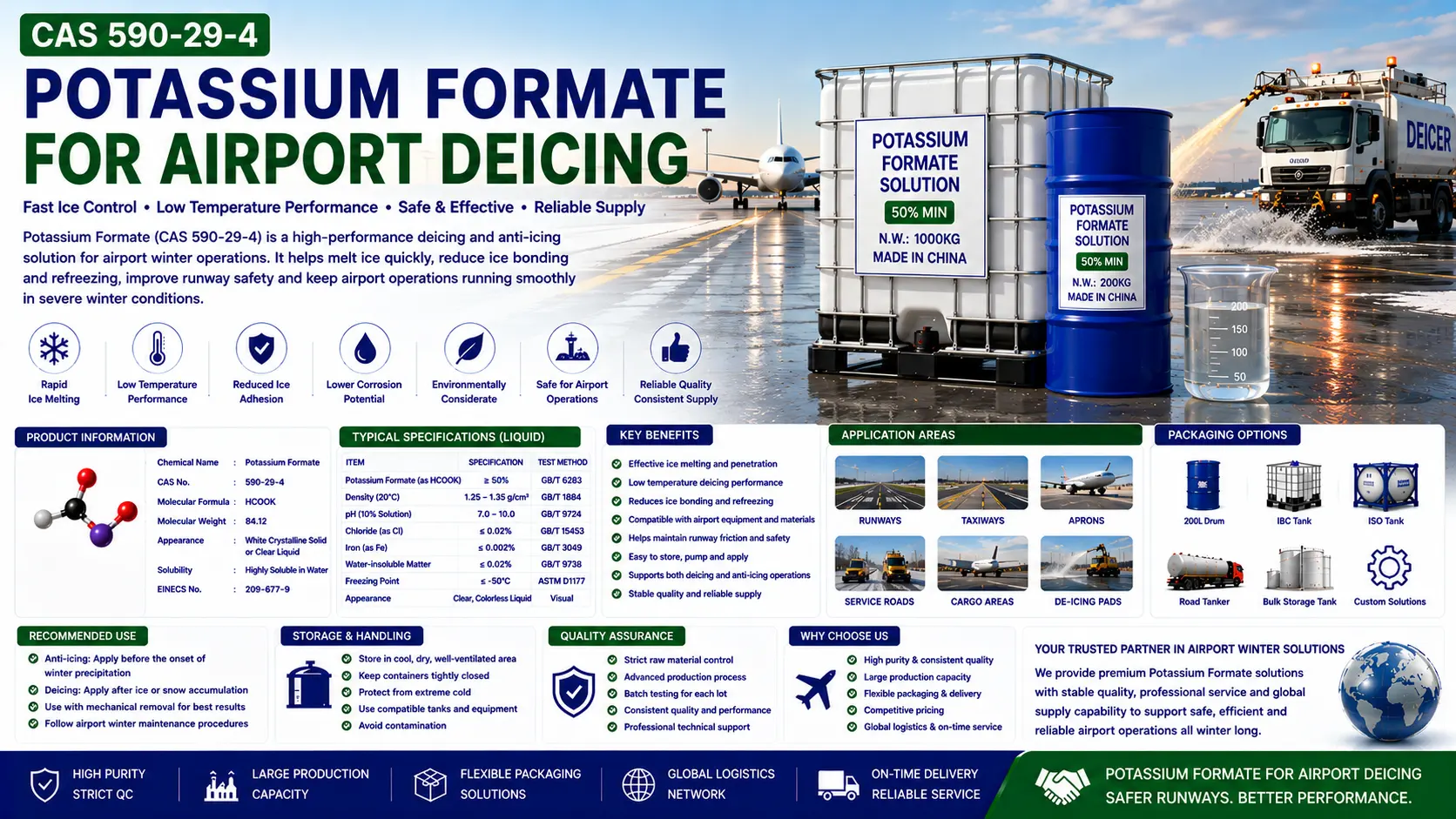
Potassium formate is highly soluble in water and available as a solid raw material or as a concentrated liquid solution. It is usually added to a final liquid product along with corrosion inhibitors and other performance additives for use in the airport.
When selecting products for use in the airport deicing process, ground service, deicing chemical formulators, distributors and procurement teams need to do more than just look at the price. Operational performance will be affected by concentration, freezing point, crystallization temperature, corrosion behavior, pavement suitability, storage conditions, packaging and batch consistency.
What Is Potassium Formate?
Potassium formate is the potassium salt of formic acid. Its chemical formula is HCOOK, and its CAS number is 590-29-4.
Typical product information includes:
- Chemical name: Potassium Formate
- CAS number: 590-29-4
- Molecular formula: HCOOK
- Molecular weight: approximately 84.12
- Appearance: White crystalline solid or clear aqueous solution
- Solubility: Highly soluble in water
- EINECS number: 209-677-9
The exact specification depends on whether the product is supplied as a solid raw material or as a finished liquid deicer.
Airport buyers should review the supplier’s technical data sheet, safety data sheet, and batch-specific certificate of analysis before placing an order.
Why Potassium Formate Is Used for Airport Deicing
Airport winter operations require fast and predictable treatment because snow and ice can affect aircraft movement, braking, visibility, ground handling, and runway availability.
Potassium formate may be selected because it offers:
- High water solubility
- Rapid liquid distribution
- Low-temperature formulation potential
- Flexible concentration adjustment
- Reduced reliance on chloride-based salts
- Convenient pumping and spraying
- Suitability for deicing and anti-icing systems
- Compatibility with bulk storage and automated application
The final product should always be evaluated as a complete formulation rather than according to the potassium formate raw material alone.
Deicing vs. Anti-Icing
Deicing
Deicing is performed after frost, snow, or ice has accumulated.
The purpose is to:
- Melt or loosen existing ice
- Break the bond between ice and pavement
- Support plowing, brushing, or sweeping
- Restore surface friction
- Reduce runway or taxiway closure time
Anti-Icing
Anti-icing is a preventive treatment applied before or during the early stages of a winter-weather event.
Its purpose is to:
- Reduce initial ice bonding
- Prevent frost from firmly attaching to pavement
- Simplify later snow and ice removal
- Reduce post-storm chemical demand
- Improve winter-maintenance efficiency
A potassium formate-based solution may be used for either strategy, depending on concentration and airport procedures.
Main Airport Application Areas
Runways
Runways require the highest level of operational control because contamination can affect aircraft braking and takeoff performance.
A potassium formate solution may be used to:
- Treat frost
- Loosen compacted ice
- Support mechanical snow removal
- Reduce refreezing
- Improve surface recovery time
Application should be coordinated with runway inspections, friction assessment, weather monitoring, and air traffic operations.
Taxiways
Taxiways may experience repeated freezing, compacted snow, and tracked contamination from aircraft movement.
Liquid deicing can help:
- Reduce ice adhesion
- Improve surface accessibility
- Support plowing and brushing
- Maintain safer aircraft movement
Aprons and Ramps
Aprons are exposed to aircraft, service vehicles, fuel operations, and personnel movement.
The deicer should be compatible with:
- Pavement
- Ground-support equipment
- Drainage systems
- Service vehicles
- Nearby infrastructure
Service Roads
Airport service roads must remain accessible for emergency vehicles, maintenance equipment, catering vehicles, and airport staff.
Potassium formate formulations may support preventive and corrective treatment on these surfaces.
Cargo and Ground-Handling Areas
Cargo zones, loading areas, and equipment parking areas may also benefit from liquid deicing and anti-icing.
The formulation should be evaluated for slip risk, residue, drainage, and contact with equipment.
How Potassium Formate Supports Ice Control
When potassium formate dissolves in water, it forms a brine with a lower freezing point than pure water.
When applied to a frozen surface, it can help:
- Penetrate frost and thin ice
- Weaken the pavement bond
- Accelerate melting
- Support mechanical removal
- Reduce refreezing under suitable conditions
Actual performance depends on:
- Product concentration
- Pavement temperature
- Air temperature
- Ice thickness
- Precipitation type
- Application rate
- Dilution by snow or water
- Traffic and aircraft movement
Freezing-Point Performance
The finished airport deicer must remain functional within the expected temperature range.
An unsuitable concentration may:
- Freeze in storage
- Crystallize in pipelines
- Block spray nozzles
- Lose effectiveness
- Require heating before use
The supplier should provide data on freezing point, crystallization point, or salt-out temperature for the actual product.
These values should be verified under realistic operating conditions.
Ice-Melting Performance
Ice-melting performance should be evaluated at different temperatures and application rates.
Important test conditions may include:
- Surface temperature
- Ice thickness
- Contact time
- Product concentration
- Application rate
- Weather conditions
- Dilution
- Mechanical removal
A product that performs well near 0°C may work more slowly at significantly lower temperatures.
Ice Bond Reduction
One of the main benefits of anti-icing treatment is reducing the bond between ice and pavement.
This may make it easier to remove contamination with:
- Runway sweepers
- Plows
- Brushes
- Snow blowers
- Slush-removal equipment
Chemical treatment and mechanical removal should be managed as one integrated process.
Corrosion Considerations
Airport deicers may come into contact with:
- Ground-support equipment
- Maintenance trucks
- Steel structures
- Drainage systems
- Lighting infrastructure
- Aircraft-adjacent components
- Other metal surfaces
Corrosion behavior depends on:
- Potassium formate concentration
- Chloride level
- pH
- Inhibitor system
- Temperature
- Exposure time
- Metal type
- Dilution
A finished formulation should undergo corrosion testing before approval for airport use.
Pavement Compatibility
Airport pavements may contain:
- Concrete
- Asphalt
- Joint sealants
- Surface coatings
- Embedded electrical systems
- Drainage materials
The deicer should be evaluated for:
- Scaling
- Spalling
- Surface residue
- Freeze-thaw effects
- Joint-seal compatibility
- Repeated chemical exposure
- Water absorption
- Long-term pavement performance
The product should only be used according to the airport’s approved winter-maintenance procedures.
Aircraft and Equipment Exposure
Runway deicer is applied to pavement rather than directly to aircraft. However, splash, spray, tracked material, or runoff may reach nearby equipment.
Airport operators should consider:
- Spray control
- Restricted application zones
- Equipment cleaning
- Drainage
- Vehicle exposure
- Ground-support equipment compatibility
The finished product should be approved within the airport’s operational and safety framework.
Environmental Considerations
Environmental performance depends on the complete formulation and application method.
Important factors may include:
- Biodegradability
- Oxygen demand
- Aquatic impact
- Soil exposure
- Runoff concentration
- Wastewater treatment
- Drainage design
- Application efficiency
Using the correct application rate can help reduce overuse and runoff.
Airport operators should follow applicable environmental permits and local discharge requirements.
Important Product Specifications
A professional supplier should provide clear technical values for:
- Potassium formate concentration
- Density
- Freezing or crystallization point
- Chloride content
- Iron content
- Water-insoluble matter
- pH
- Appearance
- Viscosity
- Corrosion performance
- Storage temperature
Concentration and Density
Concentration affects active content, freezing behavior, application rate, and storage performance.
Density is often used to verify solution concentration.
Buyers should confirm:
- Concentration by weight
- Density at a stated temperature
- Test method
- Acceptable tolerance
- Recommended dilution range
Density values should only be compared when measured under the same temperature conditions.
Chloride Content
Low chloride may help reduce corrosion risk compared with conventional chloride-based deicers.
The acceptable chloride limit should be defined according to airport equipment, pavement systems, and infrastructure.
Batch-specific results should be provided in the certificate of analysis.
Iron and Insoluble Matter
Low iron and low insoluble matter may help provide:
- Cleaner product appearance
- Reduced tank deposits
- Better spray performance
- Lower nozzle-blockage risk
- More consistent application
- Reduced maintenance
The finished liquid should be clear and free from visible suspended contamination.
Storage and Crystallization Control
Concentrated potassium formate solutions may crystallize if stored below the recommended temperature.
Potential consequences include:
- Blocked transfer lines
- Pumping difficulties
- Valve obstruction
- Tank deposits
- Uneven concentration
- Delayed winter operations
Storage systems may require:
- Insulated tanks
- Heated pipelines
- Recirculation
- Temperature monitoring
- Backup warming procedures
The supplier should provide clear instructions for preventing and reversing crystallization.
Application Equipment
Potassium Formate for Airport Deicing may be applied through:
- Airport deicing trucks
- Calibrated spray bars
- Automated liquid spreaders
- Fixed loading systems
- Pre-wetting equipment
- Spot-treatment sprayers
Equipment should be calibrated regularly to ensure uniform application.
Poor calibration may lead to:
- Underapplication
- Excessive chemical use
- Uneven treatment
- Increased runoff
- Higher operating costs
Application Rate
There is no single application rate for all airport conditions.
The correct rate depends on:
- Pavement temperature
- Air temperature
- Precipitation type
- Ice thickness
- Product concentration
- Forecast conditions
- Mechanical removal capacity
- Refreezing risk
Airport operators should use approved rate tables and adjust treatment based on real-time conditions.
Integration with Mechanical Removal
Chemical deicing should support, not replace, mechanical snow removal.
Typical equipment includes:
- Plows
- Sweepers
- Rotary brushes
- Snow blowers
- Slush-removal units
Potassium formate can help weaken the ice bond and make mechanical removal more efficient.
Packaging Options
Airport deicing products are normally supplied in liquid form.
Common options include:
- 200-liter drums
- IBC tanks
- ISO tanks
- Road tankers
- Bulk storage delivery
The best option depends on airport usage, storage capacity, delivery access, and seasonal demand.
Bulk Storage Systems
A suitable storage system should include:
- Compatible tank materials
- Clear labeling
- Secondary containment
- Temperature monitoring
- Recirculation where necessary
- Compatible pumps and seals
- Spill-control equipment
- Regular inspections
Storage tanks and transfer lines should remain clean and free from incompatible chemicals.
Quality Control
A reliable supplier should test each batch for:
- Concentration
- Density
- pH
- Chloride
- Iron
- Insoluble matter
- Appearance
- Crystallization behavior
- Product identification
Batch traceability should connect production, laboratory testing, packaging, and shipment records.
How to Evaluate a Supplier
Review Technical Data
The supplier should provide measurable values for concentration, density, impurities, freezing point, and storage conditions.
Request Batch-Specific COAs
The certificate of analysis should match the actual shipment batch.
Test a Representative Sample
Recommended testing may include:
- Concentration
- Density
- Freezing performance
- Ice-melting capacity
- Corrosion
- Pavement compatibility
- Sprayability
- Storage stability
Confirm Production Capacity
Airport demand can rise quickly before and during winter.
Buyers should confirm:
- Monthly production capacity
- Available inventory
- Standard lead time
- Emergency supply capability
- Seasonal stock planning
- Bulk tanker availability
Review Airport Experience
A supplier with airport winter-maintenance experience is more likely to understand technical, operational, logistical, and documentation requirements.
Required Documents
A professional supplier should provide:
- Technical data sheet
- Safety data sheet
- Certificate of analysis
- Commercial invoice
- Packing list
- Certificate of origin
- Bill of lading
- Customs documentation
- Inspection reports when required
All documents should use consistent product names, concentrations, batch numbers, weights, and packaging details.
Total Procurement Cost
The lowest quotation may not provide the best total value.
Airport buyers should also consider:
- Active potassium formate content
- Packaging
- Freight
- Storage tanks
- Heating or insulation
- Pumping
- Application efficiency
- Equipment cleaning
- Corrosion control
- Runoff management
- Emergency stock
- Delivery reliability
- Runway downtime risk
A stable product with consistent concentration may reduce overapplication, blocked equipment, emergency purchases, and operational delays.
Questions to Ask Before Ordering
Buyers should confirm:
- What is the potassium formate concentration?
- What is the density?
- What is the freezing or crystallization point?
- What are the chloride and iron limits?
- Is corrosion data available?
- Is pavement compatibility data available?
- Can recent batch COAs be provided?
- Is a representative sample available?
- What packaging options are offered?
- Can bulk tanker delivery be arranged?
- What is the monthly production capacity?
- What is the standard lead time?
- Can seasonal delivery schedules be arranged?
- Which technical and export documents are included?
Conclusion
Potassium Formate for Airport Deicing can aid in rapid ice control, anti-icing in winter, reduce ice bonding, good liquid application, and reliable winter operation of the airports.
The performance is related to concentration, freezing point, pavement temperature, application rate, corrosion behavior, pavement compatibility, storage temperature, and maintenance.
It is advisable for airport operators and deicing formulators to review the full technical specification, obtain batch quality documents, test a representative sample of the product and test the product under realistic winter conditions prior to purchase.
A reliable supplier should offer consistent concentration, specified impurities, appropriate packaging, adequate seasonal capacity, full documentation, technical expertise and responsiveness to questions, and reliable delivery.


Contact Us
In This Article
Related Posts
Custom Packaging Solutions from an Anhydrous Sodium Acetate Supplier in China
2026-09-23
Application Trends in Anhydrous Sodium Acetate for Special Chemical Manufacturing
2026-09-23
Anhydrous Sodium Acetate for Leather Tanning: Improve Dyeing Uniformity
2026-09-22
Formic Acid 85% for Textile Dyeing: Industrial Applications, Technical Benefits and Future Trends
2026-09-22


