



Sodium Formate for Oil Drilling: Properties, Benefits, and Supplier Guide
By vanchor
2026-07-22Related Posts

Custom Packaging Solutions from an Anhydrous Sodium Acetate Supplier in China
2026-09-23

Application Trends in Anhydrous Sodium Acetate for Special Chemical Manufacturing
2026-09-23

Anhydrous Sodium Acetate for Leather Tanning: Improve Dyeing Uniformity
2026-09-22

Formic Acid 85% for Textile Dyeing: Industrial Applications, Technical Benefits and Future Trends
2026-09-22
Sodium Formate for Oil Drilling is used in specific drilling, completion and workover fluids systems requiring density control, thermal stability, low solids and compatibility. Sodium formate is a formate salt and can be used to produce clear brines and other specialty fluids for challenging operations in the oilfield.
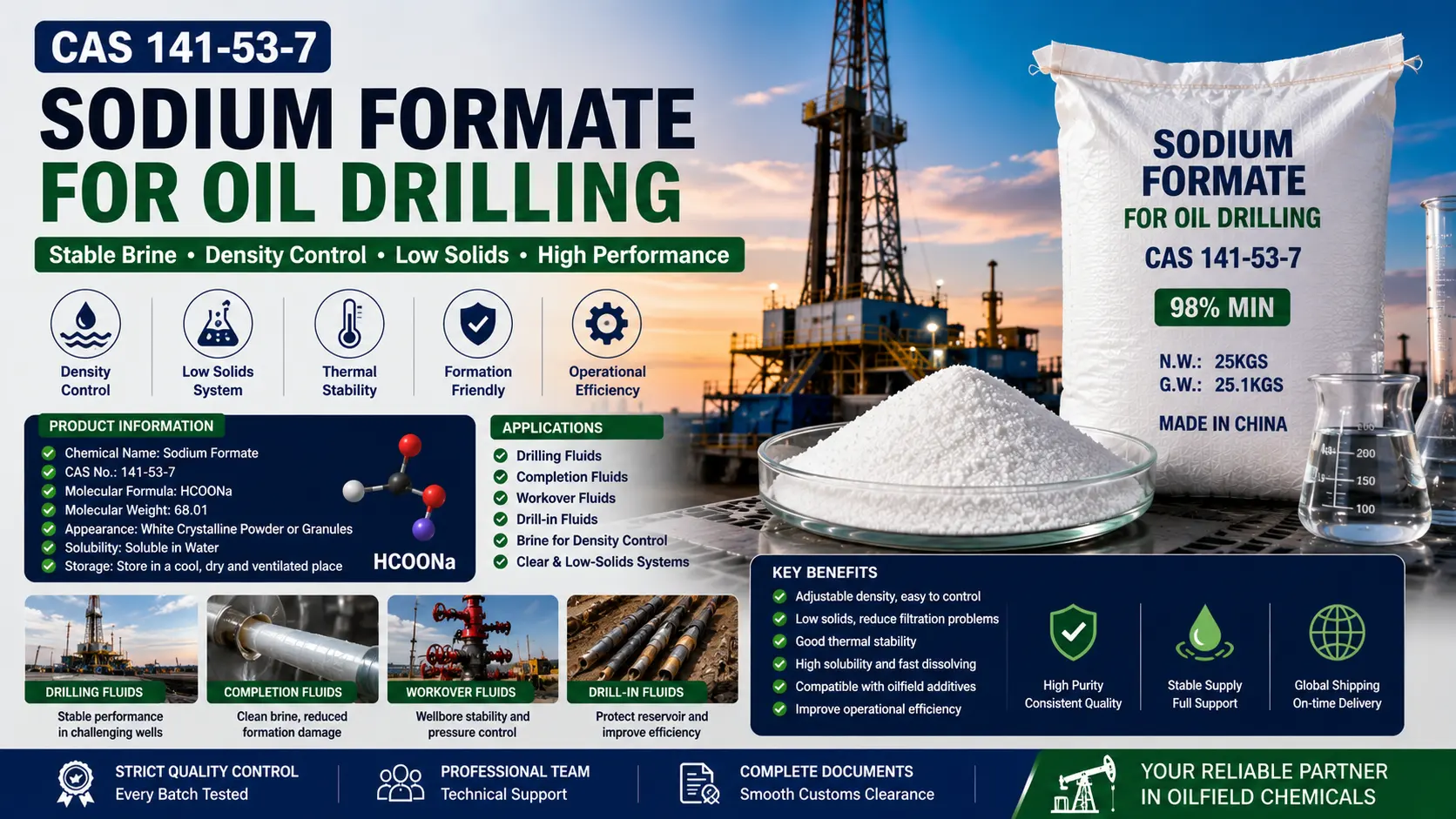
When purchasing sodium formate for drilling contractors, oilfield service companies, chemical distributors, or international buyers, it is important to evaluate the purity, chloride content, insoluble matter, iron, moisture, solution density, packaging, and supplier reliability of sodium formate. There is an emphasis on product consistency because quality fluctuations in raw materials can impact product properties and performance.
What Is Sodium Formate?
Sodium formate is the sodium salt of formic acid. Its chemical formula is HCOONa, and its CAS number is 141-53-7. It is normally supplied as a white crystalline powder or granule with good water solubility.
Typical product information includes:
- Chemical name: Sodium Formate
- CAS number: 141-53-7
- Molecular formula: HCOONa
- Molecular weight: approximately 68.01
- Appearance: White crystalline powder or granules
- Solubility: Soluble in water
- EINECS number: 205-488-0
Commercial grades may include 92%, 95%, and 98% sodium formate. Oilfield customers often prefer products with stable purity and controlled impurity levels.
Why Sodium Formate Is Used in Oil Drilling
Oilfield fluid systems must perform under challenging conditions involving temperature, pressure, formation sensitivity, and equipment compatibility.
Sodium formate can be used as a component in formate-based fluids because it offers several useful characteristics:
- Good water solubility
- Low solids content
- Adjustable brine density
- Thermal stability
- Compatibility with selected additives
- Reduced risk of solid settling
- Convenient mixing and handling
- Potential suitability for clear fluid systems
The final fluid performance depends on the complete formulation, concentration, temperature, pressure, and operating environment.
Applications in Oilfield Fluids
Drilling Fluids
Sodium formate may be used in selected drilling fluid systems where operators require a stable, low-solids fluid with controlled density.
Formate-based systems can be considered for operations where conventional high-solids fluids may increase formation damage, filtration problems, or equipment wear.
Potential benefits may include:
- Improved fluid clarity
- Reduced solids loading
- Better density control
- Stable rheological performance
- Easier filtration
- Lower risk of solids-related deposits
The fluid should be designed and tested by qualified oilfield engineers before field use.
Completion Fluids
Completion fluids must help protect the reservoir while supporting well completion activities.
Sodium formate brines may be used in selected completion systems because they can provide density without introducing large amounts of suspended solids.
Potential advantages include:
- Clean fluid characteristics
- Reduced formation contamination
- Adjustable density
- Good solution stability
- Compatibility with selected completion additives
Before use, the complete system should be evaluated for formation compatibility, corrosion, filtration, and temperature stability.
Workover Fluids
During workover operations, fluids may be required to control well pressure and maintain wellbore stability.
Sodium formate can be used in selected workover formulations where clean brine performance and predictable density are important.
Key evaluation factors include:
- Required fluid density
- Well temperature
- Formation sensitivity
- Corrosion control
- Fluid loss control
- Compatibility with elastomers and metals
Drill-In Fluids
Drill-in fluids are designed to minimize reservoir damage while maintaining wellbore stability and drilling performance.
Sodium formate may be included in selected drill-in systems where low solids and good fluid clarity are desired.
The formulation should be tested for:
- Filter cake quality
- Return permeability
- Fluid loss
- Rheology
- Thermal aging
- Contamination tolerance
Main Benefits of Sodium Formate for Oil Drilling
Density Control
Sodium formate can be dissolved in water to prepare brines with controlled density. This allows fluid engineers to adjust hydrostatic pressure according to the well design.
Low-Solids Fluid Systems
Because sodium formate dissolves in water, it can support low-solids or solids-free formulations. This may help reduce settling and simplify fluid management.
Thermal Stability
Formate brines are often selected for high-temperature environments because of their useful thermal stability in properly designed systems.
Fluid Clarity
Clear brines can be beneficial in completion and workover operations where suspended solids may increase formation damage or filtration problems.
Compatibility
Sodium formate can be compatible with selected polymers, corrosion inhibitors, fluid-loss agents, and other additives. Compatibility should always be confirmed through laboratory testing.
Operational Flexibility
Different concentrations can be prepared to match specific density and performance requirements.
Important Quality Specifications
Oilfield buyers should evaluate the complete sodium formate specification.
Important quality indicators may include:
- Sodium formate content
- Moisture
- Water-insoluble matter
- Chloride content
- Iron content
- pH value
- Particle size
- Solution density
- Appearance
- Color
Sodium Formate Content
Higher purity may provide more predictable concentration and density calculations.
Water-Insoluble Matter
Low insoluble matter is important for maintaining fluid clarity and reducing deposits, filter blockage, and equipment contamination.
Chloride Content
Chloride should be controlled because excessive levels may influence corrosion behavior and fluid compatibility.
Iron Content
Low iron is desirable in systems where color, corrosion, or chemical stability are important.
Moisture
Moisture affects the effective sodium formate content and may influence dosing accuracy.
Sodium Formate 92% vs. 98% for Oilfield Use
Sodium Formate 92%
The 92% grade may be suitable for selected general industrial or cost-sensitive oilfield formulations where broader impurity limits are acceptable.
Potential benefits include:
- Competitive cost
- Good solubility
- Availability in bulk quantities
- Practical use in selected fluid systems
Sodium Formate 98%
The 98% grade may be preferred when operators require:
- Higher purity
- Lower insoluble matter
- More predictable density
- Better batch consistency
- Tighter chloride and iron control
The final grade should be selected according to laboratory results and field requirements.
Brine Preparation Considerations
Sodium formate should be dissolved in clean water under controlled mixing conditions.
Important preparation factors include:
- Water quality
- Product purity
- Mixing temperature
- Agitation
- Target density
- Dissolution time
- Filtration
- Additive sequence
The concentration should be calculated carefully because the required quantity depends on the target brine density and final fluid volume.
Prepared brine should be tested for density, pH, clarity, solids, and compatibility before use.
Compatibility Testing
Before field application, sodium formate-based fluids should be tested with all other formulation components.
Recommended tests may include:
- Thermal aging
- Rheology
- Fluid loss
- Corrosion
- Scale tendency
- Elastomer compatibility
- Formation compatibility
- Contamination tolerance
- Filtration
- Density stability
The use of sodium formate should be based on a complete fluid program rather than on a single raw-material property.
Packaging Options
Sodium formate for oilfield applications is commonly supplied in moisture-resistant packaging.
Typical options include:
- 25 kg woven bags with inner polyethylene liners
- 25 kg paper-plastic composite bags
- 500 kg bulk bags
- 1,000 kg jumbo bags
- Palletized export packaging
- Customized labeling
For large drilling projects, jumbo bags may reduce handling and packaging costs. However, the site should have suitable lifting and feeding equipment.
Storage and Handling
Sodium formate should be stored in a cool, dry, and well-ventilated warehouse.
The product should be protected from:
- Rain
- Humidity
- Strong acids
- Contamination
- Damaged packaging
- Direct water exposure
- Improper stacking
Workers should review the supplier’s safety data sheet and use suitable gloves, eye protection, and dust-control measures.
How to Choose a Sodium Formate Supplier
Review the Technical Data Sheet
The supplier should provide a clear technical specification with measurable limits for purity and impurities.
Request Batch Certificates
A certificate of analysis should correspond to the actual production batch and include tested values.
Test a Representative Sample
The sample should be tested for purity, solubility, density, insoluble matter, chloride, iron, and compatibility with the intended fluid system.
Confirm Production Capacity
Oilfield projects may require large and time-sensitive deliveries. Buyers should confirm monthly output, inventory, lead time, and emergency supply capability.
Evaluate Export Experience
A professional exporter should understand chemical packaging, container loading, customs documents, and international logistics.
Check Quality Traceability
Every shipment should be traceable by batch number, production date, and test results.
Required Documents
Common documents for international purchasing include:
- Technical data sheet
- Safety data sheet
- Certificate of analysis
- Commercial invoice
- Packing list
- Certificate of origin
- Bill of lading
- Customs declaration documents
- Inspection certificates when required
Accurate documentation helps reduce customs delays and supports project quality control.
Total Procurement Cost
The lowest product price may not provide the best overall value.
Oilfield buyers should consider:
- Product purity
- Packaging
- Inland transportation
- Freight
- Import duties
- Storage
- Mixing efficiency
- Filtration requirements
- Batch consistency
- Field performance risks
- Delivery reliability
A stable product can help reduce fluid-treatment costs, operational delays, and quality problems.
Conclusion
Sodium Formate for Oil Drilling is used in selected drilling, completion, workover and drill-in fluid systems to provide density control, low solids, fluid clarity and thermal stability.
Before buying, oil field companies must determine the desired properties of the fluid; study the entire specification; obtain a recent certificate of analysis and test a representative sample in the full formulation.
A good supplier will offer constant purity, low level of insoluble matter, controlled chloride and iron levels, secure packaging, full documentation, technical support, and dependable international shipping.


Contact Us
In This Article
Related Posts
Custom Packaging Solutions from an Anhydrous Sodium Acetate Supplier in China
2026-09-23
Application Trends in Anhydrous Sodium Acetate for Special Chemical Manufacturing
2026-09-23
Anhydrous Sodium Acetate for Leather Tanning: Improve Dyeing Uniformity
2026-09-22
Formic Acid 85% for Textile Dyeing: Industrial Applications, Technical Benefits and Future Trends
2026-09-22


