



Acetic Acid Tank Material Compatibility: Stainless Steel, Plastics, and Lining Options
By Tonmoy
2026-09-07Related Posts
Custom Packaging Solutions from an Anhydrous Sodium Acetate Supplier in China
2026-09-23
Application Trends in Anhydrous Sodium Acetate for Special Chemical Manufacturing
2026-09-23
Anhydrous Sodium Acetate for Leather Tanning: Improve Dyeing Uniformity
2026-09-22
Formic Acid 85% for Textile Dyeing: Industrial Applications, Technical Benefits and Future Trends
2026-09-22
Acetic acid tank material compatibility depends on more than the chemical name. Concentration, temperature, exposure duration, tank construction, and every wetted component can change the suitability of a material.
HDPE, XLPE, polypropylene, FRP, lined systems, and stainless steel may all be considered for different acetic acid services. However, no material should be approved universally from a general compatibility chart. The exact acetic acid concentration and operating conditions must be matched to the tank wall, lining, fittings, gaskets, valves, seals, and transfer equipment.
For broader chemical context, see Vanchor’s acetic acid resource. For tank selection, the more important question is not simply “Which material resists acetic acid?” but “Which complete storage system is documented for this exact service?”
What Determines Acetic Acid Tank Material Compatibility?
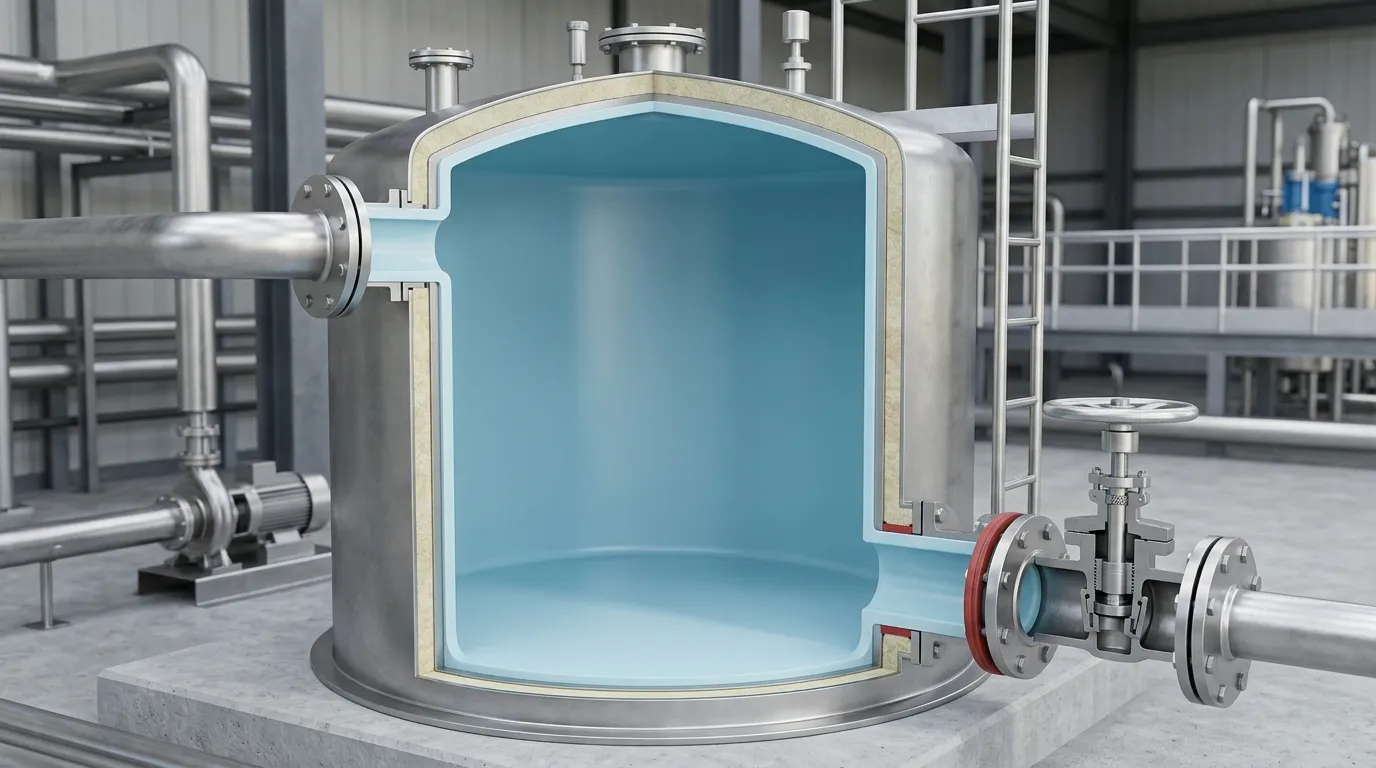
A tank compatibility review should begin with the service conditions rather than with a preferred material. At minimum, define:
- Acetic acid concentration and concentration basis
- Normal, minimum, and maximum temperature
- Continuous or intermittent exposure
- Storage duration and cycling frequency
- Agitation, pumping, filling, and draining conditions
- Tank construction and fabrication method
- All materials that contact the liquid
Concentration is especially important because a compatibility entry for one acetic acid solution should not automatically be transferred to another. A tank suitable for a 60% solution cannot be assumed suitable for 80% acetic acid or glacial acetic acid without supporting evidence.
Temperature also requires careful attention. A material chart prepared for ambient conditions may not apply to heated service, temperature cycling, or localized hot spots. The same principle applies to fittings and seals: a tank wall may appear suitable while a gasket, valve seat, or pump component has a different resistance profile.
Vanchor’s acetic acid concentration guide can provide useful concentration context, but concentration information alone does not approve a tank material.
Compatibility charts are valuable for initial screening. They are not, by themselves, final engineering approval. The final decision should be based on the exact chemical specification, service conditions, component materials, and documentation from the tank or material supplier.
Stainless Steel: How to Assess 304 and 316 for Acetic Acid Service
Stainless steel is often considered for chemical storage because of its mechanical strength, cleanable surface, and established use in industrial equipment. That does not mean every stainless-steel grade is suitable for every acetic acid service.
Is 316 stainless steel compatible with acetic acid?
The available research does not establish universal compatibility of 316 stainless steel with all acetic acid concentrations and temperatures.
One retrieved tank-resistance chart snippet associates 316 stainless steel with 60% acetic acid, together with other materials. However, the complete chart conditions, rating method, temperature limitations, and design assumptions were not available. That type of entry should therefore be treated as an attributed screening reference, not as a blanket approval for a storage installation.
Before approving 316 stainless steel, confirm:
- The exact acetic acid concentration
- The full operating and storage temperature range
- Whether the service is continuous or intermittent
- The stainless-steel grade and product form
- Welded, fabricated, or heat-affected areas
- The compatibility of nozzles, valves, gaskets, seals, and fasteners
- Any contaminants or process chemicals that may be present
- The tank manufacturer’s written recommendation or applicable corrosion data
Is 304 stainless steel compatible with acetic acid?
The research does not establish a universal 304 stainless-steel rating for acetic acid. A general statement that “stainless steel is compatible” is therefore too broad for procurement or engineering approval.
304 and 316 should not be treated as interchangeable labels. Their suitability can depend on the concentration, temperature, fabrication condition, exposure period, and the presence of other chemicals. If an existing 304 or 316 tank is being reused, the review should identify the actual alloy and examine the complete wetted system rather than relying on the tank nameplate alone.
The safe conclusion is conditional: stainless steel may be a candidate in some acetic acid services, but the exact grade and conditions require verification. A chart entry for one concentration should not be extended to glacial acetic acid, another solution concentration, or heated service without specific evidence.
Plastics and FRP: Where HDPE, XLPE, PP, and FRP Fit

Non-metallic tanks are frequently considered for corrosive liquid storage because polymer and composite systems can offer useful chemical-resistance characteristics. Their suitability still depends on the exact resin, construction, concentration, temperature, and mechanical requirements.
The following examples are drawn from retrieved industry compatibility material and must be read as conditional, source-specific guidance.
| Material or system | Retrieved indication | Conditions shown or available | What still requires verification |
|---|---|---|---|
| HDPE / XLPE | A tank-resistance chart lists HDLPE and XLPE for 60% acetic acid | Ambient-temperature chart scope | Exact resin, concentration basis, temperature, tank design, and structural suitability |
| HDLPE | The same chart lists HDLPE for 80% acetic acid | Ambient-temperature chart scope | Confirmation for the exact product and service conditions |
| PP | A retrieved chart snippet and industry guidance associate PP with acetic acid service | Full rating conditions were not available in the snippet | Complete manufacturer data, temperature, concentration, and tank construction |
| FRP | Industry guidance presents FRP as a candidate for acetic acid storage | Resin and service conditions were not specified | Resin chemistry, laminate construction, fabrication, temperature, and inspection |
| PVC | A chart snippet associates PVC with a 60% acetic acid entry | Full conditions and rating were unavailable | Do not approve without complete, applicable manufacturer data |
A chemical resistance chart from National Storage Tank lists HDLPE and XLPE for 60% acetic acid and HDLPE for 80% acetic acid under its stated ambient-temperature chart scope. These entries should remain tied to the source and conditions shown. They do not establish a universal rating for every HDPE, XLPE, or acetic acid product.
HDPE and XLPE
HDPE and XLPE may be practical candidates for some acetic acid storage applications. The relevant decision is not only whether the polymer is listed, but whether the specific tank construction is designed for the intended liquid and service conditions.
Confirm the resin designation, tank standard, wall construction, temperature range, concentration basis, and any restrictions related to filling, venting, mechanical loading, or long-term exposure.
Polypropylene
PP is another candidate identified in the retrieved material. However, the available evidence does not provide a complete, concentration-specific and temperature-specific PP rating for the intended installation. PP should therefore remain a candidate for supplier confirmation rather than a default recommendation.
FRP
FRP is a system rather than a single chemical identity. Its resistance depends heavily on the resin, reinforcement, laminate design, fabrication quality, joints, and service temperature. An FRP tank made with one resin system should not automatically be treated as equivalent to an FRP tank made with another.
For FRP, request resin-specific compatibility documentation and confirm that the data covers the exact acetic acid concentration and temperature. Do not infer that an FRP tank and an FRP lining have identical evidence.
Lining Options: What Must Be Verified Before Using a Barrier System
A lined tank should be evaluated as a complete system. The lining chemistry, substrate, fabrication method, thickness, seams, penetrations, and service conditions all affect the result.
The research did not verify a specific lining resin, maximum service temperature, lining thickness, or acetic acid concentration limit. A material name such as “lined steel” is therefore not enough to approve the tank.
Before relying on a lining system, request:
- Exact lining product and resin chemistry
- Acetic acid concentration covered by the documentation
- Minimum and maximum service temperature
- Continuous and intermittent exposure limits
- Substrate material and surface preparation requirements
- Lining thickness and fabrication method
- Seam, nozzle, and penetration details
- Permeation, adhesion, inspection, and repair information
- Compatibility of the lining with cleaning or process chemicals
The lining should also be reviewed at areas that are commonly more vulnerable than a flat tank wall, including nozzles, joints, drains, agitator penetrations, overflow points, and sampling connections.
A lining may be appropriate when the structural material and chemical barrier are selected together. It should not be treated as a generic substitute for confirming the underlying tank design.
Do Not Stop at the Tank Wall: Check the Complete Wetted System
Acetic acid tank material compatibility applies to the entire wetted system, not only to the main vessel.
Review the following components separately:
- Tank shell or vessel wall
- Lining and substrate
- Inlet and outlet piping
- Valves and pump wetted parts
- Gaskets and seals
- Nozzles, drains, and overflow connections
- Bolts and fasteners exposed to the liquid or vapor
- Sampling points and instrumentation interfaces
- Welded, fabricated, or repaired areas
Compatibility charts may list fitting, gasket, bolt, or seal materials separately from the tank material. That separation is important. A compatible tank wall does not establish that an elastomer, valve seat, flange gasket, or pump component will perform under the same concentration and temperature conditions.
The review should produce a complete wetted-material list. If a supplier provides only the tank-shell material and omits the gaskets, seals, valves, or connected piping, the compatibility assessment is incomplete.
Do not generalize one chart entry for a gasket or fitting to every installation. Component materials, temperature, compression, movement, and exposure duration may change the result.
A Practical Approval Workflow for Selecting an Acetic Acid Tank
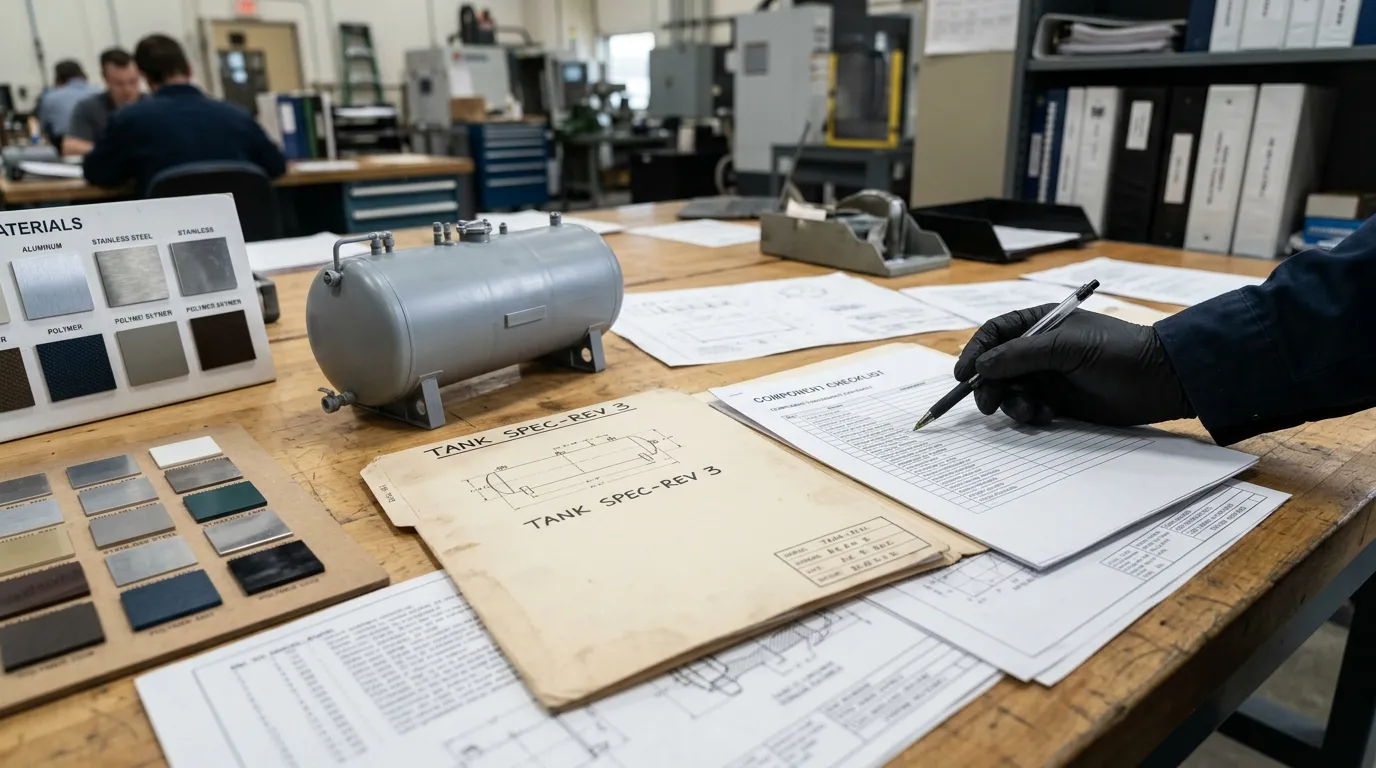
Use the following sequence when reviewing a new tank, replacement tank, or existing installation:
- Define the chemical. Record the exact acetic acid concentration, product form, and concentration basis. Do not use “acetic acid” as if it represents one uniform service.
- Record the temperature range. Include normal, minimum, and maximum storage or operating temperatures, including temperature cycling or heat tracing.
- Describe the exposure. Note storage duration, filling and draining frequency, agitation, pumping, cleaning, and any process conditions that may increase stress.
- List every wetted material. Identify the tank wall, lining, piping, valves, pump parts, gaskets, seals, fasteners, nozzles, and instruments.
- Screen candidate materials. Use an applicable compatibility chart or technical reference as an initial filter.
- Request exact-condition confirmation. Ask the tank or material supplier to confirm the specific concentration, temperature, and service conditions in writing.
- Review construction documentation. Check tank design, fabrication, lining or laminate details, inspection information, and component specifications.
- Complete the site approval. Have engineering, QA, EHS, or the responsible technical authority review the complete evidence package and applicable local requirements.
A useful RFQ or technical review package should include:
- Exact chemical name and concentration
- Product SDS and relevant specification
- Tank material and grade
- Lining product and resin information, if applicable
- Temperature range
- Tank construction and design information
- Fitting, gasket, valve, pump, and seal materials
- Compatibility chart, test data, or manufacturer recommendation
- Inspection and quality documentation
- Applicable site or jurisdictional requirements
This process is a practical decision framework, not a substitute for site-specific engineering approval. A compatibility chart can help narrow the choices, but it should not be the only document supporting the purchase or reuse decision.
Storage and Segregation Considerations Outside the Material Comparison
Material compatibility does not replace broader storage controls. The facility should also review ventilation, secondary containment, inspection, spill response, SDS requirements, and chemical segregation. For broader operational guidance, see acetic acid storage handling.
University of Illinois safety guidance identifies acetic acid incompatibilities involving materials such as hydroxides, nitric acid, peroxides, permanganates, chromic acid, and certain oxidizers. These examples should be treated as safety-screening information rather than a complete site-specific segregation plan. The applicable SDS and facility risk assessment remain necessary.
The key decision remains straightforward: approve an acetic acid tank only after the exact concentration, temperature, tank construction, lining, and complete wetted system have been reviewed together.


Contact Us
Related Posts
Custom Packaging Solutions from an Anhydrous Sodium Acetate Supplier in China
2026-09-23
Application Trends in Anhydrous Sodium Acetate for Special Chemical Manufacturing
2026-09-23
Anhydrous Sodium Acetate for Leather Tanning: Improve Dyeing Uniformity
2026-09-22
Formic Acid 85% for Textile Dyeing: Industrial Applications, Technical Benefits and Future Trends
2026-09-22


