


Isobutanol 99.3% Price and Supply in 2026: A Guide for Chemical Importers
By Vanchorsc
2026-10-22Related Posts
How to Choose a Reliable 2-Ethylhexanol (2-EH) Supplier in China: Quality, Packaging and Shipping
2026-10-22
Natural vs Synthetic Sodium Sulfate Anhydrous: Which Is Better for Industrial Applications?
2026-10-22
Isobutanol 99.3% Price and Supply in 2026: A Guide for Chemical Importers
2026-10-22
Sodium Sulfate Anhydrous 99% for Detergent Manufacturing: Benefits, Specifications and Bulk Supply
2026-10-22
Two isobutanol shipments can both satisfy a 99.3% purity requirement yet behave differently during resin formulation or chemical synthesis. One may contain more water; another may have a different residual aldehyde profile. Neither difference is necessarily apparent from the headline assay.
For importers comparing Isobutanol 99.3% Price and Supply in 2026, the purchasing question is therefore not simply which supplier offers the lowest price per ton. The material must meet its intended process requirements, and the quoted delivery arrangement must remain economical after freight, testing, and handling.
What Determines Isobutanol Prices in 2026?
Conventional petrochemical isobutanol production processes begin with the hydroformylation of propylene, where the reaction of propylene and a synthesis gas (CO/H₂) results in the formation of normal and branched butyraldehydes. Hydrogenation of isobutyraldehyde produces isobutanol and distillation is used to separate isobutanol from the other components.
Selectivity of the hydroformylation reaction influences the economics of the process.
Three factors deserve particular consideration in quotations:
•Feedstock exposure: Propylene and hydrogen costs affect the economics of the process while the costs of steam and utilities affect separation costs.
•Production allocation: Changes in operating rates, demand for n-butanol and maintenance affect the availability of branched alcohols.
•Regional supply: Differences in the freight capacity, location of inventories and the nature of the demand in various regions affect prices.
Is 99.3% Purity Sufficient for Industrial Applications?
Vanchor's industrial specification for isobutanol requires a minimum of 99.3% purity and states a molecular weight of 74.12 g/mol, and is colorless and transparent.
That purity number is not an evaluation of the equipment's manufacturing precision. It is more of a product quality specification. The analytical basis must also be confirmed. For example, GC area normalization and mass-percent reporting are not always the same, especially when water is not included in the chromatographic assay.
The impurities are of greater or lesser importance based on the application.
•Moisture: Water is involved in many synthesis, can impact phase behavior, create incompatibilities in some resins and impact others, e.g. polymeric BIDA.
•Aldehydes: Uncompleted hydrogenation or separation can leave behind carbonyl impurities that impact odor, color and other reaction activities.
•Other alcohols: The presence of n-butanol and other VOC's can impact the solvent and evaporation behavior.
When more stringent control is required, we suggest agreement on analytical methods and individual impurity limits prior to shipment. These may include GC-FID or other methods for organic impurities, Karl Fischer method for water, and others for color and acidity.
Why Does Isobutanol Perform Differently from n-Butanol?
Isobutanol and n-butanol are structural isomers, but the difference in molecular branching change their behavior.
At standard atmospheric pressure, isobutanol boils at roughly 108°C, and n-butanol boils at roughly 118°C. Knowing this, isobutanol can be thought of as a more quickly evaporating solvent than n-butanol. In turn, this can influence the behavior of coatings as solvents.
Generally, the boiling point of a solvent is of little influence on the performance of a coating. Several other factors come into play such as the combination and interactions of other solvents and the resin, the presence of humidity in the environment, film thickness, and the remaining blend of solvents.
From a chemical manufacturing standpoint, isobutanol yields isobutyl compounds and n-butanol yields n-butyl compounds. This changes the structure and the physical properties of the derivatives.
Generally, teams evaluating solvent substitutions should be more restrictive. While decreased regulatory restrictions for such evaluations are welcomed by companies, potential formulation instability, adverse changes to product behavior during evaporation and finished-product performance should be considered in the operation environment for which the solvent is being substituted.
How Do Packaging and Freight Affect Landed Cost?
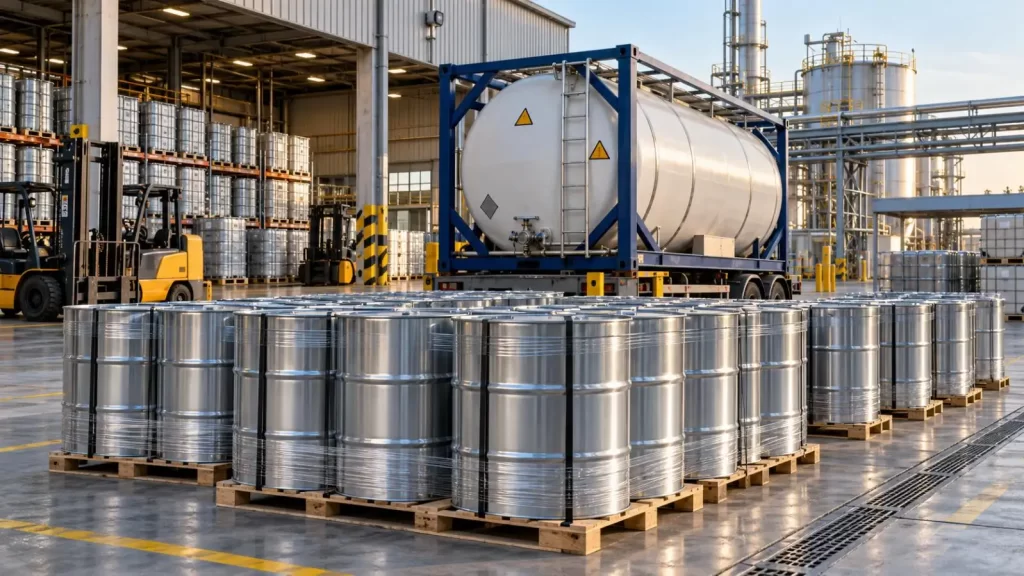
Vanchor offers 170 kg steel drums for small or segregated orders. ISO tanks are suitable for larger, recurring liquid imports. Liquid bulk vessels are appropriate for high volume, supply programs.
Isobutanol is transported as UN 1212, Class 3, Packing Group III. It's closed-cup flash point is roughly 28°C.
This classification impacts how freight is booked and packed, the documentation, and the safe unloading of the cargo. It also affects storage systems that must control flammable vapors and ignition-sourcecontrol.
A quoted FOB price can, therefore, be misleading compared to a competing CIF or delivered price.
To establish the total cost, using the same delivery boundary:
Landed Cost per Ton = (Product + Packaging + Freight + Insurance + Duties + Destination Charges) / Accepted Net Tonnage
For ISO tanks, potential detention and/or cleaning costs must be included. For drums, the total cost must include unloading labor, waste packaging, and unrecoverable product heel. Determine if the destination's facility can accept the proposed package prior to the purchase decision.
How Can Importers Verify Batch Consistency and Supply Reliability?
A pre-shipment sample demonstrates the properties of that sample, not automatically those of every future production lot.
Vanchor's published company-wide quality-control system includes incoming material inspection, in-process monitoring, finished-product testing, pre-loading verification, and shipment sample retention for at least three months. The applicability of specific procedures to each isobutanol shipment should be confirmed during order qualification.
For repetitive imports, the purchasing specification should include the following:
•Lot acceptance: Limits of purity, moisture, pertinent impurities and test methods and reporting units.
•Traceability: Batch identification linking certificates of analysis to shipping containers.
•Supply origin: Manufacturing source confirmed, available allocation and expected lead time.
•Cargo integrity: Condition of packaging, adequate tank-cleaning records and documents, and representive sampling.
•Dispute resolution: Retained samples, and terms for settling analytical disagreements.
For risky situations, incoming samples should be evaluated against historial batch results, and not only against a single, minimum, purity threshold. A material can be within specification while it shows an increasing level of an unwanted impurity.
For annual supply agreements, verification of the suppliers' delivery commitments are required. In the absence of specified terms, a supplier's general export capability would not establish a guaranteed, monthly, allocation.
Request Isobutanol 99.3% Pricing From Vanchor
At Vanchor, we supply isobutanol for use in industrial coatings, resin systems, and as a solvent in chemical synthesis.
For a quote, provide us with the desired volume, destination port, desired shipping terms, and the specific quality requirements. Our team will check the available supply, and if possible, provide a quotation.
FAQs
Q1. What Is the Purity of Vanchor Isobutanol?
Vanchor offers industrial-grade isobutanol with a minimum purity of 99.3%. Buyers should confirm the assay method and batch-specific results before ordering.
Q2. How Can I Get the Latest Isobutanol 99.3% Price From Vanchor?
Contact Vanchor with your required quantity, destination port, packaging preference, and delivery terms. Current export pricing must be confirmed through a quotation.
Q3. What Affects Isobutanol 99.3% Prices in 2026?
Major factors include propylene costs, hydrogenation and separation expenses, plant operating rates, regional availability, and freight charges. Prices also depend on order volume and delivery terms.
Q4. What Packaging Options Does Vanchor Offer for Isobutanol?
Vanchor offers 170 kg steel drums, ISO tanks, and liquid bulk vessel arrangements. Availability depends on shipment volume, destination, and logistics requirements.
Q5. How Can Buyers Verify the Quality of Vanchor Isobutanol?
Request a batch-specific certificate of analysis and confirm the test methods. GC analysis can assess organic purity, while Karl Fischer testing can measure moisture where required.


Contact Us
In This Article
Related Posts
How to Choose a Reliable 2-Ethylhexanol (2-EH) Supplier in China: Quality, Packaging and Shipping
2026-10-22
Natural vs Synthetic Sodium Sulfate Anhydrous: Which Is Better for Industrial Applications?
2026-10-22
Isobutanol 99.3% Price and Supply in 2026: A Guide for Chemical Importers
2026-10-22
Sodium Sulfate Anhydrous 99% for Detergent Manufacturing: Benefits, Specifications and Bulk Supply
2026-10-22


