



Calcium Formate Factory: A Complete Guide to Production, Market Trends, and Supplier Selection
By vanchor
2026-07-17Related Posts

Custom Packaging Solutions from an Anhydrous Sodium Acetate Supplier in China
2026-09-23

Application Trends in Anhydrous Sodium Acetate for Special Chemical Manufacturing
2026-09-23
Anhydrous Sodium Acetate for Leather Tanning: Improve Dyeing Uniformity
2026-09-22
Formic Acid 85% for Textile Dyeing: Industrial Applications, Technical Benefits and Future Trends
2026-09-22
A calcium formate factory sits at the point where industrial chemistry meets construction, feed additives, and global trade. For buyers, importers, and project developers, it helps to understand how the plant works, not just compare quotes. Product quality, process control, logistics, and compliance all affect how well calcium formate performs in use.
Calcium formate keeps showing up in more applications because it is useful and simple to handle, and it is fairly versatile. It is used in dry mix mortars, tile adhesives, concrete formulations, leather tanning, and animal nutrition. Demand is still tied to construction activity, repair work, and the need for additives that improve performance without complicating the formulation. Buyers have also become more careful about supplier reliability, environmental controls, and batch consistency.
If you are evaluating a calcium formate factory for procurement or a long term supply relationship, this guide covers the production process, key equipment, quality checks, market conditions, and the main points to review before ordering.
01
PART
What a calcium formate factory produces
PRODUCT
A calcium formate factory makes calcium formate, usually as powder or granules, for industrial and agricultural use. The product is used as a set accelerator in cement based materials and as a feed additive in some animal nutrition applications.
High purity and stable composition
Good flowability and low moisture
Controlled particle size
Packaging that survives export or bulk shipping
Grades matched to construction, feed, or technical use
End use requirements vary, so many factories make more than one grade. A construction grade may focus on mortar performance, while a feed grade needs tighter control over contamination and compliance.
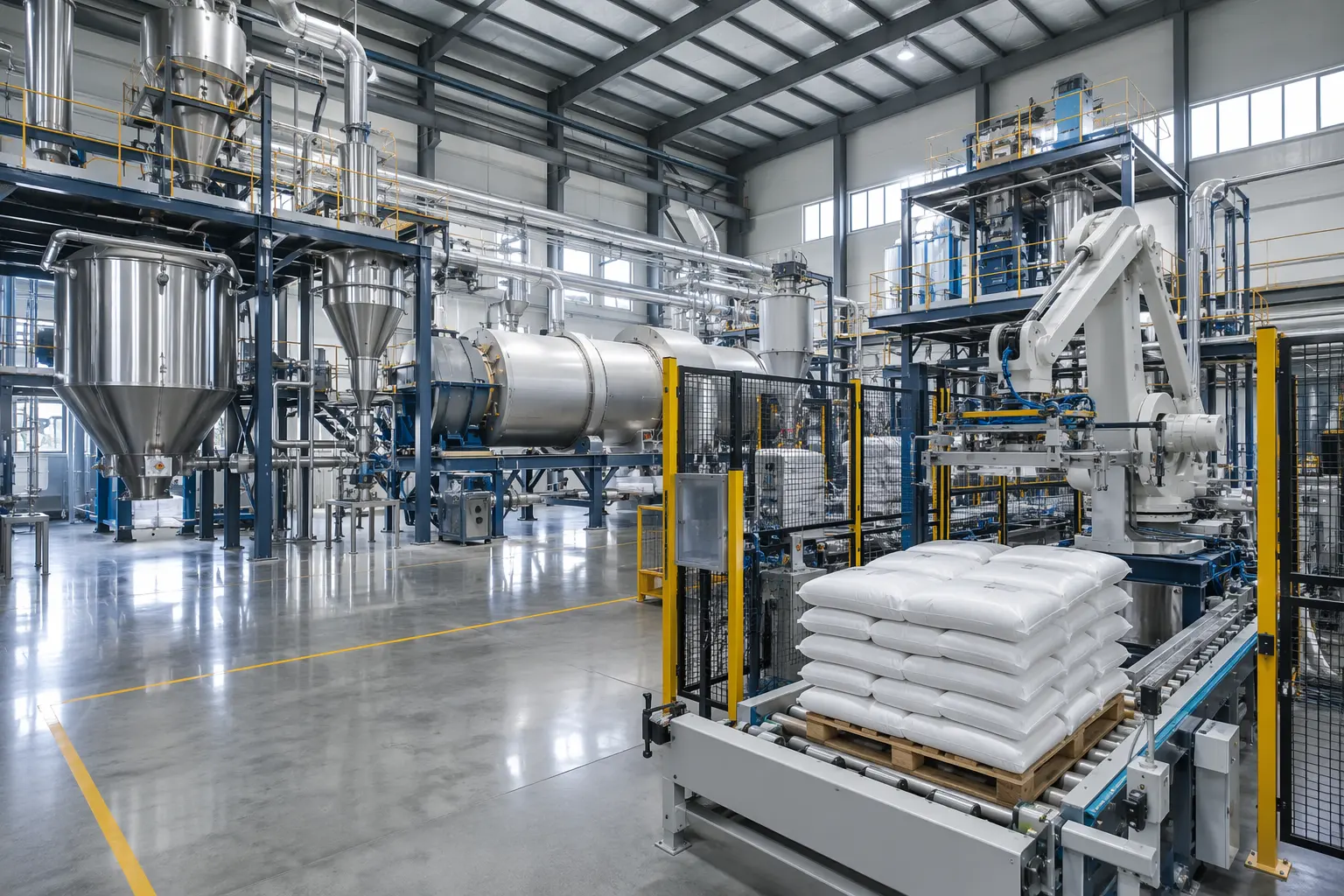
Modern calcium formate factory interior with reactors, dryers, and automated packaging lines.
02
PART
Why calcium formate demand stays steady
DEMAND
Several long running market drivers support demand for calcium formate.
Construction and dry mix mortar demand
One of the main uses for calcium formate is in dry mix mortar and cement based products. It helps speed early strength development, can improve workability in some formulations, and supports faster project schedules. That matters in markets where labor costs are high and construction windows are short.
Demand has stayed solid in places where renovation, prefabrication, and infrastructure repair continue to move forward. Buyers in these markets often look for additives that are reliable and easy to dose.
Feed additive applications
Calcium formate is also used in animal nutrition, where it may support feed preservation and digestibility depending on the formulation and the local regulatory environment. Buyers in this area usually ask for stronger documentation and traceability than industrial customers do.
Trade and sourcing diversification
Many buyers now want more than one source. They do not want to rely on a single origin or one plant for all their supply. That has increased interest in factories that can provide stable quality, clear technical data, and export documents that are complete and accurate.
03
PART
How a calcium formate factory works
PROCESS
A calcium formate factory is usually built around reaction, purification, drying, screening, and packaging. The exact route can differ, but the basic flow is similar across most industrial plants.
Raw material preparation
Production starts with raw materials, usually formic acid and a calcium source such as calcium hydroxide or calcium carbonate, depending on the process. Raw material purity matters because impurities can affect color, stability, and final performance.
Reaction and synthesis
The core step is the controlled reaction that forms calcium formate. Process control matters here. Temperature, mixing, reaction time, and pH all affect consistency. When the process stays stable, the plant produces less off spec material and gets better yield.
Filtration and purification
After the reaction, the mixture may go through filtration or separation to remove unwanted residues. This step helps the factory reach the target purity and meet application specific standards.
Drying
Moisture control is one of the most important parts of the process. Drying equipment brings the material down to the right moisture level, which improves storage stability and reduces caking during transport and warehousing.
Crushing, screening, and grading
If the factory produces powder or granules, the material is screened to reach the correct particle size distribution. That helps with flowability, blending, and packaging consistency.
Packaging and storage
Finished product is usually packed in bags, big bags, or bulk containers depending on the customer’s needs. Export customers often want moisture resistant packaging with clear labeling, batch numbers, and handling instructions.
04
PART
Key equipment in a calcium formate factory
EQUIPMENT
A modern factory depends on more than the reactor. Stable output comes from integrated equipment and a plant layout that supports the process.
Reactors or reaction tanks
Mixing systems
Filtration units
Dryers
Screening machines
Conveying systems
Packaging machines
Dust collection and environmental control systems
Laboratory testing instruments
Each piece affects output and quality. Poor drying can lead to caking. Weak screening control can create trouble in downstream blending.
Automation matters more every year.
It improves repeatability, lowers labor dependence, and reduces contamination risk.
05
PART
Quality control in calcium formate manufacturing
QUALITY
A dependable calcium formate factory does more than produce volume. It also needs a strong quality system.
Important quality indicators
Assay or content percentage
Moisture content
pH value
Insoluble matter
Particle size distribution
Bulk density
Appearance and color
Heavy metals or other contaminant limits, when relevant
Feed and specialty grades may need extra testing to meet legal and customer requirements.
A sample that tests well once is not enough. Buyers should look for factories that can hold quality steady across multiple batches.
That matters especially for large construction users, where even a small change in formulation can alter setting behavior and final performance.
Documents buyers should ask for
Certificate of Analysis
Safety Data Sheet
Product specification sheet
Batch traceability records
Quality management certifications, if available
Export and compliance documents
These papers help confirm that the supplier can work at a professional procurement level.
06
PART
Market trends affecting calcium formate factories
MARKET
Several trends are shaping the market, and buyers should keep them in mind.
Sustainability and process efficiency
Industrial buyers pay more attention now to resource use, emissions, and waste reduction. Factories that invest in cleaner processes, energy efficient drying, and dust control may have a stronger position with global customers.
More demand for application specific grades
A generic product is no longer enough for many buyers. Construction chemicals and feed related markets often want grades matched to a specific use, since the performance and regulatory needs are not the same.
Shorter lead times and more inventory planning
Supply chain disruptions have made buyers more sensitive to lead time and stock risk. A calcium formate factory with stable raw material sourcing, enough warehouse space, and dependable export logistics has a real advantage.
More technical support from suppliers
Many buyers want help with more than pricing. They want samples, testing support, and quick answers from the technical team. Factories that can help with application trials often win more business than suppliers that only ship volume.

Laboratory quality testing of calcium formate powder with sample jars, scales, and moisture analysis equipment.
07
PART
How to evaluate a calcium formate factory before buying
EVALUATION
If you are sourcing calcium formate for the first time, it helps to check the factory from several angles.
Ask whether the plant can supply your required volume consistently. Annual capacity on a brochure is not enough. You should confirm actual operating output, peak load handling, and monthly supply stability.
Make sure the factory can make the grade you need. A product for mortar may not suit feed use, and a construction grade may not meet the documentation requirements of a regulated application.
Look for a clear quality control system, from raw material inspection to final release testing. A strong system lowers the risk of inconsistent shipments.
If you are importing, the factory should understand customs documents, packaging standards, and shipping coordination. Experience with exports usually saves time and avoids expensive mistakes.
A reliable supplier should answer questions clearly, send samples promptly, and help troubleshoot if a formulation issue comes up.
A factory with steady operations, transparent ownership, and dependable logistics is often a safer long term partner than a low price supplier with unclear processes.
08
PART
Applications and buying considerations by industry
APPLICATIONS
Different industries care about different features.
Construction materials
For dry mix mortar, tile adhesives, and cement based systems, buyers usually care about setting performance, compatibility with admixtures, moisture control, particle fineness, and batch consistency.
Animal feed
For feed applications, procurement teams usually focus on compliance documentation, purity and traceability, low contamination risk, packaging hygiene, and consistent supply.
Industrial and chemical use
For technical applications, the main concerns are purity, solubility behavior, storage stability, bulk logistics, and price to performance balance.
Knowing your own application makes supplier selection easier and lowers the chance of buying the wrong grade.
09
PART
Common problems buyers should avoid
RISKS
Even experienced buyers can run into trouble if they focus only on price.
Poor moisture control can make calcium formate cake during production and packaging. That creates handling problems and can affect performance in use.
A quote without full product data is not enough. Always ask for complete technical details before ordering.
Some lower quality plants have trouble keeping output stable. That can create formulation variation and lead to disputes later.
Packaging that does not protect against moisture, puncture, or poor stacking can lead to avoidable losses in transit.
A factory that disappears after shipment can become expensive very quickly. Technical and commercial support still matters after the goods leave the plant.
10
PART
What makes a strong calcium formate factory partner
PARTNERS
A strong supplier combines manufacturing ability with basic commercial discipline.
Clear product specifications
Stable and transparent communication
Consistent quality documentation
Flexible packaging options
Experience with different industries
Ability to provide samples and support trials
Reliable export logistics
A good calcium formate factory should make purchasing easier, not harder.
11
PART
What comes next for calcium formate manufacturing
OUTLOOK
The outlook for calcium formate factories is still solid, especially for suppliers that can combine quality, efficiency, and export readiness. Construction chemicals should remain a major demand base, while specialty applications may support higher value grades.
More automated and efficient production lines
Stronger environmental controls
Higher demand for technical documentation
Continued diversification of global sourcing
More specialized grades for targeted applications
Factories that invest in process control and customer support are in a better position to win repeat business in a competitive market.
///
PART LAST
Conclusion
SUMMARY
A calcium formate factory is more than a production site. It is a system that has to deliver chemical consistency, application performance, and reliable logistics in a market that values quality and transparency. Whether you are buying for construction, feed, or technical use, the right factory should provide stable output, clear documentation, and real support for your application.
When you compare suppliers, do not stop at unit price. Review the production process, ask for quality records, confirm packaging and shipping capability, and check how well the factory understands your market. That approach lowers sourcing risk and helps build a more dependable supply chain.
For buyers looking for a long term calcium formate supply partner, the best choice is usually the factory that combines technical skill, consistent quality, responsive service, and commercial reliability.


Contact Us
Related Posts
Custom Packaging Solutions from an Anhydrous Sodium Acetate Supplier in China
2026-09-23
Application Trends in Anhydrous Sodium Acetate for Special Chemical Manufacturing
2026-09-23
Anhydrous Sodium Acetate for Leather Tanning: Improve Dyeing Uniformity
2026-09-22
Formic Acid 85% for Textile Dyeing: Industrial Applications, Technical Benefits and Future Trends
2026-09-22


