



Calcium Formate Manufacturer for Feed Additives: Feed Grade Quality and Supply Requirements
By vanchor
2026-08-17Related Posts
Custom Packaging Solutions from an Anhydrous Sodium Acetate Supplier in China
2026-09-23

Application Trends in Anhydrous Sodium Acetate for Special Chemical Manufacturing
2026-09-23
Anhydrous Sodium Acetate for Leather Tanning: Improve Dyeing Uniformity
2026-09-22

Formic Acid 85% for Textile Dyeing: Industrial Applications, Technical Benefits and Future Trends
2026-09-22
For feed mills, premix producers and distributors, evaluating a Calcium Formate Manufacturer cannot be based on comparing assay values or prices per metric ton. Feed-grade calcium formate must exhibit a consistent behavior when used as a formulated raw material and should meet an acceptable range for calcium content, moisture, insoluble matters and obnoxious contaminants.
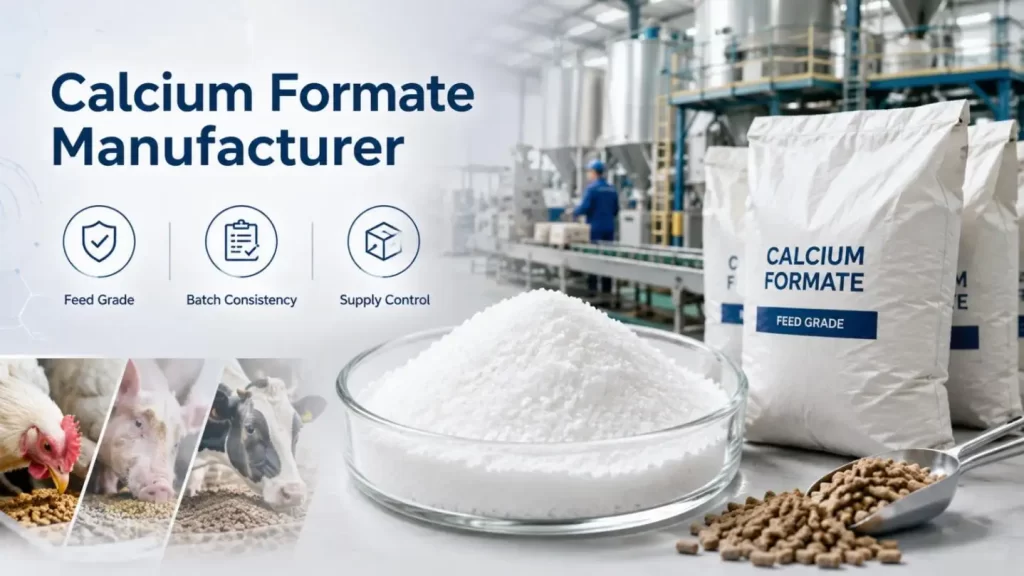
A reliable sourcing decision therefore connects five factors:
Feed-grade Specification → Batch Consistency → Contaminant Control → Documentation → Repeat Supply
At Vanchor, this approach is supported by manufacturing-linked production, quality control and international logistics rather than treating calcium formate as a generic commodity.
What Is Feed Grade Calcium Formate?
Calcium formate, Ca(HCOO)₂, is the calcium salt of formic acid. It is typically supplied as a white crystalline powder containing approximately 30% calcium by mass.
In feed formulations, calcium formate can serve two relevant functions:
•Calcium contribution within the overall mineral formulation
•Formate contribution as part of an organic-acid-based formulation strategy
Typical applications may include:
•Swine feed;
•Poultry feed;
•Compound feed;
•Mineral and functional premixes;
•Selected aquaculture formulations.
The required inclusion rate cannot be defined from calcium formate purity alone. Feed formulators must consider species, growth stage, total dietary calcium, other mineral sources, acidifier systems and applicable feed regulations.
This is why a Calcium Formate Manufacturer should supply a defined feed grade rather than expecting buyers to substitute an industrial grade based only on similar assay results.
Feed Grade vs. Industrial Grade: The Difference Is More Than Purity
A ≥98% assay does not by itself make a product suitable for feed applications.
| Evaluation Point | Feed Grade Calcium Formate | Industrial Grade |
| Main application | Feed and premix formulations | Mortar, cement and industrial chemistry |
| Calcium consistency | Formulation-critical | Process-dependent |
| Heavy-metal limits | Key purchasing parameter | Depends on application |
| Feed-specific documentation | Required by buyer/market | Usually not applicable |
| Physical consistency | Important for mixing and dosing | Application-dependent |
| Traceability | High priority | Important |
| Qualification focus | Composition + feed safety | Technical process performance |
Vanchor separates calcium formate according to its intended application, including feed, construction and tile-adhesive uses. For feed buyers, this reduces the risk of treating chemically similar but differently controlled grades as interchangeable.
Critical Feed Grade Quality Parameters
A technically capable Calcium Formate Manufacturer should control the complete specification rather than emphasize one headline purity figure.
1. Calcium Formate Content Assay
In Vanchor's definition of feed grade, we find:
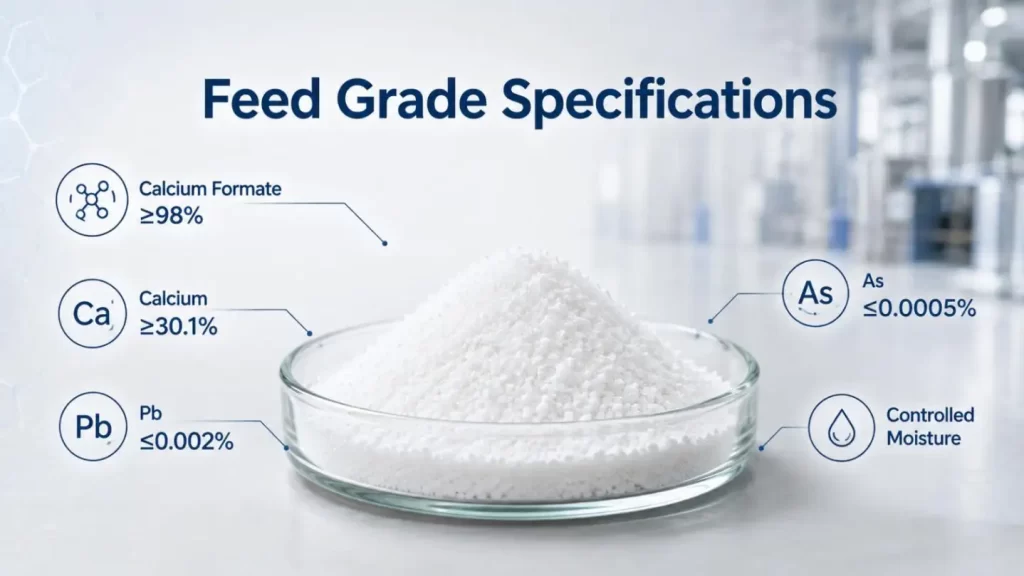
• Calcium Formate: ≥98%
Assay consistency is critical for calculation of dosages and standardization of raw-material inputs. Large variation of lots in continuous feed production may necessitate change of formulation and incoming quality control may become cumbersome.
2. Calcium Content
Vanchor specifies:
•Calcium: ≥30.1%
Calcium content is particularly relevant because feed formulators calculate total mineral contribution from multiple sources. Limestone, phosphates, calcium formate and other calcium-containing ingredients must be considered together.
For procurement teams, the practical question is therefore not only "Is purity ≥98%?" but also "Is calcium content consistent across repeat batches?"
3. Lead and Arsenic Control
For feed applications, undesirable substances require separate attention from assay.
Typical Vanchor feed-grade limits include:
•Lead (Pb): ≤0.002%
•Arsenic (As): ≤0.0005%
Destination-market requirements may involve additional criteria, so buyers should always review the current specification, batch COA and local feed regulations before commercial use.
4. Moisture and Insoluble Matter
Moisture control affects more than storage life. Excess moisture can increase the risk of:
•Powder caking;
•Reduced flowability;
•Bridging in hoppers;
•Inconsistent screw feeding;
•Handling losses during dosing.
Insoluble matter is another useful quality indicator because abnormal values may reflect differences in raw-material quality, reaction control or purification efficiency.
Particle Characteristics Matter in Real Feed Production
Laboratory chemistry is only one part of feed-grade qualification.
A Calcium Formate Manufacturer supplying premix and compound-feed plants should also understand how powder characteristics interact with industrial equipment.
Particle-size distribution can influence:
•Mixing uniformity — Excessive segregation can reduce homogeneity;
•Flowability — Important for silos, hoppers and automatic feeders;
•Dust formation — Fine fractions can increase material loss and housekeeping requirements;
•Dispersion — Especially relevant when calcium formate is incorporated into concentrated premixes.
For repeat orders, physical consistency should therefore be monitored together with chemical composition.
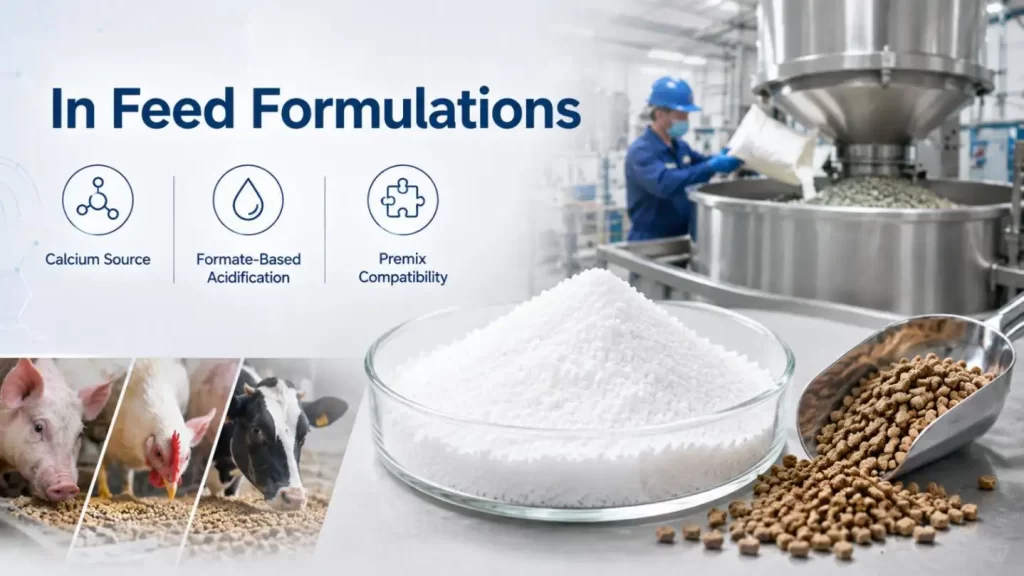
How Calcium Formate Fits Into a Feed Formulation
Calcium formate should not be evaluated as an isolated additive.
Calcium Balance
Its calcium contribution must be incorporated into the complete mineral matrix rather than added independently of other calcium sources.
Acidifier System
The formate component may be used within broader acidification strategies. Final formulation behavior depends on the complete system, including other organic acids, minerals and feed ingredients.
Premix Compatibility
Formulators may need to consider interactions with:
•Vitamins;
•Trace minerals;
•Enzymes;
•Phosphates;
•Organic acids;
•Other functional additives.
For this reason, Vanchor treats feed-grade calcium formate as a controlled formulation raw material whose composition should remain consistent from qualification sample to commercial shipment.
Manufacturing-Backed Supply vs. Trading-Only Supply
This distinction matters particularly for long-term contracts.
| Supply Factor | Manufacturing-Backed Source | Trading-Only Source |
| Production visibility | Direct | Upstream-dependent |
| Root-cause investigation | Factory-linked | Indirect |
| Batch traceability | Shorter chain | Often multi-layer |
| Specification coordination | More controllable | Source-dependent |
| Production planning | Can align with demand | Depends on third party |
| Repeat-order consistency | Easier to manage | Depends on source stability |
Trading companies can still be suitable for spot procurement. However, buyers requiring recurring feed-grade material often benefit from closer production visibility.
Vanchor combines 30 years of manufacturing experience with an approximately 50,000 m² industrial base, integrating R&D, production, testing and supply execution. This gives feed customers a more direct route from specification discussion to batch investigation when technical issues arise.
Documentation, Packaging and Export Control
A professional Calcium Formate Manufacturer should support supplier qualification with relevant documentation, such as:
•Certificate of Analysis;
•SDS;
•Technical specification;
•Batch traceability information;
•Packaging data;
•Origin/export documents;
•Applicable quality-management certificates.
Vanchor operates under ISO 9001, ISO 14001 and ISO 45001 management systems and holds China Customs AEO Advanced Certification. These systems support structured quality, environmental, occupational-safety and international trade processes.
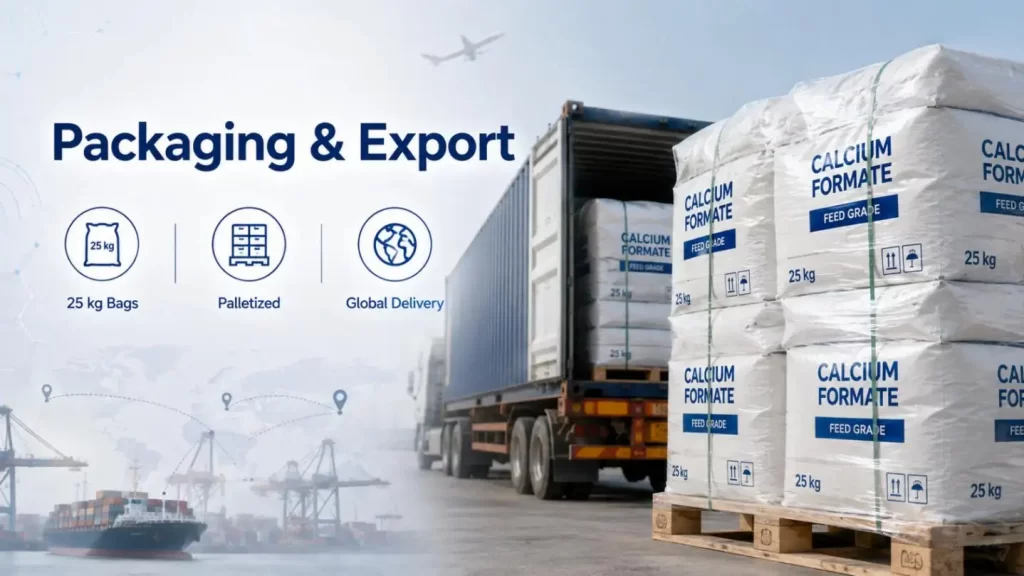
Logistics are integrated into the same supply model. Warehousing near Tianjin and Qingdao ports, combined with Vanchor's logistics resources, supports the chain from:
Production → Testing → Packaging → Warehousing → Container Loading → Port Delivery
For customers in more than 60 countries, this is particularly relevant when repeat orders require coordinated inventory, documentation and shipping schedules.
Selecting a Calcium Formate Manufacturer for Long-Term Feed Supply
A dependable Calcium Formate Manufacturer is defined less by a single laboratory number than by the ability to reproduce the required specification across commercial-scale shipments.
For feed mills, premix producers and distributors evaluating a long-term source, Vanchor can support specification review, feed-grade documentation, packaging selection and bulk supply planning through its manufacturing-backed quality and global logistics system.
FAQs
Q1. How does Vanchor ensure batch-to-batch consistency?
Vanchor integrates manufacturing, testing, and shipping management within one supply chain. Control encompasses production, lab testing, packing, storage, and final delivery coordination.
Q2. Does Vanchor supply feed-grade calcium formate?
Yes, Vanchor supplies feed-grade calcium formate for compound feed, premixes, swine and poultry feeds, and some aquaculture formulations.
Q3. What is the normal range of purity of Vanchor feed-grade calcium formate?
The normal range of Vanchor feed-grade calcium formate is (minimum) 98% Calcium Formate and (minimum) 30.1% Calcium. Purchasers should review the latest specification and batch COA before order placement.
Q4. Does Vanchor set restrictions on heavy metals in feed-grade calcium formate?
Yes, the typical specification is Lead (Pb) ≤0.002% and Arsenic (As) ≤0.0005%. Other requirements for the buyer's destination market can be reviewed.
Q5. Will Vanchor issue a Certificate of Analysis for each batch?
Yes, Vanchor can provide batch COA prior to use, concerned with assay and calcium content along with other restricted parameters.


Contact Us
In This Article
Related Posts
Custom Packaging Solutions from an Anhydrous Sodium Acetate Supplier in China
2026-09-23
Application Trends in Anhydrous Sodium Acetate for Special Chemical Manufacturing
2026-09-23
Anhydrous Sodium Acetate for Leather Tanning: Improve Dyeing Uniformity
2026-09-22
Formic Acid 85% for Textile Dyeing: Industrial Applications, Technical Benefits and Future Trends
2026-09-22


