



Sodium Acetate E262: Food-Grade Function, Specifications, and Buyer Checks
By Tonmoy
2026-08-17Related Posts

Custom Packaging Solutions from an Anhydrous Sodium Acetate Supplier in China
2026-09-23

Application Trends in Anhydrous Sodium Acetate for Special Chemical Manufacturing
2026-09-23

Anhydrous Sodium Acetate for Leather Tanning: Improve Dyeing Uniformity
2026-09-22

Formic Acid 85% for Textile Dyeing: Industrial Applications, Technical Benefits and Future Trends
2026-09-22
For food-ingredient procurement, E262 should not be treated as one interchangeable material. In the food-additive references reviewed, sodium acetate is identified as E262(i), while sodium diacetate is identified as E262(ii). These materials have different identities and should not share the same quotation, specification, label, or COA without verification.
A buyer evaluating sodium acetate food additive E262 should confirm four points before approval:
- The exact E262 subform: sodium acetate E262(i), not sodium diacetate E262(ii)
- The physical form: anhydrous or trihydrate
- The food-grade specification and its test basis
- The regulatory and batch documentation for the intended market
A high assay alone does not establish food-grade suitability.
What does E262 mean for sodium acetate?

E262 is an additive-number family associated with sodium acetates. The exact subform matters for formulation, labeling, regulatory review, and purchasing.
| Additive designation | Material identity | Relevance to this article | Buyer action |
|---|---|---|---|
| E262(i) | Sodium acetate | Primary material covered here | Confirm sodium acetate identity and physical form |
| E262(ii) | Sodium diacetate | Separate material that can be confused with sodium acetate | Do not accept its specification as a sodium acetate specification |
Food-additive references distinguish sodium acetate from sodium diacetate under the E262 designation. InfoCons identifies the E262(i) and E262(ii) distinction, while supplier and technical references separately identify sodium diacetate as E262(ii). Ataman Chemicals discusses sodium diacetate as E262(ii).
This distinction is important because a quotation that says only “E262” does not always provide enough information for technical approval. The buyer should ask the supplier to state:
- Sodium acetate or sodium diacetate
- E262(i) or E262(ii), where the applicable regulatory system uses that subdivision
- Anhydrous or trihydrate form for sodium acetate
- CAS number and chemical formula
- Applicable food-grade specification
- Intended market and application
The product name on the quotation, technical data sheet, packaging, and certificate of analysis should describe the same material.
What functions can food-grade sodium acetate provide?
Food-grade sodium acetate may be evaluated for several formulation roles, depending on the product, application, and applicable regulations.
Acidity regulation and buffering
Inspected food-ingredient sources describe sodium acetate as an acidity regulator and buffering agent. These functions relate to controlling or moderating acidity in a formulation rather than simply adding acetic acid as a liquid ingredient.
The actual suitability of sodium acetate depends on the food system, formulation target, processing conditions, and local requirements. A general description of sodium acetate as a buffering or acidity-regulating ingredient is not a substitute for application trials or regulatory review of the intended use.
Flavor contribution
Sodium acetate may contribute a mild vinegar-like, salty, or acidic sensory character in some formulations. The effect depends on the food matrix and the level used. It should not be assumed that every sodium acetate product will produce the same sensory result under all conditions.
Some food-ingredient sources describe sodium acetate in preservation-related or antimicrobial contexts. That description should be treated as application-dependent rather than as a universal performance claim. Product preservation results can depend on formulation, pH, water activity, microorganisms, processing, packaging, and the permitted use of the additive in the destination market.
For detailed preservation-specific discussion, the relevant application should be evaluated separately from this purchasing guide. The present decision is whether the offered material is the correct sodium acetate form and whether its documentation supports the intended food application.
Do not use this article as a basis for selecting a dosage, setting a preservation treatment, or claiming a shelf-life extension.
Choose the sodium acetate form before comparing specifications
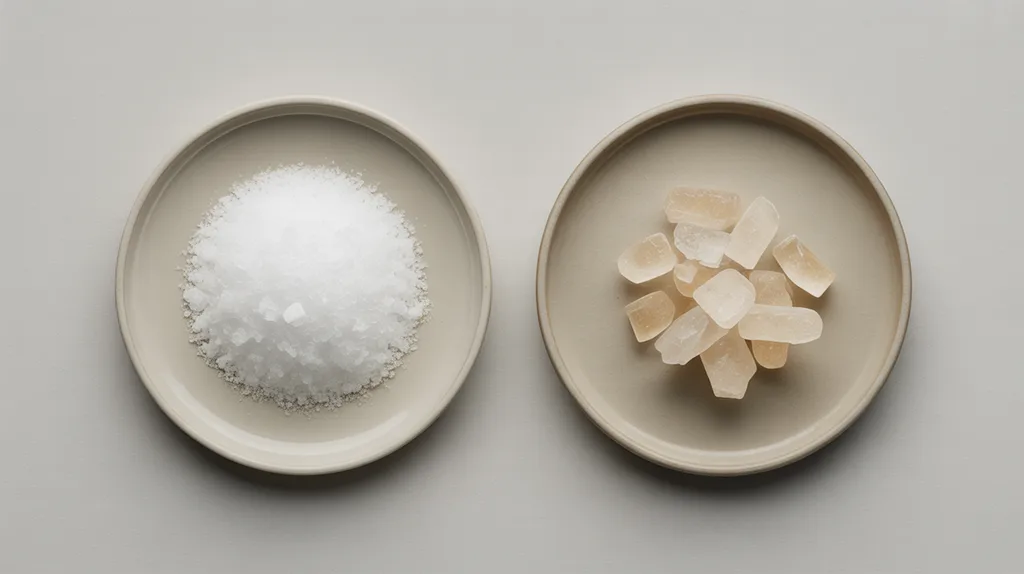
Sodium acetate may be supplied in different physical forms, including anhydrous sodium acetate and sodium acetate trihydrate. These forms should not be compared as if they were identical products.
The difference matters because water of crystallization affects:
- Chemical formula and molecular basis
- Product mass
- Moisture or water-related specification
- Assay interpretation
- Formulation calculations
- Cost comparisons
- The quantity of active sodium acetate delivered per unit mass
A supplier reference identifies sodium acetate trihydrate as CAS 6131-90-4 with the formula C₂H₃NaO₂·3H₂O. This form information is stated in the Niran Bio product reference. Because that information is supplier-stated, it should be checked against the current supplier TDS for the product being purchased.
Before comparing two offers, ask the supplier to state the form explicitly.
| Form | What to confirm | Why it matters |
|---|---|---|
| Anhydrous sodium acetate | Chemical identity, assay basis, moisture limit, and intended food-grade documentation | Avoids comparing an anhydrous basis with a hydrated product |
| Sodium acetate trihydrate | Hydrate identity, assay basis, water-related specification, and food-grade documentation | Prevents confusion between crystal water and product impurity |
| Unspecified sodium acetate | Exact form and supporting documents | An unspecified form is not adequate for final technical approval |
Do not convert between anhydrous and trihydrate quantities unless the calculation uses verified molecular data, a defined basis, and the formulation team’s approved assumptions.
Which specifications should a buyer check for food-grade sodium acetate?
The specification review should begin with identity and then move to composition, impurities, testing, and traceability. The following is a buyer-check framework, not a confirmed Vanchor product specification.
1. Chemical identity
The current TDS should state:
- Sodium acetate as the chemical name
- E262(i), where this designation applies
- Anhydrous or trihydrate form
- CAS number and formula
- Solid or solution form, if relevant
- Intended grade or application scope
Do not approve a product described only as “acetate,” “E262,” or “sodium salt” when the exact identity is not clear.
2. Assay and composition basis
Check how the assay is expressed and whether the value is:
- Minimum
- Maximum
- Typical
- Reported on an as-supplied basis
- Reported on a dry basis
- Related to anhydrous or trihydrate material
Assay, moisture, and active content are not interchangeable. A numerical value cannot be compared responsibly unless the two suppliers use the same basis and units.
3. Physical and handling specifications
Depending on the intended application, the TDS may need to define:
- Appearance
- Physical form
- Particle or powder characteristics, where relevant
- Moisture or water-of-crystallization basis
- Packaging and lot identification requirements
These fields should be reviewed against the receiving, storage, and dosing systems used at the food plant.
4. Impurity and contaminant controls
The buyer should request the applicable limits for relevant impurities and contaminants. The exact limits depend on the product specification and destination market. Do not insert generic numerical limits from another sodium acetate form, another supplier, or another jurisdiction.
5. Microbiological requirements
Where the intended food application requires microbiological controls, confirm whether the supplier specification addresses them and which test methods apply. Microbiological requirements should be tied to the actual food-grade product and its intended use.
6. Test methods and revision control
Each important specification should identify, where applicable:
- Test method
- Units
- Acceptance limit
- Specification revision
- Document date
- Whether the result is minimum, maximum, or typical
A specification without a defined test basis can be difficult for QA teams to audit or compare.
What documents should be requested before approving a supplier?

A practical approval sequence for sodium acetate E262(i) is:
- Request the current TDS for the exact product form and intended food grade.
- Request the SDS for hazard, handling, and storage information.
- Request a representative or current-lot COA showing the lot number, test results, units, methods, and specification references.
- Request the applicable food-additive or regulatory declaration for the destination market.
- Confirm the manufacturer, seller, and certificate holder, especially if they are different entities.
- Compare the documents with the quotation and packaging label to verify that the same chemical form is described throughout.
- Resolve missing fields in writing before technical approval or purchase release.
An SDS is useful for safety and handling review, but it does not by itself establish food-grade suitability. Similarly, a COA records results for a particular lot against a stated specification; it does not automatically establish universal regulatory approval.
A buyer should also avoid approving sodium acetate on the basis of:
- Assay alone
- A generic SDS
- A certificate logo without defined scope
- A product name that omits anhydrous or trihydrate form
- A specification belonging to sodium diacetate
- A COA with no lot number or test method
The COA should be read together with the TDS and the purchase specification. A separate guide on how to read chemical COA can support the batch-document review process.
Regulatory and application checks still required before food use
Food-grade suitability must be evaluated for the exact chemical form, intended food application, and destination jurisdiction.
A product’s chemical identity, assay, SDS, or COA is not sufficient by itself to establish that the product is approved for every food use or every market. The buyer should confirm:
- Which authority or regulatory framework applies
- Whether the intended application is covered
- Whether sodium acetate E262(i) is distinguished from sodium diacetate E262(ii)
- Whether the supplier’s declaration is current
- Whether the product specification matches the regulatory reference
- Whether labeling and use-level requirements apply to the finished food
The reviewed EU material concerns sodium diacetate in the available evidence and should not be used as a sodium acetate E262(i) specification. The available EU regulation source should be checked directly for the applicable legal scope.
Do not apply a numerical intake or use limit from a consumer article to a different additive form or jurisdiction. Regulatory limits can be product-, application-, and market-specific.
RFQ checklist for sodium acetate E262(i)
A procurement request should ask the supplier to provide the following information:
- Exact identity: sodium acetate E262(i), where applicable
- Physical form: anhydrous or trihydrate
- CAS number and chemical formula
- Intended food-grade specification
- Assay basis and acceptance limit
- Moisture or hydrate basis
- Relevant contaminant and microbiological requirements
- Test methods and units
- Current TDS and SDS
- Representative or lot-specific COA
- Regulatory or food-additive declaration for the destination market
- Manufacturer, seller, and certificate-holder information
- Lot traceability and packaging details required by the buyer
- Confirmation that the quotation, label, TDS, COA, and invoice describe the same product
The most important decision rule is simple: do not approve a sodium acetate E262 offer until identity, form, food-grade documentation, and jurisdictional suitability are aligned.
If your requirement is specifically for sodium acetate E262(i), provide the supplier with the required form, specification basis, destination market, and documentation expectations at the RFQ stage. This reduces the risk of receiving an unspecified E262 material or a sodium diacetate product when the formulation requires sodium acetate.


Contact Us
In This Article
Related Posts
Custom Packaging Solutions from an Anhydrous Sodium Acetate Supplier in China
2026-09-23
Application Trends in Anhydrous Sodium Acetate for Special Chemical Manufacturing
2026-09-23
Anhydrous Sodium Acetate for Leather Tanning: Improve Dyeing Uniformity
2026-09-22
Formic Acid 85% for Textile Dyeing: Industrial Applications, Technical Benefits and Future Trends
2026-09-22


