



Cooling Water Treatment Chemicals Supplier: Products, Applications, Selection, and Purchasing Guide
By vanchor
2026-07-21Related Posts
Custom Packaging Solutions from an Anhydrous Sodium Acetate Supplier in China
2026-09-23
Application Trends in Anhydrous Sodium Acetate for Special Chemical Manufacturing
2026-09-23
Anhydrous Sodium Acetate for Leather Tanning: Improve Dyeing Uniformity
2026-09-22
Formic Acid 85% for Textile Dyeing: Industrial Applications, Technical Benefits and Future Trends
2026-09-22
A Cooling Water Treatment Chemicals Supplier should offer much more than just products and competitive prices. Treatment programs for industrial plants should also be customized for the plant's cooling system design, makeup water quality, operating temperature, cycle of concentration, metallurgy, microbial activity, discharge requirements and production conditions.
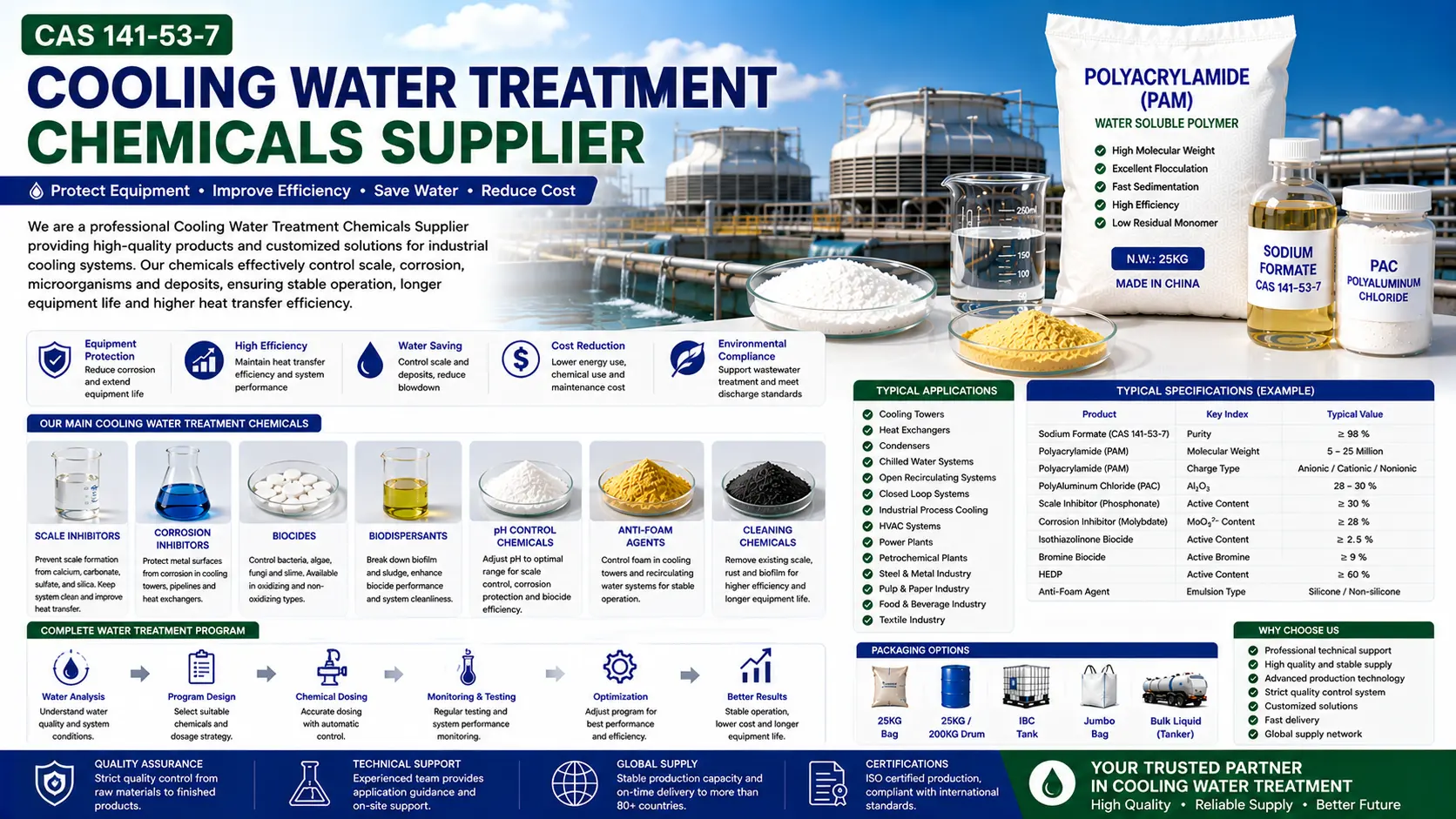
Cooling-water systems are used in most power plants, chemical plants, refineries, steel mills, paper plants, textile plants, food-processing plants, data centers, HVAC systems, and other industrial applications. These systems can experience scale, corrosion, suspended deposits, algae, bacteria, slime and biofilm if not chemically treated.
These issues will cause loss of heat transfer efficiency, limit water movement, increase energy usage, cause equipment damage, result in shorter cleaning cycles and pose risks for unplanned shutdown. A good treatment program might include scale builders, corrosion inhibitors, biocides, biodispersants, dispersants, pH-control chemicals, defoamers and cleaners.
What Are Cooling Water Treatment Chemicals?
Cooling water treatment chemicals are products used to maintain water quality and protect cooling towers, condensers, pipelines, heat exchangers, pumps, chillers, and recirculating-water systems.
Their main functions include:
- Scale prevention
- Corrosion control
- Microbial control
- Biofilm reduction
- Deposit dispersion
- Suspended-solids control
- pH adjustment
- Foam control
- Heat-transfer protection
- Cleaning and passivation
The correct chemical combination depends on whether the cooling system is open recirculating, closed-loop, once-through, evaporative, or connected to a specialized industrial process.
Why Cooling Water Treatment Is Important
Cooling systems continuously remove heat from industrial processes. As water evaporates, dissolved salts and minerals become more concentrated.
Without proper control, the system may experience:
- Calcium carbonate scale
- Calcium sulfate deposits
- Silica scaling
- Iron and manganese deposits
- Pipeline corrosion
- Heat-exchanger fouling
- Bacterial slime
- Algae growth
- Legionella-related risk
- Reduced cooling efficiency
- Increased blowdown
- Higher water consumption
A well-designed treatment program helps maintain clean heat-transfer surfaces and stable circulation.
Main Cooling Water Treatment Chemicals
Scale Inhibitors
Scale inhibitors reduce the formation and attachment of mineral deposits.
Common scale-forming substances include:
- Calcium carbonate
- Calcium sulfate
- Barium sulfate
- Strontium sulfate
- Magnesium compounds
- Silica
- Iron oxides
- Phosphate deposits
Scale-control formulations may contain:
- Phosphonates
- Polyacrylates
- Polymaleates
- Acrylic copolymers
- Phosphate compounds
- Specialized dispersants
A suitable inhibitor may help:
- Keep minerals dispersed
- Modify crystal growth
- Reduce deposit adhesion
- Increase allowable concentration cycles
- Lower cleaning frequency
- Improve heat-transfer efficiency
The correct product depends on water hardness, alkalinity, pH, silica, temperature, and concentration factor.
Corrosion Inhibitors
Cooling systems may contain carbon steel, stainless steel, copper, brass, aluminum, galvanized steel, and mixed-metal components.
Corrosion inhibitors help protect these surfaces by forming or supporting a protective layer.
Common corrosion-control chemistries may include:
- Phosphates
- Phosphonates
- Molybdates
- Nitrites
- Silicates
- Zinc compounds
- Azoles
- Organic filming inhibitors
Azoles are commonly used to protect copper and copper alloys.
The correct corrosion inhibitor depends on:
- Metal type
- Water pH
- Chloride concentration
- Dissolved oxygen
- Temperature
- Flow velocity
- System design
- Existing deposits
Oxidizing Biocides
Oxidizing biocides are widely used to control bacteria, algae, fungi, and slime.
Common examples include:
- Chlorine
- Sodium hypochlorite
- Bromine-based products
- Chlorine dioxide
- Ozone
- Peracetic acid
Potential benefits include:
- Fast microbial control
- Broad-spectrum activity
- Algae reduction
- Biofilm prevention
- Cooling-tower cleanliness
Performance depends on contact time, pH, organic loading, temperature, and oxidant demand.
Non-Oxidizing Biocides
Non-oxidizing biocides are often used periodically or alternated with oxidizing products.
Potential chemistries include:
- Isothiazolinones
- Glutaraldehyde
- Quaternary ammonium compounds
- DBNPA
- Bronopol
- THPS
- Other specialty biocides
These products may help control organisms that are less responsive to continuous oxidizing treatment.
Biocide rotation can reduce the risk of persistent microbial populations.
Biodispersants
Biodispersants help loosen and remove biological deposits.
They may improve biocide penetration by breaking up slime and biofilm.
Potential benefits include:
- Cleaner heat exchangers
- Improved microbial control
- Reduced slime formation
- Better suspended-solids removal
- Lower biofilm-related corrosion
- Reduced chemical consumption
Biodispersants are often used together with oxidizing or non-oxidizing biocides.
Deposit-Control Dispersants
Cooling water may contain dust, corrosion products, silt, clay, organic matter, and process contamination.
Dispersants help keep these materials suspended so they can be removed through blowdown, filtration, or side-stream treatment.
A suitable dispersant may reduce:
- Mud deposits
- Iron fouling
- Under-deposit corrosion
- Heat-transfer loss
- Pipeline blockage
pH-Control Chemicals
Cooling-water pH affects scaling, corrosion, biocide activity, and chemical stability.
Common pH-control chemicals include:
- Sulfuric acid
- Hydrochloric acid
- Sodium hydroxide
- Carbon dioxide
- Specialized buffered formulations
Lowering pH may reduce calcium carbonate scaling, but excessive acidity can increase corrosion.
Increasing pH may reduce certain corrosion mechanisms but can increase scaling risk.
The target range should be based on complete water chemistry.
Defoamers
Foam may develop because of surfactants, process contamination, biological activity, or excessive chemical dosing.
Defoamers may help:
- Maintain tower-basin capacity
- Prevent overflow
- Improve pump operation
- Reduce aerosol formation
- Stabilize treatment processes
The product should be compatible with biocides, inhibitors, and downstream wastewater treatment.
Cleaning Chemicals
Cooling systems may require periodic cleaning to remove:
- Mineral scale
- Rust
- Biological slime
- Oil
- Organic deposits
- Construction debris
- Process contamination
Cleaning products may include:
- Acid cleaners
- Alkaline cleaners
- Chelating agents
- Surfactants
- Biodispersants
- Passivation chemicals
The cleaning method should be selected according to deposit composition and equipment metallurgy.
Open Recirculating Cooling Systems
Open recirculating systems lose water through evaporation and use cooling towers to reject heat.
Because evaporation concentrates dissolved minerals, these systems are especially vulnerable to:
- Scale
- Corrosion
- Microbial growth
- Airborne dirt
- Biological deposits
A typical program may include:
- Scale inhibitor
- Corrosion inhibitor
- Oxidizing biocide
- Non-oxidizing biocide
- Biodispersant
- pH control
- Blowdown management
Water chemistry should be monitored frequently because evaporation, rainfall, makeup-water changes, and process leaks can alter system conditions.
Closed-Loop Cooling Systems
Closed systems circulate water without continuous exposure to the atmosphere.
They may be used in:
- Chilled-water systems
- Engine cooling
- Data centers
- Industrial process loops
- Solar systems
- Building HVAC systems
Closed-loop treatment may include:
- Corrosion inhibitors
- Nitrite or molybdate formulations
- Glycol stabilizers
- Oxygen-control products
- Microbial-control chemicals
- pH buffers
Although closed systems generally experience less contamination, oxygen entry, leaks, mixed metals, and stagnant areas may still cause corrosion and microbial growth.
Once-Through Cooling Water
Once-through systems use water only once before discharge.
Treatment requirements may include:
- Scale control
- Corrosion inhibition
- Biofouling control
- Intake-system protection
- Discharge compliance
Chemical dosage may be limited by environmental regulations and discharge conditions.
The treatment program should consider the complete water path from intake to discharge.
Cooling Towers
Cooling towers are exposed to air, dust, sunlight, insects, microorganisms, and airborne contaminants.
Common treatment challenges include:
- Algae growth
- Slime formation
- Legionella-related control requirements
- Mineral concentration
- Drift
- Basin sediment
- Corrosion
- Scale
A professional supplier should recommend a program based on tower design, water quality, operating hours, temperature, and blowdown control.
Heat Exchangers and Condensers
Heat exchangers require clean surfaces for efficient heat transfer.
Deposits may cause:
- Higher approach temperatures
- Reduced process cooling
- Increased energy consumption
- Production instability
- Localized corrosion
- Tube failure
Treatment chemicals should minimize both mineral scale and biological fouling.
Monitoring heat-transfer performance can help identify developing deposits before severe efficiency loss occurs.
Power Plant Applications
Power plants use cooling water in condensers, auxiliary systems, and cooling towers.
Treatment objectives may include:
- Condenser protection
- Scale prevention
- Corrosion control
- Microbial control
- Water conservation
- Blowdown reduction
- Reliable operation
Large systems may require automated chemical dosing, online monitoring, side-stream filtration, and regular microbiological testing.
Chemical and Petrochemical Plants
Chemical plants may experience process leaks that introduce hydrocarbons, solvents, acids, alkalis, or organic materials into cooling water.
These contaminants may:
- Increase microbial growth
- Reduce biocide effectiveness
- Cause foaming
- Create deposits
- Accelerate corrosion
Treatment programs should include process-leak monitoring and contingency procedures.
Steel and Metal Industries
Steel mills and metal-processing plants may introduce iron oxide, oil, scale, and suspended solids into cooling-water circuits.
Chemical treatment may be combined with:
- Clarifiers
- Filtration
- Oil separation
- Sedimentation
- Side-stream treatment
Dispersants and corrosion inhibitors are especially important in systems with high suspended-solid loading.
Paper, Textile, and Food Industries
Paper, textile, and food-processing facilities may introduce fibers, starch, dyes, oils, proteins, or organic residues into cooling systems.
These contaminants may increase:
- Microbial growth
- Slime formation
- Chemical demand
- Foam
- Heat-exchanger fouling
The treatment program should account for potential process contamination and should not interfere with product safety or downstream wastewater treatment.
Important Water Parameters
Before recommending cooling-water chemicals, the supplier should review:
- pH
- Conductivity
- Total hardness
- Calcium hardness
- Magnesium hardness
- Alkalinity
- Chloride
- Sulfate
- Silica
- Iron
- Manganese
- Total dissolved solids
- Suspended solids
- Microbial count
- Organic contamination
- Water temperature
Operating information should also include:
- Cooling-tower capacity
- Circulation rate
- Evaporation rate
- Blowdown rate
- Makeup-water volume
- Cycles of concentration
- Metallurgy
- Heat load
- Operating hours
Cycles of Concentration
Cycles of concentration describe how much dissolved material is concentrated in recirculating water compared with makeup water.
Higher cycles may:
- Reduce water consumption
- Reduce blowdown volume
- Lower wastewater discharge
However, they can also increase:
- Scaling risk
- Corrosion risk
- Silica concentration
- Chemical demand
- Microbial challenges
The optimum cycle level should balance water conservation with system reliability.
Chemical Dosage
There is no universal dosage suitable for every cooling-water system.
The correct dosage depends on:
- Active chemical concentration
- Circulation volume
- Makeup-water chemistry
- Blowdown rate
- Temperature
- Contamination level
- Microbial activity
- Target residual
Overdosing may:
- Increase chemical cost
- Cause foaming
- Increase discharge loading
- Create deposits
- Interfere with wastewater treatment
Underdosing may result in scale, corrosion, biofilm, and heat-transfer loss.
Monitoring and Testing
A cooling-water program should include routine testing.
Common parameters include:
- pH
- Conductivity
- Hardness
- Alkalinity
- Chloride
- Silica
- Inhibitor residual
- Oxidizing-biocide residual
- Microbial count
- Corrosion rate
- Turbidity
- Iron and copper
Monitoring tools may include:
- Corrosion coupons
- Online conductivity meters
- ORP sensors
- ATP testing
- Dip slides
- Biofilm monitors
- Heat-exchanger performance trends
Results should be reviewed over time to identify changes before major problems occur.
Automated Dosing Systems
Chemicals may be dosed through:
- Metering pumps
- Flow-paced dosing
- Conductivity-controlled systems
- ORP-controlled biocide feed
- Timer-based biocide programs
- Automated blowdown systems
Automation can improve dosage consistency and reduce chemical waste.
However, sensors and pumps must be calibrated and maintained regularly.
Product Specifications
A professional Cooling Water Treatment Chemicals Supplier should provide measurable specifications such as:
- Active ingredient
- Product concentration
- pH
- Density
- Solubility
- Freezing point
- Inhibitor content
- Biocide content
- Recommended dosage
- Shelf life
- Storage temperature
- Materials compatibility
General descriptions such as “cooling-water chemical” are not sufficient for technical purchasing.
Packaging Options
Cooling water treatment chemicals may be supplied in:
- 20 kg or 25 kg pails
- 25 kg bags
- 200 kg drums
- 250 kg drums
- IBC tanks
- Bulk tankers
- Customized packaging
The appropriate packaging depends on consumption, product form, storage space, handling equipment, and transportation regulations.
Storage and Safety
Cooling-water chemicals should be stored according to the current safety data sheet.
General precautions include:
- Keep containers tightly closed.
- Protect products from excessive heat and freezing.
- Separate oxidizing and non-oxidizing chemicals.
- Use compatible storage tanks.
- Maintain secondary containment.
- Keep labels clearly visible.
- Provide suitable personal protective equipment.
- Install eyewash and emergency-shower facilities where required.
Biocides and concentrated acids require especially careful handling and dosing controls.
How to Evaluate a Supplier
Buyers should assess:
- Product range
- Water-analysis capability
- Cooling-system experience
- Technical support
- Product specifications
- Batch consistency
- Packaging options
- Production capacity
- Export experience
- Complaint-handling procedures
A reliable supplier should ask for water analysis and operating information before recommending a treatment program.
Required Documents
A professional supplier should provide:
- Technical data sheet
- Safety data sheet
- Batch-specific certificate of analysis
- Product specification
- Recommended dosage guidance
- Storage instructions
- Commercial invoice
- Packing list
- Certificate of origin
- Transport documentation
All documents should clearly identify the product, active content, batch number, production date, and packaging.
How to Request an Accurate Quotation
A complete inquiry should include:
- Cooling-system type
- Circulation volume
- Cooling-tower capacity
- Makeup-water analysis
- pH
- Hardness
- Alkalinity
- Chloride
- Silica
- Operating temperature
- Current cycles of concentration
- System metallurgy
- Existing chemicals
- Current dosage
- Monthly consumption
- Packaging
- Destination
For example:
“Please recommend and quote scale inhibitors, corrosion inhibitors, oxidizing and non-oxidizing biocides for an open recirculating cooling tower, including TDS, SDS, COA, dosage guidance, and packaging options.”
Detailed system information helps the supplier recommend a technically suitable and economical program.
Comparing Supplier Quotations
Buyers should compare:
- Active ingredient
- Product concentration
- Recommended dosage
- Treatment performance
- Packaging
- Freight
- Technical service
- Batch consistency
- Documentation
- Delivery reliability
A low-priced diluted product may require a much higher dosage and create a higher total treatment cost.
Total Cooling-Water Treatment Cost
The total cost includes more than the chemical purchase price.
Industrial users should consider:
- Effective dosage
- Water consumption
- Blowdown volume
- Energy use
- Heat-transfer efficiency
- Cleaning frequency
- Equipment downtime
- Corrosion damage
- Tube replacement
- Wastewater-discharge cost
- Technical support
A higher-performing chemical program may reduce water, energy, cleaning, and maintenance costs enough to provide significantly better overall value.
Common Purchasing Risks
Potential risks include:
- Selecting chemicals without water analysis
- Using one product for every cooling system
- Ignoring metallurgy
- Comparing only price per drum
- Underfeeding biocides
- Poor scale-control selection
- Inadequate corrosion monitoring
- Missing technical documentation
- Inconsistent batch quality
- Incompatible storage
- Delayed delivery
- Limited technical support
These risks can be reduced through water testing, clear specifications, routine monitoring, supplier qualification, and controlled plant trials.
Conclusion
For a safe and efficient Cooling Water Treatment Chemicals Supplier, full assessment of the makeup-water quality, system design, cycles of concentration, metallurgy, microbial activity, chemical specifications, monitoring needs, technical support, packaging and delivery reliability must be evaluated.
Scale inhibitors, corrosion inhibitors, oxidizing biocides, non-oxidizing biocides, biodispersants, pH-control chemicals, deposit dispersants, defoamers and cleaning products are all part of a complete cooling-water treatment program.
Prior to the purchase, industrial users should be seeking detailed water analysis and system operating, complete technical specifications, checking complete dosage and monitoring requirements and carrying out controlled plant trials as appropriate.
The reliable supplier should be able to supply suitable products, consistent batch quality, clear specifications, prompt application guidance, full documentation, flexible packaging, and be able to deliver globally.


Contact Us
In This Article
Related Posts
Custom Packaging Solutions from an Anhydrous Sodium Acetate Supplier in China
2026-09-23
Application Trends in Anhydrous Sodium Acetate for Special Chemical Manufacturing
2026-09-23
Anhydrous Sodium Acetate for Leather Tanning: Improve Dyeing Uniformity
2026-09-22
Formic Acid 85% for Textile Dyeing: Industrial Applications, Technical Benefits and Future Trends
2026-09-22


