



Boiler Water Treatment Chemicals Supplier: Products, Applications, Selection, and Purchasing Guide
By vanchor
2026-07-21Related Posts
Custom Packaging Solutions from an Anhydrous Sodium Acetate Supplier in China
2026-09-23
Application Trends in Anhydrous Sodium Acetate for Special Chemical Manufacturing
2026-09-23
Anhydrous Sodium Acetate for Leather Tanning: Improve Dyeing Uniformity
2026-09-22
Formic Acid 85% for Textile Dyeing: Industrial Applications, Technical Benefits and Future Trends
2026-09-22
The Boiler Water Treatment Chemicals Supplier should be more than just a catalog of chemicals or a low-cost quote. Industrial users require products that are tailored to the pressure of the boiler, quality of feedwater, condensate return, steam usage, metallurgy, operating temperature, and treatment goals.
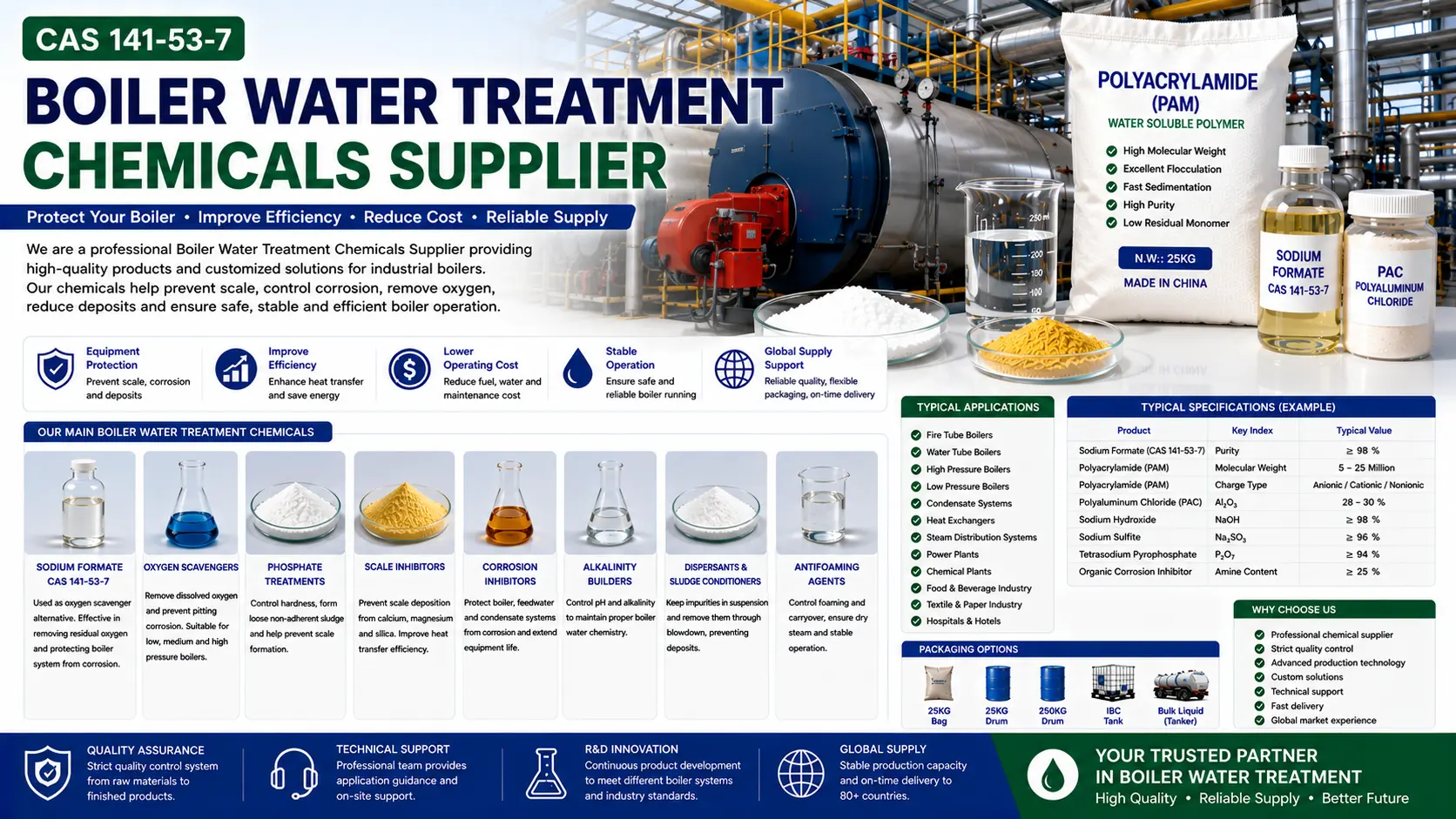
Boiler-water systems can suffer from scaling, corrosion, oxygen attack, deposits, foaming, carryover and microbiological attack in associated feedwater systems. These issues can lead to lower heat transfer efficiency, higher fuel utilisation, fouling of the steam, premature equipment life and unscheduled shutdowns.
Oxygen scavengers, alkalinity builders, phosphate treatments, scale inhibitors, dispersants, condensate corrosion inhibitors, antifoaming agents and cleaning chemicals are some of the chemicals that can be added to an effective boiler water treatment program. No blanket use of one product should be the basis for the best program; the best program should be based upon water analysis and operating data.
What Are Boiler Water Treatment Chemicals?
Boiler water treatment chemicals are products used to control impurities and protect boilers, feedwater lines, condensate systems, economizers, steam drums, and heat-transfer surfaces.
Their main functions include:
- Preventing scale formation
- Reducing corrosion
- Removing dissolved oxygen
- Controlling boiler-water pH
- Conditioning hardness sludge
- Preventing iron and copper deposits
- Reducing foaming and carryover
- Protecting condensate-return lines
- Improving heat-transfer efficiency
- Supporting stable steam production
The required treatment depends on the boiler design, operating pressure, raw-water quality, pretreatment system, steam purity requirement, and condensate-return percentage.
Why Boiler Water Treatment Is Important
Untreated or poorly treated boiler water can cause serious operational problems.
Scale Formation
Calcium, magnesium, silica, iron, and other impurities can form deposits on heat-transfer surfaces.
Even a relatively thin scale layer can reduce heat transfer and increase fuel consumption.
Severe scaling may result in:
- Tube overheating
- Restricted water circulation
- Reduced steam output
- Higher stack temperature
- Increased energy consumption
- Tube deformation
- Boiler-tube failure
Corrosion
Corrosion can affect feedwater lines, boiler tubes, economizers, steam lines, and condensate-return systems.
Common causes include:
- Dissolved oxygen
- Carbon dioxide
- Low pH
- Chloride
- High dissolved solids
- Under-deposit conditions
- Chemical contamination
Corrosion products may circulate through the system and create additional deposits.
Foaming and Carryover
High dissolved solids, oil contamination, excess alkalinity, or organic contaminants can cause boiler-water foaming.
Water droplets may then be carried into the steam, resulting in:
- Wet steam
- Product contamination
- Steam-line deposits
- Turbine or process-equipment damage
- Unstable boiler operation
Energy Loss
Scale, deposits, poor blowdown control, and condensate loss all increase operating costs.
A properly managed chemical program can improve thermal efficiency and reduce fuel, water, and maintenance expenses.
Main Boiler Water Treatment Chemicals
Oxygen Scavengers
Dissolved oxygen is a major cause of pitting corrosion in boilers and feedwater systems.
Oxygen scavengers react with residual dissolved oxygen after mechanical deaeration.
Common oxygen scavenger chemistries may include:
- Sodium sulfite
- Catalyzed sodium sulfite
- Sodium bisulfite
- Carbohydrazide
- Diethylhydroxylamine
- Hydroquinone-based products
- Other organic oxygen scavengers
The correct product depends on:
- Boiler pressure
- Feedwater temperature
- Deaerator performance
- Steam purity requirements
- Food-contact or regulatory restrictions
- Condensate-return design
Sodium sulfite is commonly used in low- and medium-pressure boilers, while alternative organic scavengers may be selected for higher-pressure or specialized systems.
Alkalinity Builders
Boiler water is normally maintained under alkaline conditions to reduce corrosion and support internal treatment chemistry.
Common alkalinity-building products include:
- Sodium hydroxide
- Sodium carbonate
- Phosphate blends
- Alkaline polymer formulations
- Coordinated phosphate programs
Proper alkalinity can help:
- Maintain protective conditions on steel surfaces
- Support hardness precipitation
- Reduce acidic corrosion
- Improve phosphate treatment
Excessive alkalinity should be avoided because it may contribute to foaming, carryover, or caustic attack under certain conditions.
Phosphate Treatments
Phosphate chemicals react with calcium hardness and convert it into a softer, removable sludge.
Common products include:
- Trisodium phosphate
- Disodium phosphate
- Monosodium phosphate
- Blended phosphate treatments
- Polymer-phosphate formulations
Phosphate treatment is commonly used in fire-tube and water-tube boilers.
The appropriate phosphate level depends on boiler pressure, water chemistry, blowdown rate, and the selected treatment philosophy.
Scale Inhibitors
Scale inhibitors reduce the formation and attachment of mineral deposits.
They may be based on:
- Phosphonates
- Polyacrylates
- Polymaleates
- Copolymers
- Chelating agents
- Specialized polymer blends
Potential targets include:
- Calcium carbonate
- Calcium sulfate
- Magnesium compounds
- Iron deposits
- Silica-related deposits
- Mixed hardness scale
Scale inhibitors should be selected according to feedwater analysis, pretreatment quality, boiler concentration cycles, and operating temperature.
Sludge Conditioners and Dispersants
When hardness or suspended solids enter the boiler, internal-treatment chemicals may convert them into a non-adherent sludge.
Dispersants help keep these particles suspended so they can be removed through blowdown.
Potential benefits include:
- Reduced deposit attachment
- Improved sludge removal
- Cleaner heat-transfer surfaces
- Lower under-deposit corrosion risk
- More stable boiler operation
Polymer dispersants should be compatible with phosphate treatments and boiler pressure.
Condensate Corrosion Inhibitors
Carbon dioxide can dissolve in condensate and form carbonic acid, reducing pH and causing corrosion in condensate-return piping.
Condensate corrosion inhibitors may include:
- Neutralizing amines
- Filming amines
- Blended amine products
Neutralizing amines raise condensate pH by neutralizing carbonic acid.
Filming amines form a protective layer on metal surfaces.
The correct product depends on:
- Condensate-system length
- Steam pressure
- Distribution-system complexity
- Return temperature
- Metallurgy
- Steam-contact restrictions
Antifoaming Agents
Antifoaming chemicals help control foam and reduce steam carryover.
They may be used when foaming is caused by:
- High dissolved solids
- Oil contamination
- Organic matter
- Excess alkalinity
- Process-return contamination
Antifoams should not replace proper blowdown, water pretreatment, and contamination control.
They should be used as part of a complete corrective program.
Chelating Agents
Chelating agents bind hardness and metal ions to keep them soluble.
Potential chemistries include:
- EDTA-based products
- NTA-based products
- Other chelant formulations
Chelant programs require precise control because excessive dosage may increase corrosion or carry metals through the system.
They are normally used only where the water quality and monitoring program can support accurate application.
Boiler Cleaning Chemicals
Boiler-cleaning chemicals may be used to remove scale, rust, iron oxide, oil, and process deposits.
Cleaning products may include:
- Alkaline cleaners
- Acid cleaners
- Chelating cleaners
- Surfactants
- Passivation chemicals
- Deposit penetrants
Cleaning should be planned according to:
- Deposit composition
- Boiler metallurgy
- Scale thickness
- Operating history
- Inspection findings
- Manufacturer recommendations
Improper cleaning can damage boiler metal or leave corrosive residues.
Feedwater Pretreatment
Chemical treatment inside the boiler cannot fully compensate for poor feedwater pretreatment.
Common pretreatment equipment includes:
- Multimedia filters
- Activated-carbon filters
- Water softeners
- Reverse-osmosis systems
- Demineralization systems
- Dealkalizers
- Deaerators
- Condensate polishers
Pretreatment may remove:
- Suspended solids
- Calcium
- Magnesium
- Silica
- Iron
- Organic contaminants
- Dissolved salts
- Oxygen
Better feedwater quality generally reduces chemical consumption, blowdown, scaling risk, and energy use.
Boiler-Water pH Control
Correct pH is essential for protecting steel surfaces and maintaining treatment performance.
Low pH may lead to:
- General corrosion
- Iron transport
- Condensate-system damage
- Reduced equipment life
Excessively high pH may contribute to:
- Foaming
- Carryover
- Caustic concentration
- Certain forms of stress corrosion
- Unstable treatment chemistry
The target pH depends on boiler pressure, metallurgy, treatment program, and operating standard.
Dissolved Oxygen Control
Mechanical deaeration is normally the first step in dissolved-oxygen removal.
A deaerator uses heat and steam contact to remove oxygen and carbon dioxide from feedwater.
Chemical oxygen scavengers are then used to remove the remaining oxygen.
Important monitoring points include:
- Deaerator temperature
- Deaerator pressure
- Feedwater oxygen
- Scavenger residual
- Feedwater-tank operation
- Chemical feed rate
- Condensate-return condition
Increasing scavenger dosage without correcting a poorly operating deaerator can increase chemical cost without solving the underlying problem.
Scale and Deposit Control
Scale formation depends on:
- Feedwater hardness
- Silica concentration
- Iron content
- Boiler pressure
- Boiler-water concentration
- pH
- Temperature
- Blowdown control
- Pretreatment performance
An effective deposit-control program may combine:
- Water softening or reverse osmosis
- Phosphate treatment
- Polymer dispersants
- Blowdown control
- Regular testing
- Internal inspection
The program should prevent deposits from forming rather than relying on frequent chemical cleaning.
Blowdown Management
Boiler blowdown removes concentrated dissolved solids, suspended sludge, and treatment by-products.
Insufficient blowdown may cause:
- High conductivity
- Foaming
- Carryover
- Deposits
- Unstable chemistry
Excessive blowdown may waste:
- Heat
- Water
- Treatment chemicals
- Fuel
- Operating time
Blowdown should be controlled according to conductivity, silica, alkalinity, chloride, treatment residuals, and boiler operating requirements.
Automatic blowdown-control systems can improve consistency and reduce energy losses.
Low-Pressure Boiler Treatment
Low-pressure boilers are commonly used in:
- Laundries
- Food plants
- Small manufacturing facilities
- Commercial buildings
- Hospitals
- Heating systems
Typical treatment programs may include:
- Sodium sulfite oxygen scavenger
- Phosphate treatment
- Alkalinity builder
- Polymer dispersant
- Condensate-return inhibitor
These systems may experience variable makeup water, intermittent operation, and limited monitoring.
A simple and robust treatment program is usually preferred.
Medium-Pressure Boiler Treatment
Medium-pressure boilers require tighter water-quality and chemical control.
Treatment may include:
- High-performance oxygen scavengers
- Coordinated phosphate control
- Polymer dispersants
- Condensate amines
- Improved pretreatment
- Automatic chemical feed
- Online conductivity monitoring
Regular laboratory testing and trend analysis are important for maintaining stable operation.
High-Pressure Boiler Treatment
High-pressure boilers require high-purity feedwater and precisely controlled chemistry.
Potential treatment strategies may include:
- Demineralized or reverse-osmosis feedwater
- Advanced deaeration
- Volatile treatment chemicals
- Coordinated or congruent phosphate programs
- Oxygenated treatment in selected systems
- High-purity condensate management
High-pressure boiler treatment should be designed by qualified specialists because small chemical deviations may cause serious equipment damage.
Steam and Condensate Systems
Steam quality affects heat exchangers, turbines, sterilizers, food processes, humidification systems, and manufacturing equipment.
Poor steam quality may result from:
- Boiler-water carryover
- High dissolved solids
- Foaming
- Chemical overfeed
- Mechanical separator failure
- Rapid load changes
Condensate should be monitored for:
- pH
- Conductivity
- Iron
- Copper
- Oil contamination
- Hardness
- Process leakage
Returning clean condensate reduces water, fuel, and chemical costs.
Boiler Water Treatment in Food and Beverage Plants
Food and beverage facilities may use steam for:
- Direct heating
- Sterilization
- Cooking
- Cleaning
- Packaging
- Humidification
Treatment products should be selected according to whether the steam directly or indirectly contacts food.
Important considerations include:
- Regulatory suitability
- Product purity
- Residual limits
- Steam-contact requirements
- Condensate safety
- Documentation
The supplier should clearly identify whether a product is appropriate for food-related steam applications.
Boiler Treatment in Power Plants
Power plants may operate high-pressure boilers and steam turbines under strict water-quality requirements.
Important treatment areas include:
- Makeup-water purification
- Condensate polishing
- Feedwater oxygen control
- Boiler-water chemistry
- Steam purity
- Silica control
- Iron transport
- Copper transport
- Cooling-water treatment
Specialized monitoring and high-purity chemicals are typically required.
Boiler Treatment in Textile and Paper Mills
Textile and paper mills consume large quantities of steam and may have variable condensate quality.
Potential contaminants include:
- Dyes
- Fibers
- Starch
- Oils
- Process chemicals
- Paper additives
Condensate contamination should be monitored carefully before return to the boiler system.
The treatment program should also consider changing steam demand and production schedules.
Boiler Treatment in Chemical Plants
Chemical facilities may have complex steam-distribution and condensate-return systems.
Potential risks include:
- Process contamination
- Solvent entry
- Acidic condensate
- Oil contamination
- Variable steam demand
- Mixed metallurgies
Chemical selection should be based on the entire steam-condensate network, not only the boiler drum.
Important Product Specifications
A professional Boiler Water Treatment Chemicals Supplier should provide clear technical specifications.
Depending on the product, these may include:
- Active ingredient
- Product concentration
- pH
- Density
- Solubility
- Freezing point
- Flash point
- Oxygen-scavenging capacity
- Phosphate content
- Polymer content
- Amine composition
- Recommended dosage
- Shelf life
- Storage requirements
General descriptions such as “boiler chemical” are not sufficient for technical procurement.
Water Analysis Before Product Selection
Before recommending a treatment program, the supplier should review:
- Total hardness
- Calcium hardness
- Magnesium hardness
- Alkalinity
- pH
- Conductivity
- Chloride
- Silica
- Iron
- Copper
- Dissolved oxygen
- Total dissolved solids
- Suspended solids
- Organic contamination
- Condensate-return percentage
Boiler operating information should also include:
- Boiler type
- Operating pressure
- Steam production
- Makeup-water rate
- Blowdown rate
- Fuel type
- Pretreatment equipment
- Condensate-system design
Chemical Dosage
There is no universal dosage for every boiler.
Dosage depends on:
- Feedwater quality
- Boiler pressure
- Makeup-water volume
- Condensate return
- Oxygen concentration
- Hardness leakage
- Blowdown rate
- Operating hours
- Chemical concentration
- Target residual
Overdosing may cause:
- Foaming
- Carryover
- High conductivity
- Excessive chemical cost
- Unstable boiler-water chemistry
Underdosing may allow scale, corrosion, oxygen attack, and deposit formation.
Monitoring and Testing
A boiler-treatment program should include regular testing.
Common parameters include:
- Feedwater hardness
- Feedwater pH
- Boiler-water pH
- Conductivity
- Sulfite or alternative scavenger residual
- Phosphate
- Alkalinity
- Silica
- Chloride
- Iron
- Condensate pH
- Condensate conductivity
Test frequency depends on boiler pressure, operating stability, and risk level.
Results should be recorded and reviewed as trends rather than treated as isolated numbers.
Chemical Feed Equipment
Treatment chemicals may be dosed through:
- Metering pumps
- Day tanks
- Injection quills
- Automated control systems
- Flow-paced dosing systems
- Conductivity-controlled blowdown systems
Chemical-feed equipment should be compatible with the product and capable of accurate, repeatable dosing.
Improper injection points may reduce treatment efficiency or cause localized corrosion.
Packaging Options
Boiler water treatment chemicals may be supplied in:
- 25 kg bags
- 20 kg or 25 kg pails
- 200 kg drums
- 250 kg drums
- IBC tanks
- Bulk tankers
- Customized packaging
The best packaging depends on:
- Monthly consumption
- Product form
- Chemical compatibility
- Storage capacity
- Handling equipment
- Transport regulations
Storage and Safety
Boiler chemicals should be stored according to the current safety data sheet.
General precautions include:
- Store in a cool and ventilated area.
- Keep containers tightly closed.
- Protect products from extreme temperatures.
- Separate acids, alkalis, oxidizers, and reducing agents.
- Use compatible storage containers.
- Maintain secondary containment for liquids.
- Keep labels readable.
- Provide appropriate protective equipment.
- Install eyewash and emergency-shower facilities where required.
Operators should receive training before handling concentrated treatment chemicals.
Required Technical Documents
A professional supplier should provide:
- Technical data sheet
- Safety data sheet
- Batch-specific certificate of analysis
- Product specification
- Recommended dosage guidance
- Storage instructions
- Commercial invoice
- Packing list
- Certificate of origin
- Transport documentation
Documents should clearly identify the product, active content, batch number, production date, and packaging.
How to Evaluate a Boiler Water Treatment Chemicals Supplier
Buyers should assess:
- Product range
- Boiler-treatment experience
- Water-analysis capability
- Technical-support quality
- Product specifications
- Batch consistency
- Production capacity
- Packaging options
- Delivery reliability
- Complaint-handling procedures
A dependable supplier should ask for water and operating data before recommending a chemical program.
How to Request an Accurate Quotation
A complete inquiry should include:
- Boiler type
- Operating pressure
- Steam output
- Feedwater source
- Pretreatment equipment
- Feedwater hardness
- pH
- Conductivity
- Silica
- Dissolved oxygen
- Condensate-return percentage
- Existing chemicals
- Current dosage
- Monthly consumption
- Packaging
- Destination
- Delivery terms
For example:
“Please recommend and quote an oxygen scavenger, phosphate treatment, polymer dispersant, and condensate corrosion inhibitor for a medium-pressure industrial boiler, including TDS, SDS, COA, dosage guidance, and packaging options.”
Detailed operating data allows the supplier to recommend a safer and more economical treatment program.
Comparing Supplier Quotations
Buyers should compare:
- Active ingredient
- Product concentration
- Recommended dosage
- Treatment objective
- Packaging
- Freight
- Documentation
- Technical service
- Batch consistency
- Delivery reliability
A diluted product may have a lower price per kilogram but require a much higher dosage.
Products should be compared according to active content and treatment cost.
Total Boiler Treatment Cost
The total cost includes more than chemical price.
Buyers should consider:
- Chemical dosage
- Fuel consumption
- Blowdown heat loss
- Makeup-water cost
- Condensate-return efficiency
- Equipment cleaning
- Boiler downtime
- Tube replacement
- Maintenance labor
- Scale-related energy loss
- Corrosion damage
- Technical support
A higher-quality treatment program may reduce fuel use and equipment damage enough to provide substantially lower overall costs.
Common Purchasing Risks
Potential risks include:
- Selecting chemicals without water analysis
- Using one universal product for every boiler
- Comparing only price per drum
- Ignoring active concentration
- Overfeeding oxygen scavenger
- Poor phosphate control
- Inadequate condensate protection
- Missing technical documentation
- Inconsistent batch quality
- Incompatible chemical storage
- Delayed delivery
- Limited technical support
These risks can be reduced through detailed system analysis, clear specifications, monitoring, batch-specific documentation, and supplier qualification.
Questions to Ask Before Ordering
Buyers should confirm:
- Which products are recommended for the boiler pressure?
- Is the treatment suitable for the feedwater quality?
- What active ingredients are used?
- What is the recommended dosage?
- Which residuals should be monitored?
- Is the product suitable for food-contact steam where required?
- Can water-analysis support be provided?
- Can recent batch COAs be supplied?
- What packaging options are available?
- What is the product shelf life?
- What storage conditions are required?
- Can automatic dosing support be provided?
- What is the normal lead time?
- Can customized treatment programs be developed?
- How are technical complaints handled?
Conclusion
The complete evaluation of the boiler pressure, feed water quality and quantity, condensate return, steam usage, boiler treatment chemistry, product concentration, technical support, documentation, packing and reliability of supply, are all parts of choosing a reliable Boiler Water Treatment Chemicals Supplier.
Oxygen scavengers, alkalinity builders, phosphate treatments, scale inhibitors, polymer dispersants, condensate corrosion inhibitors, antifoaming agents, and cleaning chemicals are just some of the components that can be a part of a complete boiler-water treatment program.
Prior to purchase, the industrial user should supply detailed information on water analysis, boiler operating data, complete technical specifications; he should determine dosage and monitoring requirements, and perform controlled plant trials as appropriate.
A reliable supplier needs to deliver appropriate treatment products, consistent batch quality, clear specifications, treatment application advice, full documentation, flexible packaging and reliable worldwide delivery.


Contact Us
In This Article
Related Posts
Custom Packaging Solutions from an Anhydrous Sodium Acetate Supplier in China
2026-09-23
Application Trends in Anhydrous Sodium Acetate for Special Chemical Manufacturing
2026-09-23
Anhydrous Sodium Acetate for Leather Tanning: Improve Dyeing Uniformity
2026-09-22
Formic Acid 85% for Textile Dyeing: Industrial Applications, Technical Benefits and Future Trends
2026-09-22


