



Custom Acetic Acid Concentration: What Buyers Need to Know
By vanchor
2026-08-11Related Posts
Custom Packaging Solutions from an Anhydrous Sodium Acetate Supplier in China
2026-09-23
Application Trends in Anhydrous Sodium Acetate for Special Chemical Manufacturing
2026-09-23
Anhydrous Sodium Acetate for Leather Tanning: Improve Dyeing Uniformity
2026-09-22
Formic Acid 85% for Textile Dyeing: Industrial Applications, Technical Benefits and Future Trends
2026-09-22
Choosing the right Custom Acetic Acid Concentration is a process-design decision, not simply a choice between diluted acid and glacial acetic acid. Different concentration ranges change active-acid input, water load, dosing volume, dilution requirements, storage conditions, and transportation efficiency.
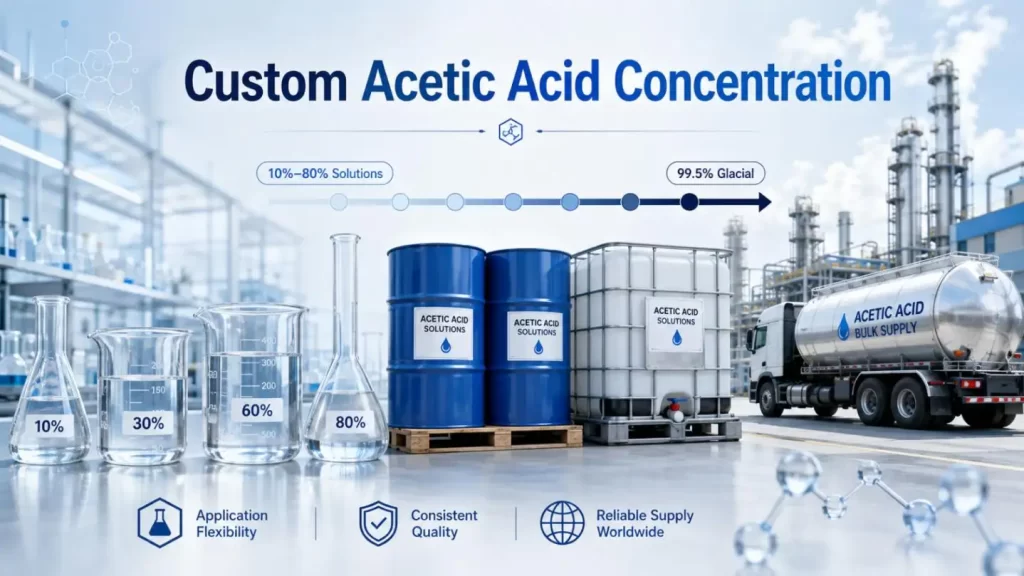
Vanchor supplies Custom Acetic Acid Concentration from 10% to 80%, an 80% min industrial grade, and 99.5% min Glacial Acetic Acid. The 10%–80% range is positioned for cleaning, textile, leather, pH adjustment, formulation, and industrial processing, while the concentrated glacial grade is intended more strongly for chemical synthesis and downstream acetate production.
Which Custom Acetic Acid Concentration Fits Which Application?
The table below should be read as a supply-selection guide, not as a universal process recipe. Final working concentration still depends on the formulation, bath ratio, required pH, substrate, dosing system, and local operating procedure.
| Custom Acetic Acid Concentration | Typical Application Fit | Why This Range Is Selected |
| 10–20% | Mild industrial cleaning, maintenance cleaning, light descaling, routine pH adjustment, ready-to-use formulations | Lower active-acid loading simplifies direct dosing and reduces on-site dilution |
| 20–40% | Textile dye-bath pH adjustment, finishing processes, general acidification, cleaning concentrates | Higher acid input than ready-use solutions while remaining practical for routine liquid dosing |
| 40–60% | Textile processing, leather pH adjustment, stronger descaling formulations, industrial blending | Balances active-acid content with manageable dilution and water input |
| 60–80% | Leather pickling/finishing, concentrated textile feed, industrial cleaning concentrates, acetate formulations, local blending | Higher active-acid density reduces transported water and storage volume |
| 80% Min | Textile dyeing, fabric neutralization, leather processing, acetate salt production, industrial cleaning and general acidification | Strong liquid acid where glacial grade is not required |
| 99.5% Min / Glacial | Acetate esters, acetic anhydride, acetate derivatives, cellulose acetate, solvent systems, pharmaceutical intermediates, coatings, adhesives and resins | Low water input and high active-acid content favor synthesis and centralized dilution |
Vanchor offers textile processing, leather treatment, industrial cleaning, descaling, pH control and industrial formulation for its 10%–80% customizable range. Its 80% grade is also specified for textile, leather, acetate salt production and industrial cleaning.
10–20%: Ready-to-Use and Low-Dilution Applications
A lower Custom Acetic Acid Concentration is most useful when the plant wants to avoid handling highly concentrated acid.
Typical uses include:
•Mild maintenance and equipment-cleaning formulations
•Light mineral-scale removal
•General process-water pH adjustment
•Ready-to-use industrial formulations
•Local distribution or private-label diluted acid products
Vanchor notes that lower concentrations are suited to milder cleaning, while customized diluted solutions can reduce the need for dedicated on-site dilution systems.
The trade-off is logistics: more water is transported for every kilogram of active CH₃COOH.
20–40%: Textile and Routine Process pH Control
The 20–40% range can be practical where acetic acid is repeatedly metered into aqueous processing systems.
Typical fits include:
•Textile dye-bath pH correction
•Fabric finishing and neutralization
•General manufacturing acidification
•Medium-strength cleaning concentrates
•Formulations subsequently diluted in the process bath
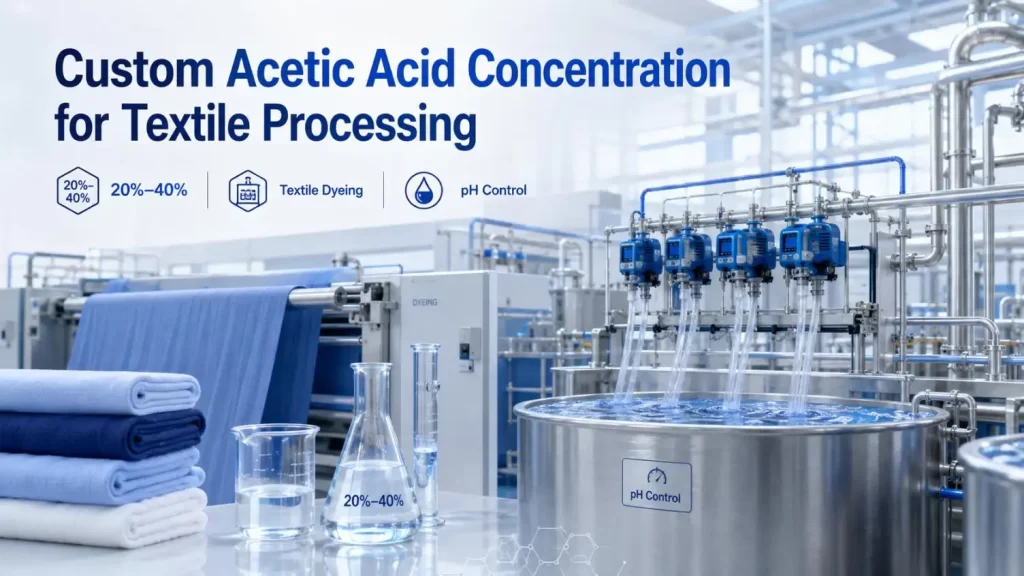
For textile mills, the advantage is not simply lower acidity. A pre-adjusted Custom Acetic Acid Concentration can reduce operator dilution steps and make repetitive dosing easier to standardize. Vanchor identifies textile dyeing pH adjustment and finishing among the core uses of its customizable acetic acid solutions.
40–60%: Stronger Formulation and Leather Processing Feed
Mid-range concentrations become more relevant when a plant needs greater active-acid loading but does not want to receive 80% or glacial material.
Potential applications include:
•Leather processing and pH adjustment
•Dye-fixing and finishing support
•Industrial descaling concentrate manufacture
•Chemical blending
•Process acidification where the solution is diluted during production
Leather processing frequently requires controlled acid addition during pickling, dyeing and finishing stages. Vanchor lists leather treatment and finishing as applications for its 10%–80% range, while allowing concentration to be adjusted to process requirements.
60–80%: Concentrated Industrial Feed Without Going Glacial
A Custom Acetic Acid Concentration in the upper diluted range is better suited where storage efficiency and high active-acid input matter.
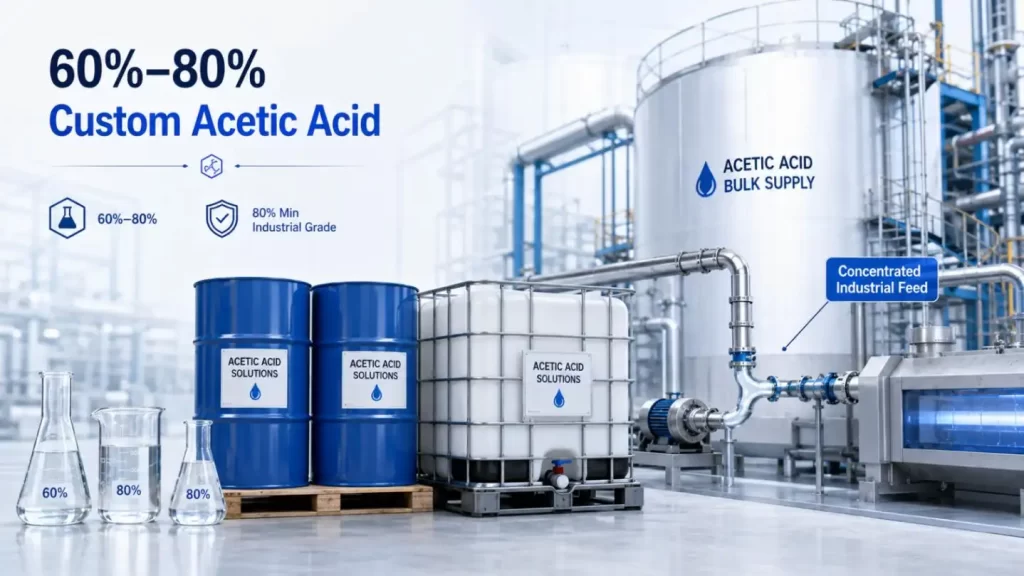
Applications may include:
•Concentrated textile-processing feed
•Leather pickling and finishing
•Industrial cleaning concentrate manufacture
•Descaling and surface-treatment formulations
•Acetate formulations
•Local dilution and chemical blending
The higher concentration reduces water transported per unit of active acid but increases handling requirements.
Why 80% Is a Distinct Industrial Option
Vanchor's 80% min Acetic Acid is specifically positioned for:
•Textile dye-bath pH adjustment
•Fabric finishing and neutralization
•Leather pickling and finishing
•Industrial cleaning and descaling
•Acetate salt production
•General manufacturing acidification
For plants that regularly consume relatively strong acetic acid but do not need the low water content of glacial grade, 80% can provide a practical intermediate supply specification.
99.5% Min: Chemical Synthesis and High-Volume Industrial Use
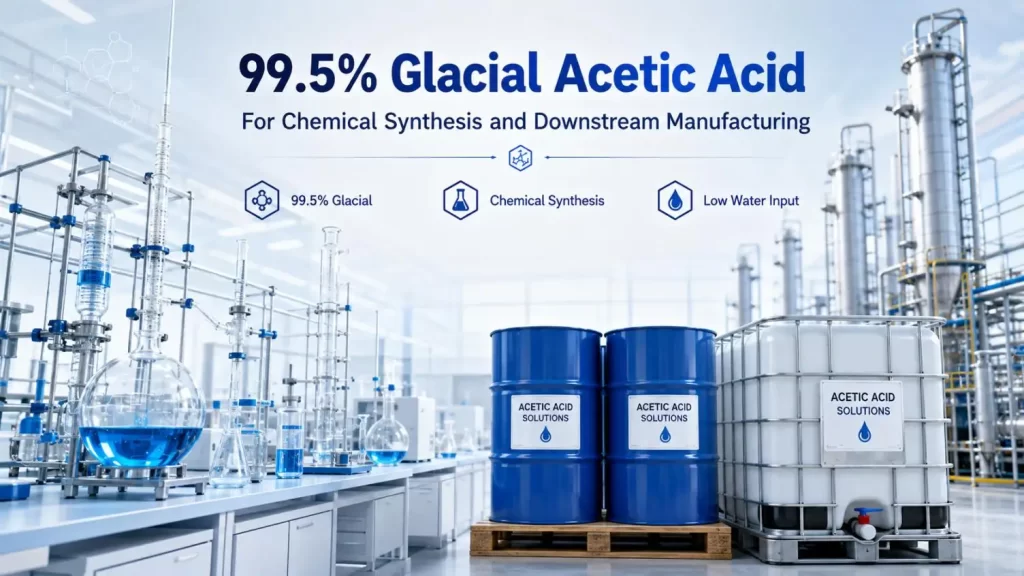
Glacial acetic acid serves a different purchasing logic. It is usually selected when water input must be minimized, when acetic acid is a chemical raw material rather than simply a pH regulator, or when a large plant performs controlled dilution internally.
Vanchor's Glacial Acetic Acid 99.5% min is used for:
•Acetate ester production
•Acetic anhydride and acetate derivatives
•Cellulose acetate and downstream chemical production
•Pharmaceutical and specialty intermediates
•Solvent and reaction-medium applications
•Coatings, adhesives, inks, resins and related solvent systems
•Textile processing after controlled dilution
This concentration also offers better freight efficiency per unit of active acid, but requires more controlled storage, transfer and dilution procedures.
Concentration Must Be Matched to the Dosing System
Changing Custom Acetic Acid Concentration changes more than the quantity ordered.
The following checks should be done on the process:
•Active-acid: When concentration changes, solution mass must be recalculated.
•Water load: Increasing the grade with water causes dilution.
•Density: Important when buying by kg, but dosing by liters.
•Pump calibration: Volumetric dosing must be adjusted for the concentration supplied.
•Tank volume: Storage space must be large for a low concentration of active acid.
•Dilution capacity: Material of high concentration must be diluted with care and control.
Thus, replacing 30% acetic acid with 80% material would cause a significant process deviation if the system is not recalculated.
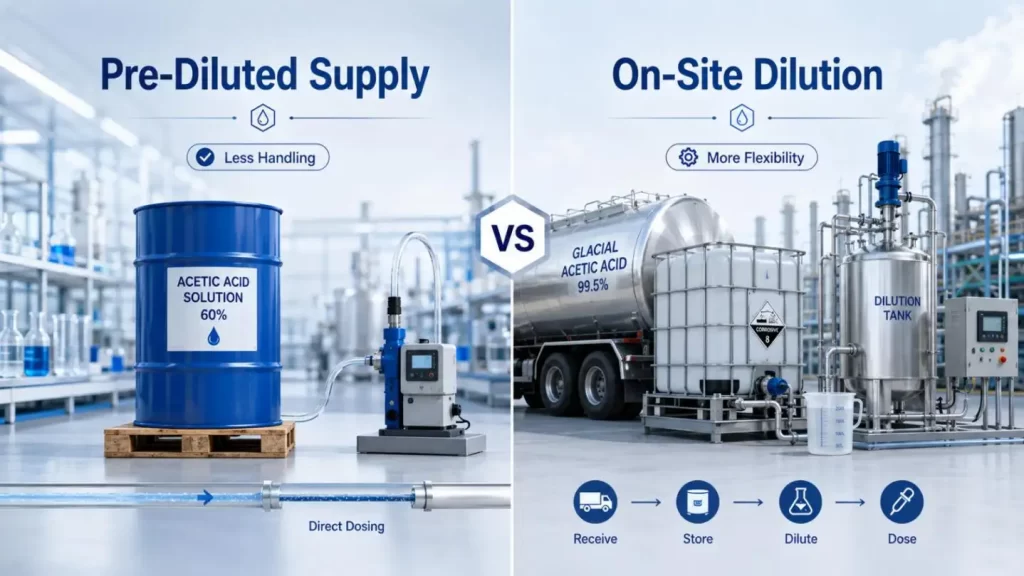
Custom Concentration or Glacial Acid: Compare the Complete System
| Decision Factor | Custom 10–80% | 99.5% Min Glacial |
| Direct process dosing | Better suited | Usually needs dilution |
| Water transported | Higher | Lower |
| On-site dilution workload | Lower | Higher |
| Storage per unit active acid | Higher | Lower |
| Multi-concentration production | Less flexible | Highly flexible |
| Chemical synthesis | Application-dependent | More suitable |
The lowest purchase price per ton is therefore not necessarily the lowest process cost.
What Buyers Should Specify in an RFQ
For a reliable Custom Acetic Acid Concentration supply, define:
•Target concentration and allowable assay range
•Application: textile, leather, cleaning, synthesis, formulation, etc.
•Required impurity limits
•Monthly or annual consumption
•Drum, IBC or bulk requirement
•Dosing method and whether further dilution is performed
•Destination market and documentation requirements
•COA and SDS requirements
Vanchor can supply customized 10%–80% acetic acid solutions, a dedicated 80% min grade, and concentrated 99.5% min glacial acetic acid, with packaging and documentation selected according to concentration and shipment conditions.
For buyers defining a new process, the most useful starting point is to provide the required working concentration, application, consumption volume and dosing method. Vanchor can then help match the Custom Acetic Acid Concentration to the actual production and supply requirements rather than selecting concentration by assay alone.
FAQs
Q1. What Custom Acetic Acid Concentrations does Vanchor supply?
Vanchor supplies Custom Acetic Acid concentrations from 10% to 80%. An 80% min Acetic Acid grade and a 99.5% min Glacial Acetic Acid are available as per different industrial requirements.
Q2. Can Vanchor customize Acetic Acid Concentration for a specific production process?
Yes. Vanchor will supply Acetic Acid as per the concentration required by the client, with consideration to the dosing system, application, water-load limits and downstream process conditions.
Q3. What Vanchor concentration of Acetic Acid would be suitable for textile processing?
Depending on the process requirement, medium or low strength concentrations could be used for adjustment of dye bath pH, finishing of textiles and neutralization, whereas more concentrated grades may be appropriate for feed systems.
Q4. For leather processing, which concentration would be more suitable?
For the pickling of leather, adjusting pH and finishing of leather, and dyeing leather, medium to high Custom Acetic Acid Concentrations would be appropriate. The final concentration would depend on the process requirement.
Q5. Does Vanchor supply Acetic Acid for industrial cleaning and descaling?
Yes. Vanchor’s Acetic Acid Solutions can be customized for the industrial cleaning and descaling, and/or acidification applications, depending on the required concentration for the severity of the cleaning process and subsequent dilution.


Contact Us
In This Article
Related Posts
Custom Packaging Solutions from an Anhydrous Sodium Acetate Supplier in China
2026-09-23
Application Trends in Anhydrous Sodium Acetate for Special Chemical Manufacturing
2026-09-23
Anhydrous Sodium Acetate for Leather Tanning: Improve Dyeing Uniformity
2026-09-22
Formic Acid 85% for Textile Dyeing: Industrial Applications, Technical Benefits and Future Trends
2026-09-22


