



Formic Acid for Leather Tanning: Functions, Benefits, and Purchasing Guide
By vanchor
2026-07-21Related Posts
Custom Packaging Solutions from an Anhydrous Sodium Acetate Supplier in China
2026-09-23

Application Trends in Anhydrous Sodium Acetate for Special Chemical Manufacturing
2026-09-23
Anhydrous Sodium Acetate for Leather Tanning: Improve Dyeing Uniformity
2026-09-22

Formic Acid 85% for Textile Dyeing: Industrial Applications, Technical Benefits and Future Trends
2026-09-22
Formic Acid for Leather Tanning is a common ingredient used for leather tanning such as pickling, chrome tanning, dyeing, neutralization and pH-control. It is an essential processing chemical for tanneries that process leather for footwear, garment, upholstery, automotive, bags, belts, and finished leather items due to its high water solubility, strong acidity, and its ability to be controlled for dosage.
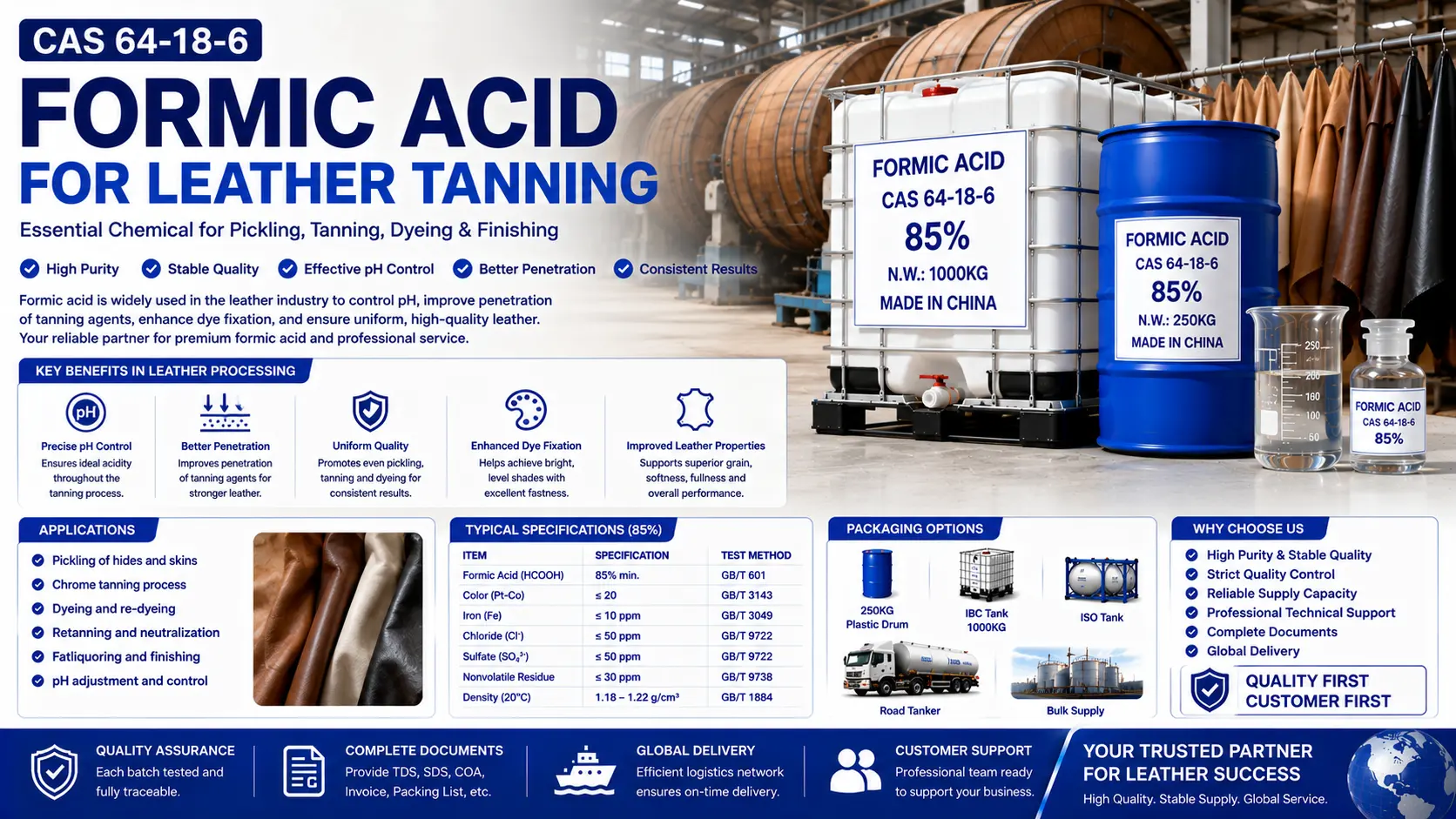
When choosing a leather manufacturer, chemical distributor, or procurement team, more than concentration and cost needs to be considered when choosing formic acid. Leather quality and production stability can be affected by the purity, the colour, the amount of iron, chloride, nonvolatile residue, packaging, batch consistency and reliability of the leather supplier.
What Is Formic Acid?
Formic acid is the simplest carboxylic acid. Its molecular formula is HCOOH, and its CAS number is 64-18-6. It is normally supplied as a clear, colorless liquid that is completely miscible with water.
Typical product information includes:
- Chemical name: Formic Acid
- CAS number: 64-18-6
- Molecular formula: HCOOH
- Molecular weight: approximately 46.03
- Appearance: Clear, colorless liquid
- Solubility: Miscible with water
- Common concentrations: 85%, 90%, 94%, 98%, and 99%
Formic acid 85% is commonly selected for general leather-processing applications because it offers a practical balance between acidity, handling, dilution, and cost.
Higher concentrations may also be used when the tannery has suitable dilution systems, storage equipment, and safety procedures.
Why Formic Acid Is Used in Leather Processing
Leather production involves multiple chemical stages that require controlled pH adjustment.
Formic acid may help:
- Lower the pH of hides and skins
- Prepare material for chrome tanning
- Improve tanning-agent penetration
- Support uniform dyeing
- Control neutralization
- Improve process repeatability
- Reduce uneven chemical distribution
- Support consistent finished-leather quality
The exact dosage depends on hide type, process stage, water quality, drum loading, temperature, and the other chemicals used in the formulation.
Formic Acid in the Pickling Process
Pickling is an important stage before chrome tanning. It lowers the pH of the pelt and prepares the collagen structure for effective tanning-agent penetration.
Formic acid may be used together with salt and other acids to achieve the required pickling conditions.
Its main functions may include:
- Gradually lowering pH
- Supporting uniform acid penetration
- Preparing collagen for chrome tanning
- Helping control swelling
- Improving process consistency
- Supporting even chrome distribution
A controlled pH reduction is important. If the acid is added too quickly or unevenly, the outer layers of the hide may acidify faster than the interior.
This can contribute to:
- Uneven pickling
- Poor chrome penetration
- Surface defects
- Grain damage
- Inconsistent leather properties
Formic acid should therefore be diluted and added gradually according to the tannery’s process instructions.
Role in Chrome Tanning
Chrome tanning requires suitable pH conditions for chromium salts to penetrate and fix within the hide structure.
Formic acid can help prepare the pickled pelt for this stage by ensuring that the pH is sufficiently low and evenly distributed.
Potential benefits include:
- Improved chrome penetration
- Better chrome distribution
- More uniform tanning
- Reduced surface fixation
- Stable wet-blue production
- Improved batch repeatability
After penetration, the tanning bath is normally basified gradually to increase chrome fixation.
The complete process should be carefully controlled because both insufficient and excessive acidity can affect chrome uptake and leather quality.
Formic Acid in Dyeing
Formic acid may also be used during leather dyeing to adjust bath acidity and support dye exhaustion or fixation.
Potential functions include:
- Lowering the dye-bath pH
- Supporting dye uptake
- Improving color penetration
- Promoting dye fixation
- Helping achieve more uniform shades
- Reducing color variation between batches
The required dosage depends on:
- Leather type
- Dye class
- Desired shade
- Retanning system
- Fatliquoring chemicals
- Water hardness
- Temperature
- Final pH target
Rapid acid addition may cause surface fixation before the dye has fully penetrated. Gradual addition can help produce more level and consistent coloration.
Formic Acid in Retanning
Retanning is used to modify the fullness, softness, firmness, grain, handle, and physical performance of leather.
Formic acid may be introduced to control the pH during or after retanning.
It can support:
- Controlled retanning-agent fixation
- Better chemical distribution
- More consistent leather fullness
- Improved grain quality
- Stable process conditions
- Better batch repeatability
The acid should be compatible with synthetic tanning agents, vegetable tannins, resins, dyes, and fatliquors used in the formulation.
Formic Acid in Neutralization
Neutralization raises the pH of chrome-tanned leather before retanning, dyeing, and fatliquoring.
Formic acid may later be used to adjust excessive alkalinity or bring the process back to the target pH.
Its role may include:
- Correcting over-neutralization
- Stabilizing bath conditions
- Preparing leather for later chemical fixation
- Improving consistency between production batches
Over-neutralization can cause loose grain, uneven dyeing, poor fixation, and weak leather properties. Accurate pH monitoring is therefore essential.
Formic Acid in Fatliquoring
Fatliquoring introduces oils and lubricating materials into the leather structure to improve softness, flexibility, and handle.
Formic acid may be added near the end of the process to support fixation of dyes and fatliquors.
Potential benefits include:
- Better emulsion exhaustion
- Improved oil fixation
- More uniform softness
- Reduced surface grease
- Improved final handle
- Stable finished-leather performance
The addition rate and final pH should be controlled to prevent premature fixation or uneven distribution.
Main Benefits of Formic Acid for Leather Tanning
Controlled pH Adjustment
Formic acid allows tanneries to reduce process pH in a measurable and controllable manner.
Good Water Solubility
It mixes easily with water and can be diluted for controlled addition.
Improved Chemical Penetration
Proper acidification may help tanning agents, dyes, and retanning chemicals penetrate the leather more evenly.
Better Batch Consistency
Stable acid concentration supports more repeatable process conditions.
Broad Process Compatibility
Formic acid can be used in pickling, tanning, dyeing, retanning, neutralization, and fatliquoring.
Efficient Dosing
Its strong acidity allows relatively small quantities to produce a noticeable pH change.
Important Quality Specifications
A professional supplier should provide a detailed technical data sheet and a batch-specific certificate of analysis.
Important specifications may include:
- Formic acid concentration
- Density
- Color
- Chloride
- Sulfate
- Iron
- Nonvolatile residue
- Appearance
- Water content
Concentration
Stable concentration is essential for accurate dosing.
If the actual concentration varies, the tannery may experience:
- Inconsistent bath pH
- Variable pickling performance
- Uneven dye fixation
- Different chrome uptake
- Production variation
- Increased chemical consumption
Buyers should confirm the guaranteed concentration and acceptable tolerance.
Color
Formic acid for leather tanning should normally be clear and colorless.
Unexpected discoloration may indicate:
- Metal contamination
- Storage degradation
- Packaging incompatibility
- Cross-contamination
- Production inconsistency
A discolored raw material may influence light-colored or white leather.
Iron Content
Iron is an important parameter for leather applications.
Excessive iron may contribute to:
- Leather discoloration
- Dark spots
- Shade variation
- Reduced brightness
- Chemical instability
- Finished-product defects
Low iron is particularly important when producing white, pastel, beige, or light-colored leather.
Chloride and Sulfate
Chloride and sulfate may influence:
- Equipment corrosion
- Bath chemistry
- Chemical compatibility
- Finished-leather appearance
- Process consistency
Buyers should define suitable impurity limits according to their production process.
Nonvolatile Residue
Nonvolatile residue represents material remaining after formic acid and water evaporate.
Excessive residue may cause:
- Drum deposits
- Chemical contamination
- Unwanted solids
- Surface defects
- Reduced raw-material purity
A low residue level is generally preferred for consistent leather processing.
Formic Acid 85% for Leather Tanning
Formic acid 85% is widely used by tanneries because it offers:
- Stable active acid content
- Practical handling
- Convenient dilution
- Broad availability
- Competitive cost
- Compatibility with common leather processes
It may be supplied in drums, IBC tanks, or bulk tankers depending on order quantity.
Higher-Concentration Formic Acid
Formic acid 90%, 94%, 98%, or 99% may also be purchased for leather processing.
Potential advantages include:
- Higher active acid content
- Reduced transportation of water
- Lower storage volume
- Flexible preparation of different concentrations
However, higher concentrations require:
- More accurate dilution
- Stronger safety controls
- Compatible storage tanks
- Qualified transfer equipment
- Better ventilation
- Trained operators
The selected grade should match the tannery’s equipment and operating procedures.
Recommended Dilution Practices
Concentrated formic acid should normally be diluted before addition to the processing drum.
Important considerations include:
- Use clean water
- Follow the required acid-to-water ratio
- Add acid slowly
- Maintain controlled mixing
- Avoid localized high acidity
- Verify final concentration
- Use compatible tanks and tools
- Follow the safety data sheet
Controlled dilution helps reduce the risk of uneven acidification and surface damage.
Dosage Control
There is no single dosage suitable for every tannery.
The required amount depends on:
- Hide or skin type
- Process weight
- Initial pH
- Target pH
- Water volume
- Acid concentration
- Salt level
- Temperature
- Other chemicals in the bath
Tanneries should determine dosage through process trials, pH monitoring, and internal technical procedures.
Importance of pH Monitoring
Reliable pH measurement is essential during leather processing.
Operators may monitor:
- Bath pH
- Cross-section pH
- Penetration uniformity
- Final pickling pH
- Dyeing pH
- Retanning pH
- Fatliquoring fixation
Using only a fixed acid dosage without checking actual pH can lead to inconsistent results.
Safe Storage
Formic acid should be stored in a cool, well-ventilated area in compatible, tightly sealed containers.
It should be kept away from:
- Alkalis
- Strong oxidizing agents
- Incompatible metals
- Heat
- Direct sunlight
- Open flames
- Contamination
- Damaged packaging
Storage systems should include clear labeling, secondary containment, leak inspection, and emergency-response procedures.
Handling and Personal Protection
Formic acid is corrosive and requires careful handling.
Suitable protective equipment may include:
- Chemical-resistant gloves
- Safety goggles
- Face shield
- Protective clothing
- Chemical-resistant footwear
- Suitable respiratory protection where required
Tanneries should also provide:
- Ventilation
- Eyewash stations
- Emergency showers
- Spill-control materials
- Trained personnel
- Written handling procedures
Packaging Options
Common packaging options include:
- 25 kg plastic drums
- 35 kg plastic drums
- 250 kg HDPE drums
- IBC tanks
- ISO tanks
- Road tankers
- Customized bulk supply
The correct option depends on monthly consumption, warehouse space, unloading equipment, and local regulations.
How to Select a Supplier
Review the Technical Specification
The supplier should provide measurable limits for concentration, color, chloride, sulfate, iron, and residue.
Request Batch-Specific COAs
The certificate of analysis should correspond to the actual production batch.
Test a Representative Sample
Recommended tests may include:
- Concentration
- Density
- Color
- Iron
- Chloride
- Sulfate
- Residue
- Leather-processing performance
Run Production Trials
A trial may evaluate:
- Pickling speed
- pH uniformity
- Chrome penetration
- Dye fixation
- Leather color
- Grain quality
- Softness
- Final handle
Compare Several Batches
Reviewing multiple COAs helps assess long-term consistency.
Confirm Supply Capacity
Tanneries should confirm:
- Monthly production capacity
- Available stock
- Normal lead time
- Emergency supply capability
- Packaging options
- Repeat-order support
Required Documents
A dependable supplier should provide:
- Technical data sheet
- Safety data sheet
- Certificate of analysis
- Commercial invoice
- Packing list
- Certificate of origin
- Bill of lading
- Customs documents
- Inspection reports when required
All documents should use consistent product names, concentration, batch numbers, net weight, and packaging information.
How to Request a Quotation
A complete inquiry should include:
- Required concentration
- Maximum iron
- Maximum chloride
- Maximum sulfate
- Color requirement
- Order quantity
- Packaging
- Destination
- Incoterm
- Delivery schedule
- Required documents
For example:
“Please quote 20 metric tons of formic acid 85% for leather tanning, packed in 250 kg HDPE drums, CIF destination port, including TDS, SDS, and batch-specific COA.”
Total Procurement Cost
The lowest price per metric ton may not provide the best overall value.
Leather manufacturers should consider:
- Active formic acid content
- Batch consistency
- Iron level
- Packaging
- Freight
- Storage
- Handling
- Process variation
- Leather rejection rates
- Chemical consumption
- Delivery reliability
A stable product with controlled impurities may reduce color defects, uneven tanning, pH variation, and production losses.
Common Purchasing Risks
Potential risks include:
- Incorrect concentration
- High iron
- Excessive chloride
- Discoloration
- Inconsistent batches
- Weak packaging
- Leakage
- Incomplete documents
- Delayed delivery
- Poor complaint handling
These risks can be reduced through clear specifications, sample approval, production trials, batch-specific COAs, and supplier audits.
Questions to Ask Before Ordering
Buyers should confirm:
- Which concentration grades are available?
- Is the product suitable for leather processing?
- What is the maximum iron content?
- What are the chloride and sulfate limits?
- What is the color specification?
- Can recent batch COAs be provided?
- Is a representative sample available?
- What packaging options are offered?
- What is the monthly supply capacity?
- What is the standard lead time?
- Can private labeling be supported?
- Can bulk tanker delivery be arranged?
- Which export documents are included?
- How are quality complaints handled?
Conclusion
Formic Acid for Leather Tanning is one of the processing chemicals that is significant for pickling, chrome tanning, dyeing, retanning, neutralization and fatliquoring. It aids in maintaining pH, promoting chemical penetration, dye and fatliquor fixation and even leather quality.
The performance is a function of concentration, purity, iron, chloride, sulfate, color, dosage, dilution, process conditions and batch consistency.
Tanneries should review the complete technical specification, obtain a certificate of analysis for a particular batch, sample for testing and production trials before buying.
A good supplier will offer a consistent concentration, low impurity levels, safe packaging, full documentation, a responsive technical team, and reliable worldwide shipping.


Contact Us
Related Posts
Custom Packaging Solutions from an Anhydrous Sodium Acetate Supplier in China
2026-09-23
Application Trends in Anhydrous Sodium Acetate for Special Chemical Manufacturing
2026-09-23
Anhydrous Sodium Acetate for Leather Tanning: Improve Dyeing Uniformity
2026-09-22
Formic Acid 85% for Textile Dyeing: Industrial Applications, Technical Benefits and Future Trends
2026-09-22


