



Formic Acid for Textile Processing: Applications, Benefits, and Purchasing Guide
By vanchor
2026-07-21Related Posts
Custom Packaging Solutions from an Anhydrous Sodium Acetate Supplier in China
2026-09-23

Application Trends in Anhydrous Sodium Acetate for Special Chemical Manufacturing
2026-09-23
Anhydrous Sodium Acetate for Leather Tanning: Improve Dyeing Uniformity
2026-09-22
Formic Acid 85% for Textile Dyeing: Industrial Applications, Technical Benefits and Future Trends
2026-09-22
Formic Acid for Textile Processing is generally utilized for pH adjustment, to neutralize alkaline residues, for dye-bath control, dye-fixing, printing, finishing, and in selected textile-cleaning operations. Due to its high acidity, full solubility in water and ability to be controlled, it is used for cotton, wool, nylon, polyester and synthetic fibers, as well as other textile materials.
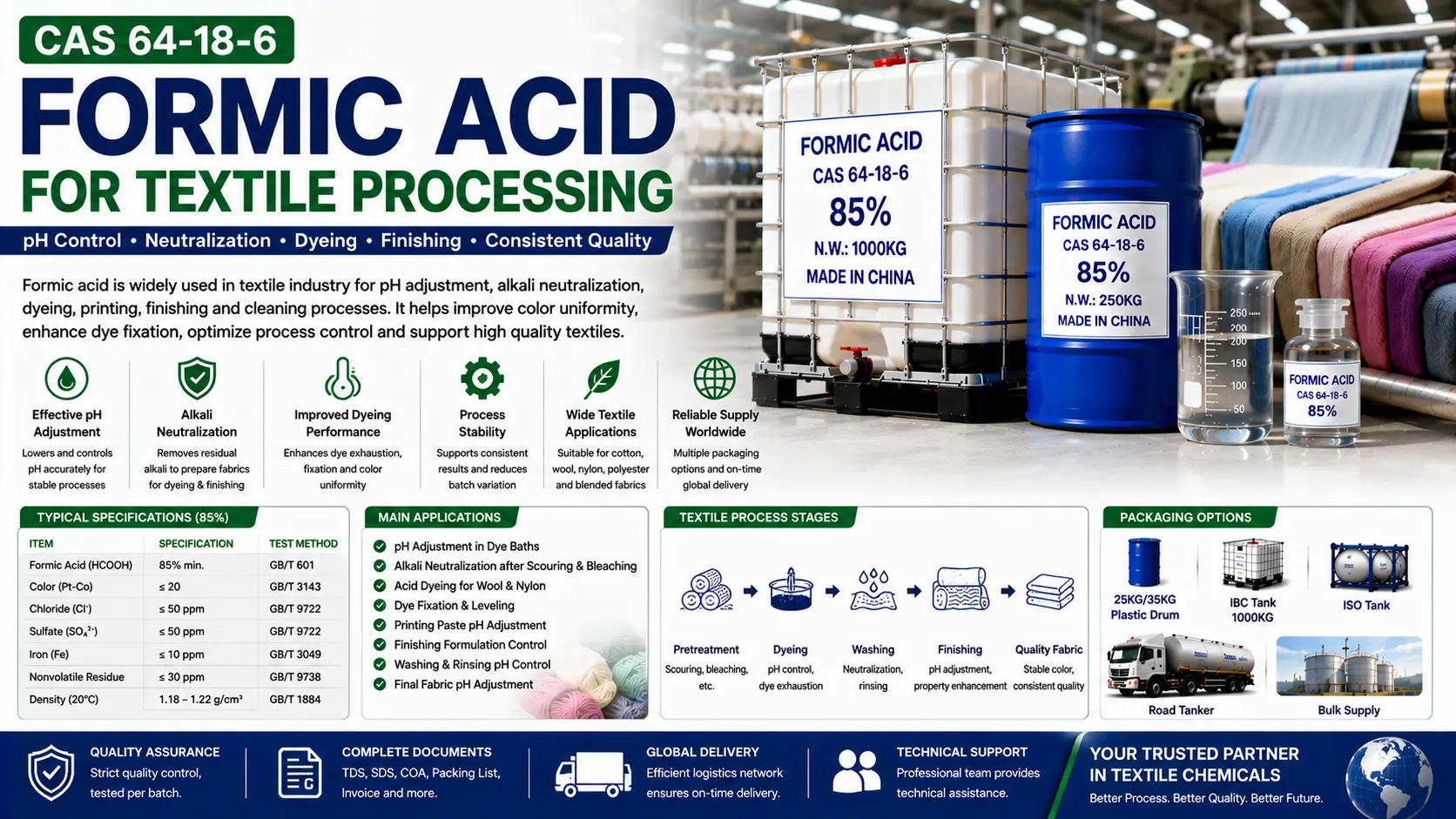
Choosing what formic acid to use is not just about concentration and cost for textile mills, dye houses, finishing plants, chemical distributors or procurement teams. The processing consistency may be affected by product colour, iron, chloride content, concentration stability, packaging and supplier reliability, which can affect finished fabric quality.
What Is Formic Acid?
Formic acid is the simplest carboxylic acid. Its chemical formula is HCOOH, and its CAS number is 64-18-6. It is usually supplied as a clear, colorless liquid that mixes completely with water.
Typical product information includes:
- Chemical name: Formic Acid
- CAS number: 64-18-6
- Molecular formula: HCOOH
- Molecular weight: approximately 46.03
- Appearance: Clear, colorless liquid
- Solubility: Miscible with water
- EINECS number: 200-579-1
- Common concentrations: 85%, 90%, 94%, 98%, and 99%
Formic acid 85% is commonly selected for general textile-processing applications because it offers a practical balance between acidity, dilution, handling, and cost.
Higher-concentration grades may also be used where the textile plant has suitable storage, dilution, dosing, ventilation, and safety systems.
Why Formic Acid Is Used in Textile Processing
Many textile operations require accurate pH control. Excessive alkalinity or acidity can influence dye solubility, fiber stability, color development, chemical fixation, equipment condition, and wastewater quality.
Formic acid may be used to:
- Lower dye-bath pH
- Neutralize alkaline residues
- Support dye exhaustion
- Promote selected dye-fixation processes
- Adjust finishing formulations
- Prepare acidic treatment baths
- Control washing and rinsing conditions
- Improve process repeatability
- Support consistent color development
The correct application depends on fiber type, dye class, water quality, processing temperature, chemical formulation, and target pH.
pH Control in Textile Production
pH is a critical process parameter in textile dyeing and finishing.
An unsuitable pH may contribute to:
- Uneven dyeing
- Poor color yield
- Reduced dye fixation
- Shade variation
- Fiber damage
- Chemical precipitation
- Inconsistent finishing
- Excessive chemical consumption
- Wastewater-treatment problems
Formic acid can provide controlled acidification when diluted and added gradually.
Operators should monitor actual bath pH rather than relying only on a fixed chemical dosage.
Neutralization After Alkaline Pretreatment
Cotton and other cellulosic textiles may undergo alkaline pretreatment processes such as:
- Scouring
- Bleaching
- Mercerizing
- Washing
- Alkaline cleaning
- Caustic treatment
Residual alkali may remain in the fabric, yarn, or processing bath after these operations.
Formic acid may be used to neutralize this alkalinity before dyeing or finishing.
Potential benefits include:
- More stable fabric pH
- Reduced alkaline carryover
- Better dye-bath control
- Improved chemical compatibility
- Lower risk of shade variation
- More repeatable production
Neutralization should be followed by appropriate rinsing and pH verification.
Formic Acid in Cotton Processing
Cotton processing often involves alkaline chemicals during pretreatment.
Before dyeing or finishing, the material may need to be brought back to a controlled pH range.
Formic acid may support:
- Neutralization after scouring
- Neutralization after bleaching
- Correction of alkaline rinse water
- pH adjustment before dyeing
- Final fabric-pH control
- Preparation for selected finishing chemicals
Cotton processors should monitor both bath pH and fabric extract pH where required.
Localized acidity should be avoided because it may cause uneven treatment.
Formic Acid in Wool Processing
Wool is a protein fiber that is sensitive to extreme pH conditions.
Formic acid may be used in selected wool-processing operations for:
- Dye-bath acidification
- pH control
- Neutralization
- Washing
- Finishing
- Preparation of acidic formulations
Controlled acidity can support dye uptake and color development with selected acid dyes and metal-complex dyes.
However, excessive acid concentration, high temperature, or extended exposure may affect wool strength, handle, or appearance.
The process should therefore be developed according to the specific wool type, dye system, and equipment.
Formic Acid in Nylon Dyeing
Nylon contains chemical groups that can interact with acid dyes.
Formic acid may be used to lower the bath pH and support the controlled uptake of selected dyes.
Potential benefits include:
- Improved dye-bath control
- Better dye exhaustion
- More consistent shade development
- Improved color uniformity
- Controlled fixation
- Reduced batch variation
Acid should be added gradually to avoid rapid surface dyeing before sufficient penetration occurs.
Temperature rise, circulation, dye concentration, and pH should be coordinated carefully.
Formic Acid in Polyester Blends
Polyester itself is commonly dyed with disperse dyes, but polyester-blend fabrics may contain cotton, wool, nylon, elastane, or other fibers that require separate pH-control stages.
Formic acid may be used during:
- Blend neutralization
- Post-dyeing washing
- Acidic reduction or cleaning stages
- Finishing preparation
- Bath-pH correction
Compatibility with the complete dye and auxiliary package should be verified before production use.
Acid Dyeing Applications
Acid dyes are commonly used for wool, nylon, silk, and selected protein or polyamide fibers.
Formic acid may help create suitable bath conditions for:
- Dye solubility
- Fiber-dye interaction
- Controlled exhaustion
- Shade development
- Level dyeing
- Final fixation
The required pH depends on the dye class and fiber.
Rapid acid addition can cause the dye to migrate too quickly to the fiber surface, increasing the risk of unlevel dyeing.
Gradual dosing can help maintain controlled dye uptake.
Reactive Dyeing and Neutralization
Reactive dyes are widely used for cotton and other cellulosic fibers under alkaline conditions.
After dye fixation, the material may require washing and neutralization to remove residual alkali.
Formic acid may be used to:
- Lower fabric pH
- Neutralize residual alkali
- Support subsequent soaping
- Prepare fabric for finishing
- Improve final pH consistency
The acid should not be added before the reactive-dye fixation stage is complete because premature acidification may reduce fixation efficiency.
Textile Printing
Formic acid may be incorporated into selected textile-printing formulations or after-treatment processes.
Possible functions include:
- pH adjustment of print pastes
- Acidification of selected dye systems
- Neutralization after printing
- Preparation for steaming or fixation
- Control of washing conditions
The acid should be compatible with:
- Dyes or pigments
- Thickeners
- Binders
- Crosslinking agents
- Catalysts
- Surfactants
- Reducing or oxidizing chemicals
Laboratory trials are recommended before large-scale printing.
Textile Finishing
Textile finishing modifies fabric properties such as softness, wrinkle resistance, water repellency, flame resistance, hand feel, dimensional stability, and surface appearance.
Formic acid may be used for:
- Finishing-bath pH adjustment
- Activation of selected catalysts
- Neutralization before finishing
- Stabilization of chemical formulations
- Final fabric-pH correction
The correct pH can influence:
- Finish durability
- Chemical penetration
- Crosslinking
- Fabric handle
- Color retention
- Storage stability
Each finishing system should be tested because some resins, softeners, emulsions, and catalysts may be sensitive to acid addition.
Formic Acid in Washing and Rinsing
Textile washing stages remove:
- Unfixed dyes
- Alkalis
- Salts
- Surfactants
- Sizing agents
- Processing residues
Formic acid may be used in selected final rinses to bring the fabric and process water into a controlled pH range.
Potential benefits include:
- Reduced alkaline residue
- Improved fabric-pH consistency
- Better preparation for finishing
- Lower risk of storage yellowing
- Improved compatibility with subsequent chemicals
The final fabric should be tested to confirm that the required pH has been achieved.
Final Fabric pH
Finished-textile pH can affect:
- Skin comfort
- Product stability
- Color retention
- Odor
- Packaging performance
- Customer specifications
- Compliance testing
Formic acid may be used to adjust final fabric pH, but excessive acid should be avoided.
The finishing plant should use validated test methods and customer-specific requirements.
Main Benefits of Formic Acid for Textile Processing
Accurate pH Adjustment
Formic acid can produce a measurable reduction in bath pH when dosed correctly.
High Water Solubility
It mixes readily with process water and can be diluted for controlled addition.
Broad Process Compatibility
It may be used in pretreatment neutralization, dyeing, printing, washing, and finishing.
Efficient Dosing
Its relatively strong acidity allows effective pH adjustment with controlled quantities.
Improved Batch Repeatability
Stable concentration helps textile mills reproduce process conditions more consistently.
Convenient Supply Options
Formic acid may be supplied in drums, IBC tanks, ISO tanks, or bulk tankers.
Important Process Variables
Fiber Type
Cotton, wool, nylon, polyester blends, silk, viscose, and elastane respond differently to acidic conditions.
The acid program should match the fiber.
Dye Class
Reactive, acid, direct, disperse, metal-complex, and other dyes have different pH requirements.
Water Quality
Water may contain:
- Calcium
- Magnesium
- Iron
- Carbonate
- Bicarbonate
- Chloride
- Suspended solids
High alkalinity may increase acid consumption and make pH control more difficult.
Temperature
Temperature influences:
- Dye exhaustion
- Acid reaction rate
- Fiber sensitivity
- Chemical stability
- Bath uniformity
Circulation and Mixing
Good circulation helps prevent localized high acidity.
Addition Rate
Gradual acid addition generally provides better process control than a rapid one-time dose.
Dilution Practices
Concentrated formic acid is commonly diluted before textile use.
Dilution may help:
- Improve dosing accuracy
- Reduce localized acidity
- Support uniform distribution
- Improve operator control
- Reduce the risk of fabric damage
Important dilution considerations include:
- Use clean water
- Use compatible tanks
- Start controlled agitation
- Add acid gradually to water
- Monitor temperature
- Confirm the final concentration
- Label the diluted solution clearly
- Follow the safety data sheet
Dilution is exothermic and must be carried out using qualified procedures.
Dosage Control
There is no universal dosage suitable for every textile process.
The required quantity depends on:
- Initial bath pH
- Target pH
- Bath volume
- Formic acid concentration
- Water alkalinity
- Fiber type
- Dye chemistry
- Auxiliary chemicals
- Temperature
- Processing stage
Plants should determine dosage through laboratory trials, production records, and real-time pH monitoring.
Overdosing can cause:
- Excessive acidity
- Fiber damage
- Shade changes
- Equipment corrosion
- Higher chemical cost
- Wastewater imbalance
Underdosing may result in incomplete neutralization or unstable dyeing conditions.
Application Equipment
Formic acid may be dosed through:
- Metering pumps
- Automated chemical kitchens
- Dilution tanks
- Dosing manifolds
- Flow-control systems
- Manual batch systems
- Central chemical distribution systems
All wetted components should be compatible with the product concentration.
Compatibility should be checked for:
- Storage tanks
- Pumps
- Hoses
- Valves
- Seals
- Gaskets
- Flow meters
- Dosing lines
Important Quality Specifications
A professional supplier should provide a detailed technical data sheet and batch-specific certificate of analysis.
Important quality parameters may include:
- Formic acid concentration
- Density
- Color
- Chloride
- Sulfate
- Iron
- Nonvolatile residue
- Appearance
- Water content
Concentration Stability
Stable concentration is important for accurate dosing.
Variation may result in:
- Different bath pH
- Shade variation
- Inconsistent neutralization
- Higher chemical consumption
- Process adjustments
- Reduced production repeatability
The actual measured concentration should appear on the certificate of analysis.
Color
Formic acid for textile processing should normally be clear and colorless.
Unexpected discoloration may indicate:
- Metal contamination
- Storage degradation
- Packaging incompatibility
- Cross-contamination
- Production inconsistency
Low-color material is especially important for white, pastel, and light-colored textiles.
Iron Content
Iron is an important quality indicator in textile processing.
Excessive iron may contribute to:
- Fabric staining
- Shade changes
- Yellowing
- Chemical precipitation
- Reduced brightness
- Finished-product defects
Low iron may be particularly important for white fabrics and sensitive dye systems.
Chloride and Sulfate
Chloride and sulfate may affect:
- Equipment corrosion
- Bath chemistry
- Dye performance
- Chemical compatibility
- Final textile quality
- Wastewater treatment
Buyers should define suitable impurity limits according to their process.
Nonvolatile Residue
Nonvolatile residue represents material remaining after formic acid and water evaporate.
Excessive residue may contribute to:
- Tank deposits
- Blocked dosing lines
- Fabric contamination
- Filter problems
- Unwanted solids
A low residue specification supports cleaner textile processing.
Formic Acid 85% for Textile Processing
Formic acid 85% is commonly selected because it offers:
- Stable active content
- Practical handling
- Convenient dilution
- Broad availability
- Competitive cost
- Suitability for multiple textile operations
It may be supplied in drums, IBC tanks, or bulk systems.
Higher-Concentration Grades
Formic acid 90%, 94%, 98%, or 99% may also be used as concentrated raw material.
Potential advantages include:
- More active acid per shipment
- Reduced transportation of water
- Lower storage volume
- Flexible on-site dilution
However, higher concentrations require:
- More accurate dilution
- Stronger ventilation
- Compatible storage
- Trained workers
- Better transfer systems
- Strict safety controls
Packaging Options
Common packaging options include:
- 25 kg plastic drums
- 35 kg plastic drums
- 250 kg HDPE drums
- IBC tanks
- ISO tanks
- Road tankers
- Customized bulk supply
The correct packaging depends on:
- Monthly consumption
- Warehouse capacity
- Chemical-dosing system
- Delivery access
- Local regulations
- Worker-safety procedures
Storage Requirements
Formic acid should be stored in a cool, well-ventilated, secure area in compatible containers.
It should be kept away from:
- Heat
- Direct sunlight
- Alkalis
- Strong oxidizing agents
- Incompatible metals
- Open flames
- Contamination
- Damaged packaging
Storage systems should include:
- Clear labels
- Secondary containment
- Leak inspections
- Spill-control materials
- Emergency showers
- Eyewash stations
- Restricted access
- Adequate ventilation
Worker Safety
Formic acid is corrosive and can cause serious skin and eye injury. Vapors may irritate the respiratory system.
Suitable personal protective equipment may include:
- Chemical-resistant gloves
- Splash goggles
- Face shield
- Protective clothing
- Chemical-resistant footwear
- Respiratory protection where required
Closed-transfer and automated dosing systems can reduce direct exposure.
Workers should follow the current safety data sheet and site procedures.
Wastewater Considerations
Textile wastewater may contain:
- Dyes
- Salts
- Alkalis
- Acids
- Surfactants
- Finishing chemicals
- Suspended solids
- Organic matter
Formic acid use can affect wastewater pH and treatment conditions.
Textile plants should monitor:
- pH
- Chemical oxygen demand
- Biological oxygen demand
- Color
- Salinity
- Suspended solids
- Flow rate
Accurate dosing can reduce unnecessary acidity and lower neutralization costs.
How to Evaluate a Supplier
Review the Technical Specification
The supplier should provide measurable limits for concentration, color, iron, chloride, sulfate, density, and residue.
Request Batch-Specific COAs
The certificate of analysis should correspond to the actual shipment batch.
Test a Representative Sample
Recommended tests may include:
- Concentration
- Density
- Color
- Iron
- Chloride
- Sulfate
- Residue
- Textile-process performance
Conduct Production Trials
A trial may evaluate:
- Neutralization efficiency
- Bath-pH stability
- Dye exhaustion
- Shade uniformity
- Fabric color
- Finishing compatibility
- Final fabric pH
- Wastewater impact
Compare Multiple Batches
Reviewing several certificates helps evaluate long-term consistency.
Confirm Supply Capacity
Buyers should ask about:
- Monthly output
- Available inventory
- Standard lead time
- Emergency supply
- Packaging options
- Bulk delivery capability
- Repeat-order support
Required Documents
A dependable supplier should provide:
- Technical data sheet
- Safety data sheet
- Batch-specific certificate of analysis
- Commercial invoice
- Packing list
- Certificate of origin
- Bill of lading
- Customs documents
- Inspection reports when required
All documents should show consistent product identity, concentration, batch number, net weight, and packaging information.
How to Request a Quotation
A complete inquiry should include:
- Required concentration
- Maximum iron
- Maximum chloride
- Maximum sulfate
- Color requirement
- Order quantity
- Packaging
- Destination
- Incoterm
- Delivery schedule
- Required documentation
- Intended textile application
For example:
“Please quote 25 metric tons of formic acid 85% for textile dyeing and finishing, packed in 250 kg HDPE drums, CIF destination port, including TDS, SDS, and batch-specific COA.”
Total Procurement Cost
The lowest unit price may not provide the best overall value.
Textile manufacturers should consider:
- Active acid content
- Batch consistency
- Color and iron levels
- Packaging
- Freight
- Storage
- Dosing accuracy
- Fabric rejection risk
- Equipment corrosion
- Wastewater treatment
- Delivery reliability
A stable product with controlled impurities may reduce shade variation, staining, chemical consumption, equipment deposits, and production losses.
Common Purchasing Risks
Potential risks include:
- Incorrect concentration
- High iron
- Excessive chloride
- Product discoloration
- Batch inconsistency
- Weak packaging
- Leakage
- Incomplete documentation
- Delayed delivery
- Poor complaint handling
These risks can be reduced through clear specifications, sample testing, production trials, batch-specific COAs, and supplier qualification.
Questions to Ask Before Ordering
Buyers should confirm:
- Which concentration grades are available?
- Is the product suitable for textile processing?
- What is the maximum iron content?
- What are the chloride and sulfate limits?
- What is the color specification?
- Can recent batch COAs be provided?
- Is a representative sample available?
- What packaging options are offered?
- Can bulk tanker delivery be arranged?
- What is the monthly supply capacity?
- What is the standard lead time?
- Can private labeling be supported?
- Which export documents are included?
- How are quality claims handled?
Conclusion
Formic Acid for Textile Processing is used in wide range of applications like pH adjustment, neutralization of alkaline residues, dye-bath control, dye fixation, wash, printing and finishing in textile.
It needs concentration, colour, iron, chloride, sulfate, dosage, fibre type, dye chemistry, water quality, temperature, mixing and batch consistency for its performance.
Textile manufacturers should carefully consider the full technical specification, ask for a batch specific certificate of analysis, sample for testing and run production trials before buying.
A good manufacturer should offer consistent concentration, defined concentrations of impurities, secure packaging, adequate documentation, technical support, and quick delivery worldwide.


Contact Us
In This Article
Related Posts
Custom Packaging Solutions from an Anhydrous Sodium Acetate Supplier in China
2026-09-23
Application Trends in Anhydrous Sodium Acetate for Special Chemical Manufacturing
2026-09-23
Anhydrous Sodium Acetate for Leather Tanning: Improve Dyeing Uniformity
2026-09-22
Formic Acid 85% for Textile Dyeing: Industrial Applications, Technical Benefits and Future Trends
2026-09-22


