



Formic Acid for Rubber Coagulation: Benefits, Process Control, and Purchasing Guide
By vanchor
2026-07-21Related Posts
Custom Packaging Solutions from an Anhydrous Sodium Acetate Supplier in China
2026-09-23
Application Trends in Anhydrous Sodium Acetate for Special Chemical Manufacturing
2026-09-23
Anhydrous Sodium Acetate for Leather Tanning: Improve Dyeing Uniformity
2026-09-22

Formic Acid 85% for Textile Dyeing: Industrial Applications, Technical Benefits and Future Trends
2026-09-22
Formic Acid for Rubber Coagulation is extensively used in rubber processing or natural rubber and latex processing for deacidification, destabilising rubber particles and assisting in the separation of rubber particles from the liquid phase. It is highly soluble and easily dosed and has strong acidity, which makes it suitable for producing rubber sheets, blocks, crumbs, concentrated rubber compound products, and other natural rubber products.
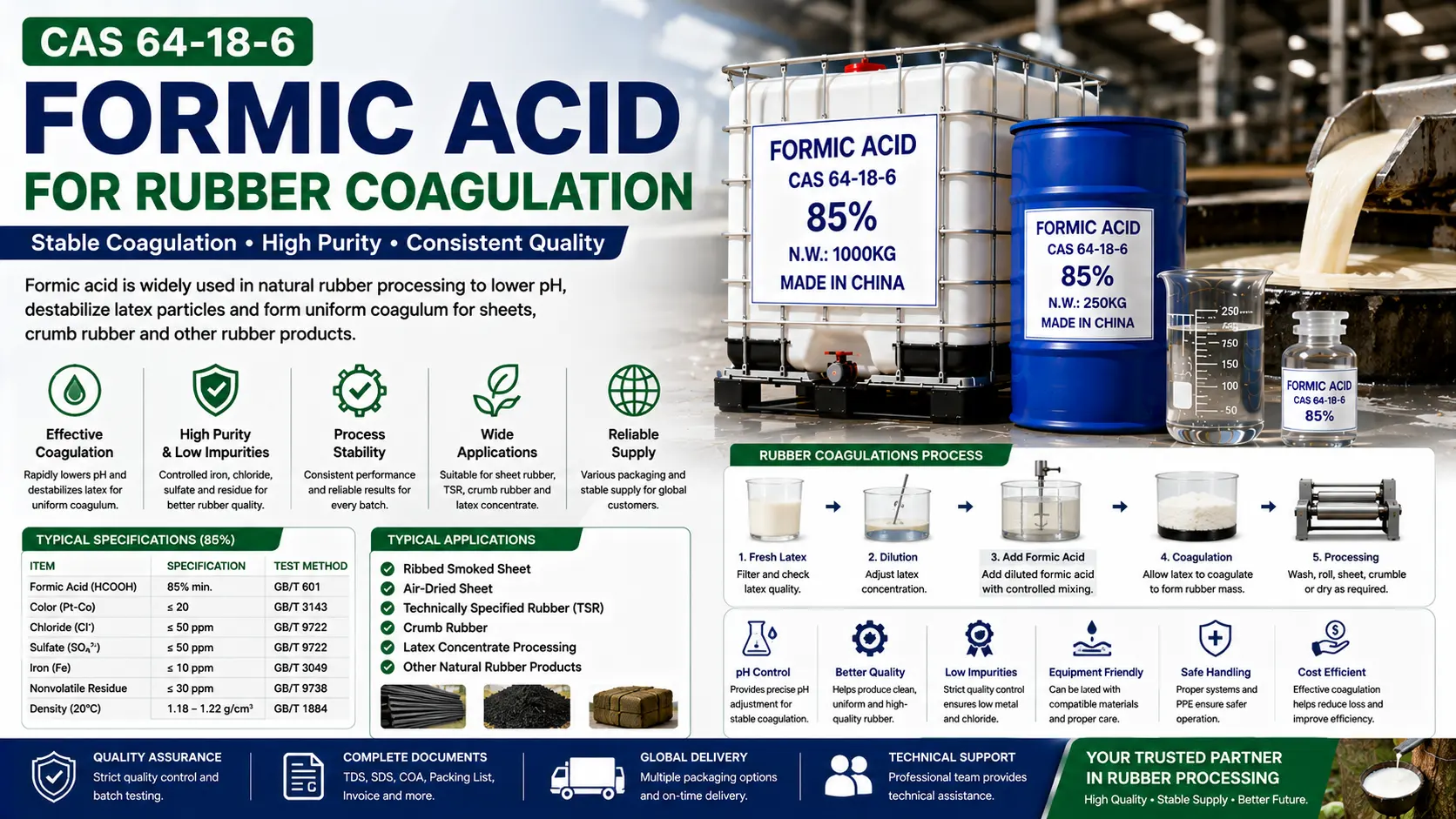
When choosing formic acid for rubber plantations, latex processing factories, chemical distributors and procurement teams will need to consider much more than concentration and price. Coagulation performance and quality of rubber can be affected by product purity, color, iron, chloride, sulfate, nonvolatile residue, packaging compatibility, batch consistency, and supplier reliability.
What Is Formic Acid?
Formic acid is the simplest carboxylic acid. Its chemical formula is HCOOH, and its CAS number is 64-18-6. It is normally supplied as a clear, colorless liquid that is completely miscible with water.
Typical product information includes:
- Chemical name: Formic Acid
- CAS number: 64-18-6
- Molecular formula: HCOOH
- Molecular weight: approximately 46.03
- Appearance: Clear, colorless liquid
- Solubility: Miscible with water
- Common concentrations: 85%, 90%, 94%, 98%, and 99%
For rubber-processing applications, formic acid 85% is commonly selected because it offers a practical balance between acidity, handling, dilution, cost, and process control.
Higher concentrations may also be used where suitable storage, dilution, safety, and dosing systems are available.
How Latex Coagulation Works
Natural latex is a colloidal dispersion containing rubber particles suspended in an aqueous phase. These particles remain stable because of surface charges and naturally occurring protective substances.
When formic acid is added, the pH of the latex decreases. As the pH approaches the destabilization range, the protective effect around the rubber particles weakens. The particles then move closer together, aggregate, and form a rubber coagulum.
The general process may include:
- Collecting and filtering fresh latex
- Measuring latex quality and dry rubber content
- Diluting latex where required
- Preparing diluted formic acid
- Adding acid under controlled mixing
- Allowing the latex to coagulate
- Separating the rubber mass
- Washing, rolling, crumbling, drying, or further processing
The exact operating procedure depends on the final rubber product and factory equipment.
Why Formic Acid Is Used for Rubber Coagulation
Formic acid is widely used because it can support:
- Controlled pH reduction
- Reliable latex destabilization
- Uniform coagulum formation
- Efficient rubber separation
- Good water solubility
- Easy preparation of dilute solutions
- Predictable processing
- Broad availability
- Consistent production when quality is stable
The final result depends on the formic acid concentration, dosage, latex composition, dry rubber content, temperature, mixing, and coagulation time.
Main Rubber Applications
Ribbed Smoked Sheet Production
In ribbed smoked sheet production, fresh latex is filtered, standardized, coagulated, rolled into sheets, washed, and dried in a smokehouse.
Formic acid can help provide:
- Uniform coagulation
- Stable sheet formation
- Controlled pH
- Better rolling consistency
- Reduced batch variation
- More predictable drying
Uneven acid distribution may produce soft spots, incomplete coagulation, or irregular sheet quality.
Air-Dried Sheet Production
Air-dried sheets follow a similar initial coagulation process but are dried without smoke.
The coagulum should be uniform enough to support:
- Smooth sheet formation
- Consistent thickness
- Effective washing
- Stable drying
- Good appearance
Raw-material color and impurity control may be particularly important where the finished sheet appearance matters.
Technically Specified Rubber
Technically specified rubber is processed according to defined quality parameters such as dirt, ash, nitrogen, volatile matter, plasticity, and color.
Formic acid may be used to coagulate field latex before:
- Milling
- Crumbing
- Washing
- Drying
- Pressing
- Baling
Stable coagulation can help improve production control and reduce variation in downstream processing.
Crumb Rubber
In crumb-rubber production, coagulated rubber is cut or granulated into smaller particles before washing and drying.
Proper coagulation may support:
- Efficient crumbing
- Uniform particle formation
- Effective washing
- Reduced sticky material
- Stable dryer operation
- Better production throughput
Latex Concentrate Processing
In some latex-concentrate systems, formic acid may be used to coagulate off-specification latex, skim latex, or selected process streams.
The correct treatment depends on:
- Ammonia content
- Dry rubber content
- Latex age
- Preservative system
- Final product target
Laboratory trials should be completed before full-scale use.
Key Benefits of Formic Acid in Rubber Processing
Rapid pH Adjustment
Formic acid can lower latex pH efficiently when properly diluted and dosed.
Uniform Coagulation
Controlled addition can support even rubber-particle aggregation throughout the coagulation tank.
Improved Process Repeatability
Stable acid concentration helps factories reproduce the same coagulation conditions across batches.
Easy Dilution
Formic acid mixes readily with water and can be prepared at the required working concentration.
Broad Equipment Compatibility
It can be used with manual, semi-automatic, or automated dosing systems when compatible materials are selected.
Reliable Supply
Formic acid is widely available in drums, IBC tanks, and bulk delivery formats.
Important Process Variables
Latex Dry Rubber Content
Dry rubber content affects the amount of acid required and the characteristics of the coagulum.
Higher dry rubber content may require:
- More precise dosing
- Better mixing
- Longer acid distribution time
- Adjusted coagulation conditions
The dry rubber content should be measured or estimated before acid addition.
Latex pH
Fresh latex pH may vary according to:
- Collection conditions
- Preservatives
- Storage time
- Ammonia content
- Contamination
- Water quality
The acid dosage should be adjusted according to actual latex conditions rather than relying only on a fixed quantity.
Ammonia Content
Ammonia is often used to preserve latex. It raises pH and can increase the amount of formic acid required for coagulation.
High-ammonia latex may require:
- More acid
- Longer mixing
- Controlled neutralization
- Longer coagulation time
Rapid acid addition may cause localized coagulation before the entire latex batch is evenly treated.
Temperature
Temperature can influence coagulation speed and mixing behavior.
Warmer conditions may accelerate chemical reactions, while lower temperatures may slow coagulation.
Factories should monitor:
- Latex temperature
- Ambient temperature
- Dilution-water temperature
- Coagulation time
Mixing
Mixing should distribute the acid evenly without causing excessive foam or mechanical damage.
Poor mixing may lead to:
- Local over-acidification
- Incomplete coagulation
- Uneven coagulum texture
- Batch variation
- Higher acid consumption
Coagulation Time
The latex should be allowed sufficient time to form a stable coagulum before cutting, rolling, or washing.
Insufficient time may result in:
- Weak coagulum
- Sticky rubber
- Material loss
- Difficult handling
Excessively long holding times may reduce production efficiency.
Formic Acid Dilution
Concentrated formic acid is commonly diluted before being added to latex.
Dilution helps:
- Improve dosing accuracy
- Reduce localized high acidity
- Support uniform distribution
- Reduce surface coagulation
- Improve operator control
Important dilution considerations include:
- Clean water quality
- Correct acid-to-water ratio
- Compatible mixing tank
- Controlled addition
- Temperature management
- Final concentration verification
Concentrated acid should generally be added slowly to water under controlled mixing, following the safety data sheet and site procedures.
Dosage Control
There is no universal formic acid dosage suitable for all latex-processing plants.
The required amount depends on:
- Formic acid concentration
- Latex dry rubber content
- Initial pH
- Ammonia content
- Latex freshness
- Water content
- Target coagulation time
- Final rubber product
- Factory process conditions
Factories should determine dosage through laboratory testing, pilot trials, and production data.
Overdosing may increase cost and create excessively acidic process water.
Underdosing may lead to incomplete or delayed coagulation.
pH Monitoring
Reliable pH monitoring is essential for process control.
Operators may monitor:
- Initial latex pH
- pH after acid addition
- Final coagulation pH
- Process-water pH
- Wastewater pH
A calibrated pH meter or validated test method should be used.
Monitoring actual pH is more reliable than using only a fixed acid dosage.
Effect on Rubber Quality
Proper formic acid use may support:
- Uniform coagulum structure
- Reduced uncoagulated latex loss
- Better rolling performance
- Improved crumb formation
- Stable drying
- More consistent rubber properties
Poor-quality acid or incorrect use may contribute to:
- Color variation
- Dark spots
- Uneven coagulation
- Excessive residual acidity
- Equipment corrosion
- Wastewater-treatment problems
- Process instability
Important Quality Specifications
A professional supplier should provide a complete technical specification and batch-specific certificate of analysis.
Important parameters may include:
- Formic acid concentration
- Density
- Color
- Chloride
- Sulfate
- Iron
- Nonvolatile residue
- Appearance
- Water content
Concentration
Stable concentration is essential for accurate dosing.
If the actual concentration varies, factories may experience:
- Variable coagulation times
- Incomplete coagulation
- Excess acid use
- Batch inconsistency
- Higher operating costs
The batch certificate should state the actual measured concentration.
Color
Formic acid should normally be clear and colorless.
Unexpected discoloration may indicate:
- Metal contamination
- Storage degradation
- Packaging incompatibility
- Cross-contamination
- Production inconsistency
Color control may be important for producing lighter-colored rubber grades.
Iron Content
Iron may influence:
- Raw-material color
- Rubber discoloration
- Equipment deposits
- Chemical stability
- Finished-product appearance
Low iron may be preferred for light-color rubber products.
Chloride and Sulfate
Chloride and sulfate may affect:
- Equipment corrosion
- Process-water chemistry
- Rubber contamination
- Wastewater treatment
- Finished-product consistency
Buyers should define acceptable limits according to their factory requirements.
Nonvolatile Residue
Nonvolatile residue represents material remaining after the acid and water evaporate.
Excessive residue may contribute to:
- Tank deposits
- Nozzle blockage
- Process contamination
- Rubber impurities
- Maintenance requirements
A low residue level supports cleaner processing.
Formic Acid 85% for Rubber Coagulation
Formic acid 85% is commonly used because it offers:
- High active acid content
- Practical handling
- Convenient dilution
- Broad availability
- Competitive cost
- Suitability for drum, IBC, and bulk supply
It is often suitable for both small latex-processing operations and large rubber factories.
Higher-Concentration Formic Acid
Formic acid 90%, 94%, 98%, or 99% may also be used as concentrated raw material.
Potential advantages include:
- More active acid per shipment
- Lower water transportation
- Reduced storage volume
- Flexible preparation of working solutions
However, higher concentrations require:
- More accurate dilution
- Stronger safety controls
- Better ventilation
- Compatible equipment
- Trained workers
- Careful storage
The selected grade should match the factory’s technical capability and safety procedures.
Formic Acid vs. Other Coagulants
Other materials may also be used to coagulate latex, depending on location, product type, and factory practice.
Potential alternatives may include:
- Acetic acid
- Other organic acids
- Acid blends
- Natural fermentation systems
Formic Acid
Potential advantages include:
- Strong acidity
- Efficient pH reduction
- Low dosage requirements
- Consistent industrial quality
- Broad availability
Acetic Acid
Potential advantages may include:
- Familiar handling in some factories
- Different odor and process characteristics
- Suitability for selected products
The best coagulant depends on cost, rubber quality, availability, equipment, wastewater conditions, and local production experience.
Packaging Options
Formic acid may be supplied in:
- 25 kg plastic drums
- 35 kg plastic drums
- 250 kg HDPE drums
- IBC tanks
- ISO tanks
- Road tankers
- Bulk delivery
The best option depends on:
- Factory consumption
- Storage space
- Dosing system
- Unloading equipment
- Local regulations
- Worker-safety requirements
Drum Supply
Drums may be suitable for:
- Small processing plants
- Trial orders
- Remote locations
- Controlled batch use
- Customers without bulk tanks
Manual handling may increase exposure risk, so closed-transfer systems are preferable.
IBC Tank Supply
IBC tanks may provide:
- Easier forklift handling
- Medium-volume storage
- Direct pump connection
- Reduced manual transfer
- Better inventory management
The valve, gasket, seal, and tank material should be compatible with formic acid.
Bulk Supply
Road tanker or ISO-tank delivery may be suitable for large rubber factories.
Bulk buyers should confirm:
- Tank compatibility
- Previous cargo
- Cleaning documents
- Valve condition
- Unloading procedures
- Receiving-tank capacity
- Secondary containment
- Emergency-response arrangements
Storage Requirements
Formic acid should be stored in a cool, secure, well-ventilated area in compatible containers.
It should be kept away from:
- Heat
- Direct sunlight
- Alkalis
- Strong oxidizing agents
- Incompatible metals
- Open flames
- Contamination
- Damaged packaging
Storage areas should include:
- Clear labels
- Secondary containment
- Leak inspections
- Spill-control materials
- Emergency showers
- Eyewash stations
- Restricted access
- Ventilation
Worker Safety
Formic acid is corrosive and can cause severe skin and eye injury. Vapors may irritate the respiratory system.
Suitable personal protective equipment may include:
- Chemical-resistant gloves
- Splash goggles
- Face shield
- Protective clothing
- Chemical-resistant footwear
- Respiratory protection where required
Workers should follow the current safety data sheet and written site procedures.
Closed pumping and automated dosing can reduce exposure.
Wastewater Considerations
Rubber coagulation produces acidic process water that may contain:
- Residual formic acid
- Natural latex serum
- Organic matter
- Suspended solids
- Rubber particles
- Nitrogen compounds
Factories should monitor:
- pH
- Chemical oxygen demand
- Biological oxygen demand
- Suspended solids
- Flow rate
Wastewater should be treated according to local environmental requirements before discharge.
Accurate acid dosing can reduce unnecessary acidity and treatment costs.
How to Evaluate a Supplier
Review the Technical Specification
The supplier should provide measurable limits for concentration, color, iron, chloride, sulfate, density, and residue.
Request Batch-Specific COAs
The certificate should correspond to the actual shipment batch.
Test a Representative Sample
Recommended testing may include:
- Concentration
- Density
- Color
- Iron
- Chloride
- Sulfate
- Residue
- Latex coagulation performance
Run a Production Trial
A trial can evaluate:
- Acid dosage
- Coagulation time
- Coagulum uniformity
- Rubber color
- Rolling performance
- Crumb formation
- Drying behavior
- Wastewater pH
Compare Multiple Batches
Reviewing several COAs helps assess long-term consistency.
Confirm Supply Capacity
Buyers should ask about:
- Monthly capacity
- Available inventory
- Standard lead time
- Emergency supply
- Packaging options
- Bulk delivery capability
- Repeat-order support
Required Documents
A dependable supplier should provide:
- Technical data sheet
- Safety data sheet
- Batch-specific certificate of analysis
- Commercial invoice
- Packing list
- Certificate of origin
- Bill of lading
- Customs documents
- Inspection reports when required
All documents should show consistent product identity, concentration, batch number, net weight, and packaging details.
How to Request a Quotation
A complete inquiry should include:
- Required concentration
- Maximum iron
- Maximum chloride
- Maximum sulfate
- Color requirement
- Order quantity
- Packaging
- Destination
- Incoterm
- Delivery schedule
- Required documents
For example:
“Please quote 25 metric tons of formic acid 85% for natural rubber coagulation, packed in 250 kg HDPE drums, CIF destination port, including TDS, SDS, and batch-specific COA.”
Total Procurement Cost
The lowest product price may not provide the best overall value.
Rubber producers should consider:
- Active acid content
- Batch consistency
- Acid dosage
- Packaging
- Freight
- Storage
- Equipment corrosion
- Rubber loss
- Coagulation time
- Wastewater treatment
- Delivery reliability
A stable product with controlled impurities may reduce batch variation, uncoagulated latex loss, equipment problems, and quality complaints.
Common Purchasing Risks
Potential risks include:
- Incorrect concentration
- High iron
- Excessive chloride
- Discoloration
- Inconsistent batches
- Weak packaging
- Leakage
- Incomplete documentation
- Delayed delivery
- Poor complaint handling
These risks can be reduced through clear specifications, sample testing, production trials, batch-specific COAs, and supplier qualification.
Questions to Ask Before Ordering
Buyers should confirm:
- Which concentration grades are available?
- Is the product suitable for natural rubber coagulation?
- What is the maximum iron content?
- What are the chloride and sulfate limits?
- What is the color specification?
- Can recent batch COAs be provided?
- Is a representative sample available?
- What packaging options are offered?
- Can bulk tanker delivery be arranged?
- What is the monthly supply capacity?
- What is the standard lead time?
- Can private labeling be supported?
- Which export documents are included?
- How are quality claims handled?
Conclusion
Formic Acid for Rubber Coagulation is a vital processing chemical employed in controlling the pH of the latex, in destabilizing the rubber particles and forming the uniform coagulum for the sheets, crumb rubber, technically specified rubber and other natural rubber products.
The performance is related to concentration, purity, dose, dry rubber content of latex, ammonia content, mixing, temperature, coagulation time and batch consistency.
Rubber processors should read the full technical specification, ask for a certificate of analysis (COA) for the batch of interest, sample and test the rubber, and perform a rubber production trial before they buy.
The supplier should offer stable concentration, controlled impurities, secure packaging, complete documentation, timely technical support and reliable worldwide delivery.


Contact Us
In This Article
Related Posts
Custom Packaging Solutions from an Anhydrous Sodium Acetate Supplier in China
2026-09-23
Application Trends in Anhydrous Sodium Acetate for Special Chemical Manufacturing
2026-09-23
Anhydrous Sodium Acetate for Leather Tanning: Improve Dyeing Uniformity
2026-09-22
Formic Acid 85% for Textile Dyeing: Industrial Applications, Technical Benefits and Future Trends
2026-09-22


