



High Density Potassium Formate Brine: Density Range, Properties and Oilfield Applications
By vanchor
2026-08-18Related Posts
Custom Packaging Solutions from an Anhydrous Sodium Acetate Supplier in China
2026-09-23
Application Trends in Anhydrous Sodium Acetate for Special Chemical Manufacturing
2026-09-23
Anhydrous Sodium Acetate for Leather Tanning: Improve Dyeing Uniformity
2026-09-22
Formic Acid 85% for Textile Dyeing: Industrial Applications, Technical Benefits and Future Trends
2026-09-22
High Density Potassium Formate Brine is a clear, water-based formate fluid used in drilling, reservoir drill-in, completion and workover operations where hydrostatic pressure must be controlled while minimizing reliance on suspended weighting solids. Potassium formate (HCOOK) is one of the three principal alkali-metal formates used in oilfield fluids, together with sodium formate and cesium formate. A clear potassium formate solution can reach approximately 1.58 g/cm³, or about 13.2 ppg, placing it in the medium-to-high-density range of formate brines.
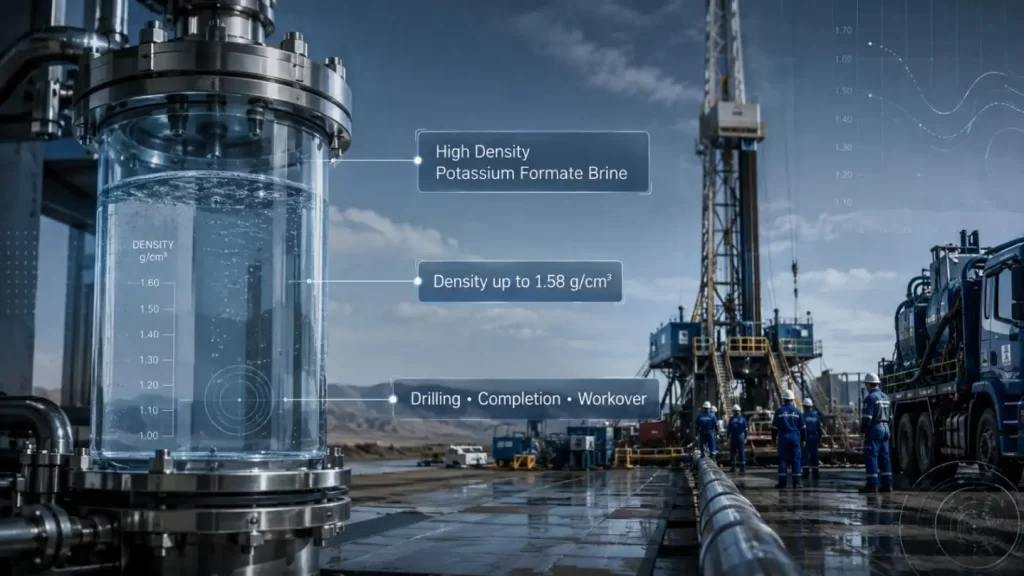
For field use, however, High Density Potassium Formate Brine should not be selected by density alone. The practical design window is controlled by concentration, temperature, pressure, crystallization behavior, formation compatibility, fluid additives and the required level of solids control.
Density Range: What Does "High Density" Actually Mean?
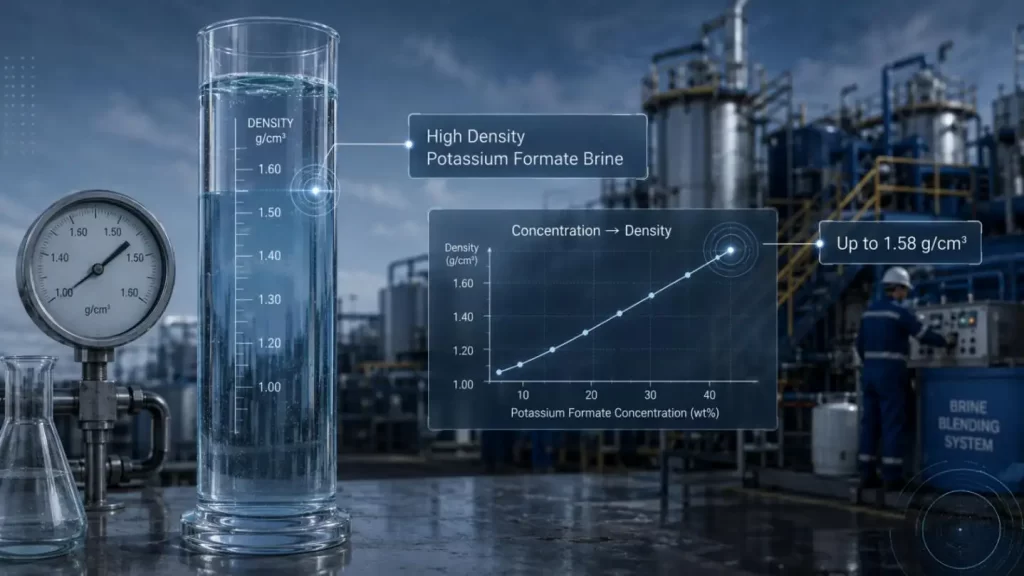
In a clear-brine system, dissolved potassium formate supplies much of the required fluid density. Increasing potassium formate concentration generally raises the brine density, allowing hydrostatic pressure to be increased without introducing conventional insoluble weighting solids.
This is important in reservoir-facing operations because clear brines are specifically used to control formation pressure while reducing the potential for solids-related formation damage.
Formate Brine Density Window
| Brine Type | Approx. Maximum Clear-Solution Density | Engineering Position |
| Sodium Formate | 1.32 g/cm³ | Lower-density formate systems |
| Potassium Formate | 1.58 g/cm³ | Medium-to-high-density systems |
| Cesium Formate | 2.40 g/cm³ | Very-high-density specialized systems |
These values represent clear solutions rather than universal operating densities. Actual working density must be established from the well-pressure requirement and fluid formulation.
This makes High Density Potassium Formate Brine particularly relevant when sodium formate does not provide enough density, while a cesium-rich system would exceed the required density range or project economics.
Density Is Only One Part of the Design Window
1. Concentration and Hydrostatic Requirement
The first engineering input should be the hydrostatic pressure required to balance the well. From that target, the fluid engineer determines the required mud/brine weight and corresponding potassium formate concentration.
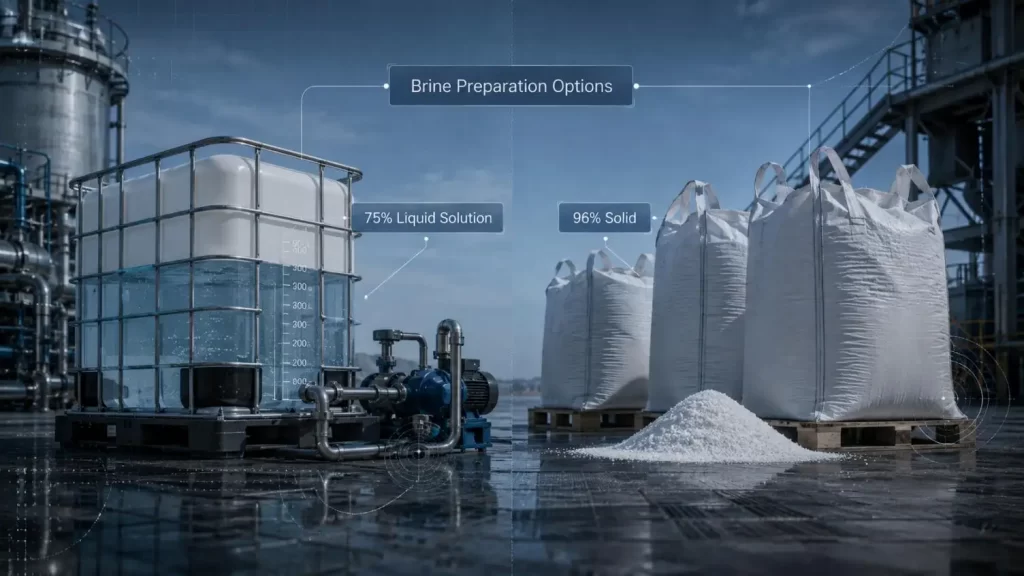
At Vanchor, we support two different preparation routes:
•75% potassium formate solution for direct liquid handling and blending
•≥96% potassium formate solid for preparing customized brine concentrations locally
Vanchor's 75% solution has an approximate density of 1.57–1.58 g/cm³ at 25°C, pH of about 9–10, and is completely miscible with water.
The ≥96% solid should not be assigned a fixed working density: its purpose is to provide high active content that can be dissolved to formulate the required High Density Potassium Formate Brine.
2. Crystallization Temperature
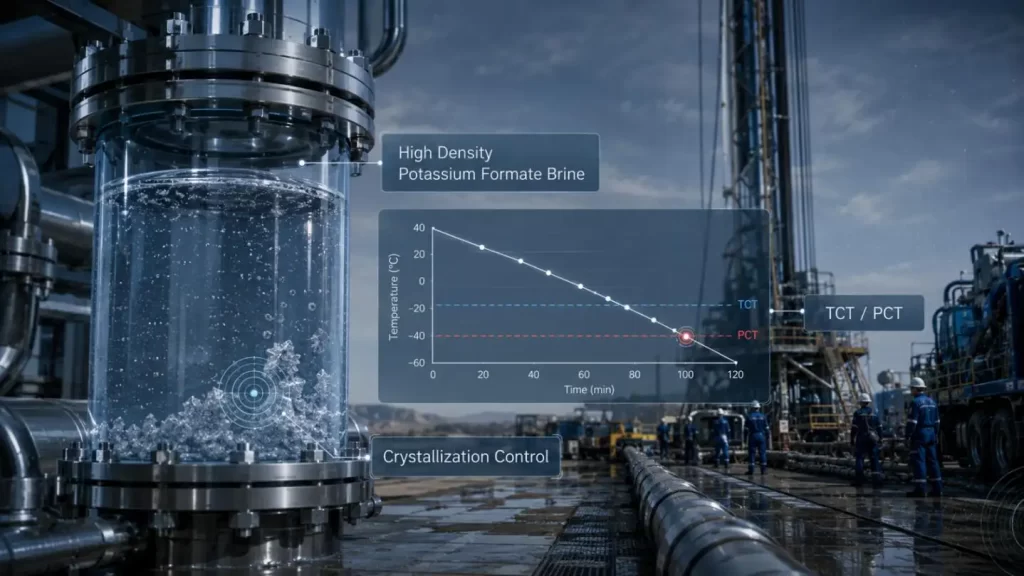
High density brings the fluid closer to its concentration-dependent crystallization limit. Therefore, maximum density is not automatically the safest operating point.
Clear-brine specifications commonly evaluate:
•TCT — True Crystallization Temperature
•PCT — Pressure Crystallization Temperature
•Surface storage temperature
•Bottomhole temperature and pressure
•Dilution or contamination during circulation
SLB notes that clear-brine systems are blended not only for density but also according to TCT, PCT and clarity.
A practical High Density Potassium Formate Brine design therefore needs sufficient crystallization margin throughout mixing, storage, pumping and downhole exposure.
Key Oilfield Applications
Reservoir Drill-In Fluids
Potassium formate can be used as the density phase in reservoir drill-in fluid systems where formation exposure makes solids control especially important. Technical qualification should consider:
•Target fluid density
•HTHP fluid-loss control
•Polymer stability
•Shale and formation compatibility
•Solids invasion
•Filter-cake cleanup
•Formation-water compatibility
Formate-based reservoir drill-in systems have also been field-tested under elevated-temperature conditions; for example, SLB documented a mixed sodium/potassium formate RDIF used at expected bottomhole temperatures up to 340°F (171°C), demonstrating why the complete additive package—not the brine alone—must be qualified for thermal exposure.
Completion and Workover Fluids
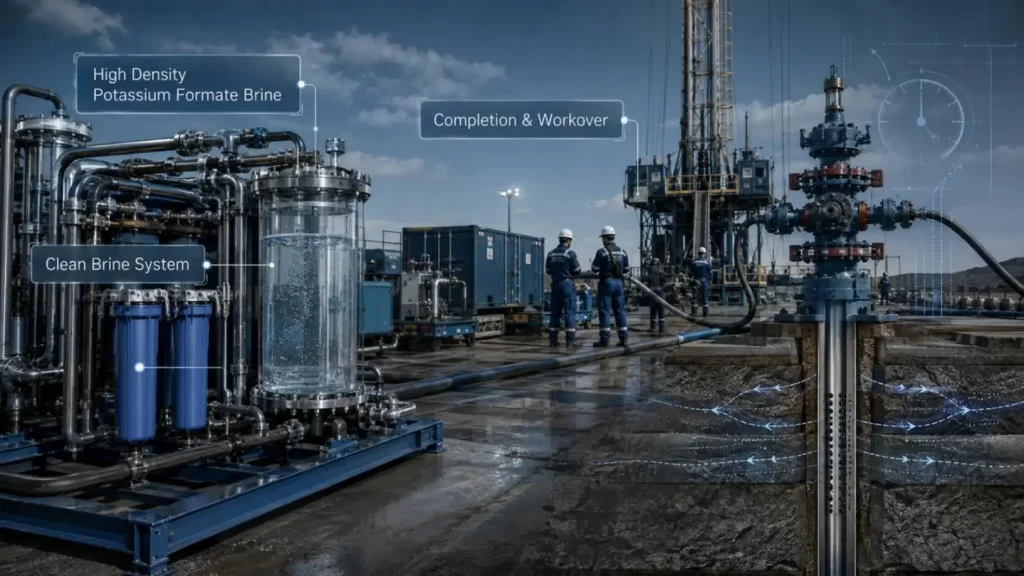
High Density Potassium Formate Brine can also support clear or low-solids completion and workover systems where pressure control must be achieved without introducing excessive particulate material into the productive interval. Formate salts are highly water-soluble and can form high-density solids-free brines, reducing dependence on weighting agents.
Before field deployment, the finished fluid should be checked for:
•Final density
•TCT/PCT margin
•Rheology
•Filtration
•Corrosion behavior
•Elastomer compatibility
•Formation-water compatibility
•Additive compatibility
•Thermal aging
•Formation-damage risk where required
75% Liquid vs. ≥96% Solid: A Supply and Blending Decision
The choice is not simply "which grade is better." It depends on the mixing infrastructure and logistics of the project.
Choose 75% Liquid When
•Direct pumping and metering are required
•Fast batch preparation is important
•Powder dissolution equipment is unavailable
•Consistent incoming concentration is preferred
•IBC or bulk-liquid handling is already available
Vanchor supplies the liquid grade in 1570 kg IBC tanks and positions it for direct pumping, metering and blending.
Choose ≥96% Solid When
•Multiple brine concentrations must be prepared
•Local blending facilities are available
•Transport efficiency per unit of active potassium formate matters
•Long-distance shipment of added water should be reduced
One metric ton of 75% solution contains approximately 750 kg active potassium formate, while one metric ton of ≥96% solid contains about 960 kg. Vanchor therefore supplies the solid grade for projects where concentration flexibility and active-material freight efficiency are priorities.
Standard solid packaging includes 25 kg moisture-proof bags and 1,000 kg jumbo bags.
Procurement Specifications Should Go Beyond Purity
For repeatable High Density Potassium Formate Brine preparation, purchasing specifications should address more than nominal assay.
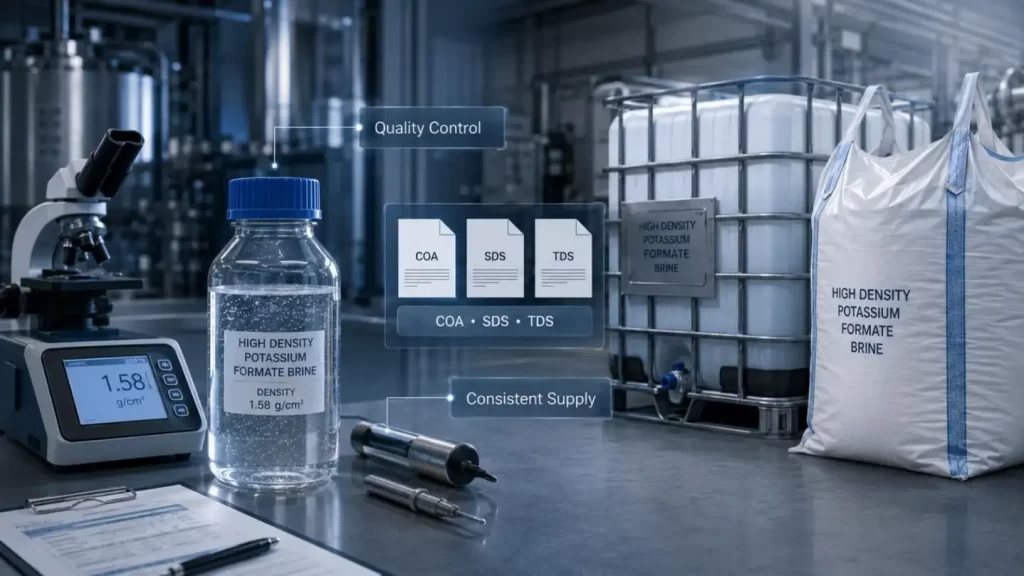
Typical controls include:
•Potassium formate concentration or purity
•Solution density
•pH
•Appearance and clarity
•Insoluble matter
•Moisture for solid grade
•Relevant impurity profile
•Batch-to-batch consistency
•Packaging integrity
•COA, SDS and TDS documentation
Vanchor provides COA, SDS and TDS with its liquid potassium formate offering and can also support export and packaging documentation for the solid grade.
Match High Density Potassium Formate Brine to the Well
A technically sound High Density Potassium Formate Brine program starts with required pressure and target density, then verifies crystallization margin, temperature exposure, formation chemistry, additive compatibility and field-handling conditions.
Vanchor supports both sides of this formulation strategy: 75% liquid potassium formate for direct blending and ≥96% solid potassium formate for flexible local brine preparation. Rather than selecting only by concentration, oilfield customers can define the target brine density, operating temperature, required supply form and project volume first. With these parameters established, Vanchor can support the appropriate potassium formate grade, packaging and supply arrangement for subsequent laboratory qualification and field use.
FAQs
Q1. What forms of potassium formate does Vanchor supply?
Vanchor supplies 75% potassium formate liquid and ≥96% potassium formate solid. The liquid grade is suitable for direct pumping and blending. The solid grade is more flexible for preparing High Density Potassium Formate Brine at different concentrations.
Q2. What is the density of Vanchor's 75% potassium formate solution?
The typical density of Vanchor's 75% potassium formate solution is between 1.57–1.58 g/cm³ at 25°C. The final working-fluid density should be checked after diluting and adding other components.
Q3. Can Vanchor supply potassium formate for drilling and completion fluids?
Yes. Vanchor supplies potassium formate for drilling fluids, reservoir drill-in fluids, completion brines, workover fluids and selected well-control systems as long as they go through formulations and laboratory qualification.
Q4. Should I choose Vanchor's 75% liquid or 96% solid potassium formate?
Pick the 75% liquid grade when you prioritize direct pumping, metering and rapid blending. The ≥96% solid grade is more appropriate if local dissolution is possible, if you need to prepare brines at multiple concentrations, or if you are trying to use less transport water.
Q5. Can Vanchor supply raw material for customized High Density Potassium Formate Brine?
Yes. Vanchor's ≥96% solid potassium formate can be utilized for preparing different brine concentrations. The required formulation should be based on the desired density, operating temperature, crystallization margin and downhole conditions.


Contact Us
In This Article
Related Posts
Custom Packaging Solutions from an Anhydrous Sodium Acetate Supplier in China
2026-09-23
Application Trends in Anhydrous Sodium Acetate for Special Chemical Manufacturing
2026-09-23
Anhydrous Sodium Acetate for Leather Tanning: Improve Dyeing Uniformity
2026-09-22
Formic Acid 85% for Textile Dyeing: Industrial Applications, Technical Benefits and Future Trends
2026-09-22


