



Sodium Acetate for Leather Pickling: Buffering, pH Control, and Process Role
By Tonmoy
2026-08-18Related Posts

Custom Packaging Solutions from an Anhydrous Sodium Acetate Supplier in China
2026-09-23

Application Trends in Anhydrous Sodium Acetate for Special Chemical Manufacturing
2026-09-23

Anhydrous Sodium Acetate for Leather Tanning: Improve Dyeing Uniformity
2026-09-22

Formic Acid 85% for Textile Dyeing: Industrial Applications, Technical Benefits and Future Trends
2026-09-22
Sodium acetate may be evaluated in leather pickling as an acetate-based process modifier associated with pH behavior and acid-swelling control. However, it should not automatically be treated as the acidifying component or as a one-for-one replacement for sodium chloride.
In conventional pickling, acid and salt perform different process functions. Research has investigated sodium acetate as an additive intended to restrict collagen swelling in acidic media, while technical tanning guidance identifies salt concentration as an important variable in controlling acid swelling. These findings are process-specific rather than a universal recipe for every hide, acid system, or tanning route (reported salt-free pickling study; technical guidance on salt additions).
The practical conclusion is that sodium acetate should be assessed within the complete pickle formulation. A suitable evaluation must consider the acid system, salt level, float composition, leather substrate, process stage, chemical form, and downstream tanning requirements.
What Sodium Acetate Can and Cannot Do in a Leather Pickle
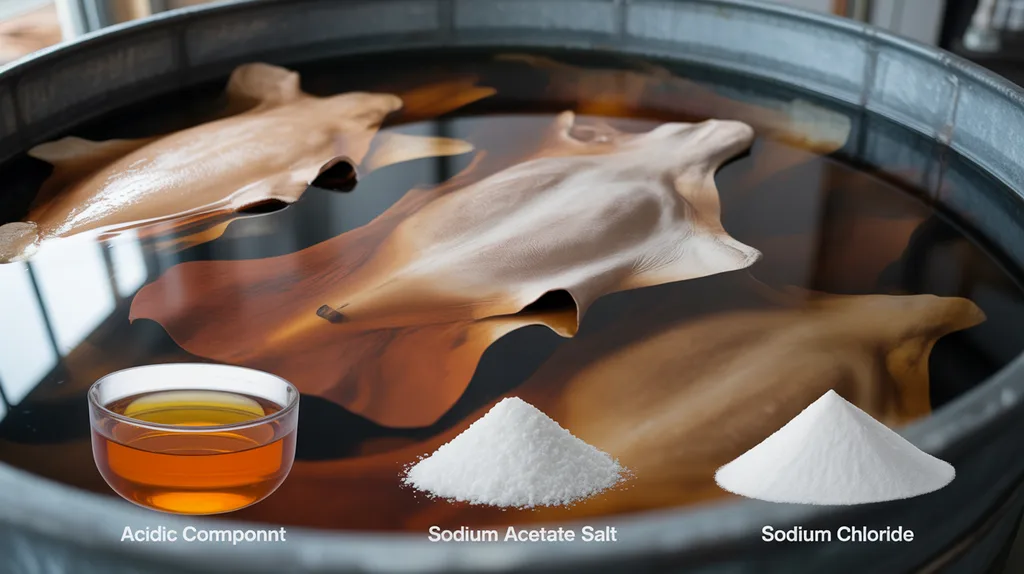
Sodium acetate is an acetate salt. In a leather pickle, its role should be kept chemically separate from the roles of the acid and the salt.
| Process component | Primary identity or function | What should not be assumed |
|---|---|---|
| Sodium acetate | An acetate-based additive or process modifier investigated in selected acidic systems | It is not automatically the main acidifying agent |
| Acidifying agent | Establishes the acidic conditions required by the pickle | It cannot be assumed to be interchangeable with sodium acetate |
| Sodium chloride | A salt component associated with limiting acid swelling in conventional systems | Sodium acetate should not automatically be treated as a replacement |
A published study on salt-free pickling investigated sodium acetate as an additive intended to restrict collagen swelling in acidic media. That is evidence of a study-specific process role, not proof that every sodium acetate product will deliver the same result in every tannery.
The distinction is important for formulation and troubleshooting. If the problem is insufficient acidification, changing the acetate level is not automatically equivalent to changing the acid system. If the problem is excessive swelling, sodium acetate should not be evaluated independently of salt concentration, acid loading, float composition, and leather response.
A technical buyer should therefore define the intended function before requesting a product:
- acetate-based process modification;
- investigation of acid-swelling behavior;
- support for a selected salt-reduction system; or
- use in a separate de-pickling stage.
The chemical form and supplied-product basis must also be specified before calculating quantities or comparing quotations.
Buffering and pH Control: Why pH Alone Is Not Enough

The title term “buffering” requires careful interpretation. An acetate-containing system can influence acid–base behavior, but the available evidence does not establish a universal sodium acetate buffer range for leather pickling.
A measured bath pH is only one process variable. It does not, by itself, establish:
- the total acid concentration or acid reserve;
- the amount of salt present;
- the composition of the float;
- how the chemicals distribute through the hide;
- the extent of collagen swelling;
- the performance of the leather after tanning and finishing.
For this reason, a tannery should avoid selecting sodium acetate solely because a laboratory solution reaches a convenient pH. General buffer chemistry does not automatically predict behavior in a complex leather pickle containing acids, salts, proteins, residual chemicals, and variable raw materials.
A more useful QA approach is to follow the pH trajectory and compare the trial against an approved control process. Depending on the tannery’s established methods, relevant observations may include:
- pH development during the process rather than only the final reading;
- acid and salt additions on a clearly defined basis;
- float composition and addition sequence;
- hide or skin type and condition;
- visible or measured swelling response;
- downstream leather properties selected by the tannery for comparison.
No universal pH target, dosage, temperature, or treatment time should be adopted from this article. Those values require a defined formulation, measurement method, raw-material specification, and controlled process trial.
How Acetate Relates to Acid Swelling and Collagen Behavior
Acid swelling is a central concern in acidic leather processing. Conventional pickling systems use salt as an important variable for limiting acid swelling, while the acid system establishes the acidic environment. Technical guidance from TFL discusses the importance of salt concentration in relation to acid swelling (TFL technical guidance).
In a separate salt-free-pickling study, sodium acetate was investigated as an additive intended to restrict collagen swelling in acidic media (ScienceDirect study). The wording matters: the source supports an investigation into this function under defined study conditions. It does not establish that sodium acetate universally controls swelling across all leather types and process designs.
A plant should therefore treat swelling control as a system-level question. The outcome may depend on:
- the type and condition of the hide or skin;
- the selected acid or acids;
- salt concentration or salt-reduction strategy;
- float ratio and mixing conditions;
- sodium acetate form and supplied-product basis;
- process sequence;
- temperature and measurement methods;
- the tanning route that follows pickling.
Finished-leather quality must also be considered. Research on pickling materials has examined effects related to leather quality and hide surface charge, but those findings should not be converted into a guarantee of improved grain, handle, strength, or final appearance for an unspecified sodium acetate product.
The appropriate question is not simply, “Does sodium acetate control swelling?” It is, “Under which defined formulation and process conditions does this sodium acetate system provide acceptable swelling behavior without compromising downstream leather performance?”
Sodium Acetate Versus Acid and Sodium Chloride
Sodium acetate, an acidifying agent, and sodium chloride should be compared by function rather than by their ability to change a pH reading.
| Criterion | Sodium acetate | Acidifying agent | Sodium chloride |
|---|---|---|---|
| Chemical role | Acetate salt; exact form must be specified | Acid component; identity depends on the recipe | Salt component |
| Role supported by the available evidence | Investigated as an additive associated with collagen-swelling restriction in selected acidic systems | Provides acidification in conventional pickling context | Important variable for limiting acid swelling in conventional systems |
| Universal replacement supported? | No | No equivalence with sodium acetate | No equivalence with sodium acetate |
| Main verification need | Form, assay basis, compatibility, pH trajectory, and leather response | Acid identity, concentration basis, addition sequence, and process fit | Salt level, float composition, and swelling response |
This comparison leads to a conditional decision path:
- If the process problem is acidification, evaluate the acid component and its addition conditions.
- If the process problem is acid swelling, evaluate the interaction between acid, salt, acetate, float composition, and the leather substrate.
- If the objective is salt reduction, require comparative trials rather than assuming sodium acetate provides the same function as sodium chloride.
- If the intended use is de-pickling, evaluate it as a separate process stage rather than as ordinary pickling chemistry.
Formic acid is a separate topic because it is an acidifying chemical, not an acetate salt. Information about formic acid for leather pickling should therefore be treated as acid-specific guidance and not transferred to sodium acetate.
Where De-Pickling Fits: A Separate Process Role
Sodium acetate has also been identified in selected workflows for de-pickling pelts before vegetable tanning. The EU tanning BAT reference document mentions sodium acetate or sodium bicarbonate in this limited context (EU BAT reference document).
This reference should not be read as a universal de-pickling recipe. It does not establish one dosage, pH value, temperature, or contact time for every leather process. Its relevance depends on the tanning route and the specific operating sequence.
The distinction can be summarized as follows:
- Pickling: prepares the hide or skin in an acidic system and requires control of acid swelling and chemical penetration.
- De-pickling: adjusts or removes the pickled condition before a subsequent process, such as a selected vegetable-tanning workflow.
A tannery considering sodium acetate for either stage should identify the process objective on the trial request and avoid using evidence from one stage to justify the other.
What to Verify Before a Plant Trial or RFQ
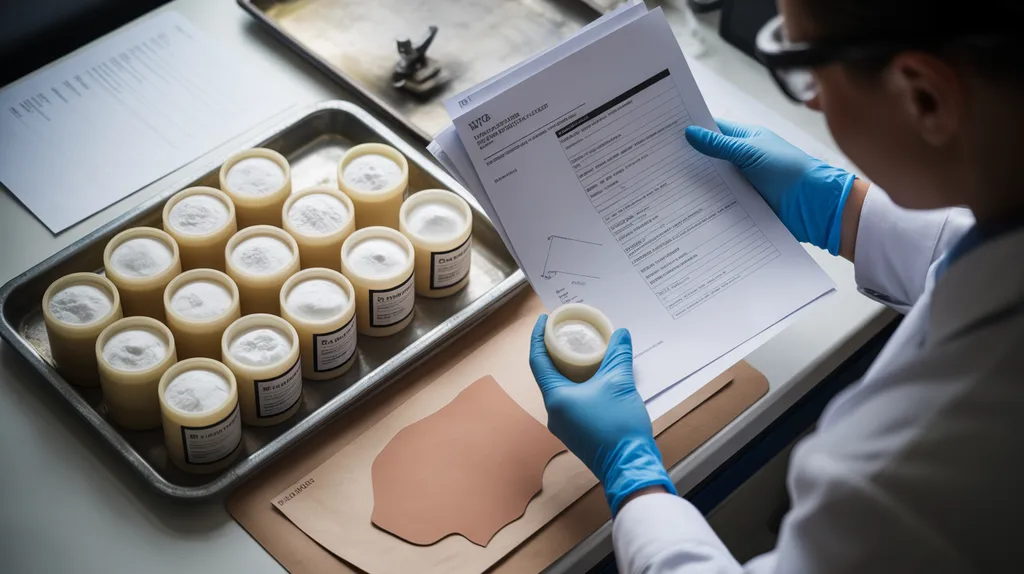
Before ordering or trialing sodium acetate for leather processing, the chemical identity and process requirements should be documented clearly.
Confirm the chemical form
The RFQ or technical inquiry should state:
- sodium acetate identity and CAS information;
- anhydrous or trihydrate form;
- solid or solution form;
- assay basis;
- moisture basis;
- supplied-product basis for any calculation.
Anhydrous and trihydrate sodium acetate are not interchangeable on a mass basis. A quantity calculated for one form should not be transferred to the other without a defined conversion and a clear statement of assumptions.
Request the relevant documents
For a technical evaluation, request and review the applicable:
- technical data sheet for specification limits and test methods;
- safety data sheet for hazard and handling information;
- certificate of analysis for the actual batch;
- product identification and packaging information.
A certificate of analysis describes a batch result. It does not, by itself, establish universal leather-process suitability, regulatory approval, or guaranteed performance. Likewise, a safety data sheet is a safety document, not proof of a particular application approval.
Define the process context
The trial request should record:
- the acid system and concentration basis;
- the salt level or salt-reduction objective;
- the float composition;
- the hide or skin type;
- the intended stage—pickling or de-pickling;
- the downstream tanning route;
- the pH measurement method and temperature;
- the existing control process used for comparison.
Measure more than the endpoint pH
A useful trial should compare the candidate system with the current process using the tannery’s established methods. Relevant observations may include:
- pH progression through the process;
- acid and salt balance;
- chemical addition sequence;
- swelling response;
- penetration or distribution indicators selected by the process team;
- finished-leather quality tests relevant to the product specification.
This is a process-validation framework, not a universal sodium acetate recipe. The appropriate measurements and acceptance criteria must be defined by the tannery for its raw materials and finished-leather requirements.
When Sodium Acetate Deserves Evaluation
Sodium acetate may deserve evaluation when a tannery is investigating an acetate-based modification of an acidic pickle, a salt-reduction approach, acid-swelling behavior, or a documented de-pickling workflow. The available evidence supports those as areas for technical assessment, not as automatic indications that sodium acetate will improve every process.
The safest selection approach is to:
- define the intended process function;
- specify the exact sodium acetate form;
- evaluate the complete acid–salt–float system;
- monitor pH trajectory rather than relying only on one reading;
- compare swelling and leather-quality results against a control;
- review product documentation before purchase.
Sodium acetate should therefore be treated as a formulation variable requiring controlled validation. Its role cannot be determined reliably from pH alone, and no universal dosage or performance guarantee is supported without product-specific and process-specific evidence.


Contact Us
In This Article
Related Posts
Custom Packaging Solutions from an Anhydrous Sodium Acetate Supplier in China
2026-09-23
Application Trends in Anhydrous Sodium Acetate for Special Chemical Manufacturing
2026-09-23
Anhydrous Sodium Acetate for Leather Tanning: Improve Dyeing Uniformity
2026-09-22
Formic Acid 85% for Textile Dyeing: Industrial Applications, Technical Benefits and Future Trends
2026-09-22


