



Polyacrylamide for Paper Making: Applications, Benefits, Grade Selection, and Purchasing Guide
By vanchor
2026-07-21Related Posts
Custom Packaging Solutions from an Anhydrous Sodium Acetate Supplier in China
2026-09-23
Application Trends in Anhydrous Sodium Acetate for Special Chemical Manufacturing
2026-09-23
Anhydrous Sodium Acetate for Leather Tanning: Improve Dyeing Uniformity
2026-09-22
Formic Acid 85% for Textile Dyeing: Industrial Applications, Technical Benefits and Future Trends
2026-09-22
Polyacrylamide for Paper Making is applied to numerous applications, such as enhancing fiber retention, filler retention, drainage, dry strength, wastewater clarification, sludge dewatering and paper machine efficiency. Polyacrylamide is a water-soluble polymer which can interact with fibers, fines, fillers and suspended solids, allowing paper manufacturers to lower losses of raw materials and provide a more stable production.
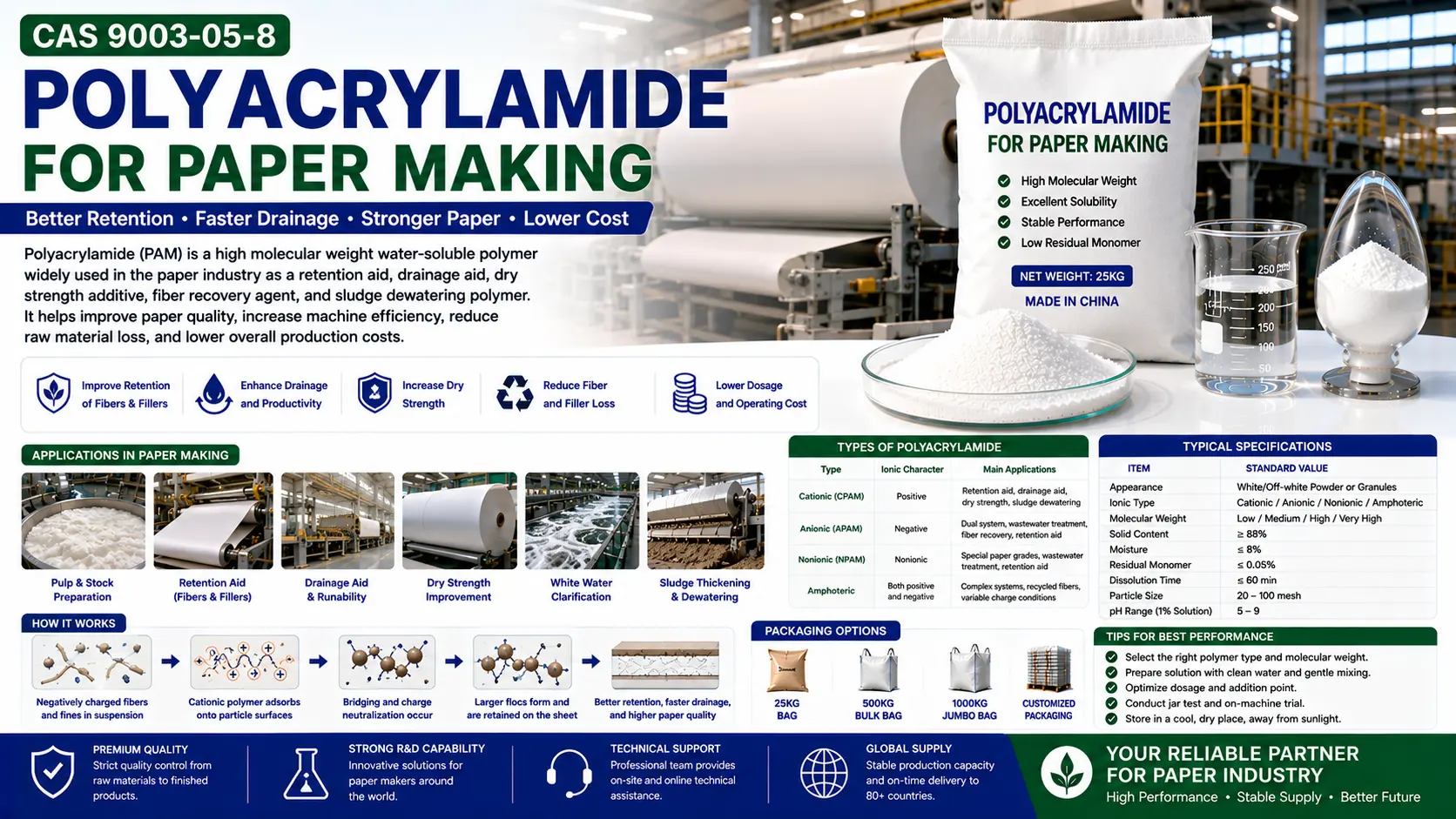
PAM is often referred to as polyacrylamide. Depending on the process, paper mills may use cationic, anionic, nonionic, or amphoteric grades. The right product depends on the type of pulp, the furnish composition, the amount of filler, the machine speed, the water chemistry, the pH, whether any additives are used and what the desired properties of the paper are.
Since all paper production systems are unique, it is not enough to choose the polymer by molecular weight or price; it must be tested in the laboratory and be tested under controlled machine conditions.
What Is Polyacrylamide?
Polyacrylamide is a synthetic water-soluble polymer produced mainly from acrylamide monomers. It is generally supplied as white or off-white powder, granules, emulsion, or liquid dispersion.
Typical product information includes:
- Product name: Polyacrylamide
- Abbreviation: PAM
- CAS number: 9003-05-8
- Appearance: White or off-white powder or granules
- Solubility: Soluble in water
- Main ionic types: Cationic, anionic, nonionic, and amphoteric
- Main functions: Retention, drainage, strength improvement, clarification, flocculation, and sludge dewatering
Dry PAM is normally dissolved in clean water before it is added to the papermaking system.
Why Polyacrylamide Is Used in Paper Making
Paper furnish contains fibers, fines, mineral fillers, pigments, starches, sizing agents, dyes, and other wet-end chemicals. Many of these materials are small enough to pass through the forming fabric if they are not retained effectively.
Polyacrylamide can help:
- Improve first-pass retention
- Increase filler retention
- Reduce fiber loss
- Improve drainage
- Support faster machine speeds
- Improve dry-paper strength
- Clarify white water
- Reduce wastewater solids
- Improve sludge dewatering
- Lower total production costs
The actual result depends on the polymer structure, dosage, addition point, furnish chemistry, and mixing conditions.
Main Types of Polyacrylamide for Paper Making
Cationic Polyacrylamide
Cationic polyacrylamide, or CPAM, contains positively charged functional groups.
It is widely used as a:
- Retention aid
- Drainage aid
- Dry-strength additive
- Fiber-recovery agent
- Paper-sludge dewatering polymer
- Wastewater flocculant
Cellulose fibers, fines, and many mineral particles commonly carry negative surface charges. Cationic PAM can interact with these materials and help form controlled flocs.
The correct cationic charge density depends on:
- Pulp type
- Recycled-fiber content
- Filler level
- Conductivity
- Anionic-trash concentration
- Existing wet-end chemicals
An excessively high charge may cause overflocculation, poor formation, deposits, or unstable machine performance.
Anionic Polyacrylamide
Anionic polyacrylamide, or APAM, contains negatively charged groups.
It may be used in:
- Dual-polymer retention systems
- Wastewater clarification
- Fiber recovery
- Mineral-filled paper systems
- Sludge treatment
- Selected strength programs
APAM may work with cationic starch, coagulants, or positively charged retention chemicals to form an effective microparticle or dual-polymer system.
Nonionic Polyacrylamide
Nonionic polyacrylamide, or NPAM, has relatively low ionic activity.
It may be suitable for:
- Selected paper grades
- Low-charge systems
- Wastewater treatment
- Acidic process conditions
- Specialized retention or thickening applications
Its performance mainly depends on polymer bridging rather than strong charge interaction.
Amphoteric Polyacrylamide
Amphoteric PAM contains both positive and negative functional groups.
It may be considered for:
- Recycled-fiber systems
- Furnishes with variable charge conditions
- Complex wet-end chemistry
- High-conductivity systems
- Specialized strength applications
Its performance should be verified through machine trials.
Polyacrylamide as a Retention Aid
Retention describes how effectively fibers, fines, fillers, and additives remain in the paper sheet during formation.
Poor retention can lead to:
- Loss of expensive fibers and fillers
- High white-water solids
- Deposits and contamination
- Unstable drainage
- Increased wastewater loading
- Paper-quality variation
Polyacrylamide helps connect fine materials to larger fibers so that more of them remain in the sheet.
Potential benefits include:
- Higher first-pass retention
- Improved filler retention
- Reduced raw-material loss
- Cleaner white-water circuits
- Lower wastewater-treatment load
- More stable basis weight and ash content
Retention should not be maximized without considering sheet formation. Excessive flocculation may create uneven fiber distribution and poor paper appearance.
Drainage Improvement
Drainage is the removal of water through the forming fabric.
A suitable PAM program may improve drainage by forming flocs that release water more easily.
Potential benefits include:
- Faster sheet formation
- Reduced vacuum demand
- Higher machine speed
- Lower steam consumption
- Improved press-section performance
- Reduced energy cost
However, excessively large flocs may damage sheet formation. The dosage should balance drainage and paper uniformity.
Dry-Strength Improvement
Certain polyacrylamide grades can improve dry-paper strength by increasing bonding between fibers.
Potential improvements may include:
- Tensile strength
- Burst strength
- Internal bond
- Folding endurance
- Surface strength
- Compression strength
Dry-strength PAM may be used in:
- Packaging paper
- Corrugated medium
- Testliner
- Recycled paper
- Tissue
- Printing paper
- Specialty paper
Performance depends on pulp quality, refining, starch use, filler content, polymer dosage, and drying conditions.
Paper-Machine Applications
Polyacrylamide may be added at different points in the wet-end system, including:
- Machine chest
- Mixing chest
- Fan pump
- Approach-flow system
- Pressure screen outlet
- Headbox feed line
- White-water treatment system
The addition point should provide sufficient distribution without exposing the forming polymer flocs to excessive shear.
Adding PAM too early may allow the flocs to break before sheet formation. Adding it too late may result in poor mixing and uneven performance.
Recycled-Paper Production
Recycled furnish often contains:
- Short fibers
- High fines content
- Fillers
- Printing inks
- Stickies
- Dissolved contaminants
- Anionic trash
These conditions can reduce retention and interfere with wet-end chemistry.
A suitable polyacrylamide program may help:
- Improve short-fiber retention
- Increase filler capture
- Reduce white-water solids
- Improve drainage
- Support dry strength
- Stabilize machine operation
Recycled systems may require a coagulant or charge-control chemical before PAM is added.
Polyacrylamide in Paper-Mill Wastewater
Paper-mill wastewater may contain:
- Cellulose fibers
- Fines
- Fillers
- Coating pigments
- Starch
- Dyes
- Suspended solids
- Organic processing chemicals
PAM may be used to support:
- Primary clarification
- Dissolved-air flotation
- Fiber recovery
- Sedimentation
- Filtration
- Sludge thickening
- Sludge dewatering
Potential benefits include:
- Lower suspended solids
- Improved recovered-fiber value
- Clearer treated water
- Reduced sludge volume
- Better filter-press or centrifuge performance
- Increased process-water recycling
Paper-Sludge Dewatering
Paper sludge may contain fibers, calcium carbonate, clay, coating pigments, starch, and organic additives.
Cationic polyacrylamide is commonly used before:
- Belt filter presses
- Screw presses
- Centrifuges
- Plate-and-frame filter presses
- Rotary drum thickeners
A suitable polymer may improve:
- Floc strength
- Free-water release
- Solids capture
- Filtrate clarity
- Cake dryness
- Equipment throughput
The polymer should be tested with the actual sludge because filler type and recycled-fiber content can significantly affect dewatering.
Important Product Specifications
A professional supplier should provide measurable information for:
- Ionic type
- Molecular weight
- Charge density
- Solid content
- Moisture
- Residual acrylamide monomer
- Particle size
- Dissolution time
- Solution viscosity
- Recommended pH range
Product descriptions such as “high molecular weight PAM” are not sufficient for technical purchasing.
Molecular Weight and Charge Density
Molecular weight influences chain length and bridging ability.
Higher molecular weight may improve retention and floc strength, but it can also:
- Slow dissolution
- Increase shear sensitivity
- Cause overflocculation
- Reduce sheet formation
- Create pumping difficulties
Charge density affects how the polymer interacts with fibers and fillers.
The correct balance should be determined through testing.
Solution Preparation
A typical preparation procedure includes:
- Fill a clean tank with water.
- Begin gentle agitation.
- Add PAM powder slowly and evenly.
- Avoid dumping the material into one location.
- Maintain low-shear mixing.
- Allow sufficient hydration and aging.
- Confirm complete dissolution.
- Transfer the solution to the dosing system.
- Adjust the dosage during machine trials.
High-speed mixing should be avoided because excessive shear can damage polymer chains.
Dosage Optimization
There is no universal dosage for every paper mill.
The correct dosage depends on:
- Pulp type
- Recycled-fiber content
- Filler level
- Machine speed
- Conductivity
- pH
- Anionic trash
- Existing additives
- Retention target
- Drainage target
- Sheet-formation requirements
Overdosing may cause:
- Poor sheet formation
- Large flocs
- Deposits
- Reduced drainage consistency
- Increased chemical cost
Underdosing may result in poor retention, high white-water solids, and limited strength improvement.
How to Evaluate a Supplier
A reliable supplier should offer:
- Multiple ionic grades
- Different molecular-weight ranges
- Various charge densities
- Retention-aid products
- Dry-strength grades
- Wastewater-treatment PAM
- Sludge-dewatering polymers
- Representative samples
- Technical testing support
- Batch-specific quality documents
Buyers should request:
- Technical data sheet
- Safety data sheet
- Certificate of analysis
- Product specification
- Packaging information
- Sample-testing support
- Production-capacity details
- Export documentation
Conclusion
The polyacrylamide for paper making is a significant polymer for enhancing the retention, drainage, dry strength, fiber recovery, wastewater clarification and sludge dewatering.
It relies on ionic type, molecular weight, charge density, furnish composition, filler content, water chemistry, dosage, addition point and machine conditions.
Paper manufacturers should obtain detailed process information, review the technical specification, take representative samples, do lab testing and conduct controlled machine trials before buying.
A good partner will offer appropriate PAM grades, constant product quality, consistent batch performance, moisture resistant packaging, full documentation, prompt technical assistance and global delivery.


Contact Us
In This Article
Related Posts
Custom Packaging Solutions from an Anhydrous Sodium Acetate Supplier in China
2026-09-23
Application Trends in Anhydrous Sodium Acetate for Special Chemical Manufacturing
2026-09-23
Anhydrous Sodium Acetate for Leather Tanning: Improve Dyeing Uniformity
2026-09-22
Formic Acid 85% for Textile Dyeing: Industrial Applications, Technical Benefits and Future Trends
2026-09-22


