



Polyacrylamide for Oil Drilling: Applications, Product Selection, Performance, and Purchasing Guide
By vanchor
2026-07-21Related Posts
Custom Packaging Solutions from an Anhydrous Sodium Acetate Supplier in China
2026-09-23
Application Trends in Anhydrous Sodium Acetate for Special Chemical Manufacturing
2026-09-23
Anhydrous Sodium Acetate for Leather Tanning: Improve Dyeing Uniformity
2026-09-22
Formic Acid 85% for Textile Dyeing: Industrial Applications, Technical Benefits and Future Trends
2026-09-22
Polyacrylamide for Oil Drilling is mainly applied to enhance the viscosity, loss, stabilization of shale, transport of cuttings, reduce drilling fluid friction, clean the wellbore, and treat wastewater during drilling fluid operations. Polyacrylamide is a high molecular weight water soluble polymer that can adjust the rheology of drilling fluid and better stabilize the performance of drilling fluid under the condition of harsh field use.
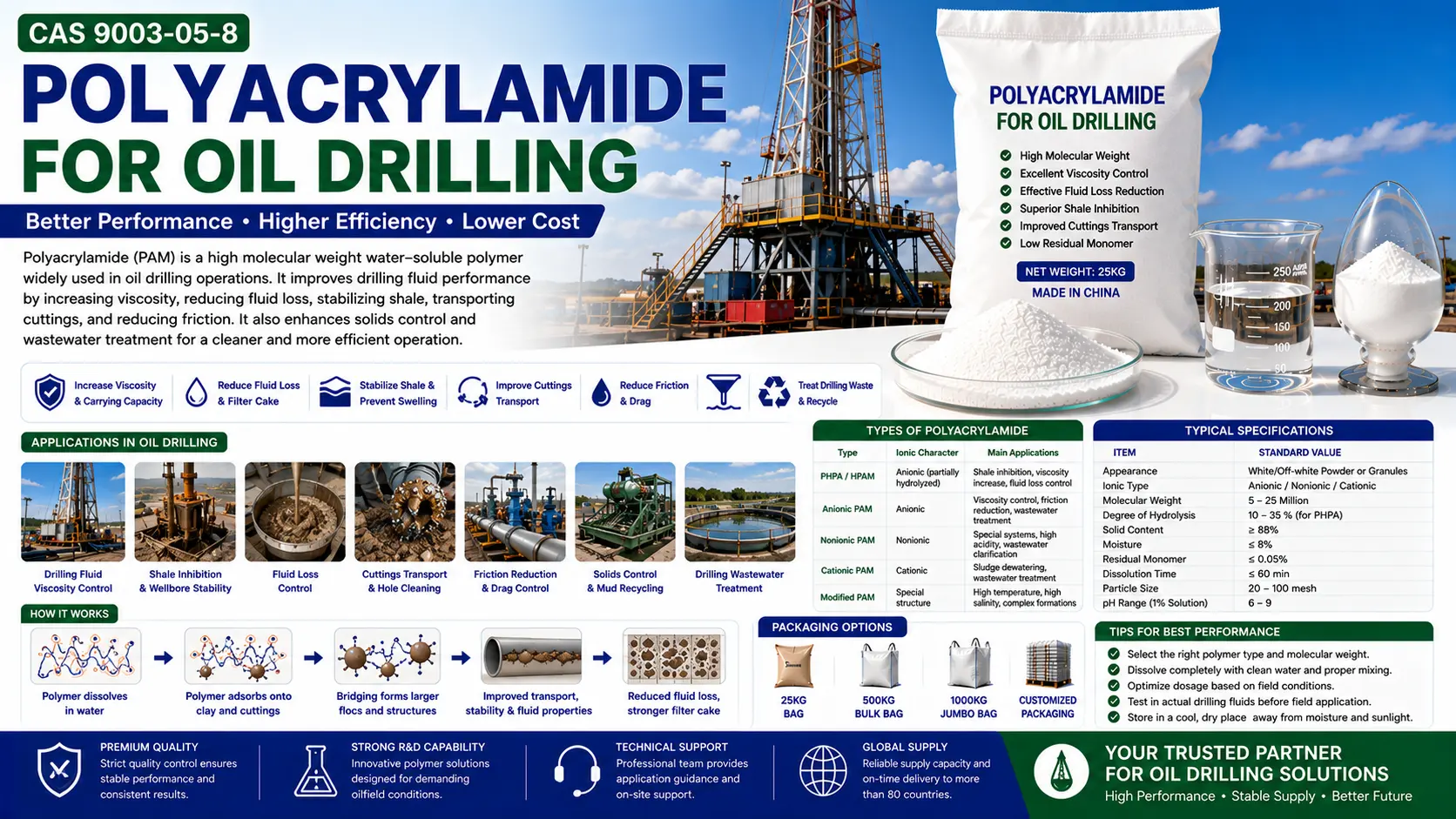
PAM is a popular term for polyacrylamide. One of the most common polymers used in this area is partially hydrolyzed polyacrylamide, commonly known as HPAM or PHPA. Oilfield operators can use the anionic, nonionic, cationic or specially modified polymer grades depending on the type of oilfield, the formation chemistry, the temperature of the operation, the salinity of the formation and the treatment objectives.
It is not a simple decision based on molecular weight or unit price that should be made when choosing the proper polymer. The field performance is affected by the hydrolysis degree, ionic character, salt tolerance, thermal stability, shear resistance, dissolution speed, residual monomer, particle size, and compatibility with other drilling-fluid additives.
What Is Polyacrylamide?
Polyacrylamide is a synthetic water-soluble polymer mainly produced from acrylamide monomers. It can be manufactured with different ionic structures and molecular properties for industrial and oilfield applications.
Typical product information includes:
- Product name: Polyacrylamide
- Abbreviation: PAM
- CAS number: 9003-05-8
- Appearance: White or off-white powder or granules
- Solubility: Soluble in water
- Common oilfield types: APAM, HPAM, PHPA, NPAM, CPAM, and modified PAM
- Main functions: Viscosity control, flocculation, fluid-loss reduction, shale inhibition, friction reduction, and wastewater treatment
Dry polyacrylamide is normally dispersed and hydrated in water before being introduced into the drilling-fluid system.
Why Polyacrylamide Is Used in Oil Drilling
Oil and gas drilling fluids must transport cuttings, control formation pressure, stabilize the wellbore, cool and lubricate the drill bit, and minimize fluid invasion into the formation.
Polyacrylamide may help improve these functions by:
- Increasing drilling-fluid viscosity
- Improving cuttings suspension
- Supporting hole cleaning
- Reducing fluid loss
- Encapsulating shale and clay
- Reducing clay dispersion
- Improving wellbore stability
- Reducing friction
- Supporting solids control
- Clarifying drilling wastewater
- Improving mud-recycling efficiency
The actual result depends on polymer grade, dosage, fluid chemistry, temperature, salinity, shear, and formation mineralogy.
Main Types of Polyacrylamide for Oil Drilling
Partially Hydrolyzed Polyacrylamide
Partially hydrolyzed polyacrylamide is commonly abbreviated as HPAM or PHPA.
It contains anionic carboxyl groups formed through partial hydrolysis of polyacrylamide.
PHPA is widely used for:
- Shale encapsulation
- Clay inhibition
- Cuttings stabilization
- Viscosity modification
- Fluid-loss control
- Friction reduction
- Drilling-fluid conditioning
Its long polymer chains can adsorb onto shale and clay surfaces, helping reduce hydration and dispersion.
Important PHPA properties include:
- Molecular weight
- Hydrolysis degree
- Anionic charge density
- Thermal stability
- Salt tolerance
- Shear resistance
- Dissolution speed
Anionic Polyacrylamide
Anionic polyacrylamide, or APAM, contains negatively charged functional groups.
It may be used in:
- Water-based drilling fluids
- Drilling-wastewater clarification
- Cuttings separation
- Solids-control systems
- Friction-reducing formulations
- Produced-water treatment
- Enhanced oil-recovery support
High-molecular-weight APAM can provide strong viscosity development and particle bridging.
Nonionic Polyacrylamide
Nonionic polyacrylamide, or NPAM, has very low ionic activity.
It may be considered for:
- High-acidity systems
- Low-charge drilling fluids
- Selected saline environments
- Specialized fluid formulations
- Oilfield wastewater treatment
- Mineral and clay suspensions
NPAM mainly relies on polymer bridging rather than strong electrostatic interaction.
Cationic Polyacrylamide
Cationic polyacrylamide, or CPAM, is less commonly used as the main drilling-fluid polymer but may be useful in:
- Oilfield sludge dewatering
- Drilling-wastewater treatment
- Produced-water clarification
- Organic-contaminant removal
- Sludge-conditioning systems
Its positive charge can interact with negatively charged organic matter and fine solids.
Modified Oilfield Polyacrylamide
Specially modified PAM grades may be designed for:
- High-temperature wells
- High-salinity formations
- Calcium-rich brines
- High-shear circulation
- Horizontal drilling
- Deep wells
- Difficult shale formations
- Offshore drilling
Modified polymers may contain functional groups that improve salt tolerance, thermal stability, or adsorption behavior.
Shale Encapsulation and Inhibition
Reactive shale can absorb water, swell, disperse, and weaken the wellbore.
These problems may cause:
- Wellbore instability
- Tight hole conditions
- Bit balling
- Excessive torque and drag
- Increased solids loading
- Poor mud properties
- Stuck pipe
- Reduced drilling efficiency
PHPA can adsorb onto shale and cuttings surfaces, creating a polymer coating that helps reduce water penetration and mechanical dispersion.
Potential benefits include:
- Improved cutting integrity
- Reduced shale swelling
- Lower clay dispersion
- Cleaner drilling fluid
- Better solids-control performance
- Reduced wellbore enlargement
The polymer should be compatible with the formation mineralogy and the complete drilling-fluid system.
Drilling-Fluid Viscosity Control
Polyacrylamide can increase fluid viscosity and improve suspension capacity.
Potential advantages include:
- Better cuttings transport
- Improved hole cleaning
- Reduced settling during circulation stops
- Better suspension of weighting materials
- More stable rheology
- Improved low-shear-rate viscosity
Excessive viscosity may increase pump pressure and reduce drilling efficiency.
The polymer dosage should therefore be optimized according to:
- Hole size
- Annular velocity
- Drilling rate
- Cuttings size
- Fluid density
- Temperature
- Pump capacity
- Horizontal or vertical well profile
Cuttings Transport
Efficient cuttings removal is essential for maintaining drilling performance.
Poor hole cleaning may lead to:
- Cuttings-bed formation
- Increased torque and drag
- Pack-off
- Stuck pipe
- Reduced rate of penetration
- Difficulty running casing
Polyacrylamide can improve the fluid’s carrying capacity by increasing viscosity and supporting stable suspension.
In deviated and horizontal wells, low-shear-rate rheology is particularly important because cuttings can settle on the lower side of the wellbore.
Fluid-Loss Control
Fluid loss occurs when the liquid phase of drilling fluid enters a permeable formation.
Excessive fluid loss may cause:
- Thick filter cake
- Formation damage
- Differential sticking
- Wellbore instability
- Increased mud consumption
- Reduced drilling efficiency
Certain polyacrylamide grades can support fluid-loss control by increasing solution viscosity and improving filter-cake structure.
PAM is often used together with:
- Starch
- Polyanionic cellulose
- Carboxymethyl cellulose
- Bentonite
- Lignite
- Synthetic fluid-loss additives
Compatibility testing is required because performance depends on salinity, temperature, pH, and the complete additive package.
Friction Reduction
High-molecular-weight polyacrylamide may reduce friction in fluid-flow systems.
Potential oilfield applications include:
- Drilling-fluid circulation
- Hydraulic-fracturing fluids
- Pipeline transport
- Water injection
- Coiled-tubing operations
- Produced-water transfer
The polymer can reduce turbulence and pressure loss under suitable conditions.
Important performance factors include:
- Molecular weight
- Solution concentration
- Shear stability
- Water quality
- Salinity
- Pumping rate
- Temperature
Excessive mechanical shear may break polymer chains and reduce friction-reduction efficiency.
High-Temperature Performance
Temperature can significantly affect polyacrylamide performance.
High temperatures may cause:
- Polymer-chain degradation
- Reduced viscosity
- Faster hydrolysis
- Loss of adsorption
- Reduced shale inhibition
- Shorter fluid service life
For deep or high-temperature wells, buyers should evaluate:
- Temperature resistance
- Viscosity retention
- Hydrolysis stability
- Long-term aging performance
- Compatibility after hot rolling
- Thermal-oxidative stability
Standard PAM may not be suitable for every high-temperature drilling environment.
Modified oilfield polymers may be required.
Salinity and Hardness Tolerance
Drilling fluids may contain sodium chloride, potassium chloride, calcium, magnesium, and other dissolved salts.
High salinity can reduce polymer-chain expansion and lower solution viscosity.
Calcium and magnesium may further affect polymer solubility and performance.
Oilfield-grade PAM should be tested in the actual water source, including:
- Fresh water
- Seawater
- Brine
- Formation water
- Recycled drilling water
- High-calcium water
Important measurements include:
- Initial viscosity
- Aged viscosity
- Dissolution behavior
- Flocculation performance
- Shale recovery
- Fluid-loss control
Shear Resistance
Drilling fluids pass through pumps, drill strings, nozzles, and surface-processing equipment.
These conditions expose polymer chains to strong mechanical shear.
Poor shear stability may result in:
- Viscosity loss
- Reduced friction reduction
- Weaker flocculation
- Lower shale-inhibition performance
- Unstable fluid properties
A suitable oilfield polyacrylamide should retain an acceptable level of performance after circulation and mechanical mixing.
pH Compatibility
Polyacrylamide performance can be influenced by drilling-fluid pH.
PHPA and APAM are commonly used in neutral to alkaline water-based mud systems.
Extreme pH may affect:
- Polymer hydrolysis
- Solubility
- Molecular structure
- Adsorption behavior
- Viscosity
- Thermal stability
The product should be tested under the planned operating pH.
Drilling-Wastewater Treatment
Drilling operations generate wastewater containing:
- Fine clay
- Cuttings
- Oil
- Suspended solids
- Polymers
- Salts
- Weighting materials
- Surfactants
- Other drilling chemicals
Polyacrylamide may be used to support:
- Coagulation and flocculation
- Sedimentation
- Dissolved-air flotation
- Filtration
- Centrifuge separation
- Sludge thickening
- Sludge dewatering
- Water recycling
Anionic PAM may be suitable for mineral-rich suspended solids, while cationic PAM may be selected for sludge containing more organic contaminants.
Drilling-Mud Recovery
Polyacrylamide may support mud-recovery systems by improving the separation of unwanted fine solids from reusable water.
Potential benefits include:
- Clearer recycled water
- Lower suspended solids
- Reduced freshwater demand
- Improved centrifuge performance
- Better filter-press operation
- Lower waste volume
- Reduced disposal costs
The polymer should not interfere with the properties of the recovered drilling fluid.
Oilfield Sludge Dewatering
Oilfield sludge may contain oil, water, clay, sand, chemicals, and organic solids.
Cationic or amphoteric polyacrylamide may be tested before:
- Belt filter presses
- Screw presses
- Centrifuges
- Plate-and-frame filter presses
- Geotextile dewatering systems
Important performance indicators include:
- Floc strength
- Water release
- Oil separation
- Filtrate clarity
- Cake solids
- Polymer dosage
- Equipment throughput
Important Product Specifications
A professional supplier should provide measurable technical data.
Important specifications include:
- Ionic type
- Molecular weight
- Hydrolysis degree
- Charge density
- Solid content
- Moisture
- Residual acrylamide monomer
- Particle size
- Dissolution time
- Solution viscosity
- Salt tolerance
- Thermal stability
- Shear resistance
- Recommended pH range
Molecular Weight
Molecular weight influences:
- Viscosity
- Friction reduction
- Polymer bridging
- Cuttings suspension
- Shale encapsulation
- Shear sensitivity
Higher molecular weight may improve viscosity and bridging but may also:
- Dissolve more slowly
- Be more sensitive to shear
- Create pumping difficulties
- Increase solution viscosity excessively
The correct molecular-weight range depends on the application.
Hydrolysis Degree
The hydrolysis degree is particularly important for PHPA and APAM.
It affects:
- Anionic charge
- Shale adsorption
- Clay interaction
- Solubility
- Salt sensitivity
- Viscosity
- Flocculation behavior
An excessively high hydrolysis level may reduce performance in high-salinity or high-calcium systems.
Solid Content and Moisture
Solid content indicates the proportion of usable polymer in the product.
Excessive moisture may:
- Reduce active polymer content
- Increase freight cost
- Cause caking
- Affect automatic feeding
- Reduce storage stability
- Create dosing variation
Products should be compared based on active content and field performance rather than unit price alone.
Residual Acrylamide Monomer
Residual acrylamide monomer should be carefully controlled.
The acceptable level depends on:
- Product grade
- Intended use
- Destination regulations
- Environmental requirements
- Customer specifications
Buyers should request batch-specific test results.
Particle Size and Dissolution
Consistent particle size supports:
- Stable feeding
- Predictable dissolution
- Reduced dust
- Lower lump formation
- Faster solution preparation
Poor dissolution may cause:
- Fish-eye formation
- Undissolved polymer
- Blocked lines
- Inaccurate dosing
- Reduced viscosity
- Lower treatment performance
Preparing Polyacrylamide Solution
A typical preparation process may include:
- Fill a clean mixing tank with suitable water.
- Start gentle agitation.
- Add PAM slowly and evenly.
- Avoid dumping powder into one location.
- Maintain low-shear mixing.
- Allow sufficient hydration and aging.
- Confirm complete dissolution.
- Transfer the solution to the dosing system.
- Adjust dosage according to field performance.
High-speed mixing should be avoided because excessive shear can damage polymer chains.
The preparation water should be checked for:
- Salinity
- Hardness
- Temperature
- pH
- Suspended solids
- Oil contamination
Dosage Optimization
There is no universal PAM dosage for every drilling system.
The correct dosage depends on:
- Drilling-fluid type
- Hole section
- Formation mineralogy
- Temperature
- Salinity
- Calcium content
- pH
- Solids loading
- Desired viscosity
- Shale-inhibition requirement
- Circulation rate
- Other additives
Overdosing may cause:
- Excessive viscosity
- High pump pressure
- Poor solids separation
- Difficult mixing
- Increased chemical cost
- Formation of polymer-rich deposits
Underdosing may result in:
- Weak shale inhibition
- Poor hole cleaning
- Reduced viscosity
- Excessive clay dispersion
- Unstable drilling-fluid properties
Laboratory Evaluation
Before field use, oilfield PAM should be tested in representative drilling water or mud.
Tests may include:
- Dissolution time
- Apparent viscosity
- Plastic viscosity
- Yield point
- Gel strength
- Fluid loss
- Shale recovery
- Cuttings dispersion
- Salt tolerance
- Calcium tolerance
- Thermal aging
- Shear stability
- Friction reduction
The test fluid should contain the planned salts, weighting materials, and additives.
Field Trials
After laboratory screening, a controlled field or pilot trial should evaluate:
- Mixing behavior
- Actual dosage
- Rheology
- Pump pressure
- Cuttings transport
- Shale stability
- Solids-control efficiency
- Fluid loss
- Mud maintenance cost
- Wastewater-treatment performance
Field trials are essential because laboratory conditions cannot fully reproduce circulation, contamination, shear, and changing formation conditions.
Packaging Options
Polyacrylamide for oil drilling is commonly supplied in:
- 25 kg PE-lined kraft bags
- Paper-plastic bags
- Moisture-resistant woven bags
- 500 kg bulk bags
- 1,000 kg jumbo bags
- Customized palletized packaging
- Drums or IBCs for emulsion products
Packaging should protect the polymer from moisture, contamination, heat, and physical damage.
Storage and Handling
PAM should be stored in a cool, dry, and ventilated warehouse.
It should be protected from:
- Moisture
- Direct sunlight
- High temperatures
- Damaged packaging
- Contamination
- Strong oxidizing agents
- Prolonged outdoor exposure
Opened bags should be resealed tightly.
Wet polyacrylamide creates extremely slippery surfaces and should be cleaned promptly.
Workers should follow the current safety data sheet and site procedures.
How to Evaluate a Supplier
A reliable oilfield-polymer supplier should offer:
- PHPA and HPAM grades
- High-molecular-weight APAM
- Salt-tolerant polymers
- High-temperature grades
- Low-residual-monomer products
- Customized hydrolysis levels
- Application-specific recommendations
- Representative samples
- Laboratory-testing support
- Batch traceability
Buyers should request:
- Technical data sheet
- Safety data sheet
- Batch-specific certificate of analysis
- Product specification
- Thermal-aging data
- Salinity-tolerance data
- Sample-testing support
- Packaging information
- Production-capacity details
- Export documentation
How to Request an Accurate Quotation
A complete inquiry should include:
- Intended drilling application
- Water-based mud type
- Well temperature
- Water salinity
- Calcium and magnesium content
- Formation type
- Required viscosity
- Hydrolysis requirement
- Molecular-weight preference
- Current additives
- Order quantity
- Packaging
- Destination
- Incoterm
- Delivery schedule
For example:
“Please recommend and quote PHPA for shale inhibition in a potassium-chloride water-based drilling fluid, with operating temperatures up to 120°C, packed in 25 kg bags, including samples, TDS, SDS, and batch-specific COA.”
Detailed technical information helps the supplier recommend a suitable product.
Comparing Supplier Quotations
Buyers should compare products according to:
- Polymer type
- Molecular weight
- Hydrolysis degree
- Salt tolerance
- Thermal stability
- Shear resistance
- Solid content
- Moisture
- Residual monomer
- Dissolution speed
- Effective dosage
- Packaging
- Technical support
- Batch consistency
Products with similar descriptions may perform very differently under field conditions.
Total Operating Cost
The lowest price per kilogram may not provide the lowest drilling cost.
Operators should consider:
- Effective dosage
- Fluid-property stability
- Shale-control performance
- Hole-cleaning efficiency
- Rate of penetration
- Pump pressure
- Mud dilution
- Waste volume
- Solids-control performance
- Downtime risk
- Technical support
A higher-performing polymer may reduce mud consumption, wellbore problems, dilution requirements, and overall drilling time.
Common Purchasing Risks
Potential risks include:
- Selecting standard PAM for high-temperature wells
- Ignoring salinity and hardness
- Choosing only by molecular weight
- Using an unsuitable hydrolysis degree
- Poor dissolution
- Weak shear resistance
- Excessive moisture
- High residual monomer
- Batch inconsistency
- Damaged packaging
- Missing technical data
- Limited application support
These risks can be reduced through clear specifications, representative testing, field trials, batch-specific COAs, and supplier qualification.
Questions to Ask Before Ordering
Buyers should confirm:
- Which PAM grade is suitable for the drilling-fluid system?
- Is PHPA or HPAM available?
- What molecular-weight ranges can be supplied?
- What hydrolysis levels are available?
- What is the maximum recommended temperature?
- Is the polymer suitable for seawater or brine?
- What calcium tolerance can be expected?
- What is the guaranteed solid content?
- What is the residual-monomer limit?
- What is the normal dissolution time?
- Can representative samples be provided?
- Can laboratory-testing support be offered?
- Can recent batch COAs be supplied?
- Are jumbo bags available?
- Can customized oilfield grades be produced?
Conclusion
Polyacrylamide for Oil Drilling is used in drilling fluid viscosity control, shale encapsulation, cuttings transport, fluid loss reduction, friction control, drilling wastewater treatment, solids separation and sludge dewatering.
It is dependent on the properties of polymer used, molecular weight, degree of hydrolysis, charge density, salinity tolerance, thermal stability, shear resistance, dissolution, dosage, formation properties and the chemistry of the drilling fluids.
Oilfield operators should have a complete and detailed well and fluid profile, the full technical specification and representative samples, perform laboratory testing and complete controlled field trials prior to purchase.
A reliable supplier needs to offer appropriate oilfield grades of PHPA, HPAM, APAM, consistency, controlled quality, moisture-proof packaging, batch-specific documentation, technical support and reliable global delivery.


Contact Us
In This Article
Related Posts
Custom Packaging Solutions from an Anhydrous Sodium Acetate Supplier in China
2026-09-23
Application Trends in Anhydrous Sodium Acetate for Special Chemical Manufacturing
2026-09-23
Anhydrous Sodium Acetate for Leather Tanning: Improve Dyeing Uniformity
2026-09-22
Formic Acid 85% for Textile Dyeing: Industrial Applications, Technical Benefits and Future Trends
2026-09-22


