



Polyacrylamide Powder Supplier: Types, Applications, Specifications, and Purchasing Guide
By vanchor
2026-07-21Related Posts
Custom Packaging Solutions from an Anhydrous Sodium Acetate Supplier in China
2026-09-23
Application Trends in Anhydrous Sodium Acetate for Special Chemical Manufacturing
2026-09-23
Anhydrous Sodium Acetate for Leather Tanning: Improve Dyeing Uniformity
2026-09-22
Formic Acid 85% for Textile Dyeing: Industrial Applications, Technical Benefits and Future Trends
2026-09-22
A good Polyacrylamide Powder Supplier ought to offer competitive rates. Additionally, industrial buyers require appropriate ionic grades, consistent molecular characteristics, controlled moisture content, low residual monomer, rapid dissolution and moisture-proof packaging, comprehensive technical documentation and reliable worldwide delivery.
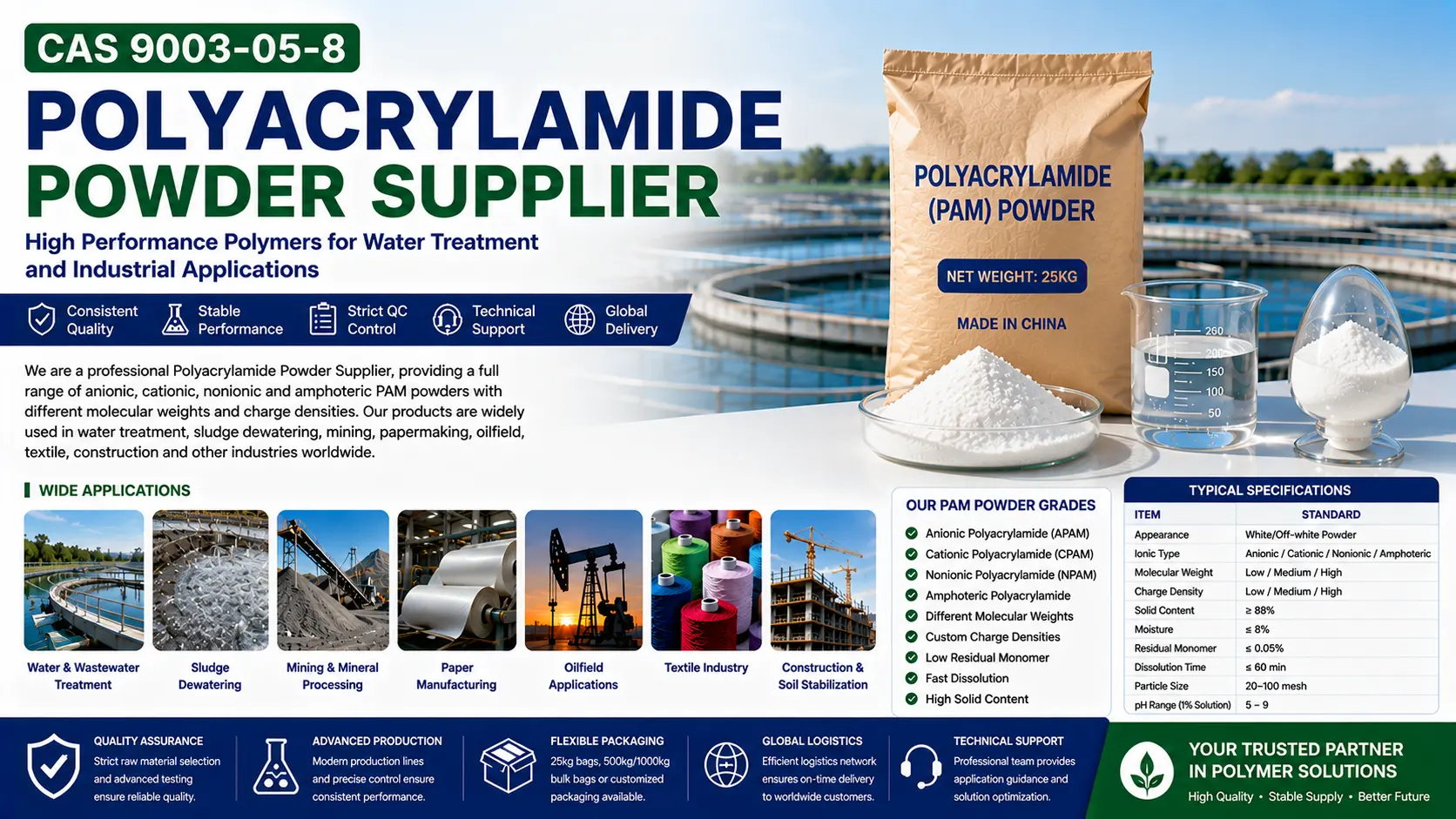
In the municipal water treatment, industrial wastewater clarification, sludge dewatering, mining, mineral processing, paper making industry, oil fields and textile wastewater, sand washing, construction and soil stabilization, the use of polyacrylamide powder is very wide spread.
Considering the molecular structure, type of ion, degree of hydrolysis, solids content, particle size, dissolution time, and treatment performance, buyers need to carefully compare the different properties of the products before ordering them according to their needs.
What Is Polyacrylamide Powder?
Polyacrylamide is a water-soluble polymer primarily produced from acrylamide monomers. It is normally supplied as a white or off-white granular powder that is dissolved in water before application.
Typical product information includes:
- Product name: Polyacrylamide
- Abbreviation: PAM
- CAS number: 9003-05-8
- Appearance: White or off-white powder or granules
- Solubility: Soluble in water
- Main types: Anionic, cationic, nonionic, and amphoteric
- Common functions: Flocculation, sedimentation, thickening, retention, filtration, and sludge dewatering
Polyacrylamide powder can be manufactured with different molecular weights, charge densities, hydrolysis levels, and particle sizes to meet specific industrial requirements.
Why Polyacrylamide Is Supplied as Powder
Powder polyacrylamide is widely used because it provides several practical advantages compared with pre-diluted liquid products.
Potential benefits include:
- High active-polymer content
- Lower transportation weight
- Long storage stability under dry conditions
- Flexible solution preparation
- Convenient packaging
- Suitability for automated dosing systems
- Lower packaging and freight cost per unit of active polymer
- Multiple ionic grades
However, the powder must be dissolved correctly before use. Poor preparation can reduce polymer efficiency and create operational problems.
Main Types of Polyacrylamide Powder
Anionic Polyacrylamide Powder
Anionic polyacrylamide, or APAM, contains negatively charged functional groups.
It is commonly used in:
- Industrial wastewater clarification
- Mining tailings
- Sand washing
- Coal washing
- Mineral processing
- Paper manufacturing
- Construction wastewater
- Soil stabilization
- Selected oilfield applications
APAM is often selected when long polymer chains are needed to bridge fine suspended particles into larger flocs.
Available APAM grades may vary in:
- Molecular weight
- Anionic charge density
- Degree of hydrolysis
- Particle size
- Solution viscosity
- Dissolution speed
Cationic Polyacrylamide Powder
Cationic polyacrylamide, or CPAM, contains positively charged groups.
Typical applications include:
- Municipal sludge dewatering
- Biological sludge treatment
- Sewage-treatment plants
- Paper sludge
- Food-processing wastewater
- Textile wastewater
- Chemical-industry effluent
- Organic wastewater
CPAM is commonly selected for sludge containing negatively charged organic matter.
The correct charge density depends on sludge composition, solids concentration, pH, and dewatering equipment.
Nonionic Polyacrylamide Powder
Nonionic polyacrylamide, or NPAM, has relatively low ionic activity.
Potential applications include:
- Acidic wastewater
- Mineral separation
- Textile processing
- Paper manufacturing
- Soil treatment
- Selected industrial clarification systems
NPAM may be suitable where strong anionic or cationic interaction is unnecessary.
Amphoteric Polyacrylamide Powder
Amphoteric polyacrylamide contains both positive and negative functional groups.
It may be used in:
- Complex wastewater
- Variable sludge streams
- Papermaking
- Mixed organic and inorganic effluent
- Specialized industrial separation systems
The product should be tested using actual wastewater or sludge before full-scale use.
How Polyacrylamide Powder Works
Polyacrylamide supports solid-liquid separation through several mechanisms.
Polymer Bridging
Long polymer chains attach to several suspended particles at the same time.
This creates larger flocs that can settle, float, filter, or dewater more easily.
Charge Neutralization
Charged polymer groups reduce the electrical repulsion between fine particles.
Once the surface charge is reduced, the particles can aggregate more efficiently.
Thickening
High-molecular-weight polyacrylamide can increase solution viscosity and modify flow behavior.
Retention and Filtration
In papermaking and selected industrial processes, PAM can improve the retention of fibers, fillers, and fine particles while supporting drainage and filtration.
Water and Wastewater Treatment
Polyacrylamide powder is widely used as a flocculant or coagulation aid.
Potential benefits include:
- Faster particle aggregation
- Larger floc formation
- Improved sedimentation
- Lower turbidity
- Better filtration
- Reduced suspended solids
- Improved sludge separation
- Increased treatment capacity
- Lower chemical consumption in selected systems
PAM may be used together with aluminum-based or iron-based inorganic coagulants.
The correct polymer grade and dosage should be confirmed through jar testing.
Municipal Wastewater Treatment
Municipal treatment plants may use polyacrylamide powder for:
- Primary clarification
- Secondary clarification
- Sludge thickening
- Sludge dewatering
- Phosphorus-removal support
- Final effluent polishing
Cationic polyacrylamide is commonly tested for biological sludge because the sludge often contains negatively charged organic material.
Important performance indicators include:
- Floc size
- Floc strength
- Filtrate clarity
- Cake solids
- Polymer dosage
- Equipment throughput
- Sludge-volume reduction
Industrial Wastewater Treatment
Industrial wastewater composition varies significantly between factories.
Polyacrylamide powder may be used in wastewater generated by:
- Textile plants
- Paper mills
- Chemical factories
- Food-processing facilities
- Mining operations
- Metal-processing plants
- Sand-washing facilities
- Construction sites
- Oilfields
- Printing and dyeing factories
The selected grade should match the wastewater’s:
- pH
- Suspended-solids concentration
- Organic content
- Salinity
- Temperature
- Particle charge
- Existing treatment chemicals
- Final water-quality target
Sludge Dewatering
Polyacrylamide powder is commonly dissolved and dosed before mechanical sludge-dewatering equipment.
Typical equipment includes:
- Belt filter presses
- Screw presses
- Centrifuges
- Plate-and-frame filter presses
- Rotary drum thickeners
- Geotextile dewatering systems
A suitable polymer may support:
- Stronger floc formation
- Faster water release
- Higher cake solids
- Cleaner filtrate
- Reduced sludge volume
- Better equipment throughput
- Lower sludge-disposal cost
Both overdosing and underdosing can reduce dewatering efficiency.
Mining and Mineral Processing
Mining companies use polyacrylamide powder for clarification, thickening, filtration, and water recovery.
Common applications include:
- Tailings thickening
- Mineral-slurry clarification
- Iron-ore processing
- Copper processing
- Gold mining
- Phosphate treatment
- Coal washing
- Clay separation
- Sand washing
Potential benefits include:
- Faster settling
- Clearer overflow
- Improved water recovery
- Higher underflow concentration
- Better thickener performance
- Reduced tailings volume
- Improved filtration
The product should be selected according to mineral type, particle size, slurry concentration, pH, salinity, and shear conditions.
Sand-Washing Applications
Sand-washing wastewater contains fine clay, silt, and mineral particles.
Anionic polyacrylamide powder may help:
- Increase settling speed
- Clarify recycled water
- Reduce suspended solids
- Improve thickener performance
- Support filter-press dewatering
- Reduce freshwater consumption
The final grade should be selected using actual wastewater samples rather than only a general product description.
Coal-Washing Applications
Coal-washing wastewater may contain fine coal particles, clay, mineral solids, and processing chemicals.
PAM may support:
- Fine-particle aggregation
- Faster clarification
- Improved coal recovery
- Cleaner recycled water
- Better slurry dewatering
- Reduced settling time
The selected polymer should form strong flocs without retaining excessive water.
Paper Manufacturing
Polyacrylamide powder may be used in papermaking as a:
- Retention aid
- Drainage aid
- Dry-strength additive
- Fiber-recovery agent
- Wastewater flocculant
- Sludge-dewatering polymer
Potential benefits include:
- Improved fiber retention
- Better filler retention
- Faster drainage
- Reduced raw-material loss
- Improved paper strength
- Cleaner process water
- Increased machine efficiency
Compatibility with pulp, fillers, starch, sizing agents, dyes, and other wet-end chemicals should be confirmed.
Oilfield Applications
Polyacrylamide and partially hydrolyzed polyacrylamide may be used in:
- Enhanced oil recovery
- Drilling-fluid treatment
- Friction reduction
- Water shutoff
- Profile control
- Produced-water treatment
- Oilfield wastewater clarification
Important performance indicators include:
- Molecular weight
- Degree of hydrolysis
- Thermal stability
- Salinity tolerance
- Shear resistance
- Dissolution speed
- Viscosity retention
Oilfield grades should be tested under representative temperature, pressure, and formation-water conditions.
Textile Wastewater Treatment
Textile wastewater may contain dyes, salts, fibers, surfactants, suspended solids, and organic auxiliaries.
Polyacrylamide powder may help:
- Increase floc size
- Improve sedimentation
- Reduce turbidity
- Support color-removal systems
- Improve sludge dewatering
- Reduce suspended solids
It is often used together with coagulants, decolorizing agents, and pH-control chemicals.
Construction and Soil Stabilization
Polyacrylamide powder may be used in:
- Tunnel wastewater
- Foundation-pit wastewater
- Concrete-processing water
- Mud-water separation
- Drilling slurry
- Soil stabilization
- Erosion control
- Construction-site clarification
The appropriate product depends on soil type, clay content, suspended solids, pH, and environmental requirements.
Important Product Specifications
A professional Polyacrylamide Powder Supplier should provide detailed and measurable specifications.
Important parameters may include:
- Ionic type
- Molecular weight
- Charge density
- Degree of hydrolysis
- Solid content
- Moisture
- Residual monomer
- Particle size
- Bulk density
- Solution viscosity
- Dissolution time
- Recommended pH range
Molecular Weight
Molecular weight influences polymer-chain length and bridging performance.
Higher molecular weight may provide:
- Stronger particle bridging
- Larger flocs
- Better thickening
- Higher solution viscosity
However, excessively high molecular weight may:
- Slow dissolution
- Increase shear sensitivity
- Create pumping difficulties
- Produce fragile or oversized flocs
The highest molecular weight is not always the best grade.
Charge Density
Charge density affects how strongly the polymer interacts with suspended solids or sludge.
Incorrect charge selection may result in:
- Weak flocs
- Slow settling
- High dosage
- Cloudy treated water
- Poor sludge dewatering
- Increased treatment cost
The correct charge density should be confirmed through application testing.
Degree of Hydrolysis
The degree of hydrolysis is especially important for anionic polyacrylamide.
It may influence:
- Anionic charge
- Solubility
- Salt sensitivity
- Particle interaction
- Flocculation efficiency
- Oilfield performance
The supplier should recommend an appropriate range for the intended use.
Solid Content and Moisture
Solid content indicates the usable polymer proportion in the supplied powder.
Excessive moisture may:
- Reduce active content
- Increase freight cost
- Cause caking
- Affect storage stability
- Reduce dosing accuracy
Buyers should compare products using guaranteed solid content rather than only the price per bag.
Residual Acrylamide Monomer
Residual acrylamide monomer should be carefully controlled.
The acceptable level depends on:
- Product grade
- Intended application
- Destination regulations
- Customer requirements
- Treatment system
Buyers should request batch-specific residual-monomer data when required.
Particle Size
Consistent particle size supports:
- Predictable dissolution
- Stable automatic feeding
- Reduced dust
- Lower lump formation
- Easier warehouse handling
- Reliable solution preparation
Very fine powder may create excessive dust, while oversized granules may dissolve too slowly.
Dissolution Performance
Correct dissolution is essential for effective PAM performance.
Poor dissolution may cause:
- Fish-eye formation
- Undissolved particles
- Blocked pumps
- Clogged dosing lines
- Lower polymer efficiency
- Increased dosage
- Unstable treatment results
The supplier should provide clear preparation instructions.
How to Prepare Polyacrylamide Powder Solution
A typical preparation process may include:
- Fill a clean preparation tank with water.
- Start gentle agitation.
- Add polyacrylamide powder slowly and evenly.
- Avoid dumping the powder into one location.
- Maintain low-shear mixing.
- Allow sufficient hydration and aging time.
- Check that the solution is fully dissolved.
- Transfer it to the dosing tank.
- Adjust the dosage according to treatment performance.
High-speed mixing should be avoided because excessive shear can damage the polymer chains.
Water Quality for Dissolution
Water quality can affect dissolution and polymer performance.
Important factors include:
- Water temperature
- Hardness
- Salinity
- pH
- Suspended solids
- Iron
- Oil contamination
Clean water is generally preferred.
Very cold water may slow hydration, while excessively hot water may damage some polymer grades.
Solution Concentration
The correct preparation concentration depends on the product and dosing system.
A solution that is too concentrated may:
- Dissolve slowly
- Become difficult to pump
- Form lumps
- Reduce mixing efficiency
A solution that is too dilute may require larger tanks and higher pumping volumes.
Users should follow the supplier’s instructions and optimize the concentration through plant trials.
Dosage Optimization
There is no universal polyacrylamide dosage for every application.
The correct dosage depends on:
- Suspended solids
- Organic content
- Particle charge
- Particle size
- pH
- Temperature
- Salinity
- Mixing conditions
- Settling time
- Dewatering equipment
Jar testing and controlled production trials should be completed before full-scale use.
Importance of Jar Testing
Jar testing allows buyers to compare different powder grades.
A test may evaluate:
- Floc formation speed
- Floc size
- Floc strength
- Settling rate
- Supernatant clarity
- Filtration performance
- Required dosage
- Sludge volume
Testing should use actual wastewater or sludge samples.
Packaging Options
Polyacrylamide powder is commonly supplied in:
- 25 kg PE-lined kraft bags
- 25 kg paper-plastic bags
- Moisture-resistant woven bags
- 500 kg bulk bags
- 1,000 kg jumbo bags
- Customized palletized packaging
Packaging should protect the product from moisture, contamination, sunlight, and physical damage.
Storage Requirements
Polyacrylamide powder should be stored in a cool, dry, and ventilated warehouse.
It should be protected from:
- Moisture
- Direct sunlight
- High temperature
- Damaged packaging
- Contamination
- Strong oxidizing agents
- Prolonged outdoor exposure
Opened bags should be sealed tightly.
Wet PAM can create extremely slippery surfaces and should be cleaned promptly.
Handling and Safety
Workers should follow the current safety data sheet and site procedures.
Recommended precautions may include:
- Protective gloves
- Safety glasses
- Dust control
- Suitable masks where required
- Dry storage
- Clean working areas
- Prompt spill cleanup
The powder should be added carefully to reduce dust and lump formation.
How to Evaluate a Polyacrylamide Powder Supplier
Review the Product Range
The supplier should offer:
- APAM
- CPAM
- NPAM
- Amphoteric PAM
- Different molecular weights
- Different charge densities
- Application-specific grades
Buyers should provide:
- Wastewater or sludge type
- pH
- Suspended-solids concentration
- Salinity
- Existing treatment chemicals
- Treatment equipment
- Current dosage
- Desired result
This helps the supplier recommend a more suitable powder grade.
Request Technical Data
The supplier should provide measurable values for:
- Ionic type
- Solid content
- Moisture
- Charge density
- Degree of hydrolysis
- Residual monomer
- Particle size
- Dissolution time
Request Batch-Specific COAs
The certificate of analysis should match the actual shipment batch.
Test Representative Samples
Recommended testing may include:
- Jar tests
- Settling tests
- Sludge-dewatering trials
- Filter-press testing
- Centrifuge testing
- Dissolution evaluation
- Treated-water analysis
Compare Multiple Batches
Reviewing several batches can help confirm long-term consistency.
Confirm Supply Capacity
Buyers should ask about:
- Monthly production or supply capacity
- Available inventory
- Standard lead time
- Emergency supply
- Customized grades
- Bulk-bag packaging
- Repeat-order support
Review Technical Support
A dependable supplier should assist with:
- Grade selection
- Sample screening
- Solution preparation
- Dosage optimization
- Application troubleshooting
- Product substitution
Required Documents
A professional supplier should provide:
- Technical data sheet
- Safety data sheet
- Batch-specific certificate of analysis
- Commercial invoice
- Packing list
- Certificate of origin
- Bill of lading
- Product specification
- Inspection reports when required
All documents should use consistent product names, ionic grades, batch numbers, quantities, and packaging information.
How to Request an Accurate Quotation
A complete inquiry should include:
- Intended application
- Wastewater or sludge characteristics
- Required ionic grade
- Molecular-weight preference
- Charge-density range
- Residual-monomer requirement
- Required quantity
- Packaging
- Destination
- Incoterm
- Delivery schedule
- Required documents
For example:
“Please recommend and quote cationic polyacrylamide powder for municipal sludge dewatering with a belt filter press, packed in 25 kg bags, including samples, TDS, SDS, and batch-specific COA.”
Detailed application information helps the supplier recommend the correct grade.
Comparing Quotations
Buyers should compare products according to:
- Ionic type
- Molecular properties
- Effective dosage
- Dissolution speed
- Solid content
- Moisture
- Residual monomer
- Packaging
- Freight
- Technical support
- Batch consistency
Products with similar labels may perform very differently in actual treatment systems.
Total Treatment Cost
The lowest price per kilogram may not provide the lowest operating cost.
Buyers should consider:
- Effective polymer dosage
- Floc strength
- Settling speed
- Water clarity
- Sludge-cake solids
- Filtrate quality
- Dissolution efficiency
- Equipment throughput
- Labor
- Packaging
- Waste disposal
- Technical support
A higher-performing powder may reduce dosage, treatment time, sludge volume, and total operating cost.
Common Purchasing Risks
Potential risks include:
- Incorrect ionic grade
- Inconsistent molecular weight
- Poor dissolution
- Excessive moisture
- High residual monomer
- Weak flocculation
- High required dosage
- Damaged packaging
- Moisture contamination
- Batch inconsistency
- Missing documents
- Delayed delivery
These risks can be reduced through sample testing, clear technical specifications, batch-specific COAs, supplier audits, and production trials.
Questions to Ask Before Ordering
Buyers should confirm:
- Which polyacrylamide powder grades are available?
- What molecular-weight ranges can be supplied?
- What charge densities are available?
- What is the guaranteed solid content?
- What is the moisture specification?
- What is the residual-monomer limit?
- What is the normal dissolution time?
- Can samples be provided?
- Can application testing be supported?
- Can recent batch COAs be supplied?
- What packaging options are available?
- What is the monthly supply capacity?
- Can customized grades be produced?
- Can bulk bags be supplied?
- How are quality claims handled?
Conclusion
To select a trustworthy Polyacrylamide Powder Supplier, one must comprehensively analyze all the following factors: the ionic type, molecular weight, charge density, degree of Hydrolysis, solid content, moisture, residual monomer, particle size, dissolution characteristics, packaging, technical support, and delivery reliability.
Polyacrylamide powder is commonly applied in many industrial fields such as the water treatment, sludge dewatering, mining, sand washing, coal washing, papermaking, oilfields, textiles, construction, soil stabilization and etc.
Buyers should give full application details, study the technical specification, ask for quality documents for a batch, sample and test representative samples, and laboratory or production trials before purchase.
A reliable supplier should be able to offer an appropriate grade of powder, a steady treatment performance, a quality control system, moisture-proof packaging, all necessary documentation, technical support, and global delivery services.


Contact Us
In This Article
Related Posts
Custom Packaging Solutions from an Anhydrous Sodium Acetate Supplier in China
2026-09-23
Application Trends in Anhydrous Sodium Acetate for Special Chemical Manufacturing
2026-09-23
Anhydrous Sodium Acetate for Leather Tanning: Improve Dyeing Uniformity
2026-09-22
Formic Acid 85% for Textile Dyeing: Industrial Applications, Technical Benefits and Future Trends
2026-09-22


