



Polyacrylamide Price: Key Cost Factors, Grade Comparison, and Purchasing Guide
By vanchor
2026-07-21Related Posts
Custom Packaging Solutions from an Anhydrous Sodium Acetate Supplier in China
2026-09-23
Application Trends in Anhydrous Sodium Acetate for Special Chemical Manufacturing
2026-09-23
Anhydrous Sodium Acetate for Leather Tanning: Improve Dyeing Uniformity
2026-09-22
Formic Acid 85% for Textile Dyeing: Industrial Applications, Technical Benefits and Future Trends
2026-09-22
The quoted price per metric ton of Polyacrylamide is only a part of its influence. The cost of a product purchased can vary according to its type, molecular weight, charge density, solid content, residual monomer, cost of raw materials, manufacturing technology, packaging, order size, freight, and performance in use.
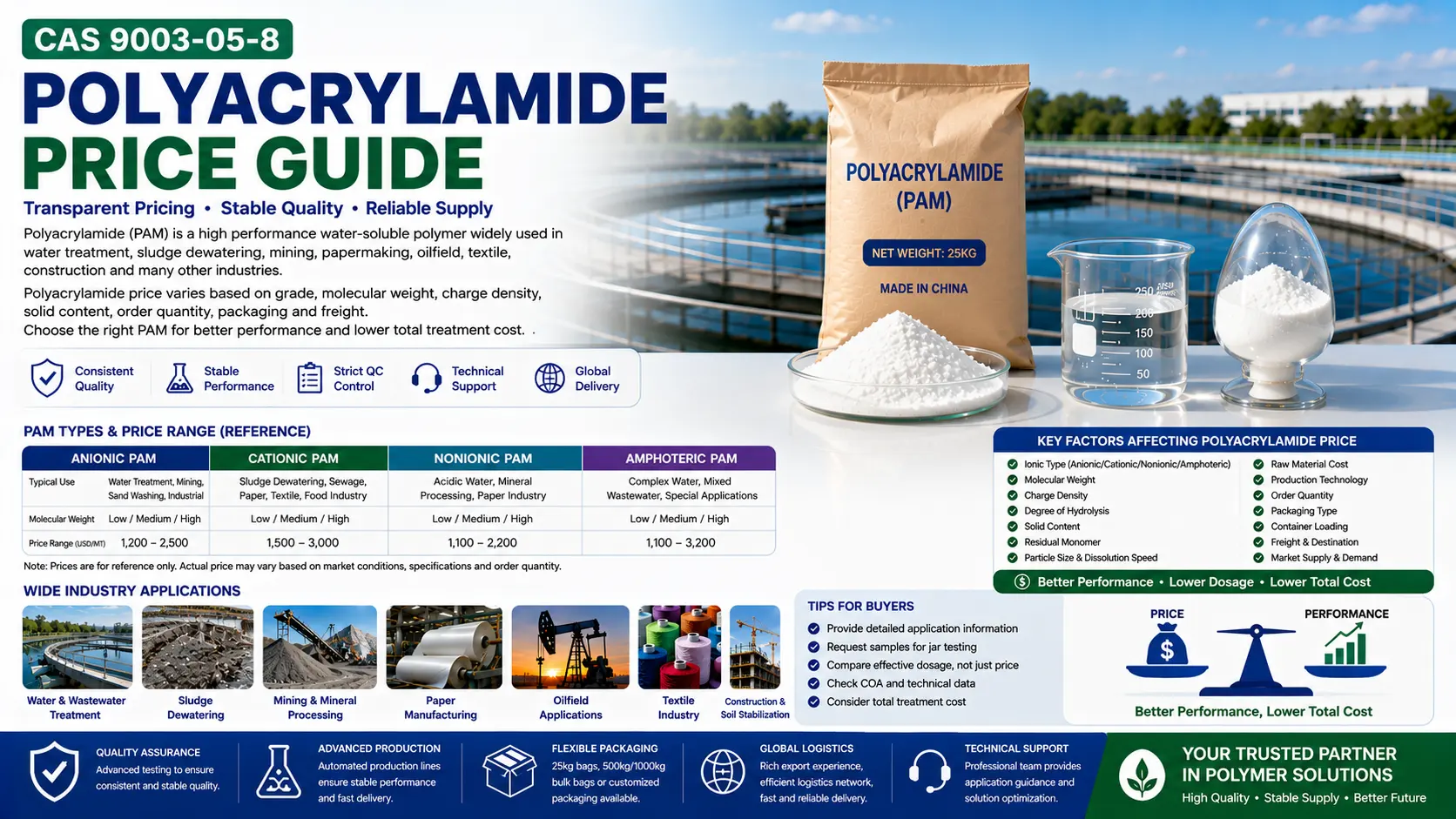
PAM is used in the field of water treatment, sludge dewatering, mining, mineral processing, sand washing, paper manufacturing, oilfield, wastewater from textile, construction and soil stabilization.
The product names may sound similar, but each one could give different results, so cost per effective dose is a better way to compare the treatments rather than just cost per unit.
What Is Polyacrylamide?
Polyacrylamide is a water-soluble polymer primarily produced from acrylamide monomers. It is normally supplied as white or off-white granules or powder and dissolved in water before use.
Typical product information includes:
- Product name: Polyacrylamide
- Abbreviation: PAM
- CAS number: 9003-05-8
- Appearance: White or off-white granules or powder
- Solubility: Soluble in water
- Main types: Anionic, cationic, nonionic, and amphoteric
- Main functions: Flocculation, thickening, retention, filtration, clarification, and sludge dewatering
The correct product depends on the application, suspended solids, particle charge, pH, salinity, temperature, treatment equipment, and required performance.
Why Polyacrylamide Prices Vary
The price of polyacrylamide can vary significantly between suppliers and product grades.
Major price factors include:
- Acrylamide raw-material cost
- Ionic type
- Molecular weight
- Charge density
- Degree of hydrolysis
- Solid content
- Residual monomer
- Production technology
- Quality-control requirements
- Particle size
- Dissolution speed
- Packaging
- Order quantity
- Transportation
- Export documentation
- Technical support
A higher-priced polymer may provide better value when it requires a lower dosage or improves treatment efficiency.
Raw-Material Costs
Acrylamide is the principal raw material used in polyacrylamide production.
Changes in acrylamide pricing can directly affect PAM manufacturing costs.
Other cost influences may include:
- Petrochemical feedstocks
- Energy prices
- Water and steam consumption
- Polymerization additives
- Initiators
- Functional monomers
- Drying expenses
- Environmental-treatment costs
When energy or upstream chemical prices rise, polyacrylamide quotations may also increase.
Anionic Polyacrylamide Price
Anionic polyacrylamide, or APAM, contains negatively charged functional groups.
It is commonly used in:
- Mining
- Sand washing
- Coal washing
- Industrial water clarification
- Construction wastewater
- Soil stabilization
- Paper manufacturing
- Selected oilfield applications
APAM price may be affected by:
- Molecular weight
- Degree of hydrolysis
- Anionic charge
- Solid content
- Dissolution rate
- Customized performance requirements
Standard APAM grades may be more economical than highly specialized mining or oilfield products.
Cationic Polyacrylamide Price
Cationic polyacrylamide, or CPAM, contains positively charged functional groups.
It is commonly used in:
- Municipal sludge dewatering
- Biological sludge treatment
- Paper sludge
- Textile wastewater
- Food-processing wastewater
- Chemical-industry effluent
- Organic wastewater
CPAM is often priced higher than standard APAM because its production requires additional cationic monomers and more complex process control.
The price may increase with:
- Higher charge density
- Higher active solid content
- Tighter residual-monomer limits
- Customized molecular properties
- Faster dissolution
- Specialized sludge-dewatering performance
Buyers should select the correct charge density rather than automatically ordering the highest-charge product.
Nonionic Polyacrylamide Price
Nonionic polyacrylamide, or NPAM, has relatively low ionic activity.
It may be used in:
- Acidic wastewater
- Mineral separation
- Textile processing
- Paper manufacturing
- Soil treatment
- Specialized clarification systems
NPAM pricing depends on molecular weight, purity, solid content, dissolution behavior, and order volume.
Although nonionic grades may have a lower charge-related production cost, specialty products can still carry higher prices.
Amphoteric Polyacrylamide Price
Amphoteric polyacrylamide contains both cationic and anionic groups.
It may be selected for:
- Complex wastewater
- Variable sludge streams
- Papermaking
- Mixed organic and inorganic effluent
- Specialized separation processes
Because amphoteric PAM requires more complex formulation and manufacturing, it may cost more than conventional anionic or nonionic grades.
Its higher purchase price may be justified when it delivers better stability in changing wastewater conditions.
Molecular Weight and Price
Molecular weight affects polymer-chain length and flocculation behavior.
High-molecular-weight PAM may provide:
- Stronger particle bridging
- Larger flocs
- Faster settling
- Improved thickening
- Higher solution viscosity
However, producing stable high-molecular-weight polymer requires strict reaction control.
Higher molecular weight may increase manufacturing costs, but it does not automatically guarantee better application performance.
An excessively high molecular weight may cause:
- Slow dissolution
- Difficult pumping
- Fragile flocs
- High shear sensitivity
- Poor compatibility with some systems
The correct molecular weight should be confirmed through testing.
Charge Density and Cost
Charge density influences how PAM interacts with suspended particles or sludge.
Higher charge density may require:
- More functional monomer
- More complex production
- Tighter reaction control
- Additional quality testing
This can increase the product price.
However, selecting an unnecessarily high charge density may increase both purchase cost and dosage without improving treatment results.
Degree of Hydrolysis
The degree of hydrolysis is particularly important for anionic polyacrylamide.
It influences:
- Anionic charge
- Solubility
- Salt sensitivity
- Flocculation behavior
- Particle interaction
- Oilfield performance
Customized hydrolysis levels may cost more than standard grades because they require tighter production control.
Solid Content
Solid content indicates how much usable polymer is contained in the supplied product.
A product with lower solid content may appear cheaper but can contain more moisture or inactive material.
Buyers should compare:
- Price per kilogram
- Solid content
- Effective polymer content
- Dosage
- Treatment result
For example, a polymer with a higher price but stronger solid content may provide a lower effective cost per unit of active polymer.
Moisture Content
Excessive moisture may:
- Reduce active material
- Increase freight cost
- Cause caking
- Affect storage stability
- Reduce dosing accuracy
- Slow feeding equipment
Low and controlled moisture generally indicates better storage and production control.
However, tighter moisture specifications may increase manufacturing cost.
Residual Acrylamide Monomer
Residual acrylamide monomer is an important quality and compliance parameter.
Lower residual-monomer levels may require:
- Improved raw-material selection
- Optimized polymerization
- Additional purification
- More laboratory testing
- Tighter production control
Products intended for sensitive applications may therefore have higher prices.
Buyers should confirm the permitted residual-monomer level for their intended use and destination market.
Particle Size
Polyacrylamide particle size affects feeding and dissolution.
A controlled particle-size distribution can provide:
- Predictable dissolution
- Reduced dust
- Stable automatic feeding
- Lower lump formation
- Better storage handling
Producing a narrow and consistent particle-size range may increase processing and classification costs.
Dissolution Speed
Fast-dissolving polyacrylamide may cost more because it requires controlled granulation, particle-size management, and specialized production technology.
Faster dissolution can reduce:
- Solution preparation time
- Tank requirements
- Undissolved particles
- Blocked dosing lines
- Operator workload
However, buyers should verify whether the faster-dissolving grade actually provides economic benefits in their equipment.
Product Form
Polyacrylamide may be supplied as:
- Dry powder
- Granules
- Emulsion
- Liquid dispersion
- Customized formulations
Dry powder generally offers:
- High active content
- Lower transportation volume
- Longer storage life
- Flexible preparation
Emulsion products may dissolve faster but can have different freight, storage, and formulation costs.
Products should be compared based on active content and treatment performance.
Application-Specific Pricing
Polyacrylamide pricing can vary according to its intended application.
Water Treatment
Standard water-treatment grades may be priced according to ionic type, molecular weight, and residual-monomer requirements.
Sludge Dewatering
Cationic products for sludge dewatering are often priced according to charge density and dewatering performance.
Mining
Mining-grade PAM may require high molecular weight, strong floc formation, salt tolerance, and large-volume supply.
Oilfield Applications
Oilfield grades may require:
- High temperature resistance
- Salinity tolerance
- Shear stability
- Viscosity retention
- Customized hydrolysis
These products may be more expensive than general water-treatment grades.
Paper Manufacturing
Paper-industry PAM may require controlled charge, molecular structure, retention performance, and compatibility with wet-end chemicals.
Packaging and Price
Common packaging options include:
- 25 kg PE-lined bags
- Paper-plastic bags
- Moisture-resistant woven bags
- 500 kg bulk bags
- 1,000 kg jumbo bags
- Palletized export packaging
- Customized branded packaging
Twenty-five-kilogram bags provide flexible handling but require more packaging material and labor.
Jumbo bags may reduce packaging costs for large industrial buyers, but they require suitable forklifts, lifting systems, and automatic feeding equipment.
Customized printing, pallets, stretch wrapping, and moisture barriers may increase the quotation.
Order Quantity
Order volume has a major influence on Polyacrylamide Price.
Small orders may include higher costs for:
- Packaging
- Production setup
- Laboratory testing
- Inland transportation
- Export handling
- Documentation
- Freight per unit
Large orders may provide:
- Lower unit pricing
- Better freight efficiency
- Customized production
- Stable supply planning
- Long-term contract terms
Buyers should avoid purchasing excessive quantities if storage conditions are not suitable.
Full-Container Orders
Full-container orders generally provide better freight efficiency than small shipments.
The total loading quantity depends on:
- Bag size
- Pallet use
- Container type
- Weight restrictions
- Destination regulations
- Warehouse unloading capability
Non-palletized loading may allow more product per container but can increase manual unloading requirements.
Freight and Destination
Transportation costs may significantly affect the delivered PAM price.
Important factors include:
- Shipping origin
- Destination port
- Ocean freight
- Container availability
- Fuel surcharges
- Inland transport
- Customs clearance
- Import duties
- Port charges
- Local delivery
Buyers should compare suppliers under the same Incoterm and destination.
A low FOB price may not result in the lowest landed cost.
Exchange Rates
International quotations are often issued in US dollars.
Currency changes can affect:
- Raw-material purchases
- Export pricing
- Freight
- Local import costs
- Supplier margins
Long-term buyers may negotiate a price-adjustment mechanism based on exchange rates and raw-material costs.
Seasonal Demand
Polyacrylamide demand may change due to:
- Mining production cycles
- Municipal treatment demand
- Construction activity
- Industrial operating rates
- Oilfield projects
- Environmental enforcement
- Seasonal water conditions
High demand or limited production capacity may increase market quotations.
Factory vs. Trading Company Price
A direct manufacturer may offer:
- Better production pricing
- Customized grades
- Stable specifications
- Direct technical support
- Stronger batch traceability
A trading company may offer:
- Smaller minimum orders
- Mixed-product sourcing
- Multiple brand options
- Consolidated shipping
- Flexible export service
The lowest factory price is not always the best option if the buyer needs technical selection, small quantities, or multiple products.
Standard vs. Customized Grades
Standard grades are normally more economical because they are produced regularly and kept in inventory.
Customized PAM may require:
- Special molecular-weight control
- Custom charge density
- Modified particle size
- Special packaging
- Application trials
- Dedicated production batches
These requirements can increase cost and minimum order quantity.
Technical Support and Pricing
Some suppliers include technical support in the product price.
Support may include:
- Sample recommendations
- Jar testing
- Grade comparison
- Solution preparation guidance
- Dosage optimization
- On-site troubleshooting
- Product-change evaluation
A supplier offering strong application support may provide a lower total treatment cost even when the unit price is slightly higher.
Why the Lowest Price Can Be Expensive
A low-cost product may create additional costs if it has:
- Incorrect ionic type
- Inconsistent molecular weight
- Slow dissolution
- Excessive moisture
- High residual monomer
- Weak flocculation
- High required dosage
- Unstable batch quality
These problems may lead to:
- Increased polymer consumption
- Poor water clarity
- Low sludge-cake solids
- Blocked dosing lines
- Reduced equipment throughput
- More sludge disposal
- Higher labor costs
- Treatment failure
The correct comparison is the cost per treated cubic meter or cost per ton of dry solids, not only the cost per kilogram of PAM.
Calculating Cost per Treated Volume
A simple treatment-cost calculation can use:
Treatment cost = Polymer price × Effective dosage
For example, a low-priced polymer that requires twice the dosage may be more expensive than a higher-priced, more efficient product.
Buyers should also consider:
- Preparation losses
- Undissolved polymer
- Labor
- Equipment cleaning
- Sludge disposal
- Treatment capacity
- Water reuse value
Cost per Ton of Dry Sludge
For sludge dewatering, buyers can compare:
- Polymer dosage per ton of dry solids
- Cake solids
- Filtrate quality
- Equipment throughput
- Sludge disposal volume
A polymer that increases cake dryness may reduce transportation and disposal expenses.
This saving can be greater than the difference in polymer purchase price.
Jar Testing Before Purchasing
Jar testing is essential before comparing quotations.
A test may evaluate:
- Floc formation speed
- Floc size
- Floc strength
- Settling rate
- Supernatant clarity
- Required dosage
- Sludge volume
- Filtration performance
Testing should use actual wastewater or sludge samples.
Production Trials
After laboratory screening, a controlled plant trial should be conducted.
The trial may evaluate:
- Real operating dosage
- Dosing stability
- Mixing requirements
- Settling performance
- Filter-press output
- Centrifuge performance
- Sludge-cake solids
- Treated-water quality
- Total operating cost
A laboratory result should not be the only basis for a long-term purchasing decision.
Quality Specifications to Compare
Buyers should compare:
- Ionic type
- Molecular weight
- Charge density
- Degree of hydrolysis
- Solid content
- Moisture
- Residual monomer
- Particle size
- Dissolution time
- Solution viscosity
- Recommended pH range
Two products should not be treated as equivalent unless their specifications and application performance are comparable.
Certificate of Analysis
A batch-specific certificate of analysis should provide actual test results.
The COA may include:
- Appearance
- Ionic type
- Solid content
- Moisture
- Degree of hydrolysis
- Charge density
- Residual monomer
- Particle size
- Dissolution time
Buyers should avoid relying only on a general product brochure.
Supplier Production Capacity
Production capacity may influence both price and delivery stability.
Buyers should ask about:
- Monthly production output
- Available inventory
- Standard lead time
- Emergency supply capability
- Customized-grade capacity
- Packaging capacity
- Peak-season planning
A supplier with stable capacity may reduce the risk of production interruptions.
Long-Term Supply Contracts
Regular buyers may negotiate annual or multi-shipment agreements.
A supply contract may define:
- Product grade
- Specification limits
- Annual quantity
- Packaging
- Delivery schedule
- Price-adjustment formula
- Inspection method
- Complaint procedure
- Payment terms
Long-term cooperation can provide more predictable pricing and stable supply.
How to Request an Accurate Quotation
A complete inquiry should include:
- Intended application
- Water or sludge type
- Required ionic grade
- Molecular-weight preference
- Charge-density range
- Solid-content requirement
- Residual-monomer limit
- Required quantity
- Packaging
- Destination
- Incoterm
- Delivery schedule
- Required documents
For example:
“Please recommend and quote anionic polyacrylamide for mining tailings clarification, packed in 25 kg bags, CIF destination port, including samples, TDS, SDS, and batch-specific COA.”
Detailed application information helps the supplier recommend an appropriate product and calculate a realistic price.
Questions to Ask About Polyacrylamide Price
Before ordering, buyers should confirm:
- Which PAM grade is included in the quotation?
- What ionic type is supplied?
- What is the molecular-weight range?
- What is the charge density?
- What is the guaranteed solid content?
- What is the maximum moisture?
- What is the residual-monomer limit?
- What is the expected dissolution time?
- What packaging is included?
- Are pallets included?
- What is the minimum order quantity?
- Which Incoterm is used?
- Is freight included?
- Can samples be provided?
- Is technical application support included?
Common Purchasing Risks
Potential risks include:
- Comparing different grades as though they are equivalent
- Choosing only by price per ton
- Ignoring effective dosage
- Accepting high moisture
- Failing to test samples
- Ordering the wrong ionic type
- Ignoring packaging quality
- Overlooking freight and import costs
- Purchasing excessive inventory
- Accepting inconsistent batch performance
These risks can be reduced through technical specifications, sample testing, production trials, and clear purchase contracts.
Conclusion
The factors affecting Polyacrylamide Price include: ionic type, molecular weight, charge density, degree of hydrolysis, solid content, residual monomers, particle size, dissolution performance and packaging, order volume, freight, supplier service.
One should not make the decision of buying PAM based on the price per kg/metric ton alone. The more important measurement is the total treatment cost, that includes dosage, dissolution efficiency, sludge reduction, equipment throughput, water clarity, labor, and waste disposal.
The buyer must supply full application information, inspect the full technical specification, sample, do jar testing and controlled production trials before buying.
A reliable supplier should be able to offer an appropriate polymer grade, consistent quality, clear specifications, good pricing, secure packaging, timely technical support and reliable worldwide delivery.


Contact Us
In This Article
Related Posts
Custom Packaging Solutions from an Anhydrous Sodium Acetate Supplier in China
2026-09-23
Application Trends in Anhydrous Sodium Acetate for Special Chemical Manufacturing
2026-09-23
Anhydrous Sodium Acetate for Leather Tanning: Improve Dyeing Uniformity
2026-09-22
Formic Acid 85% for Textile Dyeing: Industrial Applications, Technical Benefits and Future Trends
2026-09-22


