


Sodium Acetate Trihydrate Storage: Caking, Moisture, and Packaging Control
By Tonmoy
2026-08-19Related Posts

Custom Packaging Solutions from an Anhydrous Sodium Acetate Supplier in China
2026-09-23

Application Trends in Anhydrous Sodium Acetate for Special Chemical Manufacturing
2026-09-23

Anhydrous Sodium Acetate for Leather Tanning: Improve Dyeing Uniformity
2026-09-22

Formic Acid 85% for Textile Dyeing: Industrial Applications, Technical Benefits and Future Trends
2026-09-22
For solid sodium acetate trihydrate, the basic storage rule is straightforward: keep the material tightly closed in a dry, cool, well-ventilated area, and protect the package from moisture, contamination, and physical damage. Moisture control is particularly important because sodium acetate trihydrate is identified in safety-data-sheet material as a hygroscopic solid requiring protection from moisture. See the sodium acetate trihydrate product information for product identity, then confirm the exact storage requirements for the supplied grade in its current SDS and TDS.
The specific temperature range, shelf life, packaging construction, and acceptable caking limit should not be assumed from general guidance. Those details must be confirmed for the exact sodium acetate trihydrate grade and supply format.
Confirm the material identity before setting storage controls
Storage instructions should begin with product identification. Confirm that the material is solid sodium acetate trihydrate, rather than:
- Anhydrous sodium acetate
- A sodium acetate solution
- A different acetate salt
- A laboratory-grade product with different documentation
- Material supplied under an incorrect or incomplete label
The Vanchor product listing identifies sodium acetate trihydrate as CAS 6131-90-4. That identity should be checked against the purchase specification, container label, SDS, TDS, and, where applicable, the incoming COA.
This distinction matters because hydrate and anhydrous forms are separate product forms. Their specifications, water content, handling requirements, and application calculations should not be transferred from one form to the other. A full comparison belongs in a separate resource on sodium acetate trihydrate vs anhydrous, rather than being reproduced in a storage guide.
A legacy SDS should also not be treated as the current specification for every sodium acetate product. Older documents may contain incomplete or inconsistent identity information. Use the current documentation supplied for the actual grade being received and stored.
The core storage controls: dry, closed, cool, and protected

A practical sodium acetate trihydrate storage standard should address four basic controls:
| Storage risk | Practical control | What to verify |
|---|---|---|
| Moisture exposure | Store in a dry area and protect containers from water, condensation, and humid air | Current SDS/TDS wording for the exact grade |
| Open-container exposure | Keep the original package tightly closed when not in use | Approved closure and resealing procedure |
| Excessive heat or unsuitable conditions | Use a cool, well-ventilated storage area unless the product document specifies otherwise | Any grade-specific temperature range |
| Package damage or contamination | Protect bags, drums, or other containers from puncture, tearing, leaks, and contamination | Packaging specification and warehouse handling requirements |
Safety-data-sheet guidance retrieved for sodium acetate materials supports dry storage and protection from moisture. A current SDS for sodium acetate trihydrate should take precedence over general industry practice. The wording “cool” should also not be converted into a numerical temperature limit unless the applicable product document provides one.
For warehouse operations, the storage area should be suitable for keeping solid chemical packages dry and protected from avoidable damage. Do not place packages where they may be exposed to roof leaks, washdown water, standing water, condensation, or direct contact with damp floors. The exact warehouse layout, stacking method, and environmental controls remain site-specific.
How moisture exposure can contribute to caking and poor powder handling
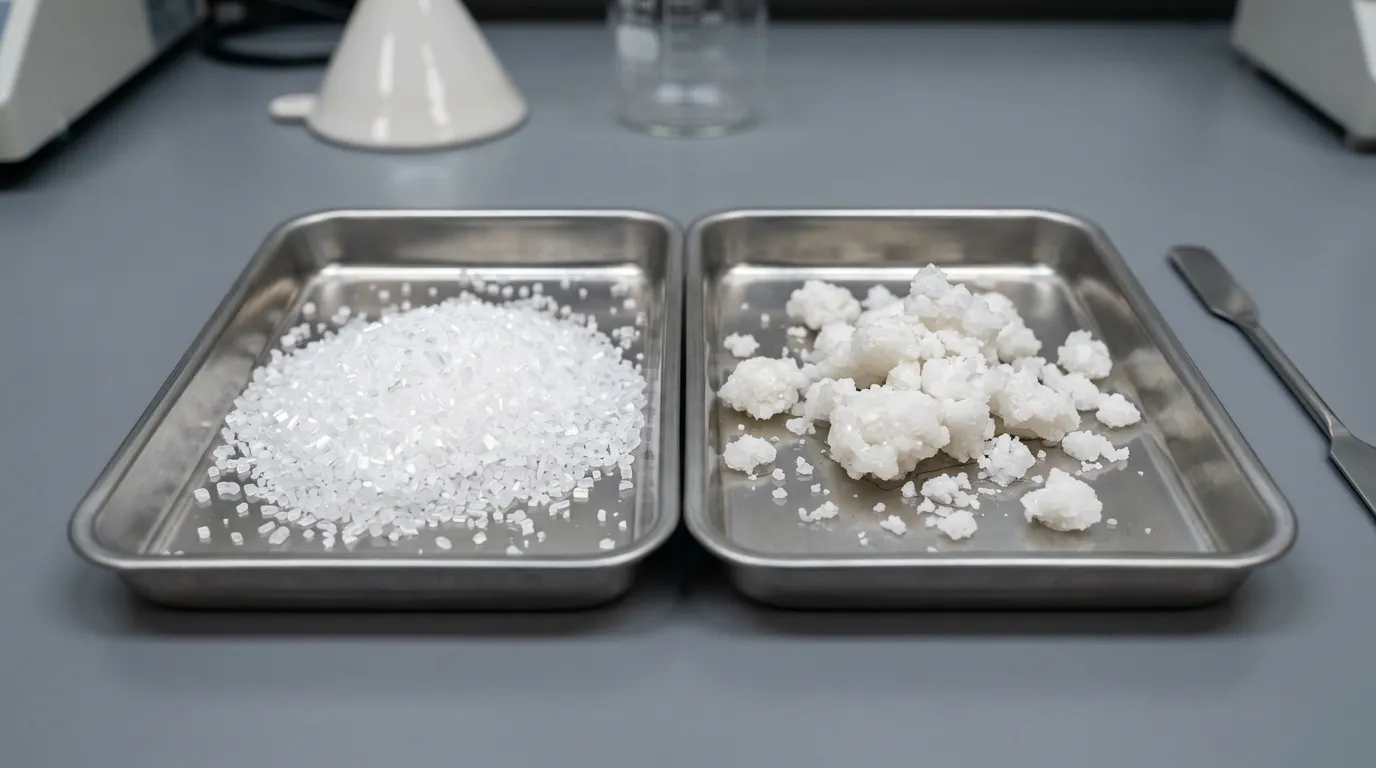
Moisture is a central storage concern for sodium acetate trihydrate because retrieved SDS information identifies the material as hygroscopic or requiring protection from moisture. In practical terms, moisture can enter through:
- An incompletely closed package
- A damaged outer bag, drum, or liner
- Repeated opening and resealing
- Condensation during temperature changes
- Wet handling equipment or warehouse surfaces
- Extended exposure during dispensing or formulation
Moisture exposure may contribute to changes in powder flow and the formation of lumps or agglomerates. This is a practical storage interpretation of the material’s moisture sensitivity; it is not a verified universal caking rate, moisture threshold, or product-performance test.
Caking can create operational problems even when the chemical identity has not been established as changed. Lumps may affect:
- Material discharge from bags, drums, or hoppers
- Weighing and feeding consistency
- Sampling representativeness
- Dissolution or dispersion during a later process
- Manual handling and transfer efficiency
Visible caking should therefore be treated as a condition requiring review, not automatically as proof that the entire lot is unusable. QA should compare the observed condition with the applicable product specification and internal disposition procedure. Do not assume that caked material may be heated, dried, screened, broken up, or returned to production without an approved assessment.
No general caking acceptance limit is established by the available evidence. If lump size, powder flow, moisture content, or rework status is important to the application, request the supplier’s specification or define an internal QA method appropriate for the exact grade.
Packaging controls to discuss with the supplier or QA team
Packaging is part of storage control. A dry warehouse cannot fully compensate for a package that permits excessive moisture exchange or cannot be properly resealed after opening.
At a minimum, packaging review should consider:
- Container integrity: Check for tears, punctures, split seams, leaks, crushed areas, or other damage.
- Closure performance: Confirm that the package can be closed securely after partial use.
- Moisture protection: Ask how the packaging limits moisture exchange during the expected storage period.
- Contamination protection: Confirm that the package protects the solid from dust, foreign material, and contact with unsuitable substances.
- Handling durability: Consider whether the packaging remains intact during unloading, pallet movement, internal transfer, and dispensing.
- Climate and storage duration: Review whether the package is suitable for the destination’s warehouse conditions and planned inventory period.
Vanchor’s manufacturer-page information identifies moisture exchange, contamination, physical damage, and unsuitable storage as packaging considerations. This is site-stated guidance, not a verified specification for a particular bag, liner, drum, barrier film, or closure system. Review the sodium acetate trihydrate manufacturer information alongside the exact packaging details provided for the material being purchased.
Do not assume that a desiccant, foil laminate, plastic liner, or particular container type is required for every sodium acetate trihydrate grade. The appropriate packaging depends on the supplied form, package size, climate, transport conditions, handling frequency, and intended storage period. Request the actual packaging description rather than relying on a generic chemical-packaging assumption.
Receiving, opening, resealing, and inspecting stored material

A simple receiving and handling sequence can reduce unnecessary moisture exposure:
- Check product identity and documentation. Confirm the product name, hydrate form, grade, lot information, and accompanying SDS or TDS.
- Inspect the package before acceptance. Look for tears, punctures, wetting, damaged closures, contamination, or evidence that the package has been exposed to moisture.
- Move accepted material into suitable storage. Keep the package closed and place it in the designated dry storage area.
- Open only what is needed. Minimize the time that the solid is exposed to warehouse or process-room air.
- Reseal promptly. Use the approved closure method and ensure that the package remains protected between uses.
- Record unusual material condition. Note visible caking, wet patches, damaged packaging, or changes in handling behavior.
- Escalate uncertain material to QA. Use the applicable internal procedure to determine whether sampling, testing, quarantine, or disposition is required.
This sequence is practical operational guidance, not a validated Vanchor procedure or a universal QA release method. The site should define its own sampling, testing, and disposition requirements.
If packaging is damaged, do not simply transfer the material into an unapproved container and assume that the original storage requirements have been restored. The replacement container, labeling, traceability, and moisture protection should be reviewed under the site’s chemical-handling procedure.
Which storage details must be confirmed in the current product documents?
Before finalizing a warehouse standard or purchase specification, confirm the following for the exact sodium acetate trihydrate grade and package format:
| Confirm before storage or purchase | Why it matters |
|---|---|
| Current SDS and TDS revision | Establishes the applicable product-specific handling information |
| Chemical identity and hydrate form | Prevents transfer of instructions from anhydrous sodium acetate or solutions |
| Recommended storage temperature, if specified | Avoids inventing a numerical temperature range |
| Packaging material, liner, and closure | Determines how the package is protected after filling and opening |
| Moisture-barrier information | Helps evaluate exposure risk during storage and transport |
| Shelf life or retest period, if provided | Supports inventory planning without assuming a universal storage duration |
| Moisture-related specification or test method | Provides a basis for QA review where moisture affects the application |
| Caking or lumping criteria | Helps distinguish a visual observation from an out-of-specification decision |
| Open-package handling instruction | Defines how partially used material should be protected |
| COA requirements, where applicable | Supports incoming-lot verification within the buyer’s quality system |
The available research does not verify these details for a current Vanchor industrial grade. They should be obtained from the current product documentation or confirmed during the purchasing process. The product page can provide product context, but it should not be treated as a substitute for an SDS, TDS, COA, or packaging specification.
Storage boundaries: what this guide does not establish
This guide supports a moisture-conscious storage approach for solid sodium acetate trihydrate. It does not establish:
- A universal storage temperature
- A fixed humidity limit
- A guaranteed shelf life
- A required storage duration
- A specific packaging material or liner
- A universal desiccant requirement
- An acceptable caking or lump-size limit
- A validated method for reworking caked material
- Food, feed, pharmaceutical, drinking-water, or other regulatory suitability
- Current stock, price, MOQ, lead time, or delivery capability
The most defensible operating rule is to keep the material dry, tightly closed, protected from contamination and physical damage, and managed according to the current documentation for the exact grade. If the storage decision depends on temperature behavior or thermal properties, consult the separate information on sodium acetate trihydrate melting point rather than using storage guidance as a substitute for a physical-property specification.
For purchasing or site-specific storage approval, the next step is to compare the supplier’s current SDS, TDS, packaging description, and quality requirements with the warehouse and QA controls used for the intended application.


Contact Us
In This Article
Related Posts
Custom Packaging Solutions from an Anhydrous Sodium Acetate Supplier in China
2026-09-23
Application Trends in Anhydrous Sodium Acetate for Special Chemical Manufacturing
2026-09-23
Anhydrous Sodium Acetate for Leather Tanning: Improve Dyeing Uniformity
2026-09-22
Formic Acid 85% for Textile Dyeing: Industrial Applications, Technical Benefits and Future Trends
2026-09-22


