



Potassium Formate for Oilfield Completion Fluids: Density, Compatibility and Formation Protection
By vanchor
2026-08-19Related Posts
Custom Packaging Solutions from an Anhydrous Sodium Acetate Supplier in China
2026-09-23
Application Trends in Anhydrous Sodium Acetate for Special Chemical Manufacturing
2026-09-23
Anhydrous Sodium Acetate for Leather Tanning: Improve Dyeing Uniformity
2026-09-22

Formic Acid 85% for Textile Dyeing: Industrial Applications, Technical Benefits and Future Trends
2026-09-22
A completion brine should provide hydrostatic pressure and density stability in a wide temperature range and minimize formation damage and incompatibility with the fluids, additives, metals, and elastomers of a reservoir.
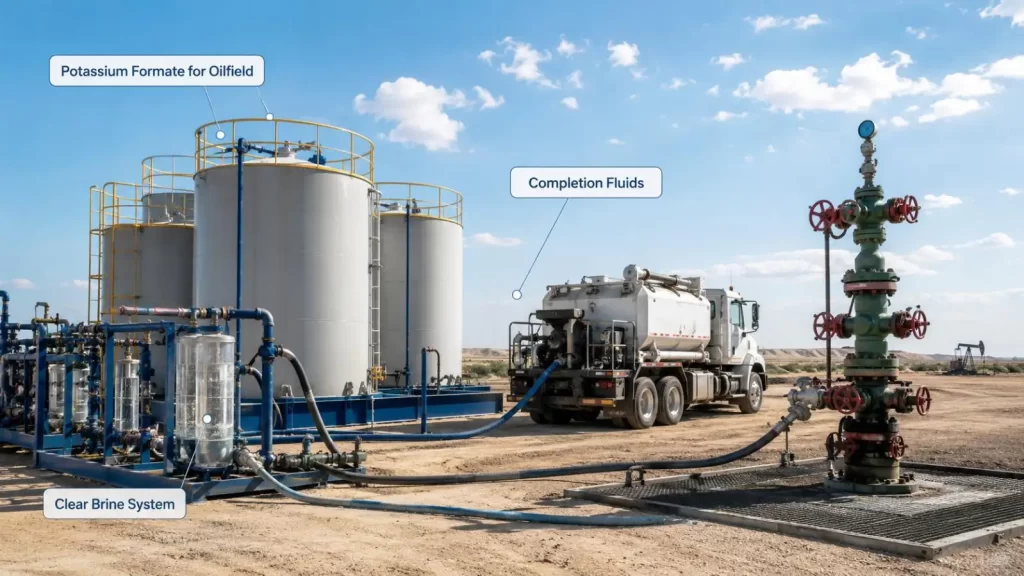
Because of these requirements, Potassium Formate for Oilfield should be assessed in conjunction with the complete brine system rather than as a single component salt. A high density potassium formate brine can provide a high level of brine density without the use of weighting solid, literally making them suitable for most clear-brine and low-solids completion systems.
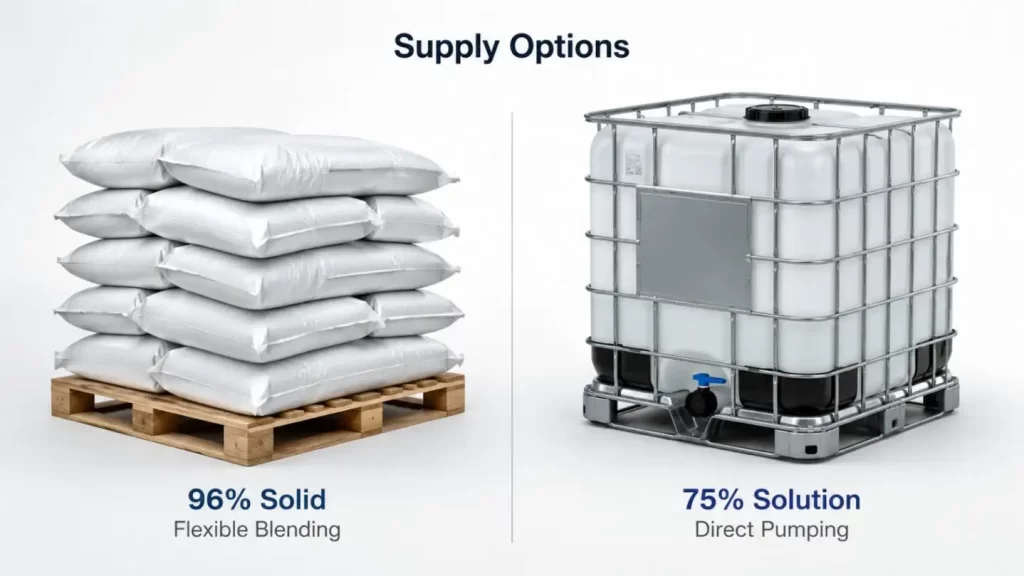
At Vanchor, we provide 96% solid potassium formate and 75% potassium formate solution, giving the fluid formulator the options they need to design the system based on the required concentration, the method of field blending, the transport costs, and the expected field conditions.
Why Potassium Formate Is Used in Completion Fluids
Potassium formate (HCOOK) is a highly water-soluble formate salt. In Potassium Formate for Oilfield completion systems, density is generated by dissolved salt rather than large quantities of suspended weighting material.
This creates several useful design possibilities:
• High-density clear or low-solids brine preparation
• Reduced dependence on barite or other weighting solids
• Controlled hydrostatic pressure during completion and workover
• Lower solids loading near the producing formation
• Flexible density adjustment through concentration control
• Application in formation-sensitive completion environments
However, the correct fluid cannot be selected from potassium formate purity alone. Density, temperature, crystallization behavior, reservoir compatibility, and completion-equipment compatibility must be considered together.
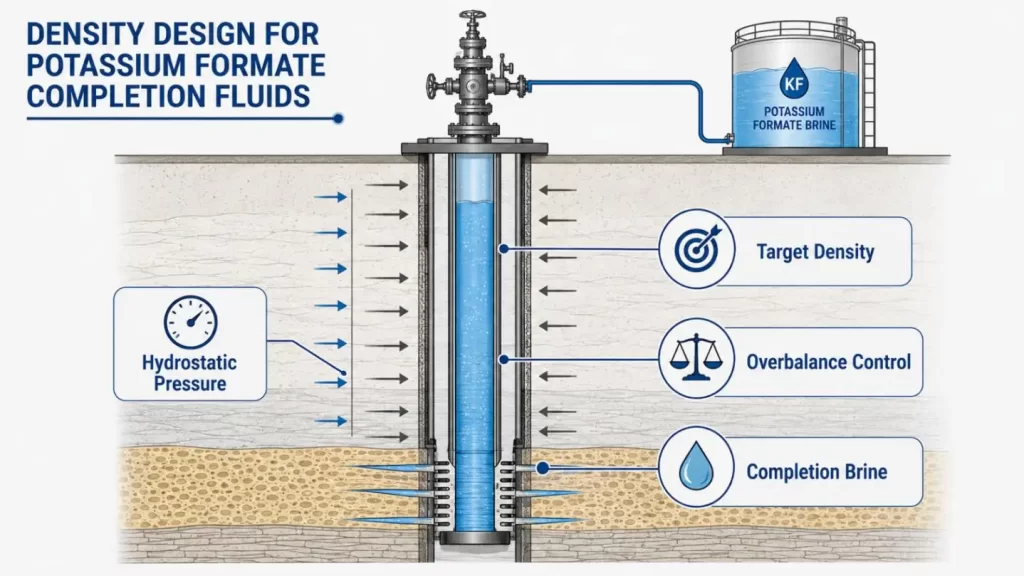
Density Design: More Than Reaching a Target Number
The density of completion fluid has a huge impact on hydrostatic pressure. Underweighing the fluid can sabotage well control. Overweighing can increase undesirable filtration of the formation.
The steps in engineering practice are:
Reservoir pressure---- => Well depth => Required hydrostatic head => Target brine density => Formate concentration => Temperature margin => Compatibility testing
Key Density Design Parameters
| Design Parameter | Effect |
| Target Brine Density | Hydrostatic pressure |
| Formate Concentration Control | Brine density |
| Bottomhole temperature | Properties of downhole fluids |
| Minimum surface temperature | Effect on crystallization |
| Dilution water chemistry | Precipitation and stability |
| Contamination level | Behavior and density of fluids |
| Additive concentration | Control of rheology and filtration |
The most important consideration for Potassium Formate in an Oilfield is that the optimal density is not the density of maximum achievability. The optimal value strike a balance between insufficient well control and excessive overbalance.
Vanchor's 96% solid potassium formate is suitable for centralized or field blending operations where the final brine concentration must be adjusted for a specific completion-fluid density.
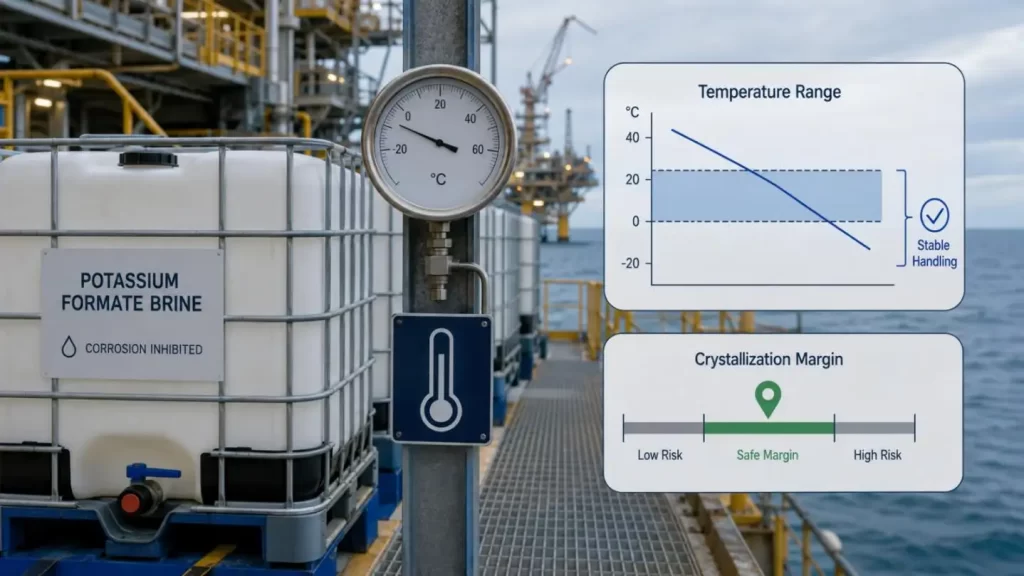
Crystallization Margin Must Be Included in Brine Design
High-density brines are concentration-sensitive. During storage, transportation, or offshore operations, the fluid may experience temperatures much lower than bottomhole temperature.
Therefore, formulation should consider:
• Lowest anticipated surface temperature
• Brine concentration
• Water dilution
• Mixed-salt composition
• Contamination during circulation
• Storage duration
A completion brine should retain sufficient crystallization margin below the expected operating temperature. Designing only for downhole density while ignoring surface conditions can create handling and pumping problems before the fluid reaches the well.
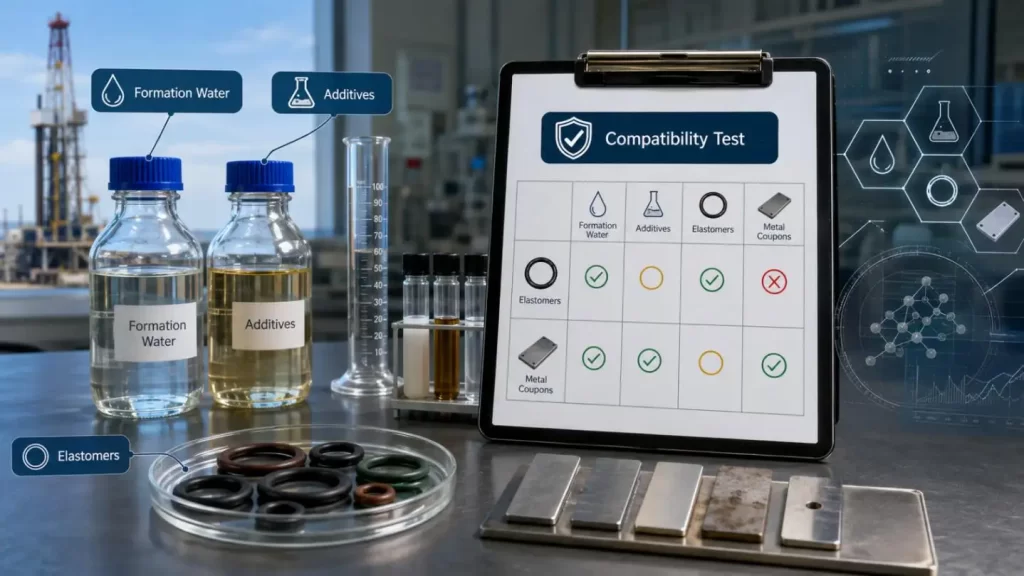
Compatibility Should Be Verified at Four Levels
A technically acceptable Potassium Formate for Oilfield system requires more than simple solubility.
1. Formation Water-Brine Interaction Issues
Brines interacting with formation water may result in some chemical changes. Testing may focus on the following:
• Salt precipitation
• Scale tendency
• Turbidity
• Mixed-water stability
• Temperature and reaction dependency
2. Interaction with Reservoir Rocks
For clay-bearing or low-permeability reservoirs, work-over/well-testing concerns may focus on:
• Core permeability retention
• Fluid invasion
• Clay sensitivity
• Filtrate interaction
• Cleanup behavior
3. Additive Compatibility
Completion fluids may contain:
• Viscosifiers
• Fluid-loss-control polymers
• Corrosion inhibitors
• Oxygen scavengers
• Surfactants
• Breakers
High ionic strength can significantly change polymer hydration and additive efficiency. Testing should therefore use the actual Potassium Formate for Oilfield concentration intended for field use.
4. Metallurgy and Elastomer Compatibility
Compatibility testing should include relevant:
• Tubing and completion metallurgy
• Packers
• Seals and O-rings
• Pumps
• Valves
• Downhole elastomers
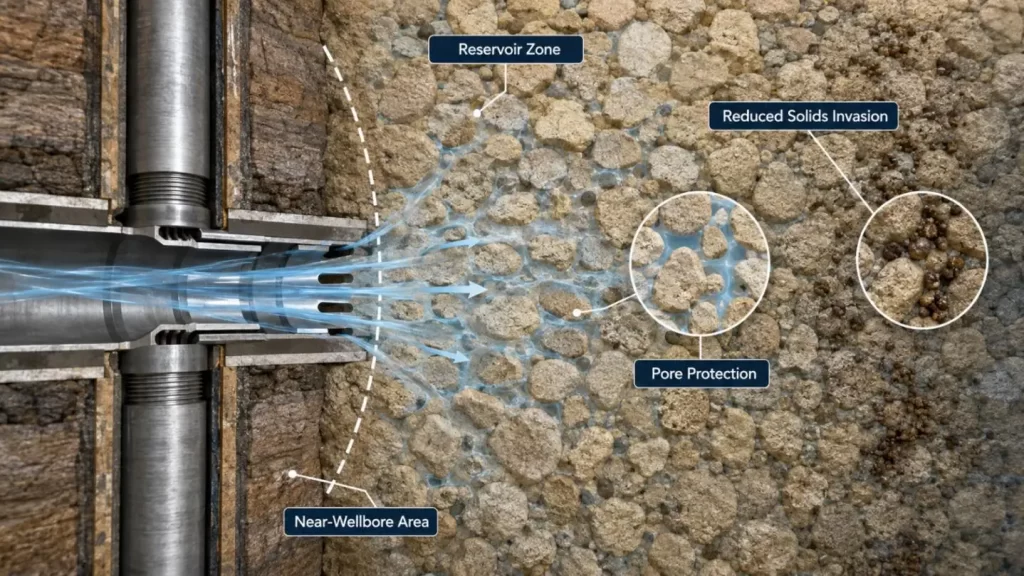
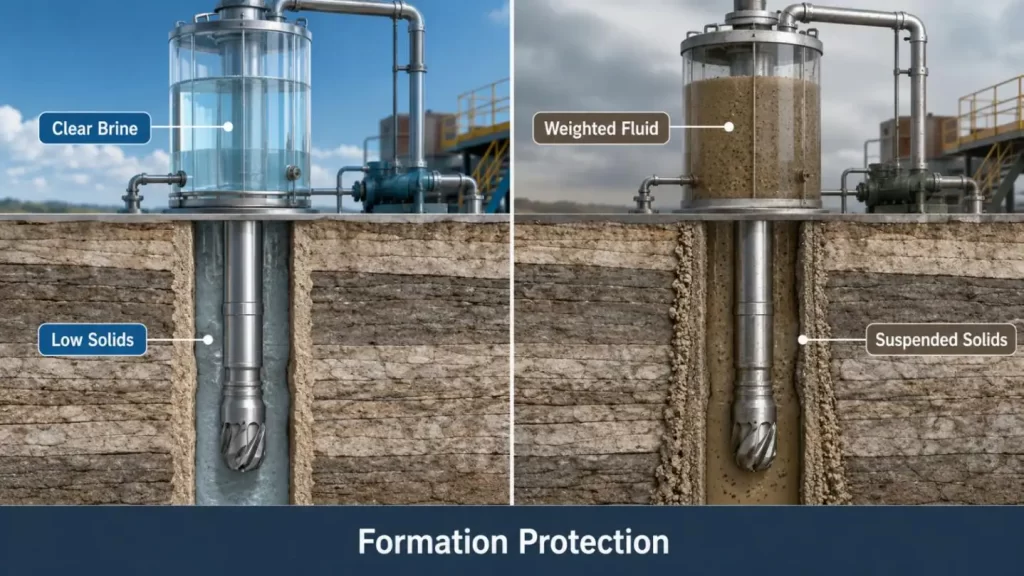
Formation Protection: Why Solids Content Matters
Formation impairment is a major concern during completion because solids or incompatible filtrate entering the near-wellbore region can reduce permeability.
Conventional weighted systems may introduce suspended particles that contribute to:
• Pore-throat plugging
• Solids invasion
• Filter-cake buildup
• Increased cleanup requirements
• Reduced post-completion productivity
A clear or low-solids Potassium Formate for Oilfield brine obtains density from dissolved formate salts, allowing engineers to reduce reliance on insoluble weighting material.
This can be valuable for:
• Low-permeability reservoirs
• Formation-sensitive intervals
• High-value producing zones
• Completion and workover operations
• Operations requiring clean completion fluids
However, potassium formate should not be described as automatically "non-damaging." Formation protection remains a system property determined by reservoir mineralogy, filtrate chemistry, differential pressure, additives, solids contamination, and cleanup strategy.
Potassium Formate vs. Conventional Completion Brines
Brine selection should remain an engineering comparison rather than a simple product ranking.
| Brine System | Density Range Tendency | Chemistry | Main Selection Consideration |
| KCl | Low–medium | Chloride | Shale inhibition, economics |
| CaCl₂ | Medium–high | Chloride | Conventional completion service |
| CaBr₂ | High | Bromide | Higher-density clear brines |
| Potassium Formate | High-density formate | Formate | Clean-fluid design and formation compatibility |
Potassium Formate for Oilfield is not universally superior to KCl, calcium chloride, or calcium bromide. Selection should consider:
• Required density
• Reservoir mineralogy
• Formation-water chemistry
• Temperature range
• Corrosion control
• Environmental constraints
• Logistics
• Fluid recovery and disposal
• Total system cost
96% Solid vs. 75% Liquid Potassium Formate
Vanchor supplies both forms because completion-fluid preparation strategies differ.
| Selection Factor | 96% Solid | 75% Solution |
| Transportation of active product | More concentrated | Includes carrier water |
| Dissolution | Required | Not required |
| Direct pumping | No | Yes |
| Concentration adjustment | Highly flexible | Convenient liquid blending |
| Handling system | Dry material equipment | Pumps and liquid tanks |
| Typical preference | Brine plants / custom blending | Rapid field preparation |
Our 96% solid Potassium Formate for Oilfield is suitable where shipping efficiency and flexible concentration adjustment are priorities. The 75% solution, with a typical density of approximately 1.57–1.58 g/cm³ at 25°C, is suitable where direct pumping, metering, and liquid blending simplify field operations.
Pre-Field Qualification Checklist
Before deployment, a potassium formate completion system should verify:
• Target density and concentration
• Crystallization margin
• Formation-water compatibility
• Scale and precipitation risk
• Core-fluid interaction
• Fluid-loss performance
• Additive compatibility
• Corrosion behavior
• Elastomer compatibility
• Filtration and solids level
• Storage and handling conditions
Selecting Potassium Formate for Oilfield by Well Conditions
The most appropriate Potassium Formate for Oilfield system is determined by three connected questions: whether the density provides sufficient hydrostatic control, whether the chemistry is compatible with the reservoir and completion equipment, and whether the fluid design minimizes formation impairment.
Vanchor supports oilfield chemical formulators, service companies, and distributors with both 96% solid and 75% liquid potassium formate. For a specific completion program, evaluating target density, concentration, temperature range, packaging, and blending conditions before procurement can help identify the more technically and operationally suitable potassium formate supply form.
FAQs
Q1. What forms of Potassium Formate for Oilfield does Vanchor supply?
Vanchor supplies both 96% solid potassium formate and 75% potassium formate solution. The solid form is better for customized brine preparation. The liquid form is better for direct pumping and metering as well as for blending.
Q2. Which Vanchor potassium formate grade is better for completion-fluid blending plants?
In completion-fluid blending plants that will be designed for varying concentrations of different brines, Vanchor has a greater offering with its 96% solid potassium formate, as the final product brine concentration and density can be adjusted during processing.
Q3. When should customers choose Vanchor's 75% potassium formate solution?
The 75% solution is the better choice when operators prefer a liquid product that can be transferred, metered, and blended without the need for additional on-site dissolution steps.
Q4. Can Vanchor's Potassium Formate for Oilfield be used for clear completion brines?
Yes. In clear, low-solids, or solids-free completion brines, potassium formate can be the dissolved salt.
Q5. Can Vanchor customize the final completion-fluid density?
Vanchor leaves it to the customer to determine the final completion fluid density with the potassium formate that Vanchor supplies as a raw material.


Contact Us
In This Article
Related Posts
Custom Packaging Solutions from an Anhydrous Sodium Acetate Supplier in China
2026-09-23
Application Trends in Anhydrous Sodium Acetate for Special Chemical Manufacturing
2026-09-23
Anhydrous Sodium Acetate for Leather Tanning: Improve Dyeing Uniformity
2026-09-22
Formic Acid 85% for Textile Dyeing: Industrial Applications, Technical Benefits and Future Trends
2026-09-22


