



Sodium Formate Chemical Supplier: Quality, Applications, and Global Purchasing Guide
By vanchor
2026-07-22Related Posts
Custom Packaging Solutions from an Anhydrous Sodium Acetate Supplier in China
2026-09-23

Application Trends in Anhydrous Sodium Acetate for Special Chemical Manufacturing
2026-09-23

Anhydrous Sodium Acetate for Leather Tanning: Improve Dyeing Uniformity
2026-09-22

Formic Acid 85% for Textile Dyeing: Industrial Applications, Technical Benefits and Future Trends
2026-09-22
The trustworthy Sodium Formate Chemical Supplier is expected to offer more than just a competitive price. Additionally, industrial buyers look for quality control, full technical specifications, safe packaging, production capacity and dependable delivery to other countries.
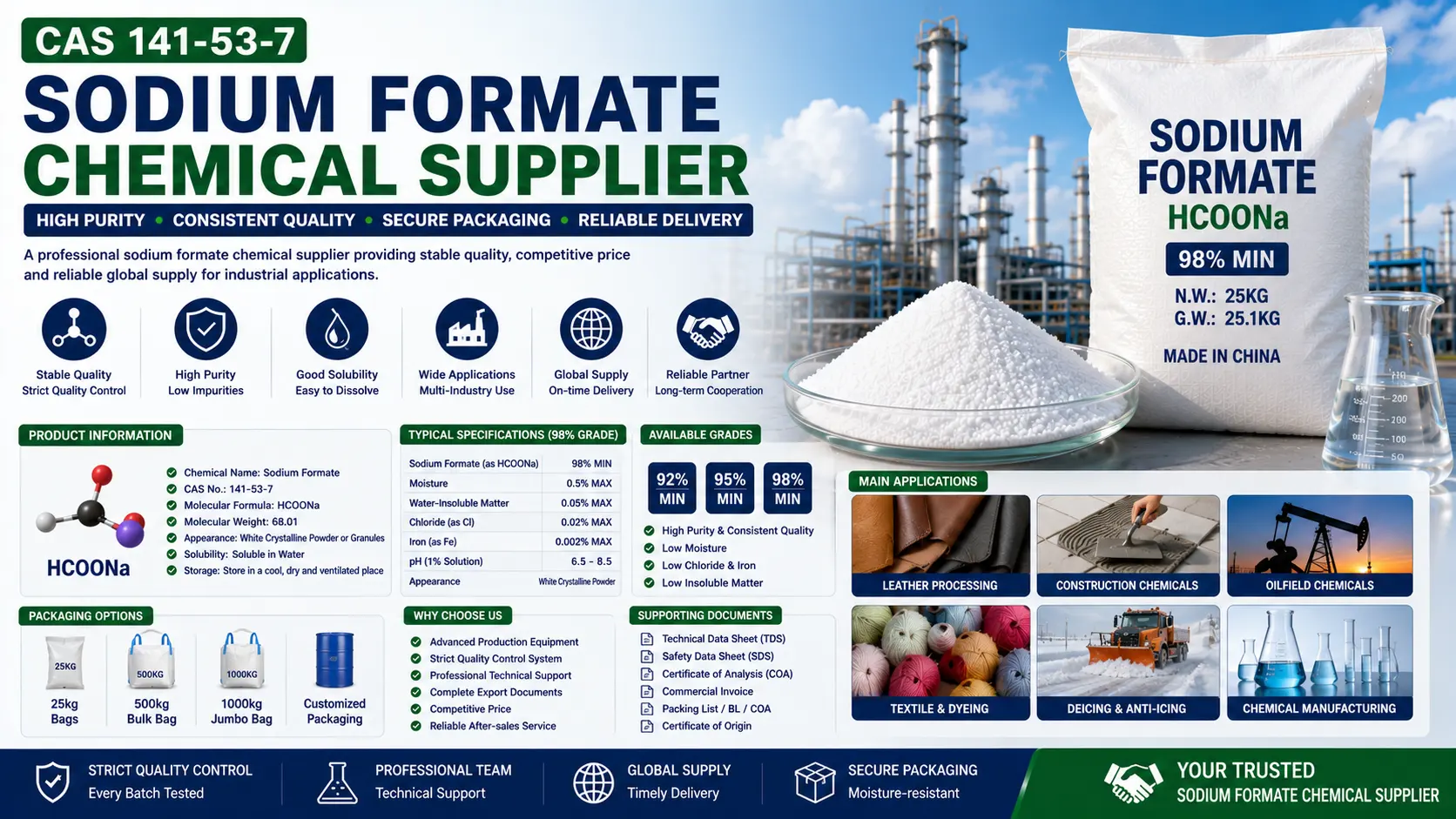
Sodium formate is used extensively in leather tanning, construction chemicals, oil field fluids, textile dyeing, deicing mixtures and chemical production. Each application may have specific technical requirements and the purity, moisture, chloride, iron, insoluble matter, particle size and batch consistency must all be considered before confirming a bulk order.
What Is Sodium Formate?
Sodium formate is the sodium salt of formic acid. Its chemical formula is HCOONa, and its CAS number is 141-53-7. It is generally supplied as a white crystalline powder or granule with good solubility in water.
Typical product information includes:
- Chemical name: Sodium Formate
- CAS number: 141-53-7
- Molecular formula: HCOONa
- Molecular weight: approximately 68.01
- Appearance: White crystalline powder or granules
- Solubility: Soluble in water
- EINECS number: 205-488-0
Commercial sodium formate is commonly available in 92%, 95%, and 98% grades. The most suitable grade depends on the intended application, impurity limits, process conditions, and purchasing budget.
Why Supplier Selection Matters
Sodium formate from different suppliers may have the same stated purity but perform differently in production.
These differences may be caused by:
- Moisture content
- Water-insoluble matter
- Chloride level
- Iron content
- Particle size
- Raw material quality
- Manufacturing process
- Storage conditions
- Packaging quality
- Testing methods
A dependable supplier should control both the main assay and the impurity profile. It should also provide batch-specific quality records rather than only a general product specification.
Main Applications of Sodium Formate
Leather Processing
Sodium formate is commonly used in leather tanning, pickling, dyeing, and related processing stages.
It can support:
- Controlled acidity
- More uniform chemical penetration
- Improved tanning consistency
- Better dye distribution
- Stable batch performance
Leather manufacturers should pay close attention to solubility, moisture, insoluble matter, and iron content.
Construction Chemicals
Sodium formate may be used in dry-mix mortar, tile adhesives, grouts, concrete admixtures, and selected precast formulations.
Depending on the complete formulation, it may support:
- Setting-time control
- Early-strength development
- Low-temperature performance
- Cement hydration
- Production consistency
The correct dosage depends on cement type, temperature, water ratio, fillers, polymers, and other admixtures.
Oilfield Fluids
Sodium formate can be used in selected drilling, completion, workover, and drill-in fluid systems.
Potential functions include:
- Density adjustment
- Low-solids fluid preparation
- Improved brine clarity
- Thermal stability
- Reduced solids settling
- Compatibility with selected additives
Oilfield buyers usually require tighter control of chloride, iron, insoluble matter, and solution density.
Textile Dyeing
In selected textile-processing systems, sodium formate may support gradual pH adjustment, bath stability, dye penetration, and shade consistency.
It may be evaluated for use with:
- Wool
- Nylon
- Blended fabrics
- Selected finishing processes
Textile mills producing light or bright shades should carefully monitor iron and insoluble matter.
Deicing and Anti-Icing
Sodium formate may be used in selected road, airport, bridge, industrial, and transportation deicing formulations.
It can contribute to:
- Freezing-point reduction
- Ice melting
- Anti-icing treatment
- Fast dissolution
- Liquid or solid deicer preparation
The final formulation should be tested for low-temperature performance, corrosion, surface compatibility, and environmental requirements.
Chemical Manufacturing
Sodium formate may be used as a raw material or process component in the manufacture of:
- Sodium hydrosulfite
- Formic acid
- Oxalic acid
- Other industrial chemicals
For chemical manufacturers, stable moisture and impurity levels are especially important because they may affect reaction control, yield, filtration, and final product quality.
Sodium Formate Grades
Sodium Formate 92%
The 92% grade may be suitable for cost-sensitive industrial applications where broader impurity limits are acceptable.
Potential advantages include:
- Competitive cost
- Good general solubility
- Wide availability
- Suitability for selected bulk applications
Sodium Formate 95%
The 95% grade provides an intermediate option between standard and higher-purity products.
It may be selected when buyers require better active content without the full cost of a 98% grade.
Sodium Formate 98%
The 98% grade may be preferred when buyers require:
- Higher active content
- Lower moisture
- Lower insoluble matter
- More consistent dosing
- Better batch stability
- Tighter impurity control
The final grade should be selected through application testing rather than purity alone.
Important Quality Specifications
A professional Sodium Formate Chemical Supplier should provide a detailed technical data sheet.
Important indicators include:
- Sodium formate content
- Moisture
- Water-insoluble matter
- Chloride content
- Iron content
- pH value
- Particle size
- Bulk density
- Appearance
- Solubility
Why Moisture Is Important
Excessive moisture may cause:
- Reduced active content
- Inaccurate dosing
- Caking
- Poor powder flow
- Storage difficulties
- Higher freight cost per unit of active material
Moisture-resistant packaging and dry storage are essential.
Why Insoluble Matter Matters
Excessive insoluble matter may result in:
- Filter blockage
- Tank deposits
- Nozzle blockage
- Equipment contamination
- Residue in formulations
- Reduced process efficiency
Applications involving clear solutions or sensitive equipment often require particularly low insoluble matter.
Chloride and Iron Control
Chloride may influence corrosion behavior, while iron may affect color, chemical stability, and product appearance.
Buyers should define acceptable limits according to the final application rather than relying only on a general industrial-grade standard.
How to Evaluate a Sodium Formate Chemical Supplier
Review the Technical Data Sheet
The specification should include measurable limits rather than only general terms such as “high purity” or “industrial grade.”
Request Batch-Specific Certificates
A certificate of analysis should correspond to the actual production batch and include tested values for important indicators.
Compare Multiple Batches
Reviewing several certificates can help buyers determine whether the supplier maintains consistent quality over time.
Test a Representative Sample
Sample testing should include:
- Purity
- Moisture
- Solubility
- Insoluble matter
- Chloride
- Iron
- Appearance
- Application performance
A laboratory trial should be followed by a small production test where possible.
Confirm Production Capacity
Buyers should ask about:
- Monthly production capacity
- Inventory availability
- Standard lead time
- Raw material supply
- Repeat-order capability
- Emergency production arrangements
This is especially important for customers with regular or seasonal demand.
Check Quality Management
A reliable supplier should maintain procedures for:
- Raw material inspection
- Production monitoring
- Finished-product testing
- Batch coding
- Retained samples
- Complaint investigation
- Corrective action
Evaluate Export Experience
International chemical supply requires experience with:
- Export packaging
- Container inspection
- Product labeling
- Customs documents
- Freight booking
- Destination requirements
- Certificate preparation
Experienced exporters can reduce shipping delays and document errors.
Packaging Options
Sodium formate is commonly supplied in moisture-resistant industrial packaging.
Typical options include:
- 25 kg woven bags with polyethylene liners
- 25 kg paper-plastic composite bags
- 500 kg bulk bags
- 1,000 kg jumbo bags
- Palletized export packaging
- Customized private-label packaging
The best packaging option depends on order quantity, warehouse conditions, handling equipment, and end-use requirements.
Container Loading
For international bulk shipments, sodium formate is commonly transported by full-container load.
Before loading, the supplier should inspect the container for:
- Moisture
- Holes
- Odor
- Rust contamination
- Floor damage
- Previous cargo residue
- Door-seal condition
The actual loading quantity depends on bag size, palletization, container type, and local weight restrictions.
Required Documents
A professional supplier should be able to provide:
- Technical data sheet
- Safety data sheet
- Certificate of analysis
- Commercial invoice
- Packing list
- Certificate of origin
- Bill of lading
- Customs declaration documents
- Inspection reports when required
All documents should use consistent product names, weights, batch numbers, and consignee details.
Storage and Handling
Sodium formate should be stored in a cool, dry, and well-ventilated warehouse.
The product should be protected from:
- Rain
- Humidity
- Strong acids
- Contamination
- Torn packaging
- Direct water exposure
- Improper stacking
Bags should remain sealed until use.
Workers should review the safety data sheet and use suitable gloves, eye protection, protective clothing, and dust-control measures where required.
Comparing Quotations
Buyers should compare quotations using the same:
- Purity grade
- Technical specification
- Packaging
- Order quantity
- Incoterm
- Destination
- Palletization
- Documentation requirements
- Delivery schedule
A low quotation may not be genuinely competitive if it includes higher moisture, weaker packaging, reduced loading efficiency, or incomplete documentation.
Total Procurement Cost
The total cost includes more than the product price.
Buyers should consider:
- Product value
- Active content
- Packaging
- Inland transportation
- Ocean freight
- Insurance
- Port charges
- Customs clearance
- Import duties
- Warehousing
- Inspection
- Production losses
- Complaint handling
A stable product with reliable delivery may provide better long-term value than a lower-priced product with inconsistent quality.
Benefits of Long-Term Cooperation
Long-term cooperation with a dependable Sodium Formate Chemical Supplier may provide:
- More stable specifications
- Better production planning
- Faster document preparation
- Customized packaging
- Improved forecasting
- More efficient complaint handling
- Better technical communication
- Reliable repeat deliveries
For regular industrial buyers, supplier consistency is often more valuable than short-term price savings.
Questions to Ask Before Ordering
Before confirming an order, buyers should ask:
- What purity grades are available?
- What are the moisture and impurity limits?
- Can you provide recent batch COAs?
- Is a representative sample available?
- What is the monthly production capacity?
- What packaging options are offered?
- What is the normal lead time?
- Can you support private labeling?
- Which export documents are included?
- What Incoterms are available?
- Can you support repeat orders?
- How are quality complaints handled?
Clear answers help reduce procurement risk.
Conclusion
When it comes to selecting the proper Sodium Formate Chemical Supplier, it's essential to thoroughly assess the product quality, control of impurities, production capacity, packaging, export experience, documentation, and delivery reliability.
Before buying, purchasers should specify the grade, check the complete technical specification, ask for certificate of batch and test a sample in the intended application.
A reliable supplier must offer a consistent quality with moisture resistant packaging, full technical and export documents, prompt service, stable bulk capacity and reliable international delivery. Through collaboration with the appropriate partner, industrial purchasers can minimise quality risks and keep their chemical supply chain more efficient.


Contact Us
In This Article
Related Posts
Custom Packaging Solutions from an Anhydrous Sodium Acetate Supplier in China
2026-09-23
Application Trends in Anhydrous Sodium Acetate for Special Chemical Manufacturing
2026-09-23
Anhydrous Sodium Acetate for Leather Tanning: Improve Dyeing Uniformity
2026-09-22
Formic Acid 85% for Textile Dyeing: Industrial Applications, Technical Benefits and Future Trends
2026-09-22


