



Sodium Formate for Construction: Benefits, Applications, and Purchasing Guide
By vanchor
2026-07-22Related Posts

Custom Packaging Solutions from an Anhydrous Sodium Acetate Supplier in China
2026-09-23

Application Trends in Anhydrous Sodium Acetate for Special Chemical Manufacturing
2026-09-23

Anhydrous Sodium Acetate for Leather Tanning: Improve Dyeing Uniformity
2026-09-22

Formic Acid 85% for Textile Dyeing: Industrial Applications, Technical Benefits and Future Trends
2026-09-22
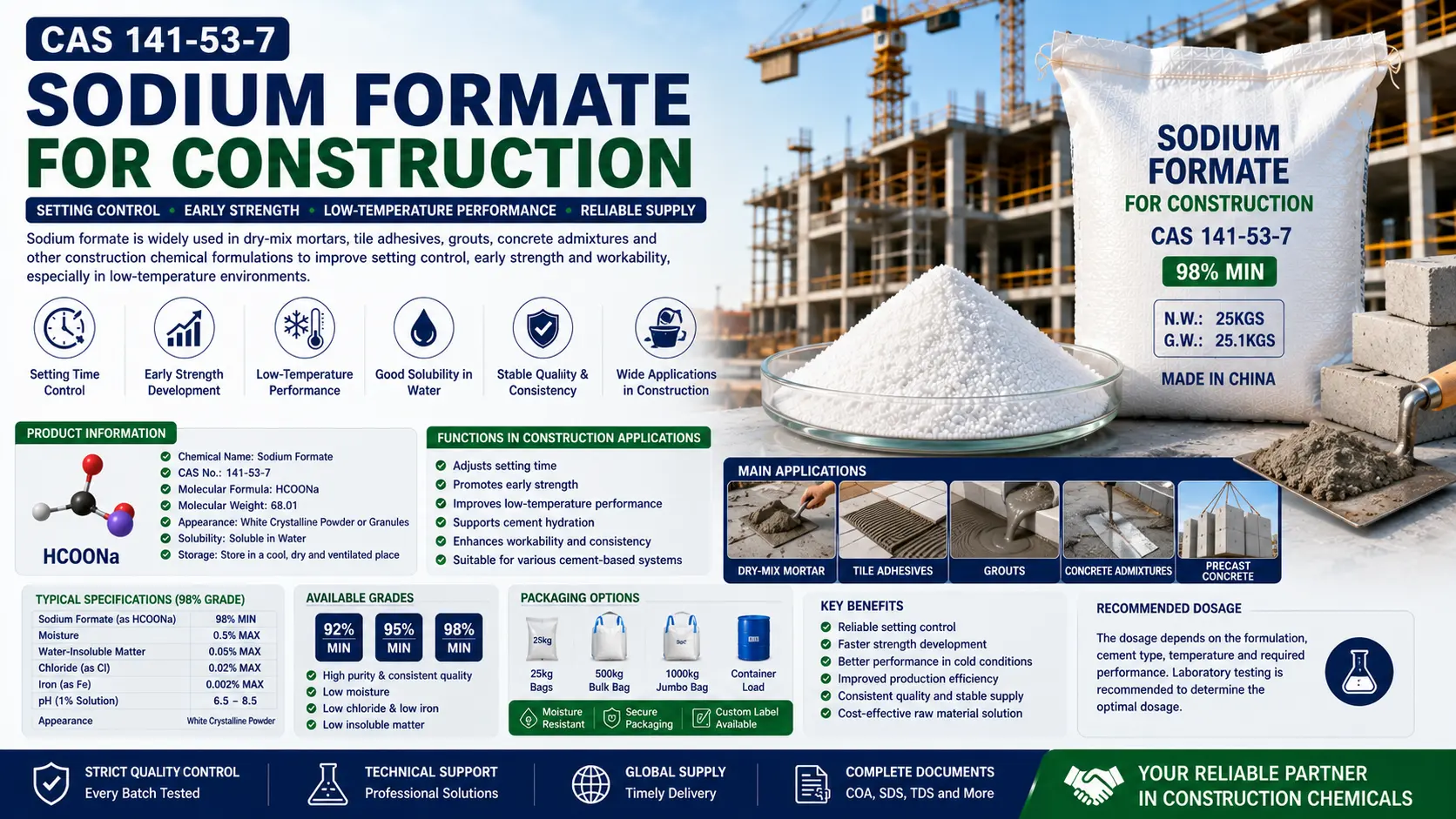
Sodium Formate for Construction is applied to certain cement based formulations, dry-mix mortars, tile adhesives, grouts, concrete admixtures, and building chemical applications. When properly formulated, can aid in setting control, early strength gain, low temperature performance and production uniformity.
When choosing between different types of sodium formate, construction chemical companies, dry-mix mortar producers and distributors, and international buyers must go beyond purity and cost. Formulation performance may be influenced by moisture, chloride, insoluble matter, particle size, solubility, packaging and batch consistency.
What Is Sodium Formate?
Sodium formate is the sodium salt of formic acid. Its chemical formula is HCOONa, and its CAS number is 141-53-7. It is generally supplied as a white crystalline powder or granule with good water solubility.
Typical product information includes:
- Chemical name: Sodium Formate
- CAS number: 141-53-7
- Molecular formula: HCOONa
- Molecular weight: approximately 68.01
- Appearance: White crystalline powder or granules
- Solubility: Soluble in water
- EINECS number: 205-488-0
Commercial sodium formate is commonly available in 92%, 95%, and 98% grades. The correct grade should be selected according to the construction application, formulation requirements, and cost target.
Why Sodium Formate Is Used in Construction Chemicals
Construction materials must perform under different temperatures, humidity levels, raw material conditions, and application environments. Sodium formate may be incorporated into selected formulations to help improve process control and early performance.
Its possible functions include:
- Supporting setting-time adjustment
- Promoting early-strength development
- Improving low-temperature performance
- Supporting cement hydration
- Helping maintain formulation consistency
- Improving production repeatability
- Supporting selected dry-mix systems
Sodium formate should not be treated as a universal additive. Its effectiveness depends on cement chemistry, dosage, temperature, water ratio, fillers, polymers, and other admixtures.
Main Construction Applications
Dry-Mix Mortar
Sodium formate may be used in dry-mix mortar formulations where controlled setting and early mechanical performance are important.
Possible applications include:
- Repair mortar
- Masonry mortar
- Rendering mortar
- Self-leveling compounds
- Waterproof mortar
- Rapid-setting mortar
Its performance should be evaluated with the complete binder and additive system.
Tile Adhesives
In selected tile adhesive formulations, sodium formate may support early setting and strength development.
Important formulation factors include:
- Cement type
- Polymer powder
- Cellulose ether
- Filler composition
- Water demand
- Open time
- Slip resistance
- Required curing speed
Excessive acceleration may reduce open time or working time, so dosage must be carefully tested.
Cement-Based Grouts
Sodium formate may be used in grouts requiring predictable setting, early strength, or low-temperature performance.
Potential applications include:
- Non-shrink grout
- Anchor grout
- Machinery foundation grout
- Repair grout
- Prefabricated component grout
The formulation should be tested for flow, expansion, bleeding, setting time, compressive strength, and dimensional stability.
Concrete Admixtures
Sodium formate may be incorporated into selected concrete admixture systems, particularly where early strength or cold-weather performance is required.
Its suitability depends on:
- Cement composition
- Water-to-cement ratio
- Aggregate
- Supplementary cementitious materials
- Superplasticizer type
- Air-entraining agent
- Curing temperature
- Required setting time
Compatibility testing is essential before field use.
Precast Concrete
Precast manufacturers often need shorter mold cycles and predictable early strength.
Sodium formate may help support:
- Earlier demolding
- Faster production cycles
- More consistent curing
- Improved cold-weather output
- Better scheduling efficiency
The complete mix design must be evaluated to avoid excessive acceleration or reduced workability.
Main Benefits
Setting-Time Control
Sodium formate may help accelerate setting in selected cement-based formulations. This can be useful when faster hardening is required.
Early-Strength Development
Improved early strength may support faster handling, demolding, finishing, or return to service.
Low-Temperature Performance
Cold conditions slow cement hydration. Sodium formate may help support more reliable setting and hardening in selected winter formulations.
Good Water Solubility
Its water solubility allows it to distribute through the mixing water when properly incorporated.
Stable Production
Consistent purity, moisture, and particle size can help construction chemical manufacturers maintain repeatable batch performance.
Flexible Use
Sodium formate can be evaluated in a range of cement-based systems, including mortars, grouts, adhesives, and admixtures.
Important Quality Specifications
Construction buyers should review the complete product specification.
Important indicators include:
- Sodium formate content
- Moisture
- Water-insoluble matter
- Chloride content
- Iron content
- pH value
- Particle size
- Bulk density
- Appearance
- Solubility
Why Moisture Matters
Excessive moisture can affect:
- Effective active content
- Dosing accuracy
- Powder flow
- Storage stability
- Caking
- Dry-mix consistency
Low and stable moisture is especially important for dry-blended construction products.
Particle Size and Mixing
Consistent particle size can improve dispersion in dry-mix formulations.
Very coarse particles may distribute unevenly, while extremely fine powder may create dust or handling difficulties.
Manufacturers should evaluate:
- Flowability
- Blending uniformity
- Dissolution speed
- Segregation risk
- Dust generation
Chloride Considerations
Chloride content should be controlled because some construction materials may contact reinforcement steel, metal anchors, or embedded components.
Projects involving reinforced concrete may have strict chloride limitations. Buyers should define the acceptable chloride level according to the formulation, standard, and intended use.
Sodium Formate 92% vs. 98% for Construction
Sodium Formate 92%
The 92% grade may be suitable for general construction formulations where cost efficiency is important and broader impurity limits are acceptable.
Potential advantages include:
- Competitive price
- Good general solubility
- Availability for bulk purchasing
- Suitability for selected dry-mix systems
Sodium Formate 98%
The 98% grade may be preferred where manufacturers require:
- Higher active content
- Lower moisture
- Better dosing accuracy
- Lower insoluble matter
- More consistent batch performance
- Tighter impurity control
The final choice should be based on formulation testing rather than purity alone.
Dosage Considerations
There is no universal dosage for Sodium Formate for Construction.
The appropriate amount depends on:
- Cement type
- Binder composition
- Temperature
- Water-to-cement ratio
- Desired setting time
- Required early strength
- Other admixtures
- Polymer content
- Application method
- Final performance target
Laboratory trials should begin with a conservative dosage range, followed by testing under expected production and application conditions.
Compatibility Testing
Before commercial use, sodium formate should be tested with all major components of the formulation.
Recommended tests may include:
- Initial and final setting time
- Flow or consistency
- Open time
- Slip resistance
- Water retention
- Compressive strength
- Flexural strength
- Bond strength
- Shrinkage
- Freeze-thaw performance
- Low-temperature curing
- Workability
Testing should reflect the actual cement, additives, fillers, and application conditions.
Low-Temperature Construction
Cold weather can slow hydration and delay strength development. This may cause:
- Extended setting
- Delayed finishing
- Longer demolding time
- Reduced production efficiency
- Higher frost-damage risk
- Project delays
Sodium formate may be used as part of a winter construction formulation to support faster early hydration.
However, it does not replace proper cold-weather practices such as:
- Heated materials
- Protected mixing
- Insulated curing
- Temperature monitoring
- Frost protection
- Correct water control
Packaging Options
Sodium formate for construction applications is commonly supplied in moisture-resistant packaging.
Typical options include:
- 25 kg woven bags with inner polyethylene liners
- 25 kg paper-plastic composite bags
- 500 kg bulk bags
- 1,000 kg jumbo bags
- Palletized export packaging
- Customized private-label packaging
The packaging should protect the product from humidity, rain, tearing, contamination, and long-term exposure to air.
Storage and Handling
Sodium formate should be stored in a cool, dry, and well-ventilated warehouse.
The material should be protected from:
- Rain
- Moisture
- Strong acids
- Contamination
- Damaged packaging
- Direct water exposure
- Excessive humidity
- Improper stacking
Bags should remain sealed until use.
Workers should follow the safety data sheet and use suitable gloves, eye protection, and dust-control equipment.
How to Choose a Supplier
Review the Technical Specification
The supplier should provide measurable limits for purity, moisture, chloride, iron, and insoluble matter.
Request Batch-Specific COAs
The certificate of analysis should correspond to the actual shipment batch.
Test a Representative Sample
The sample should be evaluated in the buyer’s own cement-based formulation.
Compare Several Batches
Reviewing certificates and samples from multiple batches helps determine whether the supplier can maintain consistent quality.
Confirm Production Capacity
Construction chemical manufacturers should confirm monthly output, inventory, standard lead time, and repeat-order capability.
Evaluate Packaging Quality
Packaging should remain strong and moisture-resistant during storage, loading, transportation, and unloading.
Review Export Experience
International suppliers should understand chemical documentation, container loading, customs procedures, and destination requirements.
Required Documents
A professional supplier should be able to provide:
- Technical data sheet
- Safety data sheet
- Certificate of analysis
- Commercial invoice
- Packing list
- Certificate of origin
- Bill of lading
- Customs declaration documents
- Inspection documents when required
Complete and accurate documents help support customs clearance and incoming quality control.
Total Procurement Cost
The lowest sodium formate quotation may not provide the best overall value.
Construction chemical buyers should consider:
- Product purity
- Moisture
- Packaging
- Freight
- Import duties
- Storage
- Dosing efficiency
- Formulation consistency
- Production rejects
- Customer complaints
- Delivery reliability
A stable raw material can reduce batch variation, rework, rejected products, and construction-site problems.
Conclusion
Sodium Formate for Construction can be incorporated into selected dry-mix mortars, tile adhesives, grouts, concrete admixtures, and precast formulations to provide a variety of benefits, including setting control, early strength development, low-temperature performance, and production consistency.
Manufacturers should establish the product specification before buying, obtain a current certificate of analysis, conduct a sample test and lab and production trials.
A reliable supplier should ensure the product is pure, has controlled moisture, the correct particle size, secure packaging, all export paperwork, stable production capacity, and reliable delivery worldwide.


Contact Us
In This Article
Related Posts
Custom Packaging Solutions from an Anhydrous Sodium Acetate Supplier in China
2026-09-23
Application Trends in Anhydrous Sodium Acetate for Special Chemical Manufacturing
2026-09-23
Anhydrous Sodium Acetate for Leather Tanning: Improve Dyeing Uniformity
2026-09-22
Formic Acid 85% for Textile Dyeing: Industrial Applications, Technical Benefits and Future Trends
2026-09-22


