



What Purity Is Required for Sodium Formate for De-Icing Applications?
By vanchor
2026-08-21Related Posts
Custom Packaging Solutions from an Anhydrous Sodium Acetate Supplier in China
2026-09-23
Application Trends in Anhydrous Sodium Acetate for Special Chemical Manufacturing
2026-09-23
Anhydrous Sodium Acetate for Leather Tanning: Improve Dyeing Uniformity
2026-09-22
Formic Acid 85% for Textile Dyeing: Industrial Applications, Technical Benefits and Future Trends
2026-09-22
The correct purity of Sodium Formate for De-Icing depends on more than the assay printed on the Certificate of Analysis. A 92%, 95%, or 98% grade can each be technically appropriate depending on the de-icing formulation, allowable chloride level, moisture tolerance, storage conditions, application equipment, and finished-product specification.
For this reason, buyers should evaluate Sodium Formate for De-Icing through a complete specification profile:
Assay → impurity profile → moisture → physical handling → formulation consistency → finished de-icing performance
At Vanchor, sodium formate is supplied in 92%, 95%, and 98% grades with defined limits for NaCl, NaOH, Na₂CO₃, Na₂S, and moisture, allowing the raw material to be matched to different de-icing formulation requirements.
Why Purity Matters in Sodium Formate for De-Icing
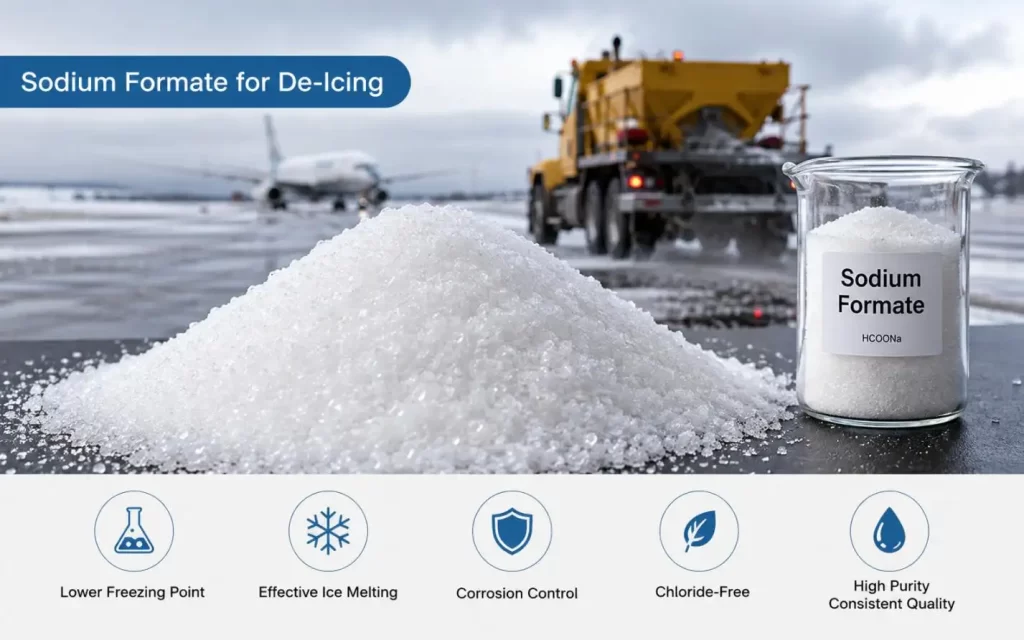
Sodium formate (HCOONa) dissolves rapidly in water and contributes dissolved ions that depress the freezing point and weaken the ice–surface interface. However, higher assay does not translate linearly into higher de-icing efficiency.
The main technical value of higher-purity Sodium Formate for De-Icing is tighter control of the material introduced into the formulation.
Higher assay can support:
•More predictable active HCOONa concentration
•More accurate dosage calculations
•Reduced non-formate salt loading
•Better batch-to-batch formulation repeatability
•More consistent dissolution and spreading behavior
For a de-icer manufacturer, this consistency becomes particularly important when the production recipe is controlled by mass dosage and the finished product must remain within a defined performance window.
92%, 95%, and 98% Sodium Formate: What Actually Changes?
Purity should always be read together with the impurity limits.
| Specification | 98% Super Grade | 95% First Grade | 92% Normal Grade |
| Sodium Formate | ≥98.0% | ≥95.0% | ≥92.0% |
| NaOH | ≤0.05% | ≤0.5% | ≤1.0% |
| Na₂CO₃ | ≤1.3% | ≤1.5% | ≤2.0% |
| NaCl | ≤0.5% | ≤1.5% | ≤3.0% |
| Na₂S | ≤0.06% | ≤0.08% | ≤0.10% |
| Moisture | ≤0.5% | ≤1.0% | ≤1.5% |
These are Vanchor's published sodium formate specifications.
92% Grade: General Industrial Formulations
92% Sodium Formate for De-Icing can be considered where the formulation has sufficient tolerance for higher levels of carbonate, chloride, and moisture.
It may suit applications where:
•Raw-material cost is a major consideration;
•The formulation does not require tight impurity control;
•Corrosion-sensitive infrastructure is not the dominant design factor.
95% Grade: Balanced Purity and Process Control
The 95% grade reduces NaCl, NaOH, and moisture compared with 92% material. It is therefore useful where manufacturers require better formulation repeatability without automatically moving to the highest assay.
98% Grade: Tighter Impurity Control
98% Sodium Formate for De-Icing provides Vanchor's lowest specified NaCl, NaOH, and moisture levels. It is more relevant when raw-material variability or impurity contribution must be minimized.
This distinction is important: 98% is not simply "stronger"; it is a more tightly controlled feedstock.
Chloride Content Can Be More Important Than the Purity Number
When Sodium Formate for De-Icing is selected as an alternative to conventional chloride-rich deicers, NaCl content deserves independent attention.
For example, Vanchor's published NaCl limits decrease from:
•≤3.0% in 92% grade
•≤1.5% in 95% grade
•≤0.5% in 98% grade
A buyer evaluating deicing chemicals for metal-rich infrastructure, maintenance equipment, drainage systems, or other corrosion-sensitive environments should therefore avoid specifying only:
"Sodium formate ≥95%"
A more useful purchasing specification defines both minimum HCOONa assay and maximum chloride content.
Why Moisture Control Matters
Moisture affects both chemical calculation and physical handling of Sodium Formate for De-Icing.
Higher moisture can influence:
•Active material delivered per kilogram;
•Powder flowability;
•Tendency toward caking during storage;
•Consistency through feeders and spreading equipment;
•Storage stability in humid environments.
Vanchor limits moisture to ≤1.5%, ≤1.0%, and ≤0.5% for its 92%, 95%, and 98% grades respectively.
For bulk winter inventories, packaging and warehouse humidity therefore matter alongside the laboratory assay.
Is 98% Sodium Formate Required for Airport Runway De-Icing?
Not automatically.
Airport applications require a distinction between the raw material and the finished runway deicer.
SAE AMS1431F applies to solid runway deicing and anti-icing products. Therefore, purchasing 98% sodium formate alone does not demonstrate that a finished airport deicer meets the applicable performance requirements.
Airport-oriented development should consider:
•Ice penetration and undercutting performance;
•Material compatibility;
•Corrosion behavior;
•Low-temperature application performance;
•Storage and spreading characteristics;
•Production consistency;
•Finished-product qualification.
High-purity Sodium Formate for De-Icing can reduce raw-material variability, but the complete formulation still needs to be qualified for its intended runway application.
How to Select the Appropriate Grade
A practical approach is to start with the application rather than defaulting to the highest assay.
| Application Requirement | Priority When Selecting Sodium Formate |
| General industrial de-icing | Cost, assay, moisture |
| Commercial deicer production | Purity, repeatability, flowability |
| Corrosion-sensitive environment | NaCl and total impurity profile |
| Controlled chemical formulation | 95–98% grade evaluation |
| High-specification deicer | Low moisture + tighter impurities |
| Airport runway formulation | Raw-material QC + finished-product qualification |
What Should Buyers Put in a Purchase Specification?
Professional procurement of Sodium Formate for De-Icing should define measurable acceptance criteria rather than using purity alone.
A useful technical specification should cover:
•HCOONa assay
•NaCl maximum
•NaOH maximum
•Na₂CO₃ maximum
•Na₂S maximum
•Moisture maximum
•Appearance and physical consistency
•Lot-specific Certificate of Analysis
•TDS and SDS/MSDS
•Packaging and moisture protection
•Batch-to-batch consistency
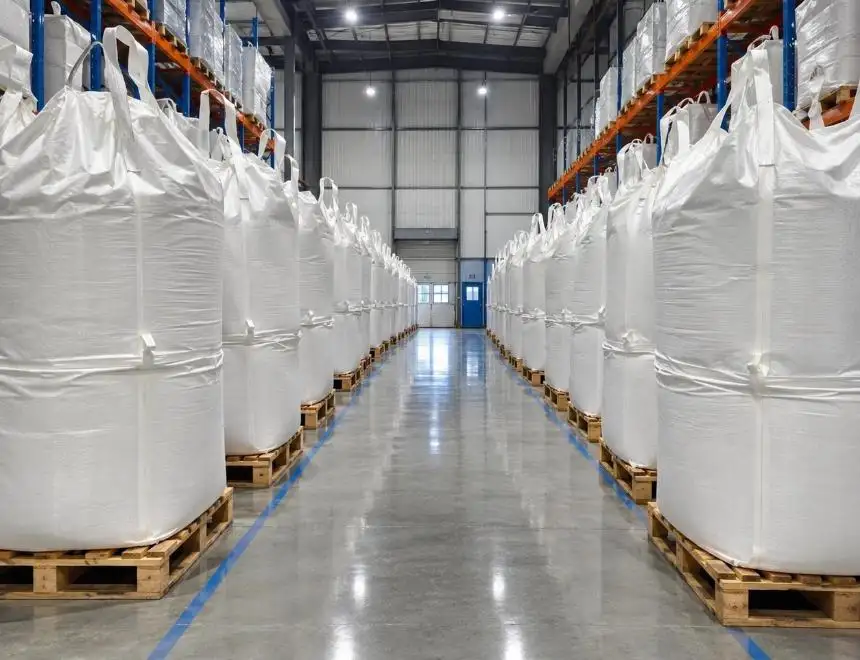
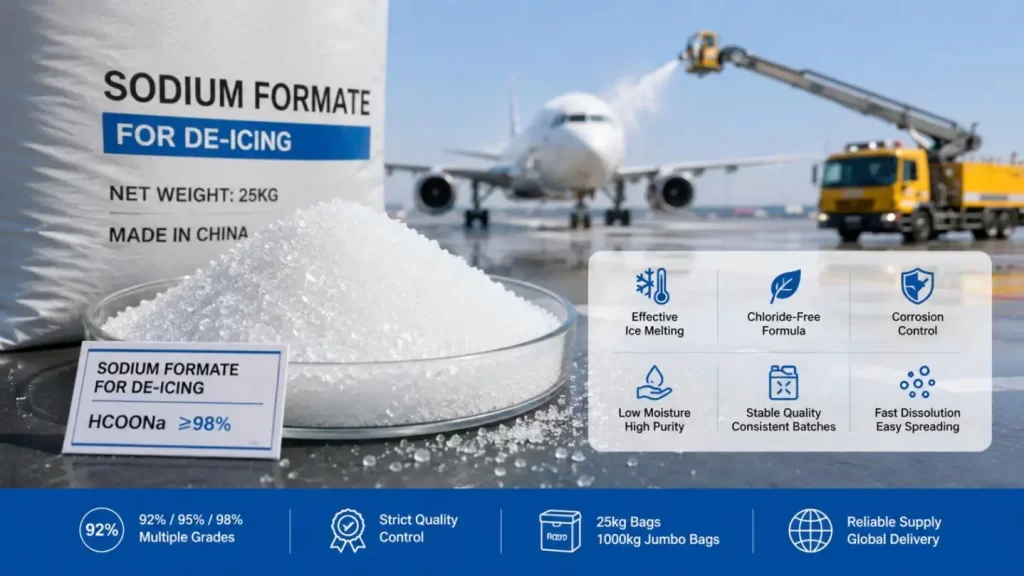
Vanchor supports this specification-driven approach by supplying 92%, 95%, and 98% sodium formate grades together with technical documentation and packaging options including 25 kg bags and 1000 kg jumbo bags.
Final Selection: Purity Should Follow the Application
There is no universal rule that every Sodium Formate for De-Icing application requires 98% material.
92% can serve less demanding industrial formulations, 95% offers improved impurity and moisture control, while 98% is more appropriate when low chloride, low moisture, and tighter raw-material consistency are priorities.
For manufacturers and formulators, the more dependable purchasing method is to identify the complete chemical profile rather than just the assay. Vanchor's 92–98% sodium formate gives a range over which users can compare purity, chloride, moisture, packaging, and documentation to their actual de-icing formulation needs. For projects requiring a more defined technical specification, Vanchor provides data and COA samples and can arrange for bulk supplies to facilitate formulation assessment.
FAQs
Q1. What purity grades of Sodium Formate for De-Icing does Vanchor supply?
Vanchor supplies sodium formate in three grades: 92%, 95% and 98%. De-icing formulators can choose a grade based on tolerance for impurities, chlorides, moisture and formulation control.
Q2. Is 98% Sodium Formate for De-Icing always necessary?
No. The grade required depends on end-use specifications. 92% may be adequate for general industrial applications. More control is exercised with 95% and 98% is used where low impurities and moisture are required.
Q3. Does Vanchor control chloride content in its sodium formate?
Yes. Different grades have different limits for NaCl. Higher purity sodium formate has more control over chlorides, and this is important for corrosion sensitive de-icing applications.
Q4. What moisture levels does Vanchor specify for sodium formate?
Vanchor's sodium formate is published with limits of ≤1.5% for 92%, ≤1% for 95% and ≤0.5% for 98%.
Q5. Can Vanchor supply Sodium Formate for De-Icing for airport formulations?
Vanchor can supply sodium formate for de-icing formulations. Buyers should also confirm that the finished deicer meets the necessary performance and qualification requirements.


Contact Us
In This Article
Related Posts
Custom Packaging Solutions from an Anhydrous Sodium Acetate Supplier in China
2026-09-23
Application Trends in Anhydrous Sodium Acetate for Special Chemical Manufacturing
2026-09-23
Anhydrous Sodium Acetate for Leather Tanning: Improve Dyeing Uniformity
2026-09-22
Formic Acid 85% for Textile Dyeing: Industrial Applications, Technical Benefits and Future Trends
2026-09-22


