



Sodium Formate for Deicing: Benefits, Applications, and Purchasing Guide
By vanchor
2026-07-22Related Posts
Custom Packaging Solutions from an Anhydrous Sodium Acetate Supplier in China
2026-09-23

Application Trends in Anhydrous Sodium Acetate for Special Chemical Manufacturing
2026-09-23

Anhydrous Sodium Acetate for Leather Tanning: Improve Dyeing Uniformity
2026-09-22

Formic Acid 85% for Textile Dyeing: Industrial Applications, Technical Benefits and Future Trends
2026-09-22
Sodium Formate for Deicing is employed in certain road maintenance, airport and industrial and transportation applications where low-temperature performance, water solubility and consistent ice control ability are significant. Sodium formate is the sodium salt of formic acid and can be included in liquid or solid deicing products that are used to reduce or melt ice formation.
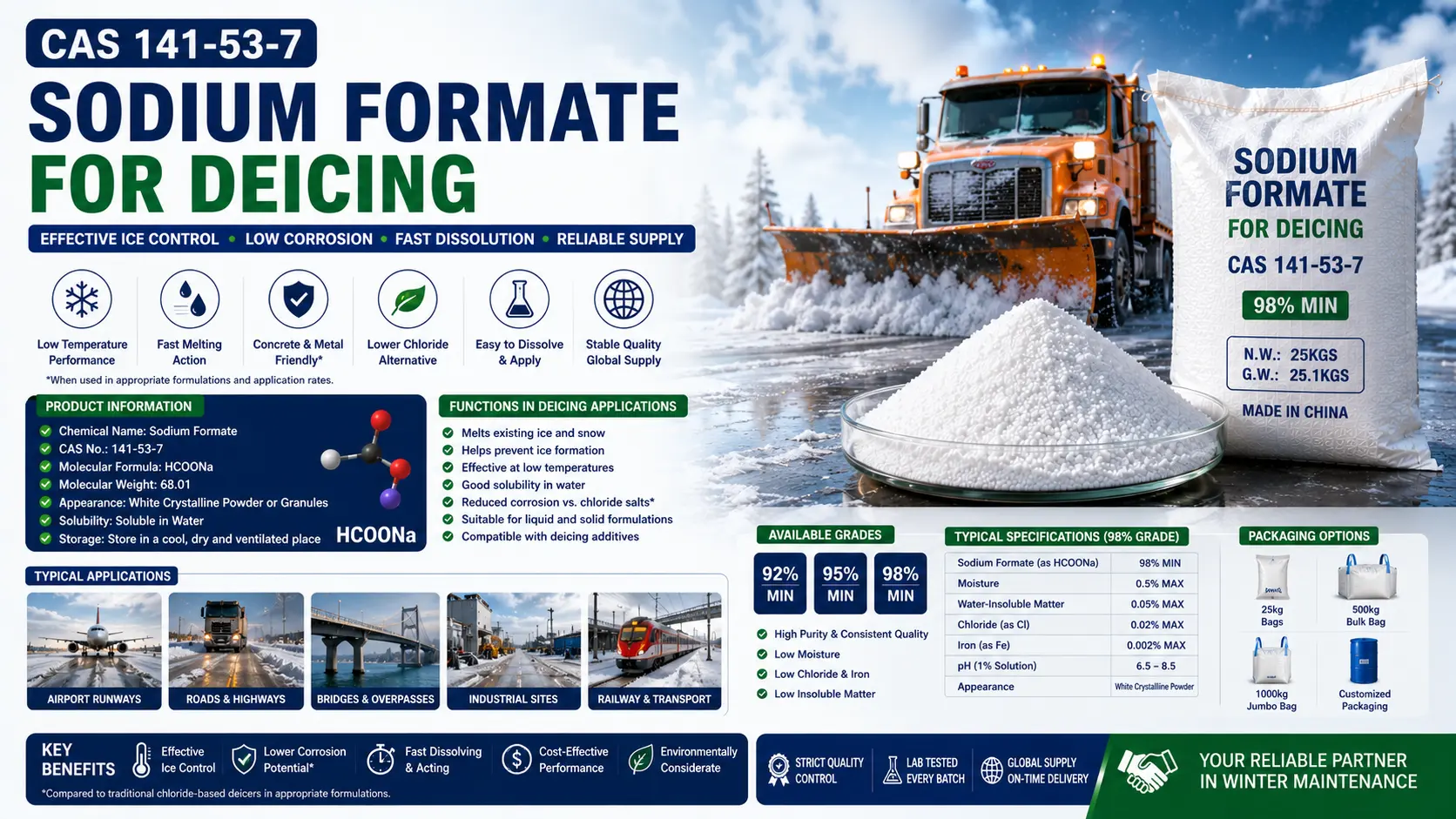
When it comes to deicing chemical formulants, municipal contractors, airport service providers, distributors and international buyers must not only consider price and purity but also the right sodium formate. There can be factors that affect the effectiveness of the final formulation such as moisture, chloride content, insoluble matter, particle size, packaging, storage stability, and corrosion performance, as well as batch consistency.
What Is Sodium Formate?
Sodium formate is the sodium salt of formic acid. Its chemical formula is HCOONa, and its CAS number is 141-53-7. It is generally supplied as a white crystalline powder or granule with good solubility in water.
Typical product information includes:
- Chemical name: Sodium Formate
- CAS number: 141-53-7
- Molecular formula: HCOONa
- Molecular weight: approximately 68.01
- Appearance: White crystalline powder or granules
- Solubility: Soluble in water
- EINECS number: 205-488-0
Commercial sodium formate is commonly available in 92%, 95%, and 98% grades. The appropriate grade depends on the deicing formulation, target performance, impurity limits, and purchasing budget.
How Sodium Formate Works in Deicing
Deicing chemicals lower the freezing point of water and help break the bond between ice and the treated surface. Sodium formate dissolves in water and can contribute to the formation of a brine that remains liquid at temperatures below the normal freezing point of water.
In practical applications, sodium formate may be used to:
- Melt existing snow and ice
- Reduce ice adhesion
- Support anti-icing treatment
- Improve low-temperature surface maintenance
- Prepare liquid deicing solutions
- Support solid deicing blends
- Reduce reliance on conventional chloride-based salts in selected systems
The final performance depends on product concentration, ambient temperature, surface temperature, application rate, precipitation, traffic conditions, and the other ingredients in the formulation.
Deicing and Anti-Icing
Although the terms are often used together, deicing and anti-icing refer to different maintenance strategies.
Deicing
Deicing is the removal or melting of snow and ice after accumulation has occurred.
Sodium formate-based products may be applied to frozen surfaces to help:
- Break the ice-to-surface bond
- Accelerate melting
- Improve mechanical snow removal
- Restore safer operating conditions
Anti-Icing
Anti-icing is a preventive treatment applied before or during the early stages of a winter-weather event.
A sodium formate solution may be used to reduce the formation of a strong ice bond. This can make later removal easier and lower the amount of deicer required after accumulation.
The correct method depends on the weather forecast, surface condition, equipment, traffic, and local operating procedures.
Main Applications of Sodium Formate for Deicing
Airport Runways and Aprons
Airport winter maintenance requires deicing products that support operational safety while minimizing risks to aircraft, pavement, equipment, and the surrounding environment.
Sodium formate may be used in selected airport pavement deicing formulations because of its solubility and low-temperature performance.
Potential application areas include:
- Runways
- Taxiways
- Aprons
- Service roads
- Loading areas
- Airport equipment zones
Any product intended for airport use should be tested against the applicable operational, environmental, pavement, and aviation requirements.
Roads and Highways
Sodium formate may be incorporated into road deicing or anti-icing formulations for selected highways, bridges, ramps, tunnels, and urban roads.
It may be used where operators require:
- Fast dissolution
- Preventive anti-icing
- Low-temperature treatment
- Reduced ice bonding
- Compatibility with liquid application equipment
Performance should be evaluated against traffic volume, pavement type, weather conditions, and local environmental requirements.
Bridges and Elevated Structures
Bridges often freeze faster than ground-level roads because cold air circulates above and below the structure.
Sodium formate-based treatments may be useful for preventive anti-icing on:
- Bridge decks
- Elevated ramps
- Overpasses
- Access roads
- High-risk shaded areas
The formulation should be assessed for corrosion, runoff, concrete compatibility, and application efficiency.
Industrial Sites
Industrial facilities may use sodium formate formulations to maintain safe access during winter conditions.
Possible treatment areas include:
- Loading docks
- Warehouse entrances
- Outdoor storage areas
- Factory roads
- Emergency access routes
- Logistics terminals
The deicer should be compatible with concrete, steel, drainage systems, vehicles, and site-specific operating requirements.
Railway and Transportation Facilities
Selected transportation facilities may use sodium formate-based products for platforms, service areas, maintenance yards, and access routes.
Application procedures should consider:
- Electrical equipment
- Metal components
- Concrete surfaces
- Passenger safety
- Drainage
- Environmental discharge
Main Benefits
Good Water Solubility
Sodium formate dissolves readily in water, making it suitable for liquid deicing and anti-icing formulations.
Low-Temperature Performance
When used at an appropriate concentration, sodium formate can help depress the freezing point of water and support ice control in cold conditions.
Flexible Formulation
The product may be used in:
- Liquid brines
- Solid granules
- Blended deicers
- Pre-wetting systems
- Preventive anti-icing solutions
Reduced Chloride Dependence
Sodium formate may be considered in formulations designed to reduce the use of chloride-based salts. However, the complete environmental and corrosion performance depends on the final product.
Fast Preparation
Its solubility allows deicing solutions to be prepared efficiently under suitable mixing conditions.
Consistent Quality
A stable sodium formate specification helps formulators control concentration, application rate, and batch performance.
Important Quality Specifications
Buyers should review the complete technical specification before using sodium formate in a deicing formulation.
Important indicators may include:
- Sodium formate content
- Moisture
- Water-insoluble matter
- Chloride content
- Iron content
- pH value
- Particle size
- Appearance
- Solubility
- Bulk density
Why Purity Matters
The sodium formate assay affects the amount of active material in the formulation.
A higher-purity grade may provide:
- More predictable concentration
- More consistent freezing-point performance
- Reduced impurity loading
- Easier formulation control
- Better batch repeatability
However, a lower-purity grade may be suitable for selected general applications where cost is a greater priority.
Moisture Control
Excessive moisture may reduce the effective sodium formate content and cause:
- Caking
- Difficult bag handling
- Reduced dosing accuracy
- Storage problems
- Inconsistent formulation concentration
Moisture-resistant packaging and dry storage are therefore important.
Water-Insoluble Matter
Low insoluble matter is useful when preparing liquid deicing solutions.
Excessive residue may contribute to:
- Filter blockage
- Nozzle blockage
- Tank deposits
- Uneven spraying
- Additional cleaning requirements
Suppliers should provide batch-specific insoluble-matter results.
Chloride Content
Chloride content is an important consideration because deicing products may come into contact with:
- Steel
- Vehicles
- Reinforcement bars
- Concrete structures
- Drainage systems
- Industrial equipment
Buyers should define acceptable chloride limits according to the intended application and complete formulation.
Sodium Formate 92% vs. 98% for Deicing
Sodium Formate 92%
The 92% grade may be suitable for cost-sensitive deicing formulations where wider impurity limits are acceptable.
Potential advantages include:
- Competitive price
- Good general solubility
- Availability in bulk quantities
- Suitability for selected industrial applications
Sodium Formate 98%
The 98% grade may be preferred for formulations requiring:
- Higher active content
- Lower moisture
- Lower insoluble matter
- More predictable solution concentration
- Better batch consistency
- Tighter impurity control
The correct grade should be confirmed through formulation and performance testing.
Formulation Considerations
Sodium formate should not be evaluated only as a raw material. The performance of the complete deicing product depends on:
- Sodium formate concentration
- Water quality
- Other salts or additives
- Corrosion inhibitors
- Surfactants
- Thickening agents
- Application temperature
- Surface conditions
- Required melting rate
- Storage stability
The final formulation should be tested under realistic winter conditions.
Important Performance Tests
Before commercial use, formulators may evaluate:
- Freezing point
- Ice-melting capacity
- Ice-penetration rate
- Anti-icing performance
- Corrosion behavior
- Concrete compatibility
- Metal compatibility
- Storage stability
- Sprayability
- Nozzle performance
- Residue
- Environmental impact
Testing methods should reflect the actual application and local requirements.
Liquid Deicer Preparation
A general preparation process may include:
- Inspecting the mixing tank
- Adding clean water
- Starting agitation
- Adding sodium formate gradually
- Allowing complete dissolution
- Checking concentration and density
- Adding compatible performance additives
- Filtering the solution if necessary
- Testing freezing-point performance
- Transferring the finished solution to storage
Actual procedures should be established by qualified formulation and operations personnel.
Factors Affecting Ice-Melting Performance
The effectiveness of Sodium Formate for Deicing depends on several conditions.
Temperature
Deicers generally work more slowly as temperature decreases. The product concentration and application rate should match the expected conditions.
Ice Thickness
Thin frost may respond more quickly than thick, compacted ice.
Application Rate
Insufficient application may not create enough brine to break the ice bond, while excessive application can increase cost and runoff.
Surface Type
Concrete, asphalt, steel, and coated surfaces may respond differently to deicing chemicals.
Traffic and Mechanical Removal
Vehicle movement, plowing, brushing, and scraping can improve the effectiveness of chemical deicers.
Packaging Options
Sodium formate for deicing applications is commonly supplied in moisture-resistant packaging.
Typical options include:
- 25 kg woven bags with inner polyethylene liners
- 25 kg paper-plastic composite bags
- 500 kg bulk bags
- 1,000 kg jumbo bags
- Palletized export packaging
- Customized private-label packaging
Large-volume users may prefer jumbo bags because they can reduce packaging and handling costs.
The receiving site should have appropriate lifting, storage, and controlled-feeding equipment.
Storage and Handling
Sodium formate should be stored in a cool, dry, and well-ventilated warehouse.
The material should be protected from:
- Rain
- Humidity
- Strong acids
- Contamination
- Damaged packaging
- Direct water exposure
- Improper stacking
The bags should remain sealed until use. Workers should follow the safety data sheet and wear appropriate gloves, eye protection, and dust-control equipment.
How to Choose a Supplier
Review the Technical Specification
The supplier should provide clearly defined limits for sodium formate content, moisture, chloride, iron, and insoluble matter.
Request Batch-Specific COAs
The certificate of analysis should correspond to the actual shipment batch.
Test a Representative Sample
Sample testing should include solubility, moisture, purity, formulation compatibility, freezing-point performance, and corrosion behavior.
Confirm Production Capacity
Seasonal deicing demand can rise quickly. Buyers should confirm:
- Monthly output
- Available inventory
- Standard lead time
- Emergency production capability
- Repeat-order support
Review Packaging Capability
The supplier should provide suitable bag sizes, palletization, moisture protection, and labeling.
Evaluate Export Experience
International buyers should work with suppliers familiar with chemical documentation, container loading, customs clearance, and global logistics.
Documents for International Supply
Common purchasing documents include:
- Technical data sheet
- Safety data sheet
- Certificate of analysis
- Commercial invoice
- Packing list
- Certificate of origin
- Bill of lading
- Customs declaration documents
- Inspection reports when required
Accurate documents help reduce customs delays and support quality traceability.
Total Procurement Cost
The lowest sodium formate quotation may not provide the lowest total cost.
Buyers should consider:
- Product purity
- Packaging
- Inland transportation
- Ocean freight
- Import duties
- Storage
- Solution preparation
- Application efficiency
- Corrosion control
- Equipment cleaning
- Delivery reliability
- Seasonal inventory risks
A consistent raw material can help reduce formulation variation, blocked equipment, urgent purchases, and winter-maintenance delays.
Conclusion
Selected liquid and solid sodium formate deicing products can be used in roads, airports, bridges, industrial sites and transportation facilities. It is also highly soluble in water and has a high freezing-point depression property, which makes it suitable as a raw material for deicing and anti-icing systems.
Buyers should be aware of the grade required, the full specification, and ask for batch quality documents prior to purchase and test a representative sample in the final formulation.
A reliable supplier should be able to offer guaranteed purity, regulated chloride level, low insoluble content, moisture-proof packaging, all export documentation and a stable production capacity and world-wide delivery.


Contact Us
In This Article
Related Posts
Custom Packaging Solutions from an Anhydrous Sodium Acetate Supplier in China
2026-09-23
Application Trends in Anhydrous Sodium Acetate for Special Chemical Manufacturing
2026-09-23
Anhydrous Sodium Acetate for Leather Tanning: Improve Dyeing Uniformity
2026-09-22
Formic Acid 85% for Textile Dyeing: Industrial Applications, Technical Benefits and Future Trends
2026-09-22


