



Sodium Formate for Sodium Hydrosulfite: Functions, Quality Requirements, and Purchasing Guide
By vanchor
2026-07-22Related Posts

Custom Packaging Solutions from an Anhydrous Sodium Acetate Supplier in China
2026-09-23

Application Trends in Anhydrous Sodium Acetate for Special Chemical Manufacturing
2026-09-23

Anhydrous Sodium Acetate for Leather Tanning: Improve Dyeing Uniformity
2026-09-22

Formic Acid 85% for Textile Dyeing: Industrial Applications, Technical Benefits and Future Trends
2026-09-22
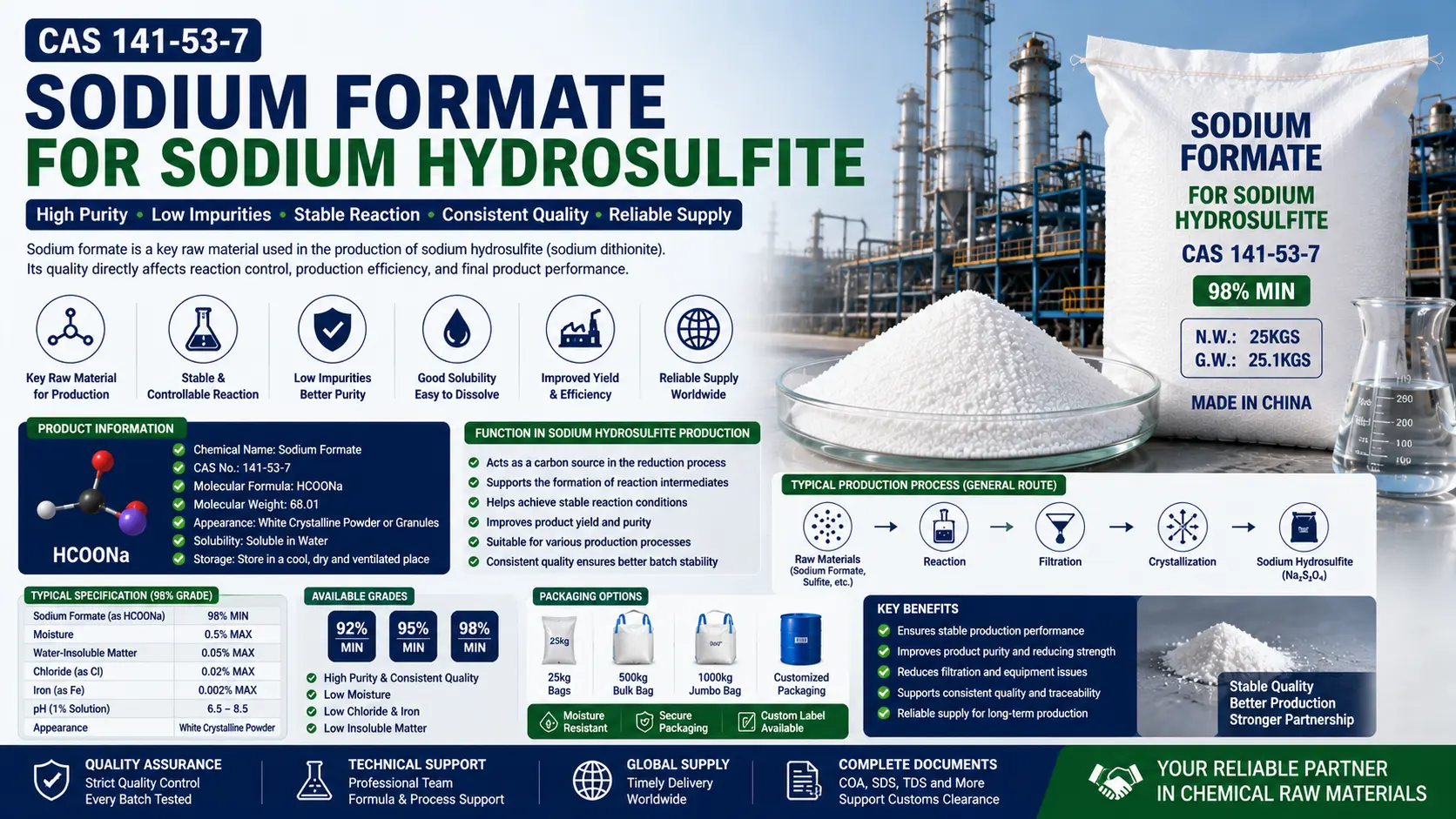
Sodium Formate for Sodium Hydrosulfite is employed as a valuable raw material in selected industrial production processes of Sodium Hydrosulfite also called sodium dithionite. The purity, moisture content, impurity profile and batch consistency can directly affect the degree of control of the reaction, the efficiency of the production process, downstream purification process, and the quality of the product.
The sodium hydrosulfite is used in the textile dyeing, pulp and paper industry, mineral treatment, chemical industry and other industrial fields as a reducing agent. Therefore, selection of an appropriate grade of sodium formate is an important aspect of raw-material management for manufacturers.
A professional supplier should ensure the quality of stable sodium formate, technical documents are complete, packaging is reliable, batch traceability, and reliable bulk delivery.
What Is Sodium Formate?
Sodium formate is the sodium salt of formic acid. Its chemical formula is HCOONa, and its CAS number is 141-53-7. It is normally supplied as a white crystalline powder or granule with good water solubility.
Typical product information includes:
- Chemical name: Sodium Formate
- CAS number: 141-53-7
- Molecular formula: HCOONa
- Molecular weight: approximately 68.01
- Appearance: White crystalline powder or granules
- Solubility: Soluble in water
- EINECS number: 205-488-0
Commercial sodium formate is available in different purity grades, commonly including 92%, 95%, and 98%. Sodium hydrosulfite manufacturers should select the grade according to their process design, reaction conditions, purification requirements, and final product specification.
What Is Sodium Hydrosulfite?
Sodium hydrosulfite is an industrial reducing agent with the chemical formula Na₂S₂O₄. It is also commonly called sodium dithionite.
The product is widely used in:
- Textile dyeing and printing
- Vat dye reduction
- Pulp and paper bleaching
- Mineral processing
- Chemical synthesis
- Water treatment
- Industrial cleaning
- Reductive bleaching processes
Because sodium hydrosulfite is sensitive to moisture, oxygen, heat, and unsuitable storage conditions, its production requires controlled raw materials and carefully managed processing conditions.
Sodium formate may be used as a feedstock or process component in selected manufacturing routes.
Why Sodium Formate Quality Matters
The stated sodium formate assay is only one part of its suitability for sodium hydrosulfite production.
Important factors include:
- Sodium formate content
- Moisture
- Water-insoluble matter
- Chloride
- Iron
- pH
- Particle size
- Appearance
- Batch consistency
- Storage stability
Variations in these properties may influence raw-material dosing, reaction stability, filtration, equipment cleanliness, product color, and final sodium hydrosulfite purity.
Role of Sodium Formate in Production
In selected sodium hydrosulfite manufacturing processes, sodium formate is used as a carbon-containing raw material within a controlled chemical reaction system.
Its exact function depends on the production route, reactor design, process conditions, and other feedstocks. Sodium formate may contribute to the generation of reaction intermediates required for sodium hydrosulfite formation.
The manufacturing process should be designed and operated by qualified chemical engineers. Raw-material dosage, temperature, pressure, reaction time, water content, and gas handling must all be carefully controlled.
Sodium formate should therefore be evaluated as part of the complete production system rather than as an isolated ingredient.
Main Benefits of Using Consistent Sodium Formate
Stable Raw-Material Composition
Consistent assay allows manufacturers to calculate dosing more accurately and maintain repeatable reaction conditions.
Improved Process Control
Stable moisture and impurity levels can help reduce unexpected changes in reaction behavior.
Better Final Product Consistency
Reliable sodium formate quality may support more consistent sodium hydrosulfite purity, appearance, reducing strength, and storage stability.
Reduced Filtration Problems
Low insoluble matter can help minimize deposits, blocked filters, and unwanted solids in the production system.
More Predictable Production Yield
Raw-material consistency can support better process repeatability and yield management.
Easier Quality Traceability
Batch-coded sodium formate allows manufacturers to investigate production variation and maintain stronger quality records.
Important Quality Specifications
Sodium Formate Content
Higher sodium formate content provides a greater concentration of the active raw material.
For demanding chemical manufacturing applications, buyers may prefer a 98% grade because it normally offers tighter composition control than lower commercial grades.
However, the final choice should be based on process testing and total production economics.
Moisture
Moisture is a critical quality indicator because it affects the effective sodium formate concentration and the total water introduced into the production process.
Excessive moisture may result in:
- Inaccurate dosing
- Reduced effective raw-material content
- Changes in reaction balance
- Additional drying or process adjustment
- Storage caking
- Handling difficulties
Moisture-resistant packaging and dry warehouse conditions are therefore important.
Water-Insoluble Matter
Low insoluble matter helps reduce:
- Filter blockage
- Reactor deposits
- Pipeline contamination
- Product residue
- Cleaning frequency
- Maintenance requirements
Manufacturers should define an acceptable insoluble-matter limit based on their equipment and purification process.
Chloride Content
Chloride may affect corrosion behavior, equipment life, product purity, and downstream performance.
Sodium hydrosulfite manufacturers should confirm whether chloride limits need to be controlled more tightly than those used for general industrial sodium formate.
Iron Content
Iron and other metallic impurities may influence product color, chemical stability, side reactions, and final quality.
Low iron content may be especially important when producing sodium hydrosulfite for textile or pulp-bleaching applications.
Particle Size
A consistent particle size can support predictable material handling, dissolution, feeding, and mixing.
Very fine powder may create dust, while large or uneven particles may dissolve more slowly.
Sodium Formate 92% vs. 98%
Sodium Formate 92%
The 92% grade may be considered for cost-sensitive processes where broader impurity and moisture limits are acceptable.
Potential advantages include:
- Lower purchasing price
- Broad industrial availability
- Suitability for selected production systems
- Competitive bulk supply
However, manufacturers should calculate the effective active-content cost rather than comparing only the price per metric ton.
Sodium Formate 98%
The 98% grade may be preferred for sodium hydrosulfite production requiring:
- Higher active content
- Lower moisture
- Lower insoluble matter
- More consistent dosing
- Better batch repeatability
- Tighter impurity control
- Reduced purification requirements
The higher purchase price may be offset by improved production efficiency and lower quality risk.
Effective Raw-Material Cost
The lowest sodium formate quotation does not always provide the lowest production cost.
Manufacturers should compare the cost based on active sodium formate content.
For example, one metric ton of 92% sodium formate contains less active material than one metric ton of 98% sodium formate. Additional moisture and impurities may also affect transportation, storage, dosing, and waste-treatment costs.
A complete comparison should include:
- Purchase price
- Active sodium formate content
- Moisture
- Freight
- Storage
- Feeding efficiency
- Filtration
- Waste generation
- Production yield
- Final product quality
Raw-Material Testing
Before approving a sodium formate supplier, manufacturers should test representative samples.
Recommended raw-material tests may include:
- Assay
- Moisture
- Water-insoluble matter
- Chloride
- Iron
- pH
- Particle size
- Appearance
- Solubility
- Bulk density
The sample should also be evaluated in a controlled production or pilot-scale trial.
Production-Trial Evaluation
A sodium formate trial should monitor more than raw-material test results.
Manufacturers may evaluate:
- Feeding behavior
- Dissolution speed
- Reaction stability
- Temperature control
- Filtration performance
- Product yield
- Sodium hydrosulfite purity
- Reducing strength
- Product color
- Storage stability
- Waste generation
Several production batches may be required before approving a new supplier for long-term use.
Packaging Options
Sodium formate for chemical manufacturing is commonly supplied in moisture-resistant industrial packaging.
Typical packaging options include:
- 25 kg woven bags with inner polyethylene liners
- 25 kg paper-plastic composite bags
- 500 kg bulk bags
- 1,000 kg jumbo bags
- Palletized export packaging
- Customized production labels
The most suitable packaging depends on warehouse conditions, feeding equipment, order volume, and plant handling procedures.
Large-volume manufacturers may prefer jumbo bags to reduce labor and packaging waste. However, the factory should have suitable lifting and controlled-feeding equipment.
Packaging Quality Requirements
Packaging should protect sodium formate from:
- Rain
- Humidity
- Contamination
- Bag tearing
- Product leakage
- Foreign materials
- Excessive compression
- Long-term exposure to humid air
Every bag should display clear product identification and batch information.
Labels may include:
- Product name
- CAS number
- Grade
- Net weight
- Batch number
- Production date
- Supplier information
- Storage instructions
Storage and Handling
Sodium formate should be stored in a cool, dry, and well-ventilated warehouse.
The product should be kept away from:
- Strong acids
- Moisture
- Rain
- Contaminated materials
- Damaged packaging
- Uncontrolled heat
- Direct water exposure
Bags should remain sealed until use. Materials should be rotated according to appropriate inventory-management procedures.
Workers should follow the supplier’s safety data sheet and use suitable personal protective equipment.
Supplier Evaluation
Technical Specification
A reliable supplier should provide a clear and measurable specification rather than only describing the product as industrial grade.
Batch-Specific Certificate of Analysis
The certificate of analysis should correspond to the actual shipment batch and include tested results.
Sample Availability
Representative samples should be available before bulk purchasing.
Production Capacity
Sodium hydrosulfite plants may consume large quantities of sodium formate. Buyers should confirm:
- Monthly capacity
- Inventory availability
- Standard lead time
- Repeat-order capability
- Raw-material continuity
- Emergency supply plans
Quality Management
The supplier should maintain procedures for:
- Raw-material inspection
- Production control
- Finished-product testing
- Retained samples
- Batch coding
- Complaint investigation
- Corrective action
Export Experience
International buyers should select suppliers familiar with chemical packaging, container loading, export documentation, customs clearance, and global shipping.
Required Documents
A professional sodium formate supplier should be able to provide:
- Technical data sheet
- Safety data sheet
- Certificate of analysis
- Commercial invoice
- Packing list
- Certificate of origin
- Bill of lading
- Customs declaration documents
- Inspection reports when required
Document information should match the actual product, batch, packaging, and shipment.
Bulk Purchasing Considerations
Before placing a bulk order, buyers should confirm:
- Required purity
- Maximum moisture
- Chloride limit
- Iron limit
- Insoluble-matter limit
- Particle size
- Packaging
- Order quantity
- Delivery schedule
- Destination port
- Incoterm
- Documentation
- Sample-approval procedure
Clear purchasing specifications reduce disputes and improve supply consistency.
Total Procurement Cost
The total cost of sodium formate includes more than the supplier’s unit price.
Manufacturers should consider:
- Product price
- Active content
- Packaging
- Inland transportation
- Freight
- Import duties
- Warehousing
- Material handling
- Filtration
- Process adjustments
- Waste treatment
- Production yield
- Off-spec product risk
A stable higher-grade material may provide better long-term value than a low-cost product with inconsistent quality.
Long-Term Supply Agreements
Manufacturers with regular demand may benefit from long-term supply agreements.
A contract can define:
- Annual quantity
- Product specification
- Packaging
- Delivery schedule
- Pricing mechanism
- Quality inspection
- Complaint handling
- Documentation
- Batch traceability
- Price-adjustment conditions
Long-term cooperation can help improve raw-material planning and reduce supply interruptions.
Conclusion
Selected sodium hydrosulfite production processes, sodium formate for sodium hydrosulfite is an important industrial raw material. Assay, moisture, insoluble matter, chloride, iron, particle size and batch consistency can all impact on reaction control and final product quality.
Manufacturers need to determine clearly their raw-material limits, study the supplier's technical documents, test a sample then carry out controlled production tests before buying.
A good supplier should be able to offer stable product quality, moisture resistant packaging, certificates for products from a batch, good production capacity, complete export documents and reliable bulk delivery. Through choosing the right sodium formate grade, sodium hydrosulfite manufacturer is able to achieve a more stable process, lower quality risk and better raw material supply chain.


Contact Us
In This Article
Related Posts
Custom Packaging Solutions from an Anhydrous Sodium Acetate Supplier in China
2026-09-23
Application Trends in Anhydrous Sodium Acetate for Special Chemical Manufacturing
2026-09-23
Anhydrous Sodium Acetate for Leather Tanning: Improve Dyeing Uniformity
2026-09-22
Formic Acid 85% for Textile Dyeing: Industrial Applications, Technical Benefits and Future Trends
2026-09-22


