



Sodium Formate for Leather Tanning: Benefits, Uses, and Supplier Guide
By vanchor
2026-07-22Related Posts

Custom Packaging Solutions from an Anhydrous Sodium Acetate Supplier in China
2026-09-23

Application Trends in Anhydrous Sodium Acetate for Special Chemical Manufacturing
2026-09-23

Anhydrous Sodium Acetate for Leather Tanning: Improve Dyeing Uniformity
2026-09-22

Formic Acid 85% for Textile Dyeing: Industrial Applications, Technical Benefits and Future Trends
2026-09-22
Sodium Formate for Leather Tanning is a versatile processing chemical that is used in leather tanning, pickling, dyes and pH control. It moderates the rate of acidity in leather manufacturing, enhances leather penetration of chemicals and provides greater processing uniformity.
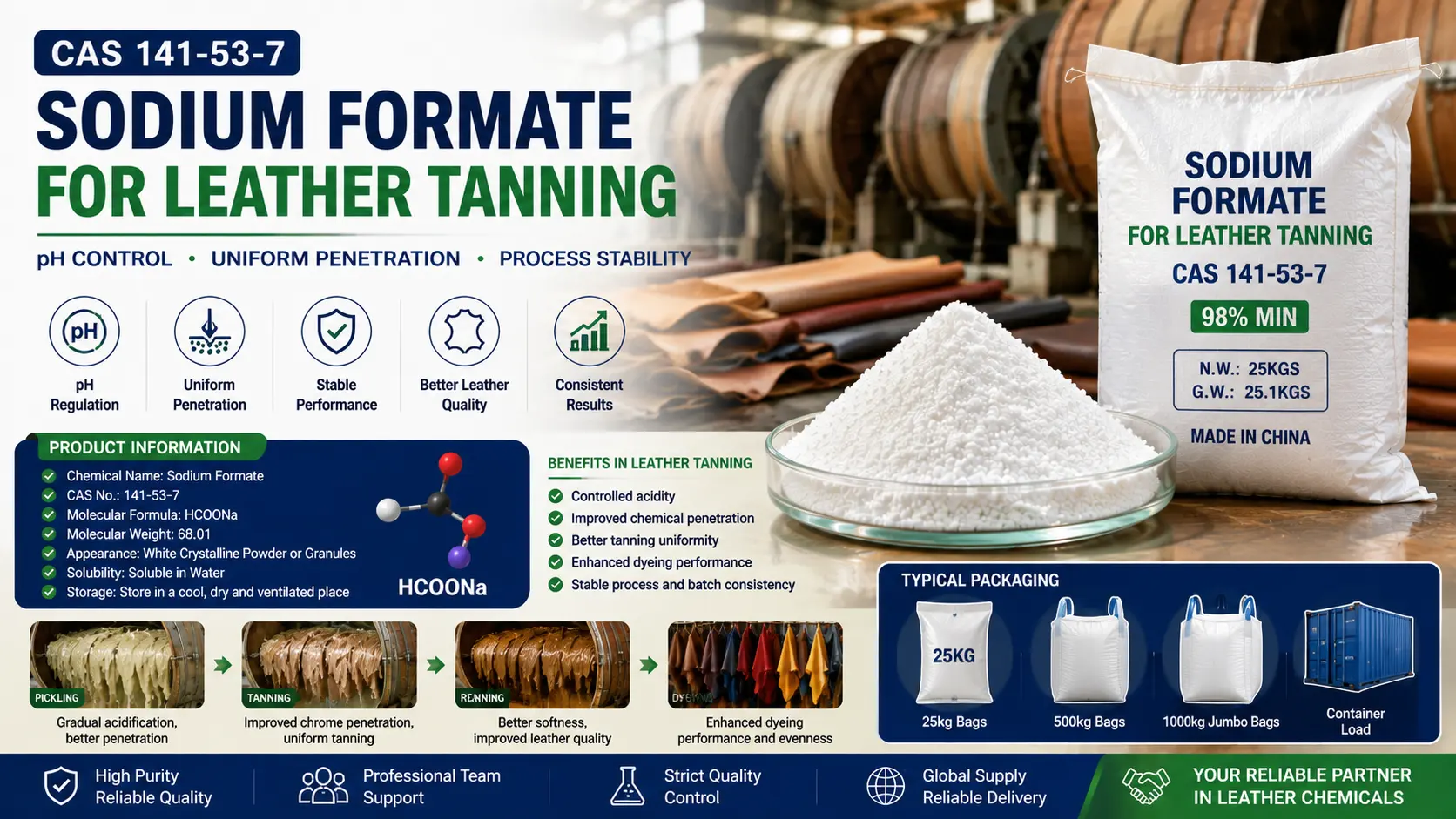
When it comes to leather chemical distributors and purchasing teams, as well as tanneries, the choice of the right sodium formate goes beyond the declared purity. The production performance may be affected by moisture, chloride, insoluble matter, particle size, solubility, packaging, and the batch uniformity.
What Is Sodium Formate?
Sodium formate is the sodium salt of formic acid. Its chemical formula is HCOONa, and its CAS number is 141-53-7. It is generally supplied as a white crystalline powder or granule that dissolves readily in water.
Commercial sodium formate is available in several purity grades, commonly including 92%, 95%, and 98%. The most suitable grade depends on the leather process, formulation, product quality target, and cost requirements.
Typical product information includes:
- Chemical name: Sodium Formate
- CAS number: 141-53-7
- Molecular formula: HCOONa
- Molecular weight: approximately 68.01
- Appearance: White crystalline powder or granules
- Solubility: Soluble in water
- EINECS number: 205-488-0
Buyers should always review the technical data sheet and batch certificate of analysis before placing a bulk order.
Why Sodium Formate Is Used in Leather Tanning
Leather processing involves several carefully controlled chemical stages. Sudden pH changes can affect the penetration and fixation of tanning agents, dyes, and auxiliaries.
Sodium formate is often used because it can support controlled acidification and help stabilize processing conditions.
Its main functions may include:
- Supporting pH regulation
- Improving acid distribution
- Promoting more uniform chemical penetration
- Supporting tanning consistency
- Reducing the risk of localized over-acidification
- Improving process repeatability
- Supporting color uniformity
Its exact effect depends on the complete formulation, hide type, process temperature, water quality, drum conditions, and dosage.
Role of Sodium Formate in Pickling
Pickling is an important preparation stage before chrome tanning and certain other tanning processes. During pickling, acids and salts are used to lower the pH of the hide.
If acidification occurs too quickly, the outer layers of the hide may reach a low pH before the inner structure. This can lead to uneven penetration and inconsistent tanning results.
Sodium formate can act as a buffering or moderating component in the pickling system. It helps create a more controlled pH reduction, allowing the chemicals to penetrate more evenly.
Potential benefits include:
- More gradual pH adjustment
- Improved cross-section penetration
- More uniform pickling
- Better preparation for tanning agents
- Reduced risk of surface damage
- Improved process control
Tanneries should confirm dosage through laboratory trials because the correct amount depends on hide thickness, salt level, acid type, float length, and process target.
Use in Chrome Tanning
In chrome tanning, uniform penetration of chromium salts is essential before fixation occurs.
Sodium formate may be used to support pH control during the tanning sequence. By helping moderate acidity, it can contribute to more even chrome distribution throughout the hide.
Possible process advantages include:
- Improved chrome penetration
- Better tanning uniformity
- More consistent cross-section results
- Reduced surface fixation
- Improved control before basification
- Better batch repeatability
Sodium formate does not replace the complete tanning formulation. It should be used as one component within a controlled process designed by qualified leather technicians.
Use in Dyeing and Retanning
Sodium formate may also be used in selected retanning and dyeing operations where controlled acidity is important.
Uniform pH conditions can influence:
- Dye penetration
- Color evenness
- Fixation behavior
- Leather softness
- Surface appearance
- Reproducibility between batches
Inconsistent sodium formate quality may affect process stability. For this reason, leather manufacturers should pay attention to purity, moisture, solubility, and insoluble matter.
A product that dissolves quickly and consistently is easier to introduce into the drum and may reduce the risk of localized concentration differences.
Main Benefits of Sodium Formate for Leather Tanning
Controlled Acidity
One of the main reasons for using sodium formate is its ability to support gradual pH adjustment. Controlled acidification helps prevent sudden changes that may affect the leather structure.
Uniform Chemical Penetration
Better pH control can support more even penetration of acids, tanning agents, and dyes through the hide cross-section.
Improved Batch Consistency
Stable raw material quality helps tanneries repeat the same process across different production batches.
Good Water Solubility
Sodium formate dissolves readily in water, making it convenient for use in leather-processing formulations.
Compatibility with Industrial Processes
It can be incorporated into many existing leather-processing systems, subject to formulation testing and technical evaluation.
Cost-Effective Processing
Depending on the grade and application, sodium formate can offer a practical balance between performance and cost.
Important Quality Specifications
Leather manufacturers should evaluate the full sodium formate specification rather than only the main assay.
Important indicators may include:
- Sodium formate content
- Moisture
- Water-insoluble matter
- Chloride content
- Iron content
- pH value
- Particle size
- Appearance
- Solubility
Sodium Formate Content
A higher assay generally indicates a greater concentration of sodium formate. However, the most suitable grade should be selected according to process requirements.
Moisture
Excess moisture may reduce the effective sodium formate content and affect storage stability.
Water-Insoluble Matter
Low insoluble matter is important because residue may affect solution preparation, equipment cleanliness, and leather appearance.
Chloride
Chloride content should be controlled according to the tannery’s formulation and quality standards.
Iron
Excess iron may contribute to discoloration or unwanted reactions in selected leather processes.
Sodium Formate 92% vs. 98% for Leather
Both 92% and 98% sodium formate may be used in leather processing, depending on the application.
Sodium Formate 92%
The 92% grade may be suitable for general leather-processing applications where cost efficiency is a priority.
Potential advantages include:
- Competitive price
- Good general performance
- Suitable for bulk purchasing
- Broad availability
Sodium Formate 98%
The 98% grade may be preferred when buyers require:
- Higher purity
- Lower impurity levels
- Better batch consistency
- More predictable formulation performance
- Tighter quality control
The final choice should be based on application testing rather than purity alone.
Recommended Use and Dosage Considerations
There is no single universal dosage for sodium formate in leather tanning.
The required amount depends on:
- Hide or skin type
- Hide thickness
- Process stage
- Float length
- Salt concentration
- Acid system
- Target pH
- Temperature
- Drum conditions
- Other chemicals in the formulation
Leather manufacturers should begin with laboratory-scale trials and adjust the dosage according to measured pH and finished-leather results.
The supplier should not provide a fixed universal dosage without understanding the customer’s process.
Packaging Options
Sodium formate for leather applications is commonly supplied in moisture-resistant industrial packaging.
Typical options include:
- 25 kg woven bags with inner polyethylene liners
- 25 kg paper-plastic composite bags
- 500 kg bulk bags
- 1,000 kg jumbo bags
- Palletized export packaging
- Customized printed bags
The packaging should protect the product from moisture, rain, contamination, and tearing during transportation.
Buyers should confirm bag size, palletization, labeling, container loading quantity, and private-label requirements before shipment.
Storage and Handling
Sodium formate should be stored in a cool, dry, and well-ventilated warehouse.
The product should be protected from:
- Rain
- Humidity
- Strong acids
- Contamination
- Damaged bags
- Direct water exposure
- Improper stacking
The original packaging should remain sealed until use.
Workers should follow the supplier’s safety data sheet and use appropriate personal protective equipment, including gloves, eye protection, and dust-control measures where necessary.
How to Choose a Supplier
Review the Technical Specification
The supplier should provide a detailed technical data sheet with clearly defined quality limits.
Request Batch Certificates
A certificate of analysis should match the actual production batch and show tested values for the main indicators.
Test a Representative Sample
The sample should be evaluated for:
- Purity
- Moisture
- Solubility
- Insoluble matter
- Appearance
- Performance in the tannery’s process
Check Batch Consistency
Review certificates from several batches to determine whether the supplier can maintain stable quality over time.
Confirm Production Capacity
A dependable supplier should support regular demand and repeat orders without major changes in specification or delivery time.
Evaluate Export Experience
International buyers should select a supplier familiar with chemical packaging, customs documents, container loading, and global logistics.
Documents for International Purchasing
A professional supplier should be able to provide:
- Technical data sheet
- Safety data sheet
- Certificate of analysis
- Commercial invoice
- Packing list
- Certificate of origin
- Bill of lading
- Customs declaration documents
- Inspection documents when required
Accurate product names, net weights, HS codes, and consignee details help reduce customs risks.
Total Procurement Cost
The lowest price is not always the most economical choice.
Leather manufacturers should consider:
- Product price
- Purity
- Packaging quality
- Freight
- Import duties
- Storage
- Solution preparation
- Batch consistency
- Production losses
- Complaint handling
A stable product may reduce color variation, reprocessing, rejected leather, and production delays.
Conclusion
Sodium Formate for Leather Tanning is an easy to use processing chemical that is used for pH support, controlled acid development, penetration and batch uniformity. Depending on the complete formulation it can be used in pickling, tanning, retanning and dyeing.
Leather manufacturers ought to determine the expected grade, peruse the entire technical specification, obtain a recent Certificate of Analysis and test a sample of that leather in their own process before they buy.
A good supplier should offer you consistent quality, excellent solubility, safe packing, all the necessary documents, technical support and reliable international delivery.


Contact Us
In This Article
Related Posts
Custom Packaging Solutions from an Anhydrous Sodium Acetate Supplier in China
2026-09-23
Application Trends in Anhydrous Sodium Acetate for Special Chemical Manufacturing
2026-09-23
Anhydrous Sodium Acetate for Leather Tanning: Improve Dyeing Uniformity
2026-09-22
Formic Acid 85% for Textile Dyeing: Industrial Applications, Technical Benefits and Future Trends
2026-09-22


