



Sodium Formate Price: Key Factors, Grades, and Bulk Purchasing Guide
By vanchor
2026-07-22Related Posts
Custom Packaging Solutions from an Anhydrous Sodium Acetate Supplier in China
2026-09-23
Application Trends in Anhydrous Sodium Acetate for Special Chemical Manufacturing
2026-09-23
Anhydrous Sodium Acetate for Leather Tanning: Improve Dyeing Uniformity
2026-09-22

Formic Acid 85% for Textile Dyeing: Industrial Applications, Technical Benefits and Future Trends
2026-09-22
The prices of Sodium Formate are significant to leather manufacturers, construction chemical manufacturers, chemical distributors, international importers and oilfield service companies. But the ultimate cost of the product isn't just based on the purity of the product. The quotation may be influenced by the raw material price, raw material production capacity, packing, order quantity, freight rate, exchange rate, and destination requirements.
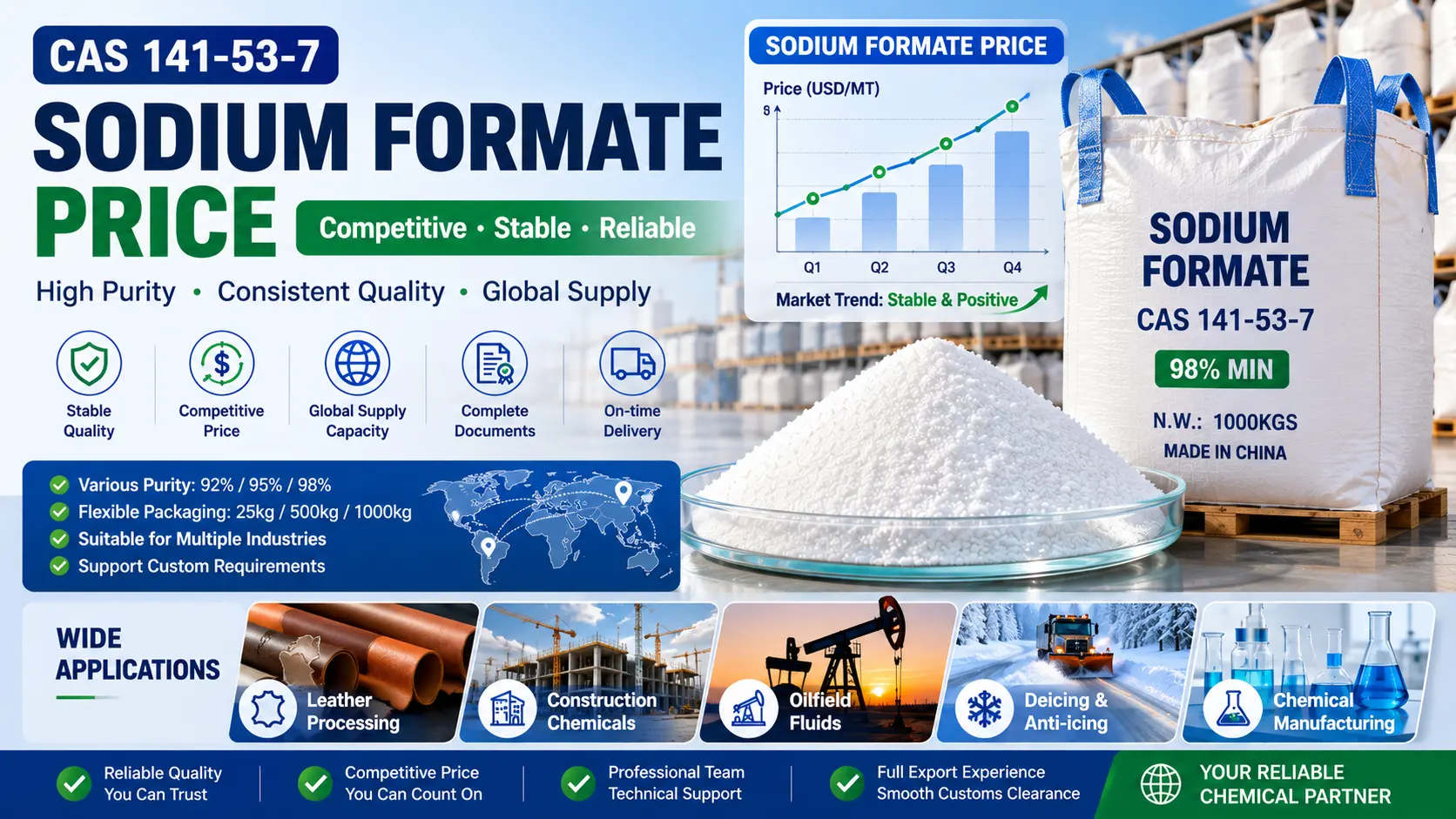
There are various industrial sodium formate grades, such as 92%, 95% and 98% grade. The costs of production and the suitability for application vary by grade. It is therefore recommended that the buyers consider technical specifications in addition to the total procurement costs, and not just the lowest price per metric ton.
What Is Sodium Formate?
Sodium formate is the sodium salt of formic acid. Its chemical formula is HCOONa, and its CAS number is 141-53-7. It is generally supplied as a white crystalline powder or granule with good water solubility.
The product is widely used in:
- Leather tanning and dyeing
- Construction chemicals
- Oilfield drilling and completion fluids
- Deicing and anti-icing formulations
- Chemical manufacturing
- Industrial processing
Its price varies according to purity, impurity limits, packaging, destination, order size, and supplier capabilities.
Main Factors Affecting Sodium Formate Price
Product Purity
Purity is one of the most important factors influencing sodium formate pricing.
Common commercial grades include:
- Sodium formate 92%
- Sodium formate 95%
- Sodium formate 98%
- Customized high-purity grades
Higher-purity products usually require tighter production control, improved raw material quality, and additional testing. As a result, sodium formate 98% is generally priced higher than sodium formate 92%.
However, a higher-purity product is not always necessary. Buyers should select the grade that matches their actual production requirements.
For general industrial applications, a 92% grade may offer a better balance between performance and cost. Applications requiring tighter impurity control may benefit from a 98% grade.
Raw Material Costs
Sodium formate production costs are influenced by the prices of raw materials, energy, labor, and industrial processing inputs.
Changes in the cost of formic acid, carbon monoxide, sodium-based materials, electricity, natural gas, and transportation may affect factory quotations.
When raw material markets fluctuate, suppliers may adjust prices more frequently. Long-term buyers should monitor market conditions and discuss quotation validity with suppliers before confirming an order.
Production Process
Different manufacturing methods may result in different product quality, impurity profiles, and production costs.
A supplier using modern equipment, automated control, and complete quality testing may have higher operating costs than a small producer with limited inspection capability. However, better manufacturing control can provide more stable quality and reduce production risks for the buyer.
The lowest-priced product may not provide the best value if it contains excessive moisture, insoluble matter, chloride, or other impurities.
Order Quantity
Order quantity has a direct impact on Sodium Formate Price.
Small trial orders generally have a higher unit cost because production preparation, documentation, packaging, warehousing, and inland delivery costs are distributed across a smaller quantity.
Bulk orders may offer more competitive pricing because they improve production and logistics efficiency.
Common purchasing quantities include:
- Laboratory samples
- One-ton trial orders
- Partial-container orders
- Full-container loads
- Multiple-container contracts
- Annual supply agreements
Buyers requiring regular shipments may obtain better terms through scheduled orders or long-term purchasing contracts.
Packaging Type
Packaging affects both product cost and transportation efficiency.
Common sodium formate packaging options include:
- 25 kg woven bags with inner polyethylene liners
- 25 kg paper-plastic composite bags
- 500 kg bulk bags
- 1,000 kg jumbo bags
- Palletized packaging
- Customized printed bags
Small bags require more packaging materials and labor per metric ton. Jumbo bags may reduce packaging and handling costs, but buyers need suitable lifting and feeding equipment.
Palletization increases loading convenience and protects the bags during transportation, but it can also reduce the quantity loaded into a container and increase the final freight cost per ton.
Freight and Shipping Conditions
International freight is a major part of the landed sodium formate cost.
The final shipping expense depends on:
- Port of loading
- Destination port
- Container type
- Order weight
- Packaging method
- Palletization
- Shipping season
- Fuel surcharges
- Port congestion
- Local delivery distance
A low factory price may become less competitive after ocean freight and destination charges are included.
Buyers should compare quotations using the same Incoterm, such as EXW, FOB, CFR, or CIF.
Exchange Rates
International sodium formate transactions are often quoted in US dollars. Exchange-rate movements can affect both suppliers and buyers.
A quotation may remain valid for only a limited period when exchange rates or freight costs are unstable.
Buyers should confirm:
- Quotation currency
- Price validity period
- Payment terms
- Exchange-rate adjustment conditions
- Deposit requirements
- Balance payment schedule
Clear payment terms can help prevent unexpected cost changes.
Destination Regulations
Different countries may require specific labels, documents, tests, pallet treatments, or import certificates.
Additional requirements may include:
- Certificate of origin
- Safety data sheet
- Technical data sheet
- Certificate of analysis
- Inspection certificate
- Special labeling
- Fumigated pallets
- Destination-language documents
- Customs classification support
These services may increase the total order cost but can reduce customs clearance risks.
Sodium Formate 92% vs. 98% Price
The price difference between 92% and 98% sodium formate reflects more than the assay percentage.
Sodium Formate 92%
Sodium formate 92% is often selected for cost-sensitive industrial applications. It may be suitable for leather processing, general construction formulations, and chemical operations that can tolerate wider impurity limits.
Its advantages include:
- Competitive unit price
- Good water solubility
- Broad industrial suitability
- Availability for bulk purchasing
- Practical balance between quality and cost
Sodium Formate 98%
Sodium formate 98% is generally preferred when customers require higher purity and more consistent performance.
It may be suitable for:
- Selected oilfield applications
- Chemical manufacturing
- Formulations with strict impurity limits
- Processes requiring lower moisture
- Applications requiring better batch consistency
Buyers should compare certificates of analysis instead of assuming that every 98% product has the same quality.
How to Request an Accurate Quotation
To receive an accurate Sodium Formate Price, buyers should provide complete purchasing information.
A quotation request should include:
- Required purity grade
- Technical specification
- Estimated quantity
- Packaging preference
- Destination port
- Required Incoterm
- Palletization requirements
- Delivery schedule
- Application
- Documentation requirements
For example:
“Please quote 25 metric tons of sodium formate 98%, packed in 25 kg bags without pallets, CIF Hamburg, including TDS, SDS, and batch COA.”
A complete inquiry allows the supplier to calculate production, packaging, loading, freight, and documentation costs accurately.
Factory Price vs. Landed Cost
The factory quotation is only one part of the total procurement cost.
Buyers should calculate the landed cost, which may include:
- Product price
- Packaging
- Inland transportation
- Export customs charges
- Ocean freight
- Insurance
- Destination port charges
- Import duties
- Customs clearance
- Local transportation
- Warehouse expenses
- Quality inspection
- Banking fees
A supplier offering a slightly higher FOB price may still provide a lower total cost if it offers efficient loading, better packaging, fewer quality problems, and reliable documentation.
Why the Lowest Price Can Be Risky
An unusually low Sodium Formate Price may indicate differences in specification, moisture content, packaging quality, production consistency, or testing standards.
Potential risks include:
- Lower actual sodium formate content
- Excessive moisture
- High insoluble matter
- Inconsistent particle size
- Weak packaging
- Damaged bags
- Incorrect documentation
- Delayed shipment
- Unstable batch quality
- Limited complaint support
Quality problems may lead to production losses that are much greater than the initial price difference.
Buyers should request a representative sample and recent certificate of analysis before confirming a bulk order.
How to Compare Sodium Formate Suppliers
Compare the Same Specification
Do not compare a 92% product directly with a 98% product. Confirm that all quotations use the same purity, moisture, packaging, and delivery terms.
Review Batch Certificates
Request certificates of analysis from several previous batches to evaluate consistency.
Test a Sample
Check purity, moisture, solubility, appearance, and application performance before placing a full-container order.
Verify Packaging
Confirm bag strength, inner liners, net weight, palletization, and labeling.
Check Production Capacity
A reliable supplier should be able to support both current demand and future repeat orders.
Evaluate Export Experience
Experienced exporters can reduce risks related to documentation, container loading, customs procedures, and international delivery.
Ways to Reduce Purchasing Costs
Buyers can reduce sodium formate procurement costs through better planning.
Useful strategies include:
- Purchase full-container quantities
- Forecast annual consumption
- Avoid urgent orders
- Select the appropriate purity grade
- Use economical packaging
- Compare FOB and CIF quotations
- Consolidate shipments
- Negotiate scheduled deliveries
- Build long-term supplier relationships
- Monitor freight and raw material markets
Cost reduction should not compromise essential product specifications or packaging quality.
Storage Costs and Inventory Planning
Bulk purchasing can reduce the unit price, but excessive inventory may create additional costs.
Buyers should consider:
- Monthly consumption
- Warehouse capacity
- Humidity control
- Inventory turnover
- Bag stacking limits
- Handling equipment
- Safety stock requirements
- Seasonal demand
Sodium formate should be stored in a dry, cool, and well-ventilated warehouse. Bags should remain sealed and protected from moisture, rain, contamination, and strong acids.
Long-Term Supply Contracts
Companies with stable annual demand may benefit from long-term supply agreements.
A contract may define:
- Product specification
- Forecast quantity
- Pricing mechanism
- Delivery schedule
- Packaging
- Payment terms
- Quality inspection
- Complaint procedure
- Documentation
- Price adjustment conditions
Long-term cooperation can improve production planning, supply stability, communication, and cost control.
Conclusion
The purity, raw materials, production methods, order quantity, packaging, freight, exchange rate, and destination requirement are all factors that affect the Sodium Formate Price. Customers need to understand full specification and landed costs, rather than the factory price alone.
Be sure to check the grade, ask for a sample to examine, obtain recent certificates of analysis and understand packaging and shipping. A reliable supplier should offer clear pricing, consistent quality, full documentation, appropriate packaging and consistent international delivery.
Technical evaluation and thorough cost analysis enable buyers to choose the most suitable sodium formate for optimal long-term procurement value and performance.


Contact Us
Related Posts
Custom Packaging Solutions from an Anhydrous Sodium Acetate Supplier in China
2026-09-23
Application Trends in Anhydrous Sodium Acetate for Special Chemical Manufacturing
2026-09-23
Anhydrous Sodium Acetate for Leather Tanning: Improve Dyeing Uniformity
2026-09-22
Formic Acid 85% for Textile Dyeing: Industrial Applications, Technical Benefits and Future Trends
2026-09-22


