



Adrenochrome CAS 54-06-8: Properties, Research Uses and Storage
By vanchor
2026-07-11Related Posts
Custom Packaging Solutions from an Anhydrous Sodium Acetate Supplier in China
2026-09-23
Application Trends in Anhydrous Sodium Acetate for Special Chemical Manufacturing
2026-09-23
Anhydrous Sodium Acetate for Leather Tanning: Improve Dyeing Uniformity
2026-09-22
Formic Acid 85% for Textile Dyeing: Industrial Applications, Technical Benefits and Future Trends
2026-09-22
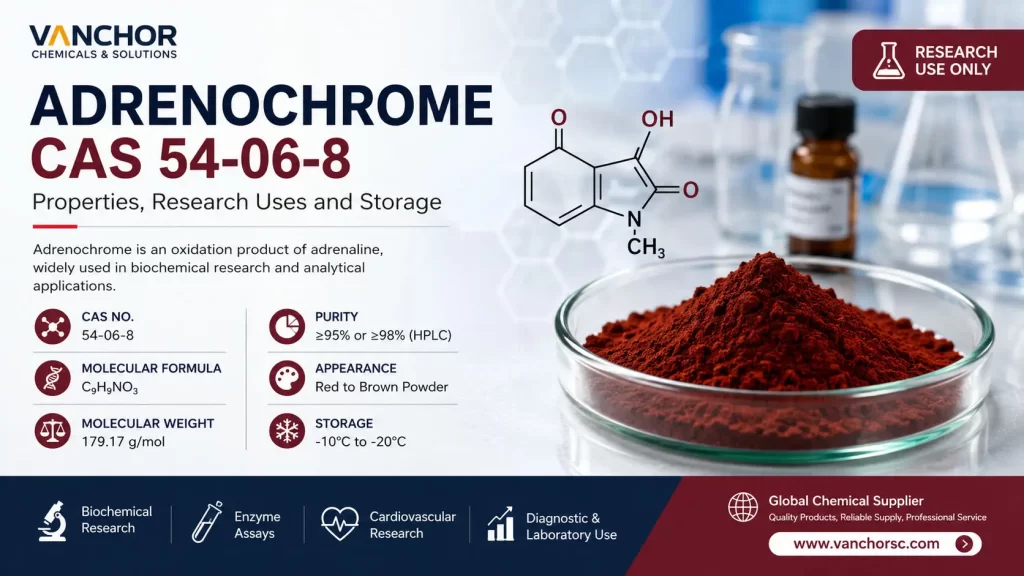
Adrenochrome CAS 54-06-8 is an oxidation product of adrenaline, also known as epinephrine. It is primarily supplied as a red-to-brown research chemical for biochemical studies, analytical applications, diagnostic assay development, and investigations involving catecholamine oxidation.
Because adrenochrome is sensitive to storage conditions and may vary by purity grade, buyers should carefully review the product specification, analytical method, packaging, storage temperature, and batch documentation before placing an order.
What Is Adrenochrome?
Adrenochrome is an organic compound formed through the oxidation of adrenaline. Its recognized chemical name is 3-hydroxy-1-methyl-5,6-indolinedione, although additional systematic names may appear in technical databases and supplier documentation.
Its molecular formula is C₉H₉NO₃, and its molecular weight is approximately 179.17 g/mol. Commercial laboratory grades are commonly offered as red-to-brown powder and may be tested by high-performance liquid chromatography, or HPLC.
Adrenochrome Technical Overview
| Property | Typical Information |
|---|---|
| Product name | Adrenochrome |
| CAS number | 54-06-8 |
| Molecular formula | C₉H₉NO₃ |
| Molecular weight | 179.17 g/mol |
| Common synonym | 3-Hydroxy-1-methyl-5,6-indolinedione |
| EC number | 200-192-8 |
| MDL number | MFCD00069732 |
| Physical form | Powder or solid |
| Typical color | Red to brown |
| Common purity grades | ≥95% or ≥98% by HPLC |
| Storage | Frozen storage according to supplier specification |
| Intended use | Research and qualified technical applications |
Commercial specifications can differ between manufacturers. For example, one supplier lists a purity of at least 98% by HPLC and storage at or below −10°C, while another lists at least 95% by HPLC with storage at −20°C. Buyers should therefore follow the specification, label, and Safety Data Sheet provided for the individual batch rather than applying a universal storage condition.
How Is Adrenochrome Formed?
Adrenochrome is produced when adrenaline undergoes oxidation. In biological and laboratory research, this transformation is studied as part of the broader chemistry of catecholamines and oxidative processes.
Published research has examined how adrenochrome participates in redox cycling and how the surrounding oxidative environment influences the conversion of adrenaline into adrenochrome and other oxidation products. These studies make adrenochrome useful as a model compound for investigating oxidative reactions involving catecholamines.
What Is Adrenochrome Used For?
Adrenochrome is mainly used as a specialized research reagent. Its suitability depends on the experimental method, required purity, analytical documentation, and storage history.
Catecholamine Oxidation Research
Researchers use adrenochrome to investigate the oxidation pathways of adrenaline and other catecholamines. These studies may examine reaction mechanisms, oxidative stress, redox cycling, and the formation of related metabolites.
Biochemical and Enzyme Assays
Adrenochrome may be used in biochemical methods involving reactive oxygen species and enzyme activity. It has also been referenced in methods used to evaluate superoxide-related reactions and superoxide dismutase activity.
Cardiovascular Research
Laboratory studies have examined adrenochrome in relation to coronary artery constriction, catecholamine-associated oxidative damage, and experimental models of cardiac stress. These are research applications and should not be interpreted as approved therapeutic uses.
Diagnostic and Laboratory Development
Commercial laboratory suppliers list adrenochrome for applications associated with diagnostic assay manufacturing, hematology, and histology. The exact suitability of a specific grade must be confirmed through the supplier’s specification and the user’s validation process.
Is Adrenochrome a Pharmaceutical or Cosmetic Ingredient?
Adrenochrome should not automatically be described as a proven pharmaceutical treatment or cosmetic active ingredient.
Some commercial descriptions make broad references to mental health, therapeutic development, antioxidant activity, or skincare. However, exploratory laboratory research does not by itself establish clinical efficacy, regulatory approval, formulation safety, or suitability for human use.
For responsible technical communication, adrenochrome should be presented primarily as a research chemical and biochemical reagent unless a specific regulated application is supported by appropriate clinical, toxicological, and regulatory documentation.
It should not be supplied for human consumption, self-medication, or unapproved therapeutic use.
What Quality Factors Should Buyers Check?
When evaluating an adrenochrome supplier, purity percentage alone is not sufficient. Buyers should review the complete specification and determine whether the material is suitable for the intended analytical or research method.
Important quality criteria include:
- Product identity confirmed by CAS number
- Purity level and analytical test method
- HPLC chromatogram where required
- Appearance and physical form
- Moisture or residual solvent limits
- Storage temperature and shelf-life information
- Recommended protection from light or air
- Batch-specific Certificate of Analysis
- Safety Data Sheet
- Manufacturing or country-of-origin information
- Research-use or application restrictions
A reliable Certificate of Analysis should identify the batch and report actual test results rather than only repeating the standard specification.
How Should Adrenochrome Be Stored?
Adrenochrome is generally supplied as a temperature-sensitive research compound. Commercial suppliers commonly recommend frozen storage, although the stated temperature may vary between products.
To support product stability:
- Keep the container tightly sealed.
- Follow the storage temperature printed on the label.
- Protect the material from unnecessary exposure to heat and light.
- Minimize repeated warming and cooling cycles.
- Use clean, dry tools during sampling.
- Avoid introducing moisture or contaminants.
- Review the SDS before handling.
- Allow the sealed container to equilibrate as instructed before opening.
Appropriate laboratory personal protective equipment may include gloves, eye protection, and respiratory protection based on the risk assessment and SDS.
How to Source Adrenochrome CAS 54-06-8
Before requesting a quotation, provide the supplier with clear technical and commercial information:
| Requirement | Information to Provide |
|---|---|
| Product | Adrenochrome CAS 54-06-8 |
| Required purity | For example, ≥95% or ≥98% by HPLC |
| Quantity | Research pack, sample, or bulk requirement |
| Application | Laboratory research or qualified technical use |
| Documentation | COA, SDS, specification, COO or analytical data |
| Packaging | Required pack size and container type |
| Storage | Required shipping and receiving temperature |
| Destination | Country and delivery location |
| Compliance | Import, customs, or end-use requirements |
Temperature-controlled logistics may be necessary depending on the specification, journey duration, season, and destination. These requirements should be confirmed before shipment.
Specialty Chemical Sourcing with Vanchor
Vanchor provides specialty chemical sourcing, custom chemical services, documentation support, packaging coordination, and international supply chain assistance for qualified industrial customers.
For products not shown in the standard product catalog, availability should be confirmed through a technical sourcing review. Our team can assess the required specification, quantity, documentation, packaging, destination market, and regulatory considerations before preparing a supply proposal.
When requesting Adrenochrome CAS 54-06-8, please include:
- Required purity and analytical method
- Expected order quantity
- Intended research or technical application
- Packaging preference
- Required documents
- Destination country
- Temperature-controlled shipping requirements
Contact Vanchor to discuss your specialty chemical sourcing requirements.
Frequently Asked Questions
What is the CAS number of adrenochrome?
The CAS number of adrenochrome is 54-06-8.
What is the molecular formula of adrenochrome?
Its molecular formula is C₉H₉NO₃.
What is the molecular weight of adrenochrome?
Adrenochrome has a molecular weight of approximately 179.17 g/mol.
What does adrenochrome look like?
Commercial adrenochrome is generally described as a red-to-brown powder or solid.
How pure is commercial adrenochrome?
Common research grades include at least 95% or 98% purity by HPLC. The actual specification depends on the manufacturer and batch.
What is adrenochrome used for?
It is mainly used in biochemical research, catecholamine oxidation studies, oxidative stress research, analytical methods, and selected diagnostic-development applications.
What temperature should adrenochrome be stored at?
Many suppliers specify frozen storage. Published commercial specifications may state −20°C or at or below −10°C. Always follow the product label and SDS.
Is adrenochrome intended for human consumption?
No. Research-grade adrenochrome should not be used for human consumption, self-medication, or unapproved therapeutic applications.
What documents should a supplier provide?
Typical documents include a batch-specific COA, SDS, product specification, and Certificate of Origin where required.
Can Vanchor supply adrenochrome?
Availability depends on the required purity, quantity, end use, destination, and compliance review. Buyers should submit a detailed sourcing inquiry for confirmation.


Contact Us
In This Article
Related Posts
Custom Packaging Solutions from an Anhydrous Sodium Acetate Supplier in China
2026-09-23
Application Trends in Anhydrous Sodium Acetate for Special Chemical Manufacturing
2026-09-23
Anhydrous Sodium Acetate for Leather Tanning: Improve Dyeing Uniformity
2026-09-22
Formic Acid 85% for Textile Dyeing: Industrial Applications, Technical Benefits and Future Trends
2026-09-22


