



Soda Ash Light vs Dense: How to Choose the Right Grade
By vanchor
2026-07-11Related Posts
Custom Packaging Solutions from an Anhydrous Sodium Acetate Supplier in China
2026-09-23
Application Trends in Anhydrous Sodium Acetate for Special Chemical Manufacturing
2026-09-23
Anhydrous Sodium Acetate for Leather Tanning: Improve Dyeing Uniformity
2026-09-22
Formic Acid 85% for Textile Dyeing: Industrial Applications, Technical Benefits and Future Trends
2026-09-22
The main difference between Soda Ash Light vs Dense is physical rather than chemical. Both products are anhydrous sodium carbonate with the chemical formula Na₂CO₃ and CAS number 497-19-8. However, Soda Ash Light has smaller particles and a lower bulk density, while Soda Ash Dense has larger granules and a substantially higher bulk density.
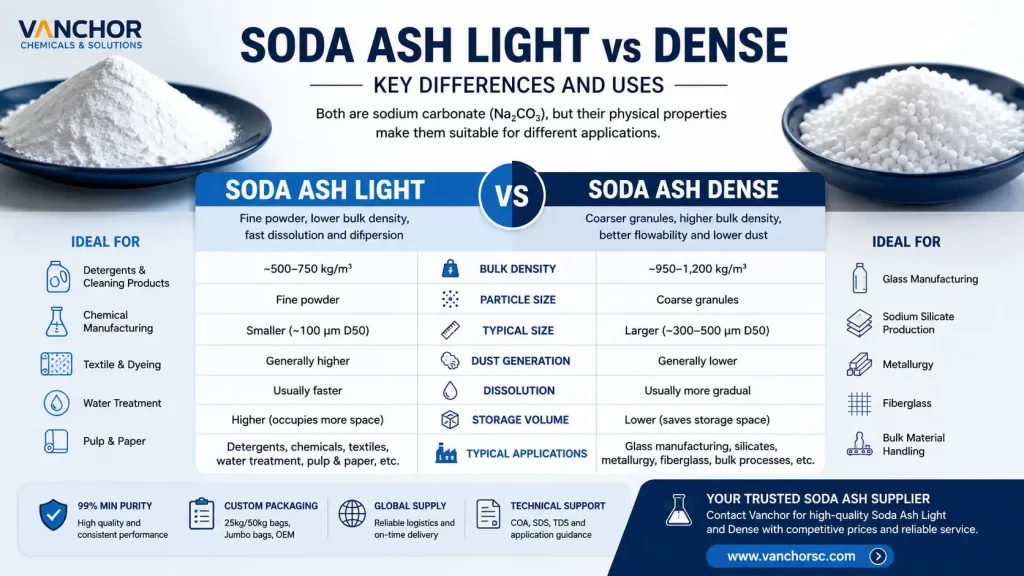
As a practical rule:
- Choose Soda Ash Light for detergents, chemical processing, water treatment and processes requiring rapid dispersion.
- Choose Soda Ash Dense for glass manufacturing, bulk material handling and production lines where low dust and consistent feeding are important.
Selecting the correct grade can improve material flow, storage efficiency, dosing accuracy and overall production performance.
What Is Soda Ash?
Soda ash is the common industrial name for sodium carbonate, a white, odourless alkaline compound that dissolves in water. It is widely used in glass manufacturing, detergents, textile processing, water treatment, pulp and paper, metallurgy and chemical production.
The standard chemical information for both light and dense grades is the same:
| Property | Typical Information |
|---|---|
| Chemical name | Sodium carbonate |
| Chemical formula | Na₂CO₃ |
| CAS number | 497-19-8 |
| Molecular weight | 105.99 g/mol |
| Appearance | White powder or granules |
| Commercial purity | Commonly 99% minimum |
| Main grades | Soda Ash Light and Soda Ash Dense |
The distinction between the two grades comes from particle structure, bulk density and handling behaviour—not from a different chemical formula.
Soda Ash Light vs Dense: Key Differences
| Characteristic | Soda Ash Light | Soda Ash Dense |
|---|---|---|
| Chemical formula | Na₂CO₃ | Na₂CO₃ |
| Typical bulk density | Approximately 500–750 kg/m³ | Approximately 950–1,200 kg/m³ |
| Particle form | Fine, light powder | Coarser, compact granules |
| Typical particle size | Smaller; approximately 100 μm D50 for some grades | Larger; approximately 300–500 μm D50 for some grades |
| Dust generation | Generally higher | Generally lower |
| Dissolution and dispersion | Usually faster | Usually more gradual |
| Storage volume per tonne | Higher | Lower |
| Typical applications | Detergents, chemicals, textiles and water treatment | Glass, silicates and large-scale bulk processing |
| Material flow | May require greater dust control | Usually better suited to conveying and automated feeding |
Bulk density and particle-size specifications vary between manufacturers. Buyers should always review the batch specification and Technical Data Sheet rather than relying on one universal value. Solvay, for example, describes typical bulk densities of approximately 0.5 tonnes per cubic metre for light soda ash and 1 tonne per cubic metre for dense soda ash.
What Is Soda Ash Light?
Soda Ash Light is a fine sodium carbonate powder with relatively low bulk density. Its smaller particles provide a larger surface area, allowing the material to disperse readily when introduced into water or chemical formulations.
Typical applications include:
- Powdered laundry detergents
- Soap and cleaning-product manufacturing
- Chemical synthesis
- Textile dyeing and finishing
- Water softening
- Industrial pH adjustment
- Pulp and paper processing
- Effluent treatment
Light soda ash is particularly useful when the production process requires quick mixing, dissolution or reaction. Its fine structure also makes it suitable for dry formulations in which sodium carbonate functions as an alkaline builder, filler or processing aid.
However, the fine particles can create more dust during bag opening, pneumatic transfer and mechanical feeding. Dust extraction, sealed conveying and appropriate personal protective equipment may therefore be important parts of the handling system.
What Is Soda Ash Dense?
Soda Ash Dense has the same sodium carbonate composition but consists of larger, heavier and more uniform particles. Dense grades can be produced by compacting and classifying light soda ash or through a monohydrate production process.
The higher bulk density means that a given weight occupies less warehouse, silo and transport volume. Dense granules also tend to produce less airborne dust and flow more consistently through bulk handling equipment.
Typical applications include:
- Container glass
- Flat and architectural glass
- Automotive glass
- Fibreglass
- Solar glass
- Glass tubes and bulbs
- Sodium silicate production
- Metallurgical processing
- Other high-volume chemical processes
Dense soda ash is generally preferred for glass production because its particle size is closer to that of silica sand. This supports more homogeneous raw-material blending and helps limit segregation during transport, storage and furnace feeding.
Why Does Glass Manufacturing Use Dense Soda Ash?
In glass manufacturing, soda ash acts as a flux. It helps lower the temperature required to melt silica, making glass production more practical and efficient.
The preference for Soda Ash Dense is related mainly to its physical properties:
- Its granules mix more uniformly with silica sand.
- Its higher density improves bulk storage efficiency.
- It creates less dust during conveying and batching.
- Its flow characteristics support continuous dosing.
- Its larger particles reduce the likelihood of material segregation.
These advantages are especially important in high-volume float-glass, container-glass and fibreglass plants where consistent furnace feeding affects operational stability and final glass quality.
Which Grade Is Better for Detergents?
Soda Ash Light is generally the preferred grade for powdered detergents, soaps and industrial cleaning formulations.
In these applications, sodium carbonate can:
- Increase formulation alkalinity
- Help soften hard water
- Support surfactant performance
- Assist in removing grease and acidic soils
- Function as a builder or formulation filler
- Improve the performance of selected powder blends
Its smaller particles normally disperse more rapidly than dense granules. However, formulation compatibility, particle-size distribution and moisture control should still be evaluated through production trials.
How to Choose Between Soda Ash Light and Dense
The best grade depends on the production process rather than purity alone.
Choose Soda Ash Light When:
- Rapid dispersion is a priority.
- The material will be dissolved before use.
- The application involves detergents or chemical formulations.
- Fine-powder dosing equipment is already available.
- Lower bulk density does not create a storage limitation.
Choose Soda Ash Dense When:
- The application is glass manufacturing.
- The plant uses silos, conveyors or automated bulk feeders.
- Dust reduction is important.
- Storage and shipping volume need to be optimized.
- Consistent granular flow is required.
For some chemical and water-treatment applications, either grade may work. The decision should then consider dissolution equipment, dosing accuracy, local price, packaging, storage capacity and total delivered cost.
Procurement Factors Beyond Grade
When comparing suppliers, buyers should evaluate more than whether the product is light or dense.
Important purchasing criteria include:
- Total alkalinity expressed as Na₂CO₃
- Bulk density range
- Particle-size distribution
- Chloride and sulphate content
- Iron content
- Water-insoluble matter
- Moisture or volatile-matter limit
- Packaging strength and moisture resistance
- Batch-specific Certificate of Analysis
- SDS and Technical Data Sheet availability
- Loading quantity and international logistics support
A lower unit price does not always produce the lowest operating cost. Powder loss, dust collection, warehouse volume, feeding reliability and transport efficiency can materially affect the real cost of using soda ash.
Soda Ash Supply from Vanchor
Vanchor supplies both Soda Ash Light and Soda Ash Dense for glass, detergent, textile, mining, water-treatment and chemical-manufacturing applications.
Available supply support includes:
- Sodium carbonate with 99% minimum purity
- Light and dense grades
- Moisture-resistant industrial packaging
- Bulk and recurring order support
- COA, SDS and technical documentation
- Customized packaging and OEM labelling
- International warehousing and shipping coordination
To obtain an accurate recommendation, buyers should provide the intended application, required specification, annual consumption, preferred packaging and destination port.
Frequently Asked Questions
Is Soda Ash Light chemically different from Soda Ash Dense?
No. Both grades are sodium carbonate with the formula Na₂CO₃. Their main differences are bulk density, particle size and handling behaviour.
Can Soda Ash Light be used in glass manufacturing?
It can be used in some glass processes, but dense soda ash is generally preferred because it offers more compatible particle sizing, lower dust and better bulk flow.
Which grade dissolves faster?
Soda Ash Light generally disperses and dissolves faster because it has smaller particles and a larger surface area.
Which grade requires less storage space?
Soda Ash Dense requires less storage volume per tonne because its bulk density is significantly higher.
Is Soda Ash Dense more pure than Soda Ash Light?
Not necessarily. Both grades can be manufactured to comparable sodium carbonate purity. The Certificate of Analysis should be used to compare actual specifications.
Which soda ash is used in detergents?
Soda Ash Light is commonly selected for detergent powders, soaps and cleaning formulations.
Which soda ash is best for water treatment?
Light soda ash is frequently used because it disperses readily, but either grade may be suitable depending on the dissolving and dosing system.
How should soda ash be stored?
Store it in a cool, dry and well-ventilated area. Keep bags sealed and protect the product from moisture because sodium carbonate can absorb water from humid air.
What packaging is available?
Common export options include industrial woven bags and large FIBC or jumbo bags. Packaging should be selected according to order volume and handling equipment.
How can buyers request a quotation?
Provide the required grade, purity, quantity, packaging, application and destination port so the supplier can prepare an accurate technical and commercial proposal.
Select the Right Soda Ash for Your Process
The choice between Soda Ash Light vs Dense should be based on application, handling equipment, storage capacity and production requirements.
Soda Ash Light provides fine particles and rapid dispersion for detergents, chemical processing, textiles and water treatment. Soda Ash Dense provides higher bulk density, improved flow and lower dust for glass manufacturing and large-scale material handling.
Contact Vanchor with your product specification and application requirements to receive a suitable soda ash grade recommendation, technical documentation and export quotation.


Contact Us
Related Posts
Custom Packaging Solutions from an Anhydrous Sodium Acetate Supplier in China
2026-09-23
Application Trends in Anhydrous Sodium Acetate for Special Chemical Manufacturing
2026-09-23
Anhydrous Sodium Acetate for Leather Tanning: Improve Dyeing Uniformity
2026-09-22
Formic Acid 85% for Textile Dyeing: Industrial Applications, Technical Benefits and Future Trends
2026-09-22


