



Acetic Acid Storage and Handling: Tank Materials and Safety Controls
By vanchor
2026-07-11Related Posts
Custom Packaging Solutions from an Anhydrous Sodium Acetate Supplier in China
2026-09-23

Application Trends in Anhydrous Sodium Acetate for Special Chemical Manufacturing
2026-09-23

Anhydrous Sodium Acetate for Leather Tanning: Improve Dyeing Uniformity
2026-09-22
Formic Acid 85% for Textile Dyeing: Industrial Applications, Technical Benefits and Future Trends
2026-09-22
Acetic acid storage and handling depends on two things: choosing a compatible tank material and applying the right safety controls. For readers dealing with glacial acetic acid or bulk acetic acid service, the practical question is not just “how do I store it?” but “what material, controls, and checks keep the system safe over time?”
For broader sourcing and formulation context, see the parent guide on How a Verified Glacial Acetic Acid Exporter Supports Precision Formulation Work (inferred).
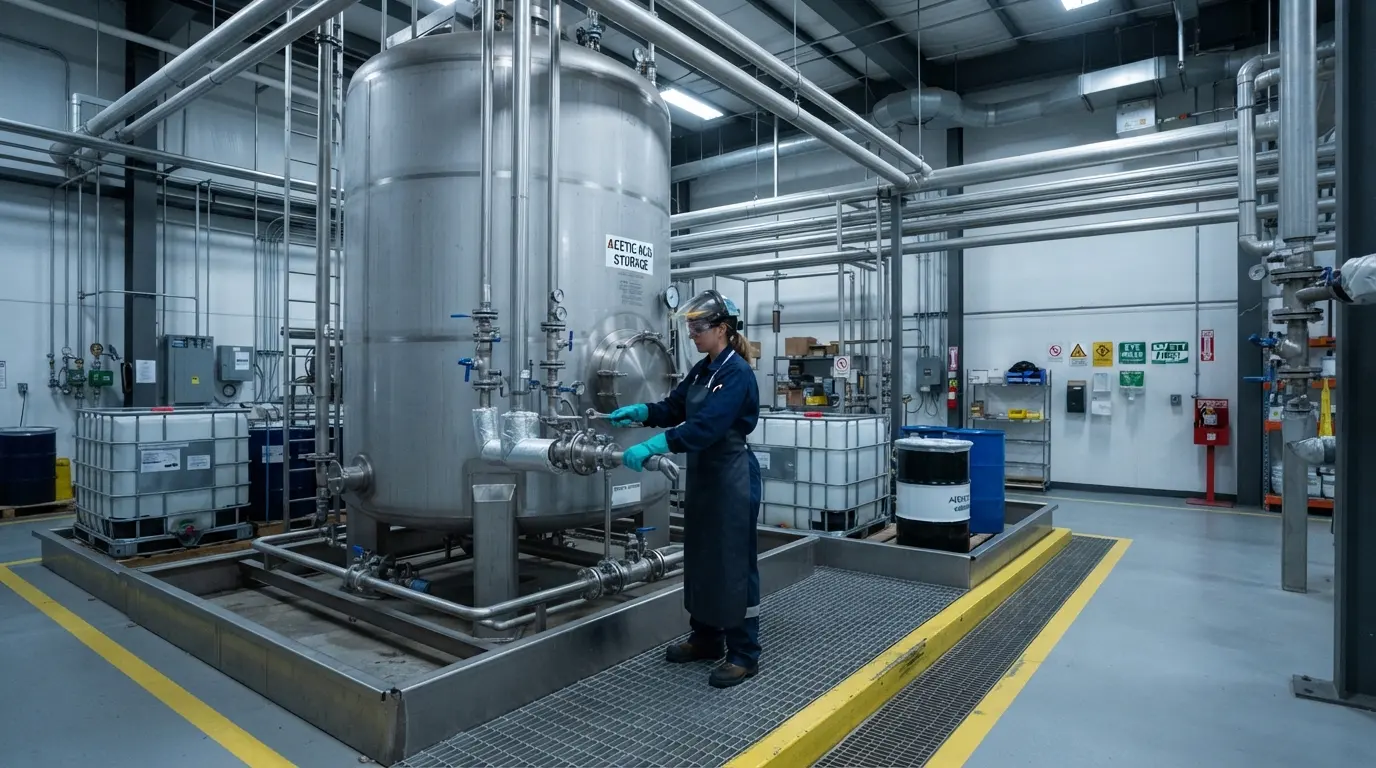
Why Acetic Acid Storage Needs More Than Basic Chemical Handling
Acetic acid is corrosive, and concentrated forms also raise flammability and vapor-control concerns, so storage needs to account for both chemical compatibility and workplace safety. The main failure modes are material corrosion, vapor buildup, static ignition, and exposure during transfer or routine handling.sigmaaldrich+1
That is why storage guidance usually focuses on compatible tanks, ventilation, ignition-source control, PPE, and spill readiness instead of a single “one-size-fits-all” container choice.uwm+1
Tank Materials That Commonly Come Up in Acetic Acid Service
For industrial acetic acid service, the material question usually starts with stainless steel because it is the most common practical family discussed in technical guidance. The exact choice matters: concentration, temperature, and service conditions can change whether one grade is a better fit than another.bssa.org+1
| Material | Practical role in acetic acid service | What to watch |
|---|---|---|
| Stainless steel | Common tank family for acetic acid storage | Grade selection matters; not every condition is the same. |
| 304 stainless steel | Often discussed as a workable option in some acetic acid conditions | Suitability depends on concentration and temperature. |
| 316 stainless steel | Often considered when more corrosion resistance is needed | May be preferred in harsher service conditions. |
| Lined tanks | Alternative where a protective barrier is needed | Must be checked for lining compatibility and integrity. |
| Carbon steel | Contrast material, not the default choice in acetic acid service | Corrosion risk is the key concern. |
The useful decision is not “stainless steel or not,” but “which material holds up under this concentration, temperature, and operating pattern?” Corrosion guidance from technical sources emphasizes that these variables can change the answer.bssa.org+1
304 vs 316 Stainless Steel for Acetic Acid
304 and 316 are the grades most likely to come up in buyer discussions because they are practical, common, and easy to compare. The right choice depends on how demanding the service conditions are, especially if the storage system is intended for bulk or long-duration use.bssa.org
304 stainless steel is often the baseline comparison point.
316 stainless steel is commonly discussed when more corrosion resistance is needed.
If the system will run hotter, longer, or under more demanding conditions, the safer engineering review matters more than a generic material preference.bssa.org+1
Storage Conditions That Reduce Risk
Even the right tank material does not make the system safe by itself. Acetic acid should be stored in a cool, well-ventilated area with containers kept closed, labeled, and protected from unnecessary heat or ignition sources.sigmaaldrich+1
A practical storage checklist looks like this:
Verify the container or tank material is appropriate for the intended concentration and temperature.
Keep storage areas ventilated so vapors do not accumulate.
Remove or control ignition sources near the storage and transfer point.
Keep all containers tightly closed when not in use.
Confirm that labeling and hazard communication are in place.
Make sure an SDS is available to the team before handling begins.uwm+1
These controls are standard because the risk is not limited to the tank itself; it also appears during filling, sampling, transfer, and maintenance.sigmaaldrich+1
Handling Controls for Transfers and Routine Work
Routine handling is where many preventable incidents happen, especially during open transfer or cleanup work. Workers should use appropriate PPE, and where transfer conditions create static risk, grounding and bonding become part of the handling system rather than an optional extra.sigmaaldrich
A simple operating rule works well: reduce exposure, keep the product in a closed path where possible, and prepare for spills before the transfer begins. That means the PPE, spill kit, and emergency response steps should be ready before the first valve is opened.uwm+1
Common Handling Mistakes to Avoid
The most common errors are usually basic: leaving containers open, assuming all stainless steels behave the same, ignoring ventilation, or treating spill response as a separate task that can wait. Each of those shortcuts increases the chance of exposure or corrosion-related failure.sigmaaldrich+1
If the product is moved frequently, the handling procedure should be written around the actual workflow, not around the ideal workflow. That is especially important in plants where acetic acid is transferred from drums, IBCs, or bulk containers.vanchorsc+1
What to Check Before Choosing a Storage Setup
Before choosing a tank or storage arrangement, the team should confirm five things: concentration, temperature, service duration, expected transfer frequency, and whether the chosen material has enough corrosion resistance for the planned use. Those factors are what make a storage decision practical rather than theoretical.bssa.org+1
A useful buyer checklist is:
Is the product glacial acetic acid or a diluted solution?
Will the tank run warm, ambient, or under variable temperature?
Is the system for short-term holding or continuous bulk storage?
Are the transfer steps closed, or will there be repeated opening and sampling?
Is the container type matched to the handling pattern, such as drums, IBC tanks, or ISO tank containers?vanchorsc+1
This is also where documentation matters. An SDS supports hazard controls, while a COA supports product verification and batch consistency. Vanchor’s website states that it supports COA and SDS documentation and discusses drums, IBC tanks, and ISO tank containers as packaging formats.vanchorsc+3
When to Escalate to Engineering Review
Basic guidance is enough for many routine storage cases, but not all of them. If the storage volume is large, the temperature is unusual, the material choice is uncertain, or the site is trying to extend tank life in a demanding environment, the safer move is to escalate the selection to an engineering or safety review.bssa.org+1
That review should focus on whether the material, venting, transfer design, and emergency controls actually fit the operating condition. The goal is not just compliance; it is avoiding a material choice that looks acceptable on paper but fails in real service.sigmaaldrich+1
Practical Next Step
If you are evaluating acetic acid storage for an industrial site, start with the tank material, then check the safety controls, then verify the documentation and packaging format that match the use case. For supplier and documentation context, the broader parent page remains the best next stop: How a Verified Glacial Acetic Acid Exporter Supports Precision Formulation Work (inferred).vanchorsc+1


Contact Us
In This Article
Related Posts
Custom Packaging Solutions from an Anhydrous Sodium Acetate Supplier in China
2026-09-23
Application Trends in Anhydrous Sodium Acetate for Special Chemical Manufacturing
2026-09-23
Anhydrous Sodium Acetate for Leather Tanning: Improve Dyeing Uniformity
2026-09-22
Formic Acid 85% for Textile Dyeing: Industrial Applications, Technical Benefits and Future Trends
2026-09-22


