



Wastewater Treatment Chemical Supplier: Products, Applications, Selection, and Purchasing Guide
By vanchor
2026-07-21Related Posts
Custom Packaging Solutions from an Anhydrous Sodium Acetate Supplier in China
2026-09-23
Application Trends in Anhydrous Sodium Acetate for Special Chemical Manufacturing
2026-09-23
Anhydrous Sodium Acetate for Leather Tanning: Improve Dyeing Uniformity
2026-09-22
Formic Acid 85% for Textile Dyeing: Industrial Applications, Technical Benefits and Future Trends
2026-09-22
A good wastewater treatment chemical supplier should offer more than competitive rates or a wide range of chemicals. Other customers include municipal treatment plants, engineering contractors, industrial factories, distributors, mining companies, paper mills, textile plants, and food-processing plants, and they all require the same level of quality control, chemical grades, application testing, documentation, packaging flexibility and reliability of delivery.
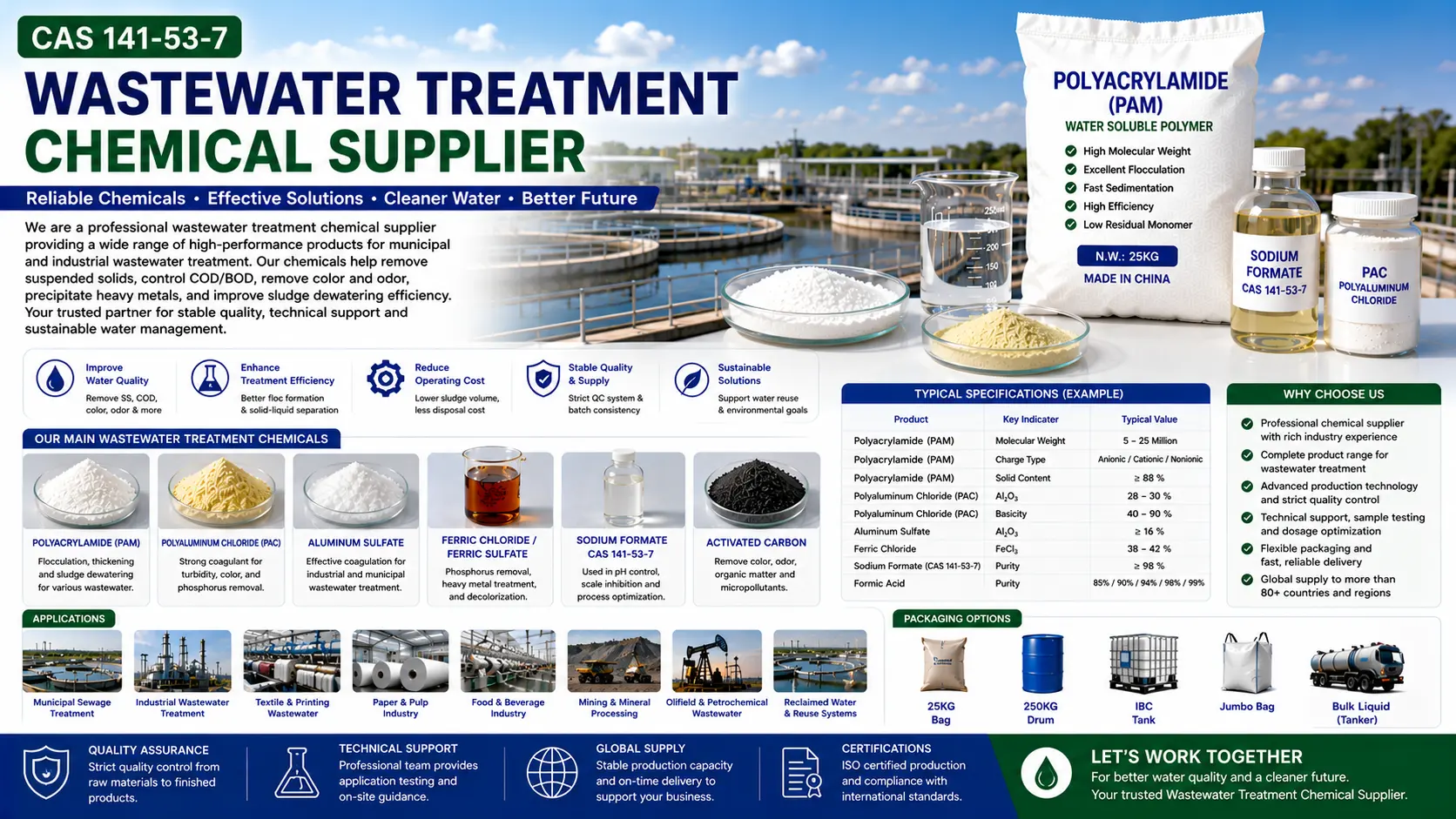
Suspended solids, organic matter, oils, dyes, fibres, heavy metals, salts, microorganisms, nutrients, acids, alkalis and production residues are all potential contaminants that can be present in wastewater. In normal circumstances, these pollutants can't be eliminated by a single chemical. A combination of coagulants, flocculants, pH adjusters, decolorizing agents, precipitants, oxidants, defoamers and sludge-conditioning polymers often is required to achieve effective treatment.
Careful wastewater analysis, laboratory testing, dosage optimization and comprehensive plant testing is required to select the appropriate products. It is important for the buyers to consider the overall treatment cost instead of just price per kilogram of the chemicals.
What Are Wastewater Treatment Chemicals?
Wastewater treatment chemicals are products used to improve the physical, chemical, or biological removal of contaminants from water.
Their primary functions may include:
- Coagulation
- Flocculation
- Sedimentation
- Dissolved-air flotation
- Filtration
- pH adjustment
- Color removal
- Heavy-metal precipitation
- Phosphorus removal
- Oil-water separation
- Odor control
- Foam control
- Sludge thickening
- Sludge dewatering
- Disinfection
- Water-reuse support
The correct chemical program depends on the wastewater source, contaminant concentration, treatment process, equipment, discharge standard, and reuse objective.
Why Chemical Treatment Is Important
Wastewater particles are often too small to settle naturally. Dissolved contaminants may also remain stable even after physical filtration.
Chemical treatment can help:
- Destabilize fine particles
- Form larger and stronger flocs
- Remove suspended solids
- Reduce turbidity
- Separate oil and grease
- Remove color
- Precipitate heavy metals
- Improve biological treatment
- Reduce phosphorus
- Improve sludge dewatering
- Lower final sludge volume
- Support treated-water reuse
An optimized treatment program can also improve equipment capacity and reduce downstream operating costs.
Main Wastewater Treatment Chemicals
Polyacrylamide
Polyacrylamide, commonly abbreviated as PAM, is a water-soluble polymer used for flocculation, clarification, thickening, filtration, and sludge dewatering.
Its CAS number is 9003-05-8.
The principal types include:
- Anionic polyacrylamide
- Cationic polyacrylamide
- Nonionic polyacrylamide
- Amphoteric polyacrylamide
Anionic PAM is commonly used for mineral particles, clay, and inorganic suspended solids.
Cationic PAM is frequently selected for biological sludge, food-processing sludge, paper sludge, and organic industrial wastewater.
Nonionic PAM may be considered for acidic or low-charge wastewater systems.
The correct polymer should be selected according to molecular weight, charge density, hydrolysis degree, wastewater chemistry, and treatment equipment.
Polyaluminum Chloride
Polyaluminum chloride, or PAC, is an inorganic coagulant widely used to destabilize fine suspended particles.
It may be used in:
- Municipal wastewater
- Industrial wastewater
- Textile effluent
- Paper-mill water
- Food-processing wastewater
- Mining water
- Chemical-industry effluent
- Process-water clarification
Potential advantages include:
- Fast coagulation
- Strong turbidity reduction
- Broad pH adaptability
- Effective sedimentation
- Compatibility with polymer flocculants
- Lower sludge production in selected systems
PAC is available in powder and liquid forms with different aluminum contents and basicity levels.
Aluminum Sulfate
Aluminum sulfate is a traditional coagulant used for:
- Suspended-solids removal
- Turbidity reduction
- Phosphorus precipitation
- Color removal
- Paper manufacturing
- Industrial clarification
Its performance depends on wastewater pH, alkalinity, temperature, mixing, and dosage.
Ferric Chloride
Ferric chloride is widely used for:
- Phosphorus removal
- Heavy-metal treatment
- Color reduction
- Suspended-solids removal
- Sulfide control
- Sludge conditioning
It can perform effectively over a broad pH range but requires corrosion-resistant storage and dosing equipment.
Ferric Sulfate
Ferric sulfate may be used for:
- Coagulation
- Phosphorus precipitation
- Color reduction
- Metal removal
- Industrial wastewater clarification
- Sludge conditioning
The selection between ferric chloride and ferric sulfate depends on process requirements, chloride limits, storage systems, and total cost.
Decolorizing Agents
Industrial wastewater from textile, printing, dyeing, paper, pigment, and chemical plants may contain difficult color compounds.
Decolorizing chemicals may help remove:
- Reactive dyes
- Acid dyes
- Direct dyes
- Pigments
- Organic color compounds
- Printing residues
They may be used alone or together with PAC, ferric salts, and polyacrylamide.
Actual wastewater testing is essential because different dye types respond differently.
Heavy-Metal Precipitants
Wastewater from electroplating, metal finishing, electronics, mining, and chemical production may contain:
- Copper
- Nickel
- Zinc
- Chromium
- Lead
- Cadmium
- Mercury
- Cobalt
Treatment chemicals can convert dissolved metals into insoluble particles that can be removed through sedimentation or filtration.
Common treatment products include:
- Lime
- Sodium hydroxide
- Sulfide-based precipitants
- Organic heavy-metal precipitants
- Coagulants
- Polyacrylamide flocculants
Chelating agents may make metal removal more difficult and require specialized products.
pH Adjusters
pH control is essential for coagulation, biological treatment, metal precipitation, oxidation, and discharge compliance.
Common acidic chemicals include:
- Sulfuric acid
- Hydrochloric acid
- Formic acid
- Carbon dioxide
Common alkaline chemicals include:
- Sodium hydroxide
- Lime
- Sodium carbonate
- Magnesium hydroxide
Automated pH control should use reliable sensors, dosing pumps, and safety systems.
Activated Carbon
Activated carbon is used to adsorb:
- Organic contaminants
- Odor compounds
- Residual color
- Chlorine
- Solvents
- Selected micropollutants
- Trace production chemicals
It is available as powdered, granular, or pelletized material.
Activated carbon is often used as a polishing treatment after primary contaminant removal.
Oxidizing Agents
Oxidizing chemicals may be used for:
- Color reduction
- Odor control
- Cyanide destruction
- Sulfide oxidation
- Organic-contaminant treatment
- Disinfection
- Chemical-oxygen-demand reduction in selected systems
Typical oxidants include:
- Hydrogen peroxide
- Sodium hypochlorite
- Ozone
- Potassium permanganate
- Fenton reagents
Oxidation programs require careful control because excessive dosage may increase cost, create by-products, or interfere with biological treatment.
Defoamers
Foam may occur in biological tanks, flotation systems, chemical reactors, equalization basins, and sludge-treatment processes.
Defoamers help:
- Reduce surface foam
- Maintain tank capacity
- Protect sensors
- Improve process stability
- Reduce overflow risk
- Support cleaner operation
The selected defoamer should be compatible with downstream biological or membrane processes.
Nutrient Chemicals
Some biological wastewater systems require nitrogen, phosphorus, or trace nutrients to support microbial activity.
Nutrient addition may be necessary when wastewater contains high organic loading but insufficient nitrogen or phosphorus.
Dosage should be based on actual biological demand to avoid excessive nutrient discharge.
Biocides and Disinfectants
Biocides and disinfectants may be used for:
- Final effluent disinfection
- Odor control
- Slime reduction
- Process-water protection
- Storage-tank sanitation
- Reuse-water systems
Selection should consider contact time, discharge requirements, materials compatibility, and potential by-products.
Coagulation and Flocculation
Coagulation and flocculation are two separate but connected stages.
Coagulation
Suspended particles often carry surface charges that prevent aggregation.
Coagulants such as PAC, aluminum sulfate, ferric chloride, or ferric sulfate reduce these charges and destabilize the particles.
Flocculation
After coagulation, polyacrylamide connects the destabilized particles into larger flocs.
These flocs can then be removed through:
- Sedimentation
- Dissolved-air flotation
- Filtration
- Centrifugation
- Mechanical sludge dewatering
The dosage and addition sequence should be optimized through jar testing.
Municipal Wastewater Treatment
Municipal wastewater plants may use chemicals for:
- Primary clarification
- Phosphorus removal
- Secondary clarification
- Sludge thickening
- Sludge dewatering
- Odor control
- Final effluent polishing
- Disinfection
Cationic polyacrylamide is commonly used for biological sludge because activated sludge usually contains negatively charged organic solids.
Important performance indicators include:
- Solids capture
- Floc strength
- Filtrate clarity
- Cake solids
- Polymer dosage
- Sludge volume
- Equipment throughput
- Disposal cost
Industrial Wastewater Treatment
Industrial wastewater varies significantly between facilities.
Potential contaminants include:
- Suspended solids
- Oils and grease
- Heavy metals
- Dyes
- Fibers
- Proteins
- Solvents
- Salts
- Acids
- Alkalis
- Surfactants
- Organic production residues
Chemical programs should be selected using actual wastewater samples.
A treatment process may include:
- Equalization
- pH adjustment
- Coagulation
- Flocculation
- Sedimentation or flotation
- Biological treatment
- Filtration
- Advanced oxidation
- Disinfection
- Sludge dewatering
Textile Wastewater Treatment
Textile wastewater may contain:
- Reactive dyes
- Disperse dyes
- Pigments
- Salts
- Fibers
- Surfactants
- Starch
- Organic auxiliaries
A chemical-treatment program may include:
- pH adjustment
- PAC or ferric coagulants
- Decolorizing agents
- Polyacrylamide
- Oxidants
- Defoamers
- Sludge-dewatering polymers
Important treatment goals include:
- Color reduction
- Turbidity removal
- Suspended-solids control
- Chemical-oxygen-demand reduction
- Improved sludge separation
The chemical program should not create excessive sludge or interfere with downstream biological treatment.
Paper-Mill Wastewater
Paper-mill wastewater may contain:
- Cellulose fibers
- Fines
- Calcium carbonate
- Clay
- Coating pigments
- Starch
- Dyes
- Wet-end additives
Treatment chemicals may support:
- Fiber recovery
- White-water clarification
- Sedimentation
- Dissolved-air flotation
- Sludge thickening
- Mechanical dewatering
- Water recycling
Polyacrylamide and inorganic coagulants are commonly used together.
Food-Processing Wastewater
Food-processing wastewater may contain:
- Fats
- Oils
- Proteins
- Carbohydrates
- Fibers
- Suspended solids
- Biodegradable organic matter
Common sources include:
- Meat processing
- Dairy production
- Beverage production
- Brewing
- Seafood processing
- Vegetable processing
- Sugar manufacturing
- Starch processing
Treatment chemicals may improve:
- Oil and grease separation
- Dissolved-air flotation
- Suspended-solids removal
- Sludge thickening
- Sludge dewatering
Cationic polyacrylamide is often evaluated for high-organic sludge.
Mining Wastewater Treatment
Mining and mineral-processing wastewater may contain clay, fine minerals, metals, suspended solids, salts, and process reagents.
Chemical applications include:
- Tailings clarification
- Mine-water treatment
- Heavy-metal precipitation
- Sand washing
- Coal washing
- Slurry thickening
- Process-water recovery
- Sludge dewatering
Anionic polyacrylamide is commonly selected for mineral particles and tailings.
The product should be tested using actual slurry and recycled process water.
Metal-Finishing Wastewater
Metal-processing and electroplating wastewater may contain chromium, nickel, zinc, copper, oils, acids, alkalis, and chelating agents.
Treatment may include:
- Oxidation or reduction
- pH adjustment
- Metal precipitation
- Coagulation
- Flocculation
- Filtration
- Sludge dewatering
Chemical dosage must be carefully controlled because metal solubility changes with pH.
Chemical-Industry Wastewater
Chemical-industry wastewater may contain:
- Organic intermediates
- Resins
- Pigments
- Solvents
- Emulsions
- Salts
- Acids and alkalis
- Reaction residues
The treatment program may require multiple stages, including:
- pH correction
- Emulsion breaking
- Coagulation
- Flocculation
- Oxidation
- Activated-carbon adsorption
- Biological treatment
- Sludge dewatering
Compatibility testing is essential because some chemicals may react with treatment agents.
Oilfield Wastewater
Oilfield wastewater may contain:
- Oil and grease
- Suspended solids
- Clay
- Salts
- Drilling additives
- Iron
- Organic chemicals
- Emulsions
Treatment chemicals may support:
- Emulsion breaking
- Coagulation
- Flocculation
- Oil-water separation
- Filtration
- Sludge conditioning
- Produced-water reinjection
- Wastewater reuse
High salinity can affect polymer performance, so actual field water should be used for testing.
Sludge Thickening and Dewatering
Wastewater-treatment chemicals are commonly applied before:
- Belt filter presses
- Screw presses
- Centrifuges
- Plate-and-frame filter presses
- Rotary drum thickeners
- Geotextile dewatering systems
A suitable polymer may improve:
- Floc strength
- Water release
- Solids capture
- Filtrate clarity
- Cake dryness
- Equipment throughput
- Sludge-volume reduction
The selected polymer must match the sludge composition and equipment type.
Important Product Specifications
A professional supplier should provide measurable specifications.
Depending on the product, important parameters may include:
- Active content
- Molecular weight
- Charge density
- Degree of hydrolysis
- Aluminum content
- Iron content
- Basicity
- pH
- Density
- Moisture
- Insoluble matter
- Residual monomer
- Heavy metals
- Particle size
- Dissolution time
- Shelf life
A general description such as “industrial grade” is not sufficient for technical purchasing.
Laboratory Jar Testing
Jar testing helps identify the best coagulant, flocculant, and dosage.
A typical test may evaluate:
- pH adjustment
- Coagulant type
- Coagulant dosage
- Polymer type
- Polymer dosage
- Mixing speed
- Floc formation
- Settling rate
- Supernatant clarity
- Sludge volume
Testing should use fresh and representative wastewater.
Sludge-Dewatering Trials
Sludge trials may compare:
- Cationic charge density
- Molecular weight
- Polymer dosage
- Mixing intensity
- Water-release speed
- Filtrate clarity
- Cake solids
- Equipment throughput
Laboratory results should be followed by a controlled plant trial.
Chemical Addition Sequence
The addition sequence can significantly affect performance.
A common sequence may include:
- Adjust wastewater pH.
- Add the inorganic coagulant.
- Mix rapidly for particle destabilization.
- Add the polymer flocculant.
- Mix gently to form larger flocs.
- Allow sedimentation or flotation.
- Transfer sludge for thickening or dewatering.
Incorrect addition points or excessive mixing may break flocs and increase chemical consumption.
Dosage Optimization
There is no universal dosage suitable for every wastewater stream.
Dosage depends on:
- Contaminant type
- Suspended-solid concentration
- Organic loading
- pH
- Salinity
- Temperature
- Existing chemicals
- Treatment equipment
- Required discharge quality
Overdosing may:
- Increase operating cost
- Create excessive sludge
- Restabilize particles
- Produce sticky sludge
- Increase residual chemicals
Underdosing may result in poor clarification, weak flocs, high turbidity, and low solids capture.
Quality Control
A reliable supplier should maintain quality control throughout manufacturing and distribution.
Typical controls include:
- Raw-material inspection
- In-process monitoring
- Finished-product testing
- Packaging inspection
- Batch numbering
- Retained samples
- Warehouse control
- Shipment verification
Batch consistency is particularly important because unexpected chemical variation can disrupt plant operation.
Batch Documentation
Buyers should request:
- Technical data sheet
- Safety data sheet
- Batch-specific certificate of analysis
- Product specification
- Packing list
- Commercial invoice
- Certificate of origin
- Bill of lading
- Inspection report when required
All documents should use consistent product names, grades, concentrations, batch numbers, quantities, and packaging details.
Packaging Options
Wastewater-treatment chemicals may be supplied in:
- 25 kg bags
- 200 kg drums
- 250 kg drums
- 500 kg bulk bags
- 1,000 kg jumbo bags
- IBC tanks
- ISO tanks
- Road tankers
- Customized packaging
Packaging selection depends on:
- Chemical form
- Order volume
- Storage capacity
- Unloading equipment
- Safety requirements
- Transport regulations
Storage and Safety
General storage precautions include:
- Keep powder products dry.
- Protect liquid chemicals from extreme temperatures.
- Separate incompatible acids, alkalis, oxidants, and reducing agents.
- Use compatible storage tanks.
- Maintain secondary containment for liquids.
- Keep product labels visible.
- Follow the safety data sheet.
- Provide appropriate personal protective equipment.
- Install eyewash and emergency-shower equipment where required.
Wet polyacrylamide can create extremely slippery surfaces and should be cleaned promptly.
How to Evaluate a Wastewater Treatment Chemical Supplier
Buyers should evaluate:
- Product range
- Technical knowledge
- Application-testing capability
- Product specifications
- Batch consistency
- Packaging options
- Supply capacity
- Documentation
- Export experience
- Complaint-handling procedures
A dependable supplier should ask for wastewater data before recommending a product.
How to Request an Accurate Quotation
A complete inquiry should include:
- Wastewater source
- Industry
- Treatment objective
- pH
- Suspended solids
- Color
- Chemical-oxygen demand
- Heavy metals
- Oil and grease
- Salinity
- Existing chemicals
- Treatment equipment
- Required product quantity
- Packaging
- Destination
- Incoterm
For example:
“Please recommend and quote PAC, a decolorizing agent, and polyacrylamide for textile wastewater clarification and sludge dewatering, including samples, TDS, SDS, batch-specific COA, packaging options, and delivery terms.”
Detailed information allows the supplier to recommend a more suitable treatment program.
Comparing Supplier Quotations
Buyers should compare:
- Product grade
- Active content
- Technical specifications
- Effective dosage
- Treatment performance
- Sludge generation
- Packaging
- Freight
- Documentation
- Technical support
- Delivery reliability
A lower purchase price may create a higher treatment cost if the chemical requires a larger dosage or produces more sludge.
Total Treatment Cost
The total cost may include:
- Chemical price
- Effective dosage
- pH-adjustment chemicals
- Solution-preparation water
- Labor
- Energy
- Sludge generation
- Sludge transport
- Waste disposal
- Equipment cleaning
- Filter performance
- Water-reuse value
The best treatment chemical is the one that achieves the required result at the lowest overall operating cost.
Common Purchasing Risks
Potential risks include:
- Selecting chemicals only by price
- Using the wrong product grade
- Ignoring active content
- Failing to test representative samples
- Accepting inconsistent batches
- Poor dissolution
- Excessive impurities
- Damaged packaging
- Missing documentation
- Incompatible products
- Delayed delivery
- Limited technical support
These risks can be reduced through clear specifications, sample testing, batch-specific COAs, supplier qualification, and controlled plant trials.
Questions to Ask Before Ordering
Buyers should confirm:
- Which products are recommended for the wastewater?
- Can representative samples be provided?
- Can jar testing be supported?
- Can sludge-dewatering tests be performed?
- What active contents are guaranteed?
- Can batch-specific COAs be supplied?
- What packaging options are available?
- What is the normal lead time?
- What is the monthly supply capacity?
- Can customized grades be produced?
- Which export documents are included?
- Can third-party inspection be arranged?
- How are quality complaints handled?
- Is long-term technical support available?
Conclusion
When selecting a Wastewater Treatment Chemical Supplier, the complete evaluation of the product range, technical specifications, application performance, batch consistency, packaging, documentation, technical support, supply capacity and reliability of delivery services are important.
Coagulation, flocculation, color removal, heavy metal precipitation, pH adjustment, oxidation, foam control, sludge thickening, sludge dewatering and final water polishing are all areas where wastewater-treatment chemicals are widely used.
Buyers should supply comprehensive wastewater and equipment information, take representative samples, subject them to laboratory tests, and submit batch-specific quality documents, plus carry out controlled plant trials before purchasing.
A reliable supplier should be able to supply proper chemicals, consistent product quality, clear specifications, flexible packaging, full documentation, technical support and reliable worldwide delivery.


Contact Us
In This Article
Related Posts
Custom Packaging Solutions from an Anhydrous Sodium Acetate Supplier in China
2026-09-23
Application Trends in Anhydrous Sodium Acetate for Special Chemical Manufacturing
2026-09-23
Anhydrous Sodium Acetate for Leather Tanning: Improve Dyeing Uniformity
2026-09-22
Formic Acid 85% for Textile Dyeing: Industrial Applications, Technical Benefits and Future Trends
2026-09-22


