"
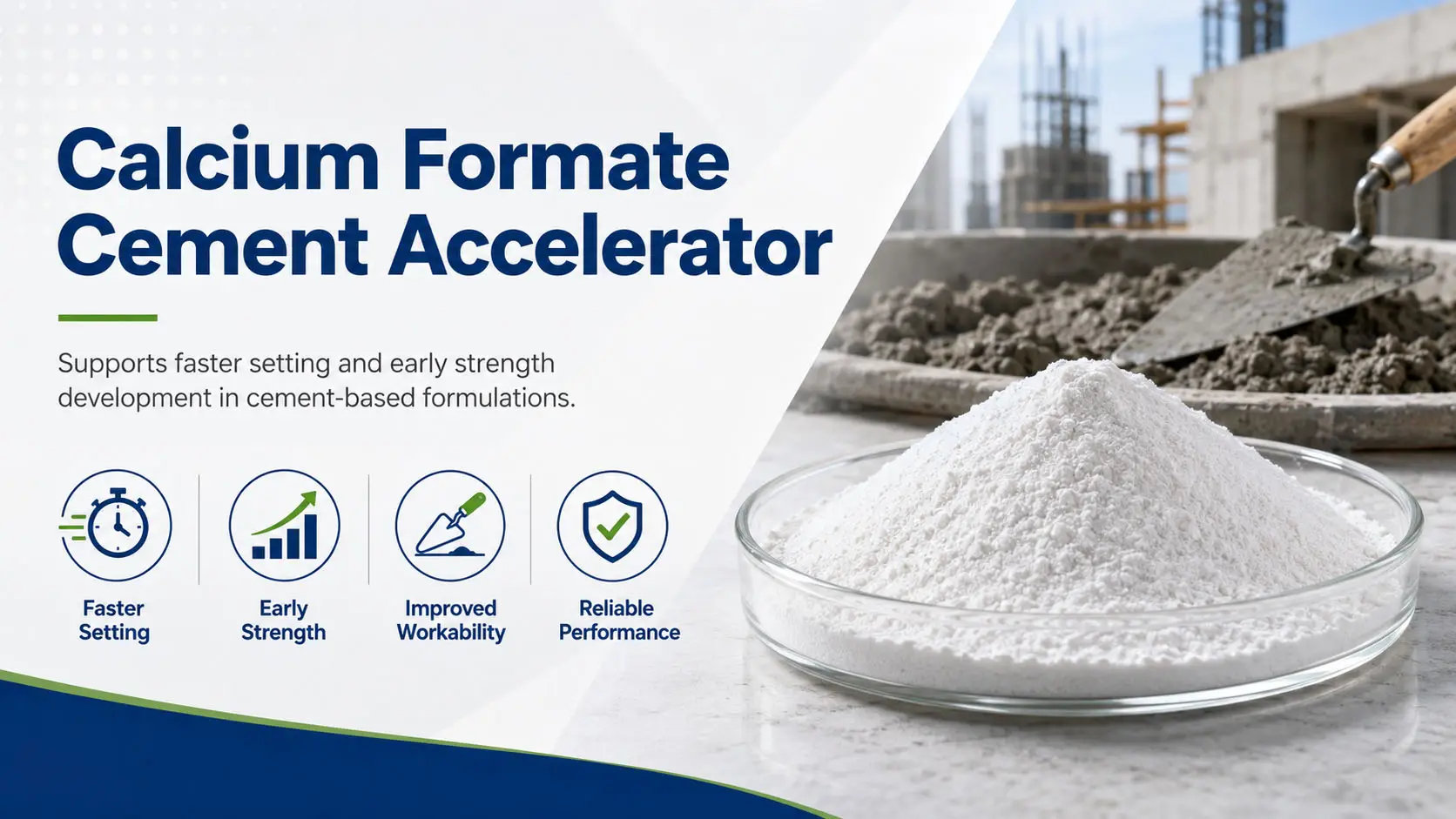
Calcium formate is a non-chloride cement accelerator that improves early strength without the corrosion risks linked to calcium chloride.
— Construction chemistry overview
Calcium formate is one of the more common non-chloride cement accelerators used in modern construction chemistry. It is popular in dry-mix mortar , repair materials, and precast production because it can improve early strength without bringing the corrosion risks linked to calcium chloride.
That does not make it a cure-all. It works best when the mix design , cement type , and dosage are matched to the job. When that happens, calcium formate can help shorten production cycles, improve handling speed, and support more consistent performance in cold weather or fast-track projects.
Key takeaways from this guide:
OVERVIEW
What calcium formate is
01
Calcium formate is the calcium salt of formic acid . In construction materials, it usually comes as a white crystalline powder and is used as a setting and hardening accelerator in cement-based products.
It is common in dry-mix formulations such as tile adhesives, self-leveling compounds, repair mortars, renders, and grouts.
Formulators often choose it because it can speed up early hydration and early strength development without the chloride-related corrosion concerns that come with calcium chloride. That makes it a better fit for reinforced systems and products that need predictable performance.
MECHANISM
How it works as a cement accelerator
02
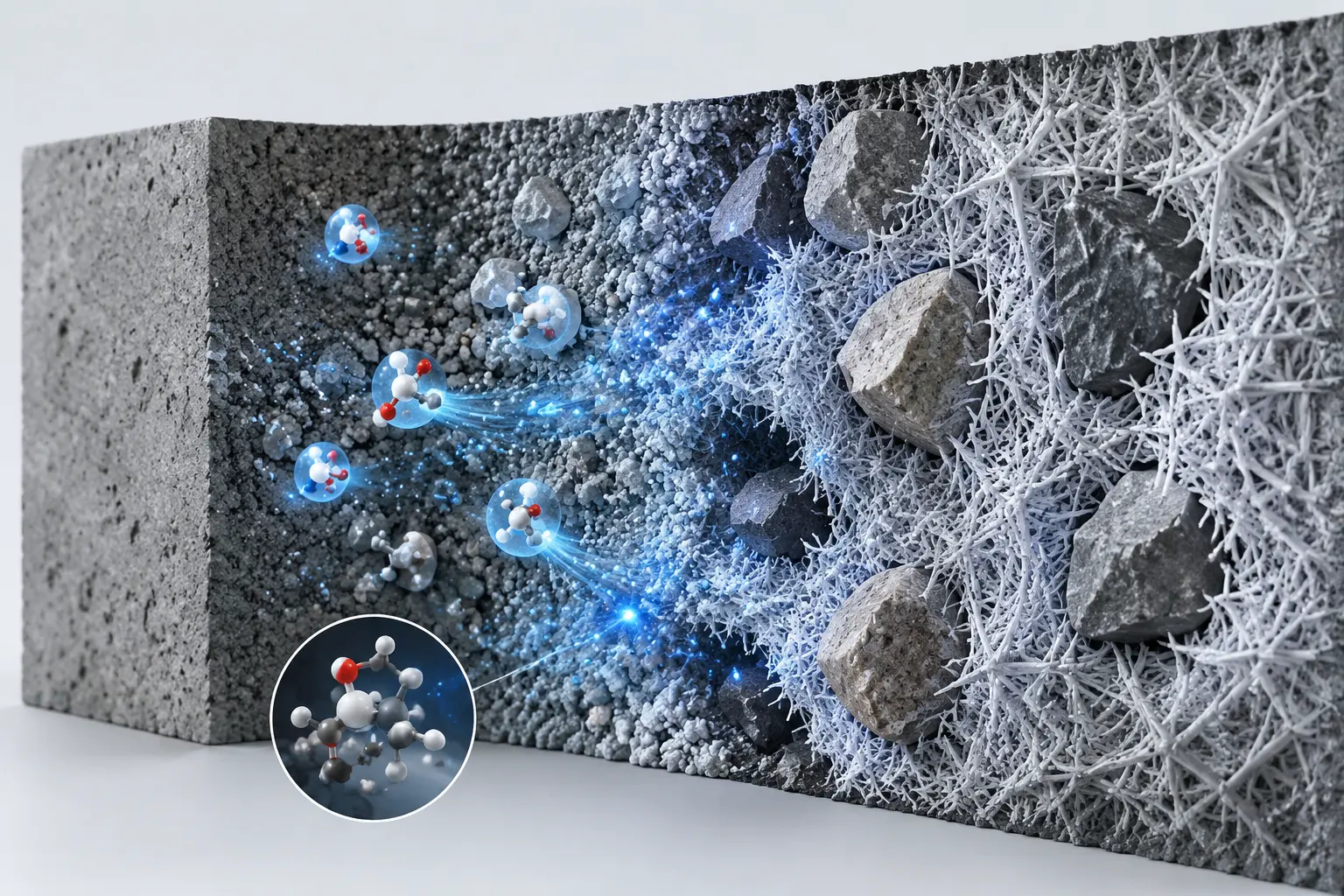
Cement hardens through hydration. When water is added, the cement compounds react and form products that give the mix strength over time. Calcium formate helps that process move faster at the beginning.
The exact effect depends on the cement chemistry, fineness, temperature, and the rest of the admixture package, but the usual result is faster dissolution of cement particles, earlier formation of hydration products, quicker early strength gain, and less waiting time before finishing or demolding.
— Cross-section illustration of cement hydration with calcium formate accelerating early strength development; best size 1200x800
In practice, this can mean a mortar or concrete product reaches useful strength sooner . That matters when plants want shorter cycle times or when work is happening in cool conditions. The effect is usually most visible in the first 24 to 72 hours.
DEMAND
Why it stays in demand
03
Faster project schedules
Contractors and manufacturers want shorter turnaround times. A faster setting system can help with demolding , stacking , packaging, and moving the product to the next step.
Growth in precast and modular construction
Precast plants and modular builders rely on repeatable cycles . Early strength control helps them release forms sooner and keep production moving.
Cold-weather work
Low temperatures slow hydration. Calcium formate does not replace curing or temperature control, but it can help a mix gain strength more quickly in cool conditions.
Non-chloride preference
Many users want to avoid chloride accelerators because of corrosion concerns and specification limits. Calcium formate is often chosen for that reason.
Lower-clinker and blended cement systems
As cement and admixture systems change, early strength can drop. Calcium formate can help restore part of that lost performance in the right formulation.
Early strength improvement
This is the main reason for using it. Better early compressive strength can mean faster demolding, earlier shipment, and shorter storage time.
Faster setting and handling
In mortar products, a faster set can improve workflow on site or in the plant.
Chloride-free performance
It is often preferred where steel reinforcement is present or where chloride additives are not allowed.
Better productivity
Shorter cure times can improve plant throughput and reduce inventory pressure.
Broad dry-mix compatibility
It is used in many dry-mix products, including tile adhesives, grouts, skim coats, self-leveling compounds, and repair mortars.
Flexible formulation use
It can be combined with water reducers, retarders, and rheology modifiers, which makes it useful in multi-additive systems.
APPLICATIONS
Common applications
05
Tile adhesives
It helps improve early strength and lets installers move ahead faster, which is useful in renovation work and commercial interiors.
Repair mortars
Repair systems often need quick strength gain so structures can return to service sooner.
Self-leveling compounds
These products need controlled setting and predictable early hardening. Calcium formate can support faster readiness for light foot traffic, depending on the formula.
Precast concrete
Precast producers use accelerators to reduce demolding time and improve output. Calcium formate can help when the cement and curing conditions are suitable.
Grouts and renders
These products often need a reliable set and early performance, especially in time-sensitive work.
Dry-mix construction chemicals
Dry-mix mortars remain a strong use case because they need standardized, repeatable performance in storage, transport, and application.
DOSAGE
Dosage and formulation basics
06
There is no universal dosage for calcium formate. The right level depends on cement composition and reactivity, use of supplementary cementitious materials, ambient and substrate temperature, target set time and early strength, water content, interaction with water reducers, retarders, and air-entraining agents, and the required working time.
Small dosage changes can shift both set time and finishability , so trial batches matter. In some mixes, calcium formate can shorten working time more than expected or raise water demand if the formula is already fast-setting.
For that reason, the additive should always be tested in the actual product, not judged only from general product data.
COMPARISON
Calcium formate compared with other accelerators
07
Choosing an accelerator is a chemistry decision, not just a speed decision.
Compared with calcium chloride
Calcium chloride is strong and effective, but it can raise corrosion concerns in reinforced systems and may be restricted by specifications. Calcium formate is often the safer choice when chloride-free performance is required.
Compared with sodium-based accelerators
Sodium salts can also speed hydration, but they may affect efflorescence, durability, or alkali balance in some products. Calcium formate is often more comfortable to use in dry-mix systems.
Compared with aluminate-based systems
Aluminate accelerators can be very effective in shotcrete and specialized applications, but they can be more sensitive to the formulation and cost more. Calcium formate is usually easier to work with in standard mortars.
Compared with set-retaining systems
These do the opposite job. Retarders and set-control agents extend working time. Calcium formate is used when faster strength gain is the goal. Some products use both, balanced carefully.
BUYER GUIDE
What buyers should check
08
Not every calcium formate product performs the same way. Buyers should look beyond price.
Purity and consistency
A stable active content helps keep performance predictable from batch to batch.
Particle characteristics
Particle size and flow behavior can affect blending and dispersion in dry-mix production.
Moisture content
Too much moisture can create handling and storage problems.
Solubility and dispersion
The additive should distribute evenly in the mix so it does not create hot spots or uneven performance.
Compatibility with the cement system
Different cements and fillers respond differently. Testing is important, especially when changing suppliers.
Packaging and logistics
Moisture protection, shelf life, and packaging quality all affect real-world performance.
TRENDS
Market trends affecting demand
09
Shorter construction cycles
Owners and contractors want projects finished faster. That keeps early-strength additives in demand.
More dry-mix mortar production
Dry-mix products are easier to standardize, package, and transport, which makes them a natural fit for calcium formate.
Greater focus on durability and compliance
Non-chloride systems remain attractive where corrosion risk matters.
More factory-controlled production
Precast and modular construction depend on repeatable cycle times, so accelerators are useful for keeping output steady.
Changes in lower-carbon cement systems
As cement blends change, some mixes lose early strength. Accelerator packages help bring that performance back.
More scrutiny of suppliers
Buyers want technical data, quality control, and traceability. Product support matters almost as much as raw material cost.
LIMITS
Common limits and tradeoffs
10
Calcium formate is useful, but it has limits.
It will not fix a bad mix
If the aggregate grading is poor, the water content is too high, or the rest of the formulation is incompatible, the accelerator will not solve the root problem.
Too much can shorten working time too far
Overdosing can make a product hard to apply, finish, or pump.
Performance depends on the full formula
Two products with the same calcium formate level can behave differently because of differences in cement, fillers, polymers, and other additives.
Cold weather still slows hydration
Acceleration helps, but it does not remove the need for proper curing and temperature control.
Cost must match output gains
The value comes from productivity, less rework, and shorter cycles, not just from the additive itself.
BUYING
Practical buying guide
11
Define the end use
Tile adhesive, repair mortar, self-leveling compound, precast concrete, and grout all have different performance targets.
Ask for technical support
Look for data on purity, moisture, pH, particle size, and representative performance in cementitious systems.
Run pilot trials
Lab and plant-scale tests are the safest way to confirm dosage and compatibility.
Check packaging and storage
Construction chemicals are sensitive to moisture and contamination.
Compare total value, not unit price alone
A slightly more expensive product may save money if it improves consistency or reduces failures.
— Modern precast concrete plant with workers inspecting early demolding and production cycle optimization; best size 1200x800
Calcium formate should remain useful as long as construction keeps pushing for speed, consistency, and compatibility . Demand is likely to stay strongest in dry-mix mortar, precast, and repair products, where early strength has a direct impact on cost and schedule.
The market is also becoming more technical . Buyers want better documentation, more application-specific testing , and clearer performance evidence. Suppliers that can offer technical support and consistent quality are likely to stand out.
For end users, the direction is clear: faster delivery schedules , tighter quality expectations , and more blended cement systems will keep acceleration chemistry relevant.
Calcium formate is a practical non-chloride accelerator for cement-based products. It helps materials gain early strength faster, improves handling speed, and fits many applications where corrosion risk and durability matter.
It is widely used in dry-mix mortars, tile adhesives, repair systems, self-leveling compounds, and precast products. In a market shaped by faster schedules, lower-carbon cement systems, and more industrialized building methods, it remains a useful option.
The best results come from proper formulation work and real testing , not from treating it as a one-size-fits-all additive. If you are evaluating calcium formate for a product line or sourcing decision, focus on compatibility, dosage, technical support, and field performance.