"
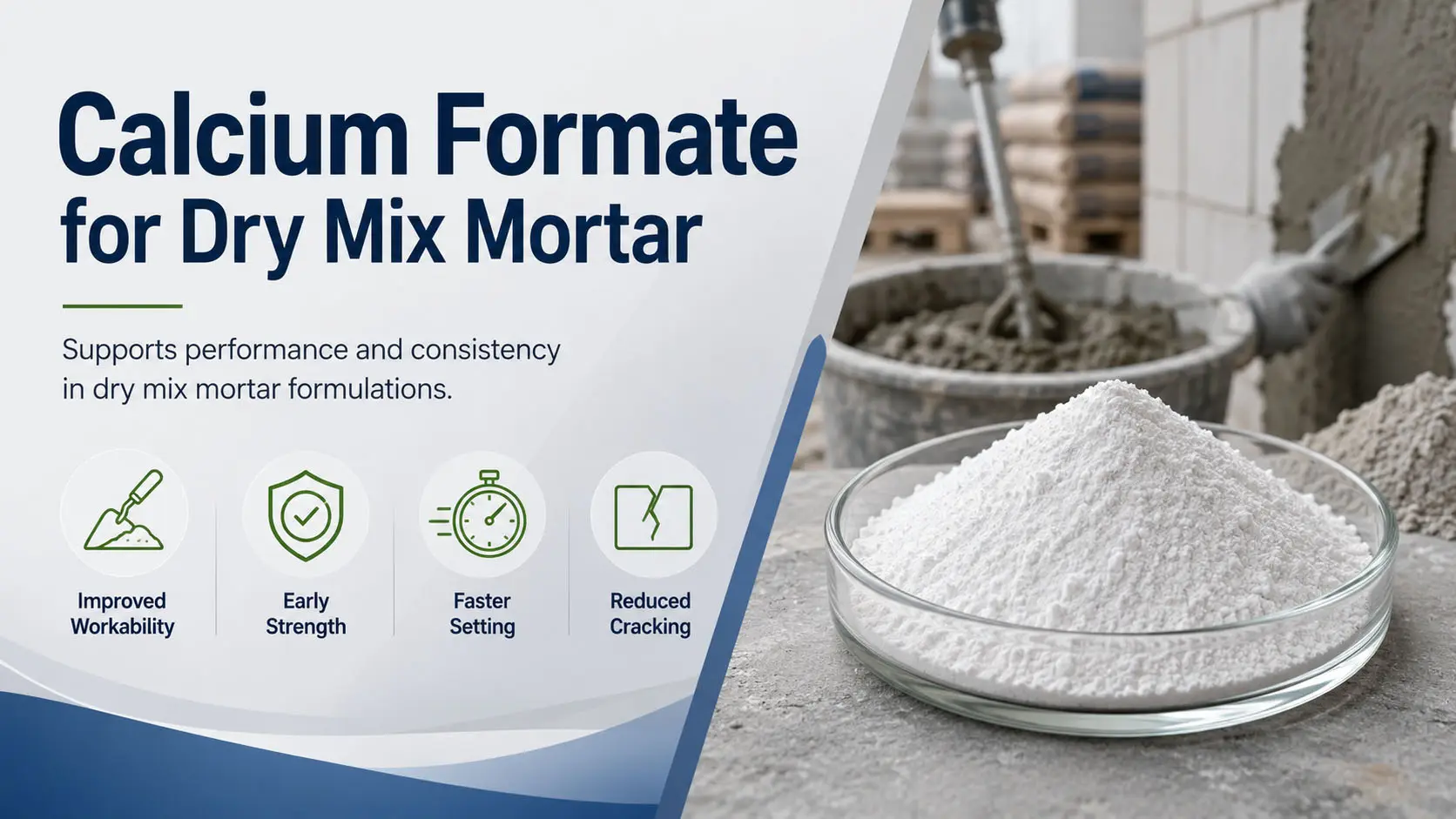
Calcium formate has become a common additive in dry mix mortar because it solves several practical problems at the same time.
It speeds up early strength gain , helps mortar perform better in cooler weather, and gives manufacturers a way to make products more consistent from batch to batch.
As construction projects continue to demand faster turnaround and more predictable results, interest in calcium formate has increased across Asia, the Middle East, Europe, and other markets where weather, labor shortages, and schedule pressure all affect product choice.
This article looks at what calcium formate does, where it fits, how it compares with other accelerators, and what buyers should check before using it.
Here are the core takeaways:
01
What is calcium formate?
02
Why it matters in dry mix mortar
03
How it works in cement systems
GUIDE
What is calcium formate?
01
Calcium formate is the calcium salt of formic acid . In dry mix mortar, it is usually used as a setting accelerator and early-strength enhancer.
It is typically sold as a fine white powder and blends well into cement-based systems. Because it does not contain chloride, it is often preferred when formulators want faster set without the corrosion concerns linked to chloride-based accelerators.
In simple terms, it helps cement hydrate more efficiently at the start of curing. That can shorten setting time, raise early compressive strength, and help mortar become workable sooner.
GUIDE
Why calcium formate matters in dry mix mortar
02
Dry mix mortar has to do several jobs at once. It needs to mix easily, stay workable long enough for application, bond well, and still gain strength on schedule.
Common dry mix products
Tile adhesives , repair mortars , grouting mortars , masonry mortars , self-leveling compounds , external insulation and finish systems , and non-shrink and rapid-repair mixes all benefit from that balance.
It is valued not only for performance, but also for consistency. More construction work now depends on standardized dry mix products because they reduce site variation and speed up installation.
Additives that help products behave the same way in different weather conditions are especially useful.
GUIDE
How calcium formate works in cement-based systems
03
Calcium formate affects hydration chemistry in a way that encourages earlier formation of hydration products. The exact result depends on the full formulation, the cement type, and the site conditions, but the practical effects are well known.
Faster early hydration
Calcium formate helps cement start hydrating sooner. That can shorten the initial set and improve early strength, which is useful for products that need a faster turnaround.
Better early strength
Early strength is often just as important as final strength in dry mix mortar. Faster strength gain can reduce demolding time, improve productivity, and allow earlier finishing or traffic.
Better cold-weather performance
Hydration slows down in low temperatures. Calcium formate can offset some of that slowdown, which helps mortar perform more reliably in winter or in cooler regions.
Good compatibility with many formulations
Calcium formate is often used with cellulose ethers, redispersible polymer powders, defoamers, and retarders. When the system is balanced correctly, it fits into many commercial mortar formulations.
GUIDE
Main benefits of calcium formate for dry mix mortar
04
Faster setting and hardening
One of the main reasons to use calcium formate is faster set. That is useful when crews need quicker finishing or less time between application and the next step.
Improved early strength
Higher early compressive and flexural strength can reduce the risk of damage during curing and support faster job turnover. That is particularly helpful in repair mortars and tile adhesives.
Better performance in low temperatures
Cold weather often slows down mortar performance. Calcium formate can help restore some of that lost speed and reduce delayed set.
Chloride free option
Because it is chloride free, calcium formate is usually a safer choice than chloride-based accelerators in reinforced applications or in systems where corrosion resistance matters.
More marketable finished products
For manufacturers, it can help create products that return to service faster, which is a useful selling point in competitive markets.
GUIDE
Typical dry mix mortar applications
05
Tile adhesive
Tile adhesives often need controlled acceleration so installers can get good grab and early strength without losing workability. Calcium formate can help with that balance when it is dosed correctly.
Repair mortar
Repair mortars often need rapid strength gain so damaged structures can return to service quickly. Calcium formate is commonly used for that reason.
Self-leveling compound
Self-leveling floors need both flow and a predictable set. Calcium formate can help the material set after placement while still giving enough working time during application.
Masonry mortar
For masonry mortar, stable setting behavior and early stability matter. Calcium formate can help keep placement more predictable for block or brick work.
Grout and non-shrink mortar
Grouts often need early strength and dependable hardening. Calcium formate supports those needs in industrial and infrastructure work.
GUIDE
Calcium formate compared with other accelerators
06
Formulators often compare calcium formate with calcium chloride, sodium aluminate, or proprietary accelerator blends. Each option has its own tradeoffs.
Compared with calcium chloride
Calcium chloride is a strong accelerator, but it can create corrosion concerns in reinforced applications. Calcium formate is often preferred when a chloride free option is needed.
Compared with sodium aluminate
Sodium aluminate can work well, but it can be harder to handle in some formulations. Calcium formate is usually easier to integrate into standard dry mix systems.
Compared with proprietary accelerator packages
Custom blends may offer more targeted performance, but calcium formate often stands out for its cost balance and wide availability. It can also be part of a larger accelerator package.
The right choice depends on the target setting speed, open time, climate, and technical requirements of the product.
GUIDE
Market trends shaping demand in 2024
07
Several long running market trends continue to support demand for calcium formate.
Faster construction schedules
Contractors and developers still want shorter project timelines. Mortars that set faster and gain strength earlier help reduce waiting time and improve labor efficiency.
More renovation and repair work
Many markets are seeing steady demand for renovation, retrofit, and maintenance. Those jobs often call for fast setting or rapid repair materials, which suits calcium formate well.
Growth in prefabrication and modular building
Off site and modular construction depend on stable, predictable materials. Calcium formate helps support repeatable performance in factory controlled production.
Higher quality expectations
Users want mortars that behave the same across batches and seasons. That puts more value on additives that improve consistency.
Sustainability and material efficiency
Calcium formate is not a sustainability label by itself, but it can still help reduce waste by lowering rework and improving reliability. In a market that cares about efficiency, that matters.
GUIDE
How to choose the right calcium formate grade
08
Not every calcium formate product behaves the same way in mortar. Buyers and formulators should look at several points when sourcing it.
Purity and consistency
A consistent product helps reduce batch variation. For dry mix manufacturers, steady quality is often more important than a one time performance claim.
Particle size and flowability
Particle size affects how the powder blends and disperses. Good flow also matters for automated dosing and packaging.
Moisture content
Too much moisture can hurt storage stability and mixing behavior. A low, controlled moisture level is usually preferred.
Application specific performance
The right dosage depends on whether the product is for tile adhesive , self-leveling compound , grout , or repair mortar. A grade that works in one system may need adjustment in another.
Supplier support
Technical support is useful. A supplier that can give dosage guidance, compatibility feedback, and steady quality is usually more valuable than one offering only low pricing.
GUIDE
Dosage considerations
09
There is no universal dosage for calcium formate in dry mix mortar. The right level depends on the cement type, aggregate grading, polymer content, other admixtures, and the target setting profile.
In practice, formulators usually run lab trials to find the right range.
The goal is not simply to make the mortar faster. The goal is to keep application , setting , strength gain , and durability in balance.
Start with a controlled trial range instead of assuming a fixed dose.
Check both early strength and open time, since faster set can shorten working time.
Test performance at realistic site temperatures.
Confirm compatibility with cellulose ether , redispersible polymer powder, and any retarder in the system.
Check storage stability and packaging behavior in the finished dry mix.
GUIDE
Formulation challenges to watch
10
Calcium formate is useful, but it still needs careful handling. If it is overused or poorly balanced, problems can appear.
Reduced open time
If the dosage is too high, installers may lose workable time, especially in warm weather.
Uneven set
A mix can become too fast at the surface while still being underdeveloped inside if the full system is not balanced properly.
Compatibility shifts
Different cements, fillers, and polymers can change how calcium formate behaves. A formulation may need adjustment from one product line to another.
Temperature sensitivity
Acceleration changes with ambient temperature. A product designed for winter use may behave differently in summer.
These are not reasons to avoid calcium formate. They are reasons to test it carefully in the full system.
GUIDE
Best practices for manufacturers and buyers
11
A structured evaluation process can save time and reduce risk when selecting calcium formate for dry mix mortar.
Define the target
Decide whether the main goal is faster set, better early strength, colder weather performance, or a mix of those needs. That makes it easier to choose the right grade and dosage.
Test the full formulation
Always check calcium formate in the complete mortar, not just in a simplified lab mix. Real compatibility is what matters.
Compare total value, not just price
A cheaper product can become expensive if it creates variation, adds rework, or limits performance. Total cost is the better measure.
Review supply reliability
Dry mix production depends on dependable raw materials. Lead time, packaging consistency, and technical support all matter.
Validate field performance
Lab data is useful, but site behavior matters more. Test application, set, and early strength under real working conditions.
GUIDE
Where calcium formate fits in future dry mix mortar development
12
Dry mix mortar is likely to keep moving toward faster, more reliable, and more specialized products. That keeps calcium formate relevant.
Faster repair mortars for infrastructure maintenance
Infrastructure work often needs quick return to service and dependable early strength. Calcium formate fits that direction well.
Tile adhesives for large format tiles
Large format tile work needs controlled set, good grab, and stable handling. That makes performance balance especially important.
Self-leveling compounds with balanced flow and set
These products need smooth placement and a predictable finish window. Calcium formate can help support that balance.
Mortars for colder climates or unstable seasonal conditions
Seasonal swings make set control harder. A chloride free accelerator that helps in cool conditions stays attractive.
Factory blended products with consistent performance
Factory blending is built on repeatability. Calcium formate supports that shift toward engineered mortar systems.
Calcium formate is no longer just a basic accelerator. It is part of a wider move toward more engineered mortar systems.
Calcium formate for dry mix mortar offers a useful mix of early-strength gain , faster set , and chloride free performance. It fits the needs of construction markets that want speed, consistency, and dependable results across different climates and applications.
For manufacturers, it can improve product competitiveness. For contractors and applicators, it can help deliver faster project completion and more predictable results.
The main point is balance. Calcium formate works best when it is chosen with the full mortar system in mind, tested under real conditions, and matched to the intended use.