



Calcium Formate for Concrete: Benefits, Applications, Dosage, and Performance Guide
By vanchor
2026-07-17Related Posts

How to Choose a Reliable 2-Ethylhexanol (2-EH) Supplier in China: Quality, Packaging and Shipping
2026-10-22

Natural vs Synthetic Sodium Sulfate Anhydrous: Which Is Better for Industrial Applications?
2026-10-22

Isobutanol 99.3% Price and Supply in 2026: A Guide for Chemical Importers
2026-10-22

Sodium Sulfate Anhydrous 99% for Detergent Manufacturing: Benefits, Specifications and Bulk Supply
2026-10-22
Calcium formate is used in modern concrete because it helps projects move faster without changing the basic mix design.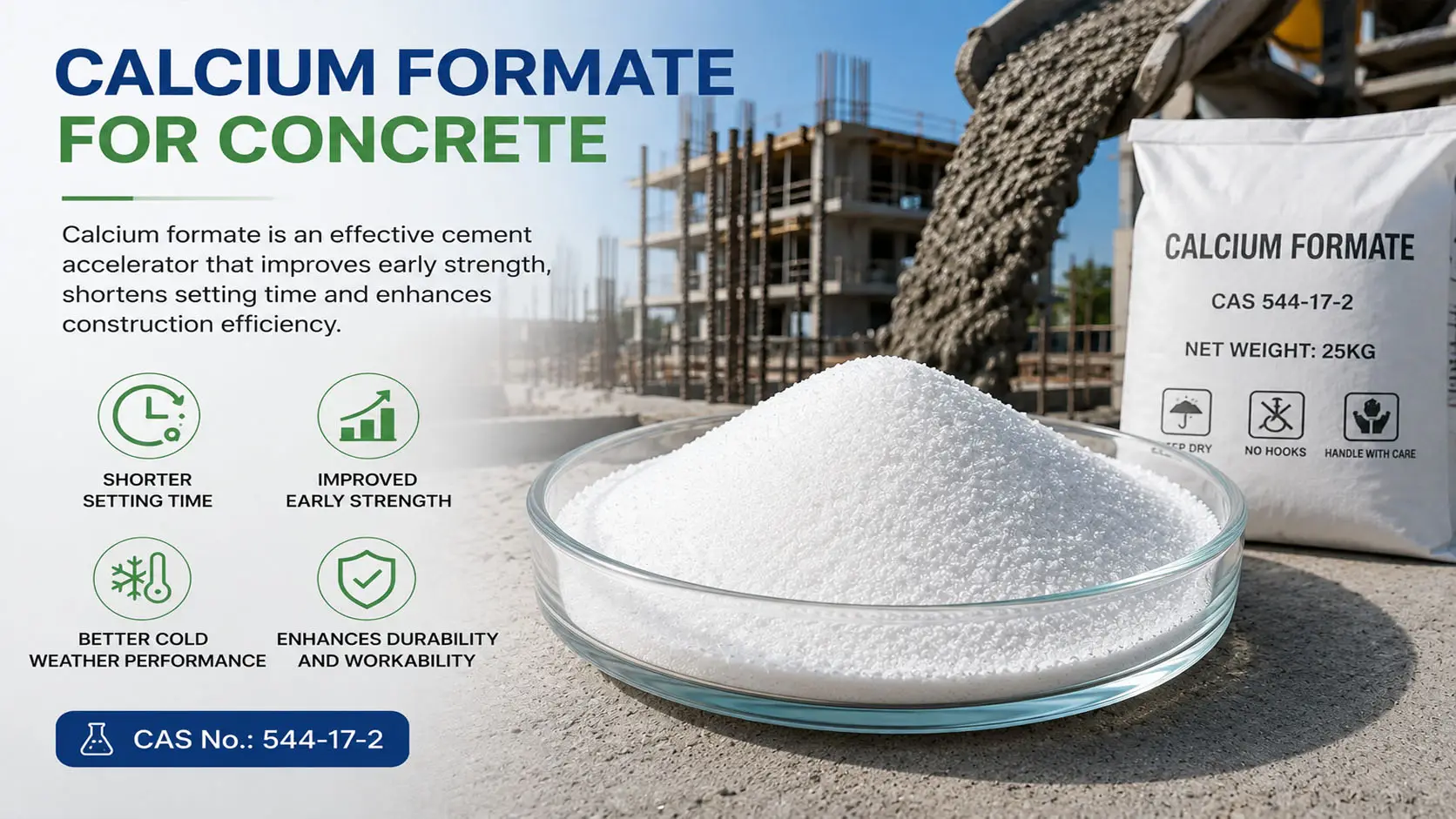
As schedules get tighter, labor costs stay high, and more work shifts to precast and ready mix production, early strength has become more important.
That is where calcium formate for concrete is useful.
Unlike some additives that solve only one problem, calcium formate can support several needs at once.
It is often used as an accelerating admixture when concrete needs to gain strength quickly in cold weather, in precast plants, or on jobs where formwork has to come off sooner.
It can also help improve production flow and reduce delays caused by slow hydration.
Producers and contractors want materials that improve efficiency while keeping concrete consistent and durable.
Calcium formate fits that requirement, which is why it shows up in traditional construction as well as in precast elements, repair mortars, and dry mix systems.
01
PART
What is calcium formate?
BASICS
Calcium formate is the calcium salt of formic acid. In construction materials, it is mainly used as a concrete accelerator and early strength additive. It usually comes as a white crystalline powder and blends easily into dry mixes, admixture systems, and some ready mix applications.
In concrete, calcium formate speeds cement hydration. That means the cement starts reacting with water more quickly, so the mix develops strength sooner. This is especially helpful when fast turnover matters, such as in precast production, fast-track projects, or cold-weather pours.
Why it matters in concrete chemistry
Concrete performance depends on the balance between workability, setting time, and strength gain.
Some traditional accelerators work well but can create concerns about corrosion, compatibility, or finish quality.
Calcium formate is often chosen because it offers a workable middle ground. It speeds hydration while staying relatively easy to use in mix development.
It is not a cure-all, and it does not replace good mix design, curing, or temperature control.
Used properly, though, it can help improve production efficiency and project flow.
02
PART
Why calcium formate for concrete is in demand now
DEMAND
Several trends are driving more interest in calcium formate for concrete among suppliers, contractors, and precast manufacturers.
Faster construction timelines
Commercial, residential, and infrastructure projects all face pressure to finish sooner. Owners want faster delivery, and contractors want earlier stripping, handling, and loading. Early strength is often a practical advantage.
Growth in precast and prefabrication
Precast concrete and modular construction continue to expand because they improve productivity, reduce site congestion, and give better control in factory settings. In these systems, a material that helps concrete gain strength sooner can improve mold turnover and plant output.
Cold-weather construction needs
Construction still continues in cold climates, and low temperatures slow hydration. That can delay strength development and add cost. Calcium formate helps improve early performance in cooler conditions, which makes planning easier during winter work.
Pressure for efficiency and consistency
Concrete producers are expected to reduce waste, limit downtime, and keep output predictable. By helping concrete reach target strength sooner, calcium formate can support more efficient scheduling and production.
03
PART
How calcium formate works in concrete
MECHANISM
Calcium formate works as a hydration accelerator. It helps the cementitious system move through the early stages of reaction more quickly, which can shorten set time and improve early strength development.
Acceleration of cement hydration
When cement meets water, chemical reactions begin that create the hardened structure of concrete. Calcium formate encourages those reactions to move faster, especially during the first hours after mixing.
Early strength development
Its main benefit is faster early compressive strength gain. That matters when formwork needs to be removed sooner, precast units need to be demolded quickly, or repaired surfaces need to return to service faster.
Influence on setting time
Depending on dosage and mix design, calcium formate can shorten initial and final set. That can be useful in controlled environments, but it also means placement and finishing need to be planned carefully.
Compatibility considerations
Calcium formate is usually used with cement, supplementary cementitious materials, water reducers, and other admixtures. Its performance can change with cement chemistry, temperature, water cement ratio, and other chemicals in the mix. Trial mixes are important.
04
PART
Key benefits of calcium formate for concrete
BENEFITS
Calcium formate offers several practical benefits when it is used in the right application.
Improved early strength
This is the main advantage. Faster early strength makes it easier to strip forms, move precast units, and keep work moving without long delays.
Better cold-weather performance
Concrete gains strength more slowly in cool conditions. Calcium formate helps reduce that slowdown, which supports winter work and tighter schedules.
Faster precast production
In precast plants, output depends on how quickly molds can be reused. If concrete reaches handling strength sooner, production cycles can shorten and throughput can improve.
Useful in dry mix products
Calcium formate is often used in dry mix mortars, tile adhesives, grouts, and repair products where controlled acceleration is needed.
Better operational efficiency
Projects that can remove forms sooner, cut waiting time, or move follow-on trades earlier can save labor and overhead. That is one reason the product remains widely used.
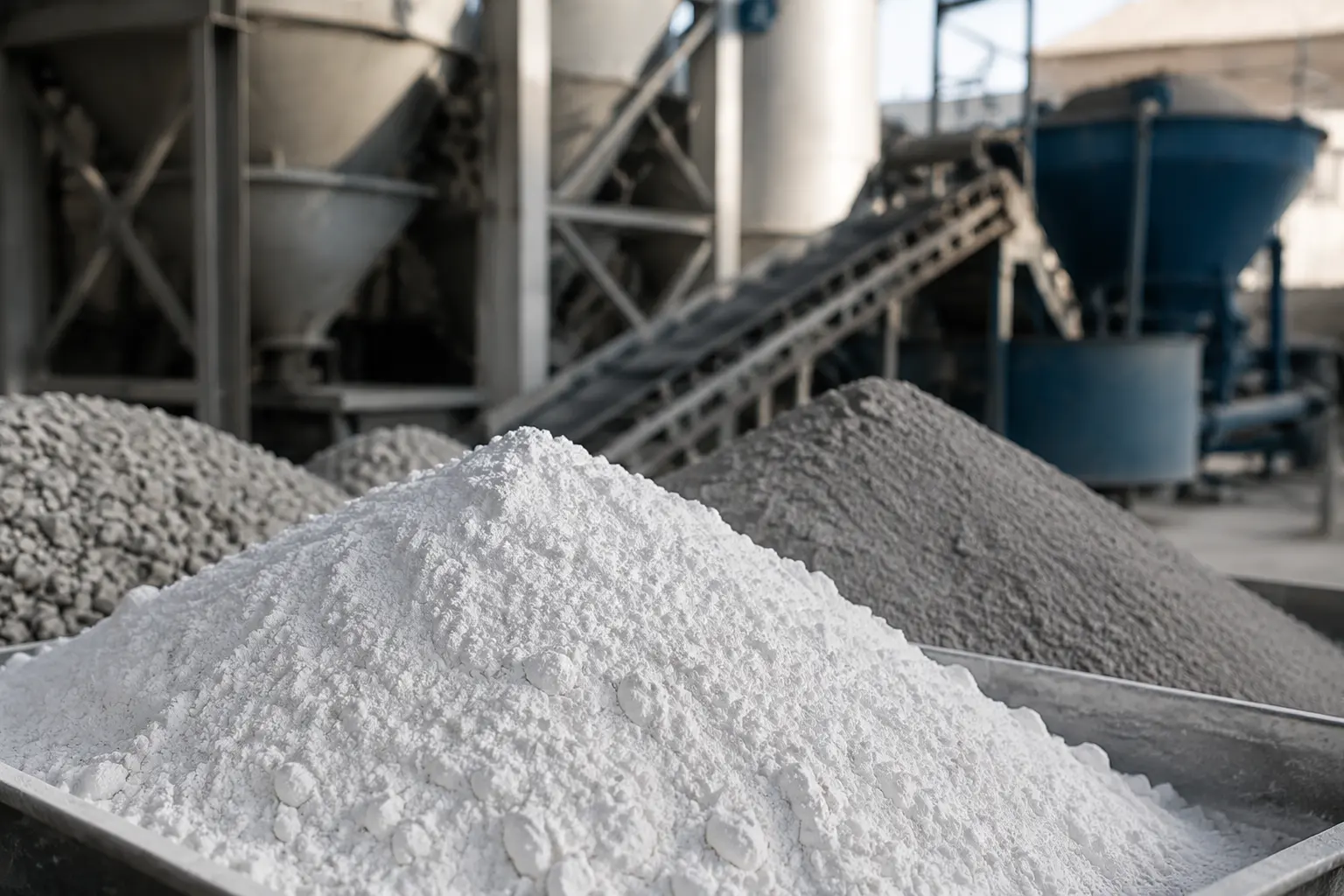
Close-up of calcium formate powder beside cementitious materials and batching equipment
05
PART
Typical applications in the concrete industry
APPLICATIONS
Calcium formate is used across several parts of the concrete sector where early performance matters.
Precast concrete
Precast producers often use calcium formate to improve cycle times and reach demolding strength sooner. It is commonly used in beams, panels, pipes, pavers, and architectural parts.
Ready mix concrete
In ready mix work, calcium formate can help with cold-weather placement or jobs that need faster strength gain. The right dosage depends on local conditions, mix design, and testing.
Repair mortars and fast-setting systems
Repair materials often need quick return to service. Calcium formate can support faster hardening in these formulations.
Tile adhesives and dry mix mortars
In construction chemicals, calcium formate is used to improve early setting and handling behavior. These products are not structural concrete, but the same chemistry is at work.
Shotcrete and specialized applications
In some sprayed or rapid-placement systems, controlled acceleration helps build thickness and keep work moving. Whether calcium formate is a good choice depends on the binder system and the application.
06
PART
Recommended dosage and mix design considerations
DOSAGE
Dosage should not be copied from one project to another without testing. Cement type, ambient temperature, water cement ratio, admixture package, and strength targets all affect the result.
Start with trial batches
Setting time
Slump retention
Early compressive strength
24 hour and 7 day strength
Finishability and compatibility with other admixtures
Watch cement chemistry
Different cements react differently to accelerators. The same dosage can work well in one mix and poorly in another. Blended cements and supplementary materials can also change the result.
Coordinate with other admixtures
If the mix already uses a water reducer, air entrainer, or set controller, calcium formate may interact with those products. Lab testing helps avoid problems before full production starts.
Avoid over-acceleration
More is not always better. Too much acceleration can shorten working time, affect the finish, or create strength variation. The right dosage is the one that meets the goal with the fewest side effects.
07
PART
Performance factors that affect results
FACTORS
Several field and material conditions influence how calcium formate performs.
Temperature
Lower temperatures slow hydration, so calcium formate often has a stronger effect in cold weather. In hot weather, the mix may already set quickly, so the dosage strategy may need to change.
Water cement ratio
A lower water cement ratio can improve final strength, but it can also change how the accelerator behaves. The balance still matters.
Cement type and fineness
Some cements respond faster than others. Fineness, alkali content, and clinker composition all affect acceleration.
Curing conditions
No accelerator can make up for poor curing. If moisture leaves too quickly, strength and durability can still suffer. Proper curing is still necessary.
Placement and finishing schedule
Accelerated concrete may require tighter coordination between batching, placement, finishing, and curing. Contractors should match labor and equipment plans to the shorter working window.
08
PART
Common concerns and misconceptions
FAQ
A few misunderstandings about calcium formate come up often.
Does it replace proper curing?
No. Calcium formate helps early hydration, but it does not remove the need for curing. Moisture control still matters.
Is it only for winter use?
No. Cold weather is a major use case, but precast plants and fast-track jobs use it all year.
Does it always increase final strength?
Not necessarily. The main benefit is early strength. Final strength depends more on the mix design, curing, and overall material quality.
Is it the same as a superplasticizer?
No. A superplasticizer improves flow and can reduce water demand, while calcium formate mainly speeds setting and early strength gain. They can be used together, but they do different jobs.
09
PART
How to choose the right supplier or grade
SUPPLIER
For commercial users, consistency matters as much as raw performance. When buying calcium formate for concrete, look for suppliers that can provide technical data and stable quality control.
Key questions to ask
What is the purity or assay range?
What particle size or physical form is supplied?
Is the product intended for concrete, dry mix, or both?
What compatibility data is available with common cement types?
Can the supplier support trial batch development?
What good technical support looks like
A strong supplier should help with dosage guidance, application testing, and troubleshooting if the mix behaves differently across seasons or raw material sources. In construction materials, that support can be worth as much as the product itself.
10
PART
Market outlook for calcium formate in construction
OUTLOOK
The outlook remains positive because the product solves a real production problem: helping concrete gain strength sooner.
Construction markets still face schedule pressure, labor shortages, and efficiency targets. Precast and modular methods keep growing, and cold-weather work remains necessary in many regions. Producers also want admixtures that fit into existing systems without adding unnecessary complexity.
That combination supports steady demand for calcium formate in concrete and related dry mix sectors. The strongest use cases will continue to be the ones where speed, predictability, and production efficiency matter directly to the business.
11
PART
Best practices for using calcium formate in concrete
BEST PRACTICES
If you are evaluating calcium formate for a project or product line, a few practical steps help.
Test before scaling
Do not move from theory to full production too quickly. Start with controlled trial mixes and compare them with your baseline.
A dosage that works in summer may behave differently in winter. Keep records by temperature, cement lot, and admixture combination.
If the goal is early stripping, faster precast cycles, or quicker repair return to service, calcium formate may fit well. If the goal is flow, pumpability, or slump retention, you may need other admixtures too.
Batching, placing, and finishing crews should know that acceleration changes the working window. Clear communication reduces surprises on site.
///
LAST
Conclusion
SUMMARY
Calcium formate for concrete is a practical option for projects that need faster early strength development. It can help with cold-weather performance and works well in precast and dry mix production systems. For contractors and manufacturers working under tighter schedules, it can improve efficiency and reduce waiting time.
The key is to use it carefully. Calcium formate works best when it matches the cement system, has been tested in advance, and is managed with proper curing and scheduling. When those conditions are in place, it can be a useful part of a modern concrete formulation strategy.
If your work depends on faster production, better early strength, and more reliable turnaround, calcium formate is worth serious consideration as part of your concrete admixture toolkit.
If this guide helped, share it with the team that needs faster concrete cycles.
Like
Read
Share
THANKS FOR READING


Contact Us
Related Posts
How to Choose a Reliable 2-Ethylhexanol (2-EH) Supplier in China: Quality, Packaging and Shipping
2026-10-22
Natural vs Synthetic Sodium Sulfate Anhydrous: Which Is Better for Industrial Applications?
2026-10-22
Isobutanol 99.3% Price and Supply in 2026: A Guide for Chemical Importers
2026-10-22
Sodium Sulfate Anhydrous 99% for Detergent Manufacturing: Benefits, Specifications and Bulk Supply
2026-10-22


