



Calcium Formate Concrete Additive Supplier: A Practical Procurement Guide
By vanchor
2026-07-17Related Posts

Custom Packaging Solutions from an Anhydrous Sodium Acetate Supplier in China
2026-09-23

Application Trends in Anhydrous Sodium Acetate for Special Chemical Manufacturing
2026-09-23

Anhydrous Sodium Acetate for Leather Tanning: Improve Dyeing Uniformity
2026-09-22

Formic Acid 85% for Textile Dyeing: Industrial Applications, Technical Benefits and Future Trends
2026-09-22
Calcium formate is used in selected concrete, mortar, grout, precast, and other cement-based formulations where faster setting or earlier strength development is required. Although it is added in relatively small quantities, differences in purity, moisture, particle properties, and batch consistency can affect production results.
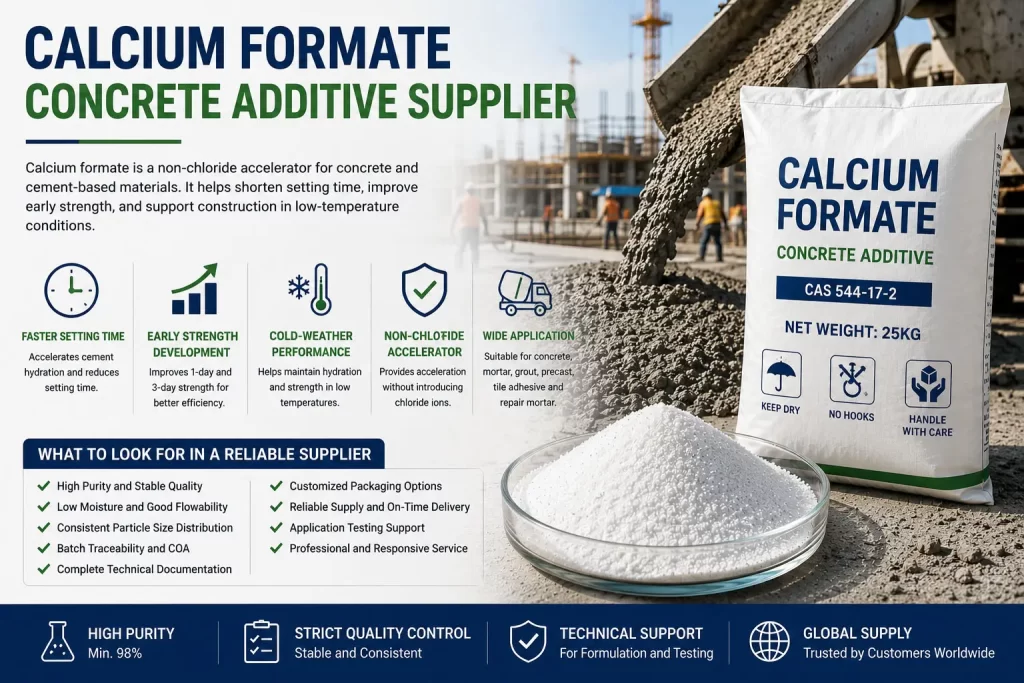
For this reason, selecting a Calcium Formate Concrete Additive Supplier should involve more than comparing price and stated assay. Concrete manufacturers and construction-chemical formulators should also evaluate application compatibility, documentation, traceability, packaging, delivery reliability, and technical support.
What Is Calcium Formate?
Calcium formate is the calcium salt of formic acid. It is normally supplied as a white crystalline powder that can be incorporated into dry blends or compatible cement-based systems.
| Property | Basic Information |
|---|---|
| Chemical name | Calcium formate |
| Chemical formula | Ca(HCOO)₂ |
| CAS number | 544-17-2 |
| Physical form | White crystalline powder |
| Main construction role | Non-chloride cement accelerator |
| Common applications | Concrete, mortar, grout, tile adhesive and precast products |
Construction-grade calcium formate is generally selected to influence early cement hydration. Its actual performance depends on cement chemistry, temperature, dosage, water content, mineral additions, and other admixtures.
How Does Calcium Formate Work in Concrete?
Cement develops strength through hydration after it is mixed with water. At lower temperatures or under specific production schedules, this reaction may proceed more slowly than required.
Calcium formate can influence certain early hydration reactions. Depending on the formulation, it may contribute to:
- Shorter Setting Time: The concrete or cementitious material may begin hardening earlier.
- Earlier Strength Development: One-day or three-day strength may improve under suitable conditions.
- Cold-Weather Support: The additive may help offset slower hydration at reduced temperatures.
- Shorter Production Cycles: Earlier strength can support faster demolding or handling in some precast applications.
- Non-Chloride Acceleration: Calcium formate does not introduce chloride in the same way as calcium chloride.
These effects should be confirmed through testing. Calcium formate is not a universal solution for low strength, poor curing, excessive water, unsuitable aggregate grading, or incorrect cement selection.
Common Concrete and Cement-Based Applications
Precast Concrete
Precast production often depends on predictable early strength so that components can be removed from molds, handled, or transferred without damage.
A Calcium Formate Concrete Additive Supplier may provide material for products such as:
- Concrete blocks
- Paving units
- Small precast elements
- Architectural cement products
- Selected structural components
The dosage must be coordinated with steam curing, water reducers, cement fineness, and the required demolding schedule.
Cold-Weather Concrete
Low temperatures slow cement hydration and delay strength development. Calcium formate may be considered as part of a broader cold-weather concreting strategy.
However, it does not replace:
- Heated mixing water
- Insulated formwork
- Temperature monitoring
- Suitable curing protection
- Cold-weather construction procedures
Laboratory trials should reproduce the expected site temperature rather than relying only on room-temperature testing.
Cement-Based Grout
Grouts may require early hardness, rapid installation, controlled flow, and dimensional stability.
In grout formulations, calcium formate should be tested alongside:
- Superplasticizers
- Shrinkage-compensating materials
- Fillers
- Defoamers
- Retarders
- Supplementary cementitious materials
Faster setting should not compromise flow retention or placement quality.
Repair Mortar and Rapid-Setting Products
Repair systems often need earlier return to service. Calcium formate may support early strength in patching mortar, floor repair compounds, and rapid-maintenance products.
The final result also depends on substrate preparation, bonding agents, polymer modification, curing, and application thickness.
Dry-Mix Construction Materials
Because calcium formate is supplied as a powder, it can be blended into factory-produced construction materials such as:
- Dry-mix mortar
- Tile adhesive
- Cement plaster
- Waterproof mortar
- Self-leveling compounds
- Masonry mortar
Uniform dispersion is essential because poor mixing can create inconsistent setting behavior.
Calcium Formate Compared with Calcium Chloride
Calcium chloride is a strong cement accelerator, but chloride content may be restricted in reinforced or prestressed concrete because of corrosion concerns.
| Factor | Calcium Formate | Calcium Chloride |
|---|---|---|
| Main purpose | Early hydration and strength acceleration | Strong setting acceleration |
| Chloride addition | No direct chloride addition | Introduces chloride ions |
| Dry-mix compatibility | Commonly used in powdered formulations | Application-dependent |
| Reinforced concrete use | Requires project verification | Frequently restricted |
| Acceleration level | Depends strongly on formulation | Often more aggressive |
A non-chloride designation does not automatically make calcium formate suitable for every concrete application. Relevant standards, reinforcement conditions, and project specifications must still be reviewed.
What Should Buyers Check?
A reliable Calcium Formate Concrete Additive Supplier should provide clear technical and quality information.
Product Assay
Assay indicates the calcium formate content, but it should not be reviewed alone. Consistency between batches is often more important than a small difference in nominal purity.
Moisture Content
Excess moisture can cause caking, reduced powder flow, and inaccurate dosing. It may also affect storage stability in dry-mix production.
Insoluble Matter
High levels of insoluble residue may affect dispersion or indicate inconsistent raw-material control.
Particle Size
Stable particle properties support uniform blending. Very coarse or highly variable material may be more difficult to distribute evenly.
Batch Traceability
Each shipment should be linked to a production batch and quality-control record. Batch traceability helps investigate formulation changes or performance deviations.
Technical Documentation
Buyers should request:
- Certificate of Analysis
- Technical Data Sheet
- Safety Data Sheet
- Product specification
- Packaging information
- Storage guidance
- Regulatory or compliance documents where applicable
The information on the COA should correspond to the supplied batch rather than represent only a general specification.
How Should Calcium Formate Be Tested?
Before commercial use, calcium formate should be tested in the complete concrete or mortar formulation.
Recommended evaluations include:
| Test | Purpose |
|---|---|
| Initial and final setting time | Measures the acceleration effect |
| One-day and three-day strength | Evaluates early strength development |
| Twenty-eight-day strength | Confirms longer-term performance |
| Slump or flow retention | Checks workability during placement |
| Air content | Identifies interaction with other admixtures |
| Shrinkage | Evaluates dimensional stability |
| Low-temperature performance | Simulates cold-weather conditions |
| Admixture compatibility | Tests interaction with water reducers and retarders |
Trials should include a control mix without calcium formate and several dosage levels. Changing one variable at a time makes the results easier to interpret.
Supplier Evaluation Questions
Before selecting a Calcium Formate Concrete Additive Supplier, procurement and technical teams may ask:
- What assay and moisture limits are guaranteed?
- Is every shipment supplied with a batch-specific COA?
- How is particle-size consistency controlled?
- Are samples available for formulation testing?
- Which packaging options are offered?
- How is moisture exposure controlled during storage and shipping?
- Can the supplier support repeat orders with stable specifications?
- What is the normal production and delivery schedule?
- Is technical communication available when performance changes occur?
A supplier should be able to answer these questions with documented information rather than general statements.
Vanchor’s Supply Approach
Vanchor supplies calcium formate for concrete, mortar, tile adhesive, grout, and other cement-based applications. Product specifications, packaging, documentation, and sample requirements can be reviewed according to the intended market and formulation.
Before purchasing, users should compare the supplied specification with their own cement system and performance targets. Application trials remain necessary because raw materials and environmental conditions differ between manufacturers.
Storage and Handling
Calcium formate should be stored in sealed, moisture-resistant packaging in a dry and ventilated warehouse.
Recommended practices include:
- Keep bags away from wet floors and walls.
- Protect pallets from rain and condensation.
- Reseal opened packaging promptly.
- Use suitable dust-control equipment.
- Follow the supplier’s SDS.
- Apply first-in, first-out inventory management.
- Record batch numbers during production.
Improper storage can cause caking and reduce dosing consistency.
Conclusion
Choosing a Calcium Formate Concrete Additive Supplier requires an evaluation of product quality, formulation compatibility, documentation, packaging, traceability, and supply stability.
Calcium formate may support shorter setting time, early strength development, cold-weather performance, and faster production cycles in selected cement-based systems. However, its effectiveness depends on cement chemistry, dosage, curing, temperature, water content, and other admixtures.
The most reliable procurement approach combines supplier qualification with controlled laboratory testing. Stable specifications, batch-specific quality records, representative samples, and realistic application trials help manufacturers achieve more predictable concrete and mortar performance.


Contact Us
Related Posts
Custom Packaging Solutions from an Anhydrous Sodium Acetate Supplier in China
2026-09-23
Application Trends in Anhydrous Sodium Acetate for Special Chemical Manufacturing
2026-09-23
Anhydrous Sodium Acetate for Leather Tanning: Improve Dyeing Uniformity
2026-09-22
Formic Acid 85% for Textile Dyeing: Industrial Applications, Technical Benefits and Future Trends
2026-09-22


