



Sodium Formate Supplier: Applications, Specifications, and Procurement Factors
By vanchor
2026-07-17Related Posts

How to Choose a Reliable 2-Ethylhexanol (2-EH) Supplier in China: Quality, Packaging and Shipping
2026-10-22

Natural vs Synthetic Sodium Sulfate Anhydrous: Which Is Better for Industrial Applications?
2026-10-22

Isobutanol 99.3% Price and Supply in 2026: A Guide for Chemical Importers
2026-10-22
Sodium Sulfate Anhydrous 99% for Detergent Manufacturing: Benefits, Specifications and Bulk Supply
2026-10-22
Sodium formate is used in several industrial processes, including leather and textile processing, chemical manufacturing, deicing formulations, and selected formate-based fluid systems. Because these applications have different requirements, buyers should not select a Sodium Formate Supplier based only on quoted price or nominal purity.
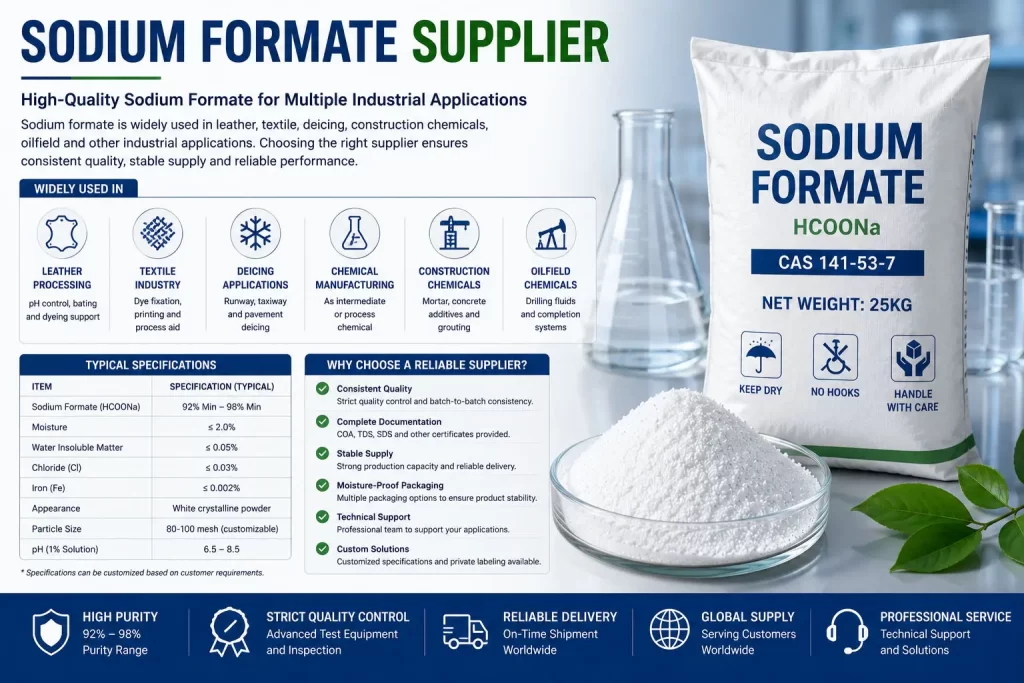
A suitable supplier should provide consistent specifications, batch-specific quality documents, moisture-resistant packaging, traceable production records, and reliable delivery planning. Buyers should also verify that the selected grade matches the intended process rather than assuming that one sodium formate product is suitable for every application.
What Is Sodium Formate?
Sodium formate is the sodium salt of formic acid. Its CAS number is 141-53-7, molecular formula is HCOONa or CHNaO₂, and molecular weight is approximately 68.01 g/mol. It is generally supplied as a white crystalline solid or powder.
| Property | Basic Information |
|---|---|
| Chemical name | Sodium formate |
| CAS number | 141-53-7 |
| Molecular formula | HCOONa |
| Molecular weight | Approximately 68.01 g/mol |
| Appearance | White crystalline powder or solid |
| Main commercial forms | Industrial powder and formulated solution |
Sodium formate is hygroscopic, so packaging and warehouse humidity can influence flowability and storage stability.
Where Is Sodium Formate Used?
The required grade and physical properties depend on the application.
Leather and Textile Processing
Formic acid and formate chemistry are used in leather and textile processing for purposes such as pH control, dyeing support, and process stabilization. BASF notes that formic acid supports leather processing and dye fixation, while Vanchor lists sodium formate among chemicals supplied for textile and leather applications.
For these applications, buyers may need to evaluate:
- Purity and insoluble matter
- Iron and other color-forming impurities
- Dissolution behavior
- Batch consistency
- Compatibility with dyes and process chemicals
Deicing Formulations
Sodium formate is used as a freezing-point depressant in certain airfield pavement deicers. The U.S. Environmental Protection Agency identifies sodium formate among the principal chemicals used in runway, taxiway, apron, and ramp deicing formulations.
A Sodium Formate Supplier serving deicing formulators may need to provide:
- Controlled particle-size distribution
- Reliable low-temperature dissolution
- Moisture-resistant packaging
- Stable seasonal supply
- Documentation required by the finished deicer specification
The finished deicing product may also contain corrosion inhibitors or other additives, so raw sodium formate should not automatically be described as a complete deicing formulation.
Chemical Manufacturing
Sodium formate may be used as a chemical intermediate, process salt, or raw material in downstream manufacturing. In these applications, impurity limits and reaction consistency may be more important than appearance alone.
Manufacturers should consider whether the process is sensitive to:
- Chloride
- Sulfate
- Iron
- Water-insoluble matter
- Moisture
- pH
- Particle size
The purchasing specification should be based on the downstream process rather than copied from a general industrial-grade data sheet.
Which Specifications Matter?
Commercial sodium formate grades can differ significantly. Vanchor states that its current supply range includes grades from approximately 92% to 98%, depending on the contract and application.
| Specification | Why Buyers Should Check It |
|---|---|
| Sodium formate assay | Indicates the primary chemical content |
| Moisture | Influences caking, storage, and dosing |
| Water-insoluble matter | May affect dissolution and processing |
| Chloride | Important in corrosion-sensitive processes |
| Iron | May affect color-sensitive applications |
| Particle size | Influences flow, blending, and dissolution |
| pH of solution | Helps assess process compatibility |
| Appearance | May indicate contamination or storage problems |
A higher assay is not always sufficient to justify selecting one product over another. A slightly lower-purity grade with stable moisture, controlled impurities, and consistent particle size may perform more predictably in some industrial processes.
Why Does Batch Consistency Matter?
A specification defines the permitted range, but it does not show how much the product varies from one batch to another.
Large variations in moisture, impurity levels, or particle distribution can lead to:
- Different dissolution times
- Unstable dosing
- Powder bridging in feeding systems
- Process pH variation
- Inconsistent finished-product performance
- Additional incoming inspection requirements
A reliable Sodium Formate Supplier should therefore provide a batch-specific Certificate of Analysis rather than only a generic specification sheet.
Documents to Request from a Supplier
Before approving a supplier, procurement and technical teams should request:
- Certificate of Analysis: Confirms the tested results for the delivered batch.
- Technical Data Sheet: Defines typical properties, grades, and recommended handling.
- Safety Data Sheet: Provides hazard, handling, storage, and emergency information.
- Product Specification: Identifies guaranteed limits rather than typical values.
- Packaging Information: Describes bag structure, palletization, and net weight.
- Traceability Records: Connect the shipment to production and inspection records.
- Compliance Documents: May include REACH, customs, quality-system, or market-specific statements where applicable.
Documents should identify the actual supplier, manufacturer, product grade, and batch. Generic files without clear product identification provide limited value during audits or quality investigations.
Packaging and Storage Considerations
Because sodium formate can absorb moisture, packaging quality is an important procurement factor. Damaged or poorly sealed bags may result in caking even when the chemical assay remains within specification.
Common purchasing options may include:
- 25 kg moisture-resistant bags
- Palletized export packaging
- Large bulk bags
- Customized labeling
- Container loading with moisture protection
The material should be stored in a dry, covered, and ventilated warehouse. Open bags should be resealed, and pallets should be protected from wet floors, rain, and condensation.
Questions to Ask a Sodium Formate Supplier
A supplier assessment should include both technical and logistical questions.
| Supplier Question | Procurement Purpose |
|---|---|
| Which purity grades are routinely produced? | Confirms grade availability |
| Which limits are guaranteed? | Separates specifications from typical data |
| Is a batch-specific COA supplied? | Supports incoming quality control |
| Can samples be provided? | Enables process and formulation testing |
| How is moisture controlled? | Reduces caking risk |
| What packaging formats are available? | Confirms production compatibility |
| How is batch traceability maintained? | Supports quality investigations |
| What is the normal lead time? | Improves purchasing planning |
| Can repeat orders use the same specification? | Supports long-term consistency |
Price Should Not Be the Only Criterion
Sodium formate pricing may vary with purity, impurity limits, order quantity, packaging, freight, port conditions, and delivery terms. Vanchor also identifies grade, volume, and logistics as important purchasing variables.
A lower unit price may create additional costs if the material causes:
- More frequent production adjustments
- Additional laboratory inspection
- Poor powder handling
- Delayed shipments
- Damaged packaging
- Inconsistent downstream performance
A complete comparison should therefore consider total procurement and processing cost rather than price per metric ton alone.
Sodium Formate Supply from Vanchor
Vanchor includes sodium formate in its formate portfolio and supplies the product for industrial markets including textile and leather processing, construction-related chemicals, and oilfield chemical supply. The company states that available sodium formate grades generally range from 92% to 98%, with batch testing conducted before storage or shipment.
Buyers should confirm the exact specification, packaging, documentation, and application suitability before placing an order. Representative samples can also be evaluated under actual production conditions.
Conclusion
Selecting a Sodium Formate Supplier requires more than comparing assay and price. Buyers should evaluate impurities, moisture, particle properties, batch consistency, packaging, documentation, traceability, and delivery reliability.
The correct sodium formate grade depends on whether the material will be used in leather processing, textiles, chemical manufacturing, deicing formulations, or another industrial process. A controlled supplier qualification process—including document review, sample testing, and batch comparison—can reduce procurement risk and support more predictable production.


Contact Us
In This Article
Related Posts
How to Choose a Reliable 2-Ethylhexanol (2-EH) Supplier in China: Quality, Packaging and Shipping
2026-10-22
Natural vs Synthetic Sodium Sulfate Anhydrous: Which Is Better for Industrial Applications?
2026-10-22
Isobutanol 99.3% Price and Supply in 2026: A Guide for Chemical Importers
2026-10-22
Sodium Sulfate Anhydrous 99% for Detergent Manufacturing: Benefits, Specifications and Bulk Supply
2026-10-22


