



Calcium Formate for Mortar: Applications, Performance, and Formulation Factors
By vanchor
2026-07-17Related Posts

How to Choose a Reliable 2-Ethylhexanol (2-EH) Supplier in China: Quality, Packaging and Shipping
2026-10-22

Natural vs Synthetic Sodium Sulfate Anhydrous: Which Is Better for Industrial Applications?
2026-10-22

Isobutanol 99.3% Price and Supply in 2026: A Guide for Chemical Importers
2026-10-22

Sodium Sulfate Anhydrous 99% for Detergent Manufacturing: Benefits, Specifications and Bulk Supply
2026-10-22
Mortar performance depends on more than cement and sand. Water demand, aggregate grading, ambient temperature, curing conditions, polymers, cellulose ethers, and chemical additives all influence how a mortar mixes, sets, and develops strength.
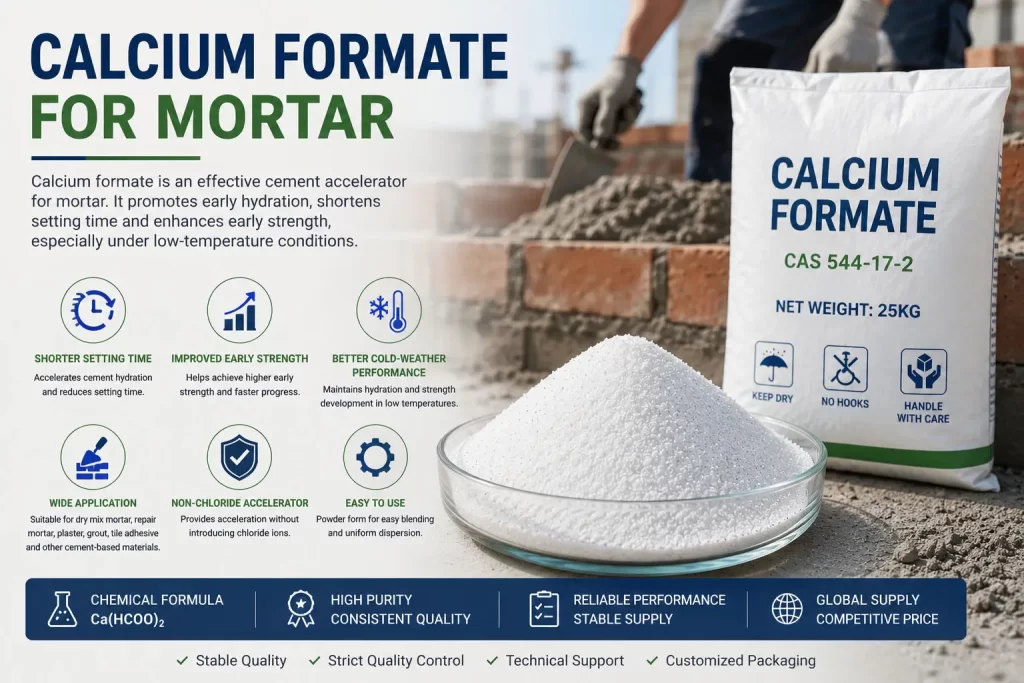
Calcium Formate for Mortar is a powdered accelerator that is typically employed in dry-mix cement-based mortars. It is used primarily for early cement hydration, to reduce the setting time and to accelerate the strength development.
But, the addition of calcium formate does not necessarily give better properties to all mortars. The dosage should be related to the working time, water retention, adhesion, shrinkage and usage at final application.
What Is Calcium Formate?
Calcium formate is the calcium salt of formic acid. It is generally supplied as a white crystalline powder that can be blended directly into factory-produced mortar.
| Property | Basic Information |
|---|---|
| Chemical name | Calcium formate |
| Chemical formula | Ca(HCOO)₂ |
| CAS number | 544-17-2 |
| Physical form | White crystalline powder |
| Main function in mortar | Cement hydration accelerator |
| Common applications | Dry-mix mortar, repair mortar, plaster, grout and tile adhesive |
Construction-grade material should provide stable purity, controlled moisture, suitable particle size, and consistent batch quality.
How Does Calcium Formate Work in Mortar?
Cement-based mortar hardens through hydration. After water is added, cement compounds react and gradually form a solid binding structure.
Calcium Formate for Mortar may accelerate part of this early hydration process. Depending on cement chemistry and formulation conditions, it may contribute to:
- Shorter Setting Time: The mortar can begin to harden earlier.
- Improved Early Strength: One-day or three-day strength may develop faster.
- Cold-Weather Support: The additive may help compensate for slower hydration at lower temperatures.
- Earlier Handling: Faster hardening may reduce waiting time before finishing, demolding, loading, or subsequent work.
These effects vary between formulations. A dosage that works in one mortar may perform differently when the cement, polymer, aggregate, or temperature changes.
Main Mortar Applications
Dry-Mix Mortar
Calcium Formate for Mortar is particularly suitable for dry-blended products because it can be dosed together with cement, aggregate, cellulose ether, polymer powder, and other additives.
Typical dry-mix applications include:
- Masonry mortar
- Rendering mortar
- Cement plaster
- Waterproof mortar
- Floor mortar
- Non-shrink grout
- Repair compounds
Its function should be defined according to the target setting profile rather than added as a general-purpose performance enhancer.
Repair Mortar
Repair products often require early strength so that damaged surfaces can return to service quickly.
Calcium formate may be used in:
- Concrete patching mortar
- Floor repair systems
- Rapid maintenance compounds
- Surface restoration products
- Edge and corner repair mortar
Final repair performance still depends on substrate preparation, curing, polymer modification, application thickness, and moisture conditions.
Rendering and Plaster Mortar
In rendering and plaster systems, Calcium Formate for Mortar may support earlier hardening, especially in cool environments.
However, the mortar must retain sufficient time for:
- Mixing
- Pumping
- Spreading
- Leveling
- Surface finishing
Excessive acceleration can make application difficult, particularly over large wall areas.
Grout and Floor Compounds
Certain cement-based grouts and floor products require early hardness or faster return to service.
In these systems, calcium formate may help accelerate early development, but compatibility with fluidizers, shrinkage-control additives, fillers, and supplementary binders must be verified.
Tile Adhesive
Tile adhesive is also a mortar system, but its formulation requirements are more complex. Calcium formate may improve early hardening, while cellulose ether and polymer powder control open time, adhesion, and flexibility.
An excessive dosage may shorten tile-adjustment time or cause premature surface drying.
Calcium Formate and Other Mortar Additives
Each additive performs a different function within mortar.
| Additive | Main Function | Important Consideration |
|---|---|---|
| Calcium formate | Setting and early-strength acceleration | May shorten working time |
| Cellulose ether | Water retention and rheology control | Influences open time and workability |
| Redispersible polymer powder | Adhesion and flexibility | Affects water demand and cost |
| Starch ether | Anti-sag and rheology adjustment | Excess dosage can reduce flow |
| Retarder | Extends setting time | May counteract acceleration |
| Superplasticizer | Reduces water demand | Cement compatibility is important |
| Defoamer | Controls entrained air | May influence density and strength |
Calcium Formate for Mortar should therefore be evaluated as part of the complete additive system.
What Determines the Dosage?
There is no universal dosage suitable for all mortar products. The required level depends on several interacting factors.
Cement Composition
Different cement sources contain different clinker phases, gypsum levels, and fineness. These variables can change how strongly the cement responds to an accelerator.
Temperature
Low temperatures slow cement hydration. A formulation intended for winter construction may require a different accelerator level from one designed for warm conditions.
Water-to-Cement Ratio
Higher water content can change strength development, consistency, and setting behavior.
Cellulose Ether and Polymer Content
Water-retention agents and polymers influence moisture movement, rheology, adhesion, and hydration. These materials may change the apparent effect of calcium formate.
Required Working Time
A fast-setting repair mortar and a manually applied plaster have very different working-time requirements.
Supplementary Materials
Fly ash, slag, limestone powder, and other mineral components can alter hydration and early strength.
Recommended Performance Tests
Before commercial production, Calcium Formate for Mortar should be evaluated through controlled laboratory trials.
Important tests include:
- Initial and Final Setting Time: Determines the degree of acceleration.
- One-Day and Three-Day Strength: Measures early compressive or flexural development.
- Twenty-Eight-Day Strength: Confirms longer-term performance.
- Workability Retention: Checks whether the mortar remains practical during application.
- Water Retention: Important for plaster, rendering mortar, and tile adhesive.
- Adhesion Strength: Required for repair mortar and bonded applications.
- Shrinkage: Identifies dimensional changes during hardening.
- Cracking Resistance: Evaluates whether rapid hardening increases cracking risk.
- Low-Temperature Performance: Simulates realistic winter conditions.
- Storage Stability: Confirms that the dry blend remains free flowing.
Each test should include a control formulation without calcium formate.
Common Formulation Problems
Mortar Sets Too Quickly
Possible causes include excessive calcium formate, highly reactive cement, warm temperatures, or insufficient retarder.
Working Time Is Too Short
The accelerator level may need to be reduced, or the cellulose ether and retarder system may require adjustment.
Early Strength Does Not Improve
The cement type, dosage, purity, mixing uniformity, or supplementary materials may limit the expected response.
Mortar Becomes Difficult to Spread
Faster hydration, insufficient water retention, or poor rheological balance may affect application.
Cracking Increases
Rapid moisture loss, high cement content, insufficient curing, or excessive acceleration may contribute to cracking.
How to Evaluate Product Quality
Calcium Formate for Mortar should be selected based on both chemical and physical consistency.
Purchasers should review:
- Assay
- Moisture content
- Water-insoluble matter
- Particle size
- Powder flowability
- Batch consistency
- Packaging integrity
- Certificate of Analysis
- Technical Data Sheet
- Safety Data Sheet
- Batch traceability
A high assay is useful, but stable performance between shipments is equally important for mortar production.
Storage and Handling
Calcium formate should be stored in sealed, moisture-resistant packaging in a dry and ventilated warehouse.
Recommended practices include:
- Keep bags away from wet floors and walls.
- Protect pallets from rain and humidity.
- Reseal opened bags.
- Use suitable dust-control equipment.
- Follow the supplier’s safety documentation.
- Apply first-in, first-out inventory management.
- Record batch numbers during production.
Moisture exposure can cause caking and reduce dosing consistency.
Selecting Calcium Formate for Mortar Production
A suitable product should match the formulation rather than simply meet a general purity target.
Vanchor supplies Calcium Formate for Mortar applications including dry-mix mortar, repair compounds, tile adhesive, plaster, grout, and related cement-based materials. Specifications should be reviewed together with laboratory samples and application testing.
Before purchasing, manufacturers may ask:
- What assay and moisture ranges are guaranteed?
- Is a batch-specific COA available?
- What particle-size range is supplied?
- Can packaging be adapted to production needs?
- Are samples available for formulation trials?
- How is batch consistency controlled?
- What technical documentation is provided?
Conclusion
Calcium Formate for Mortar is principally used to accelerate the cement hydration, shorten setting time and to facilitate early strength gain. It may be used as a dry-mix mortar, repair mortar, plaster, rendering material, grout, floor compound and tile adhesive. It is dependent on the type and content of cement, temperature, dosage, water content, mineral admixtures and other polymers and admixtures. Avoid excessive acceleration, as this can result in a decrease in working time and/or impact on application behavior. Calcium Formate for Mortar should be tested as part of the final formulation under typical production and construction conditions for reliable results. Predictable mortar performance is achieved through the stability of purity, control of moisture, particle properties, packaging, and batch traceability.


Contact Us
Related Posts
How to Choose a Reliable 2-Ethylhexanol (2-EH) Supplier in China: Quality, Packaging and Shipping
2026-10-22
Natural vs Synthetic Sodium Sulfate Anhydrous: Which Is Better for Industrial Applications?
2026-10-22
Isobutanol 99.3% Price and Supply in 2026: A Guide for Chemical Importers
2026-10-22
Sodium Sulfate Anhydrous 99% for Detergent Manufacturing: Benefits, Specifications and Bulk Supply
2026-10-22


