



Calcium Formate Feed Grade vs Industrial Grade: What Is the Difference?
By vanchor
2026-07-11Related Posts

Custom Packaging Solutions from an Anhydrous Sodium Acetate Supplier in China
2026-09-23

Application Trends in Anhydrous Sodium Acetate for Special Chemical Manufacturing
2026-09-23

Anhydrous Sodium Acetate for Leather Tanning: Improve Dyeing Uniformity
2026-09-22

Formic Acid 85% for Textile Dyeing: Industrial Applications, Technical Benefits and Future Trends
2026-09-22
The most important difference between Calcium Formate Feed Grade vs Industrial Grade is not necessarily the calcium formate percentage. Both grades may contain at least 98% calcium formate and have the same chemical formula, Ca(HCOO)₂.
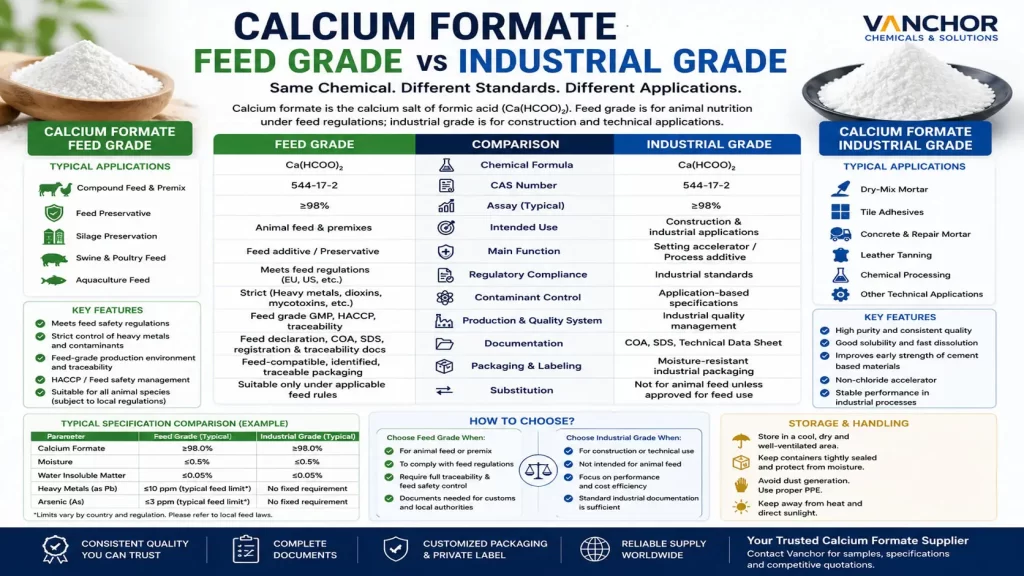
The real distinction is their intended use, contaminant control, production environment, traceability, regulatory documentation and quality-management system.
Feed-grade calcium formate must be manufactured and supplied for animal nutrition under the applicable feed-safety requirements of the destination market. Industrial-grade calcium formate is designed for construction materials, leather processing and other technical applications. It should not be used in animal feed unless the manufacturer can demonstrate that the product, production site and documentation meet the relevant feed regulations.
As a practical rule:
- Choose feed-grade calcium formate for compound feed, premixes and approved feed-preservation applications.
- Choose industrial-grade calcium formate for dry-mix mortar, tile adhesives, concrete, leather tanning and technical chemical processes.
What Is Calcium Formate?
Calcium formate is the calcium salt of formic acid. It is generally supplied as a white, free-flowing crystalline powder.
| Property | General Information |
|---|---|
| Chemical name | Calcium formate |
| Chemical formula | Ca(HCOO)₂ |
| Alternative formula | C₂H₂CaO₄ |
| CAS number | 544-17-2 |
| Molecular weight | Approximately 130.1 g/mol |
| Appearance | White crystalline powder |
| Main commercial grades | Feed grade and industrial grade |
| Water solubility | Soluble in water |
| Main functions | Feed preservative or industrial process additive |
The chemical identity remains the same across grades. However, matching a CAS number or assay result does not by itself establish that a product is suitable for animal feed.
Calcium Formate Feed Grade vs Industrial Grade: Quick Comparison
| Comparison Point | Feed Grade Calcium Formate | Industrial Grade Calcium Formate |
|---|---|---|
| Chemical formula | Ca(HCOO)₂ | Ca(HCOO)₂ |
| CAS number | 544-17-2 | 544-17-2 |
| Typical assay | Often ≥98% | Often ≥98% |
| Intended use | Animal feed and premixes | Construction and technical processes |
| Main function | Approved feed preservative or formulation ingredient | Cement accelerator and processing additive |
| Contaminant control | Must comply with feed-market requirements | Based on industrial application specifications |
| Production controls | Feed hygiene, HACCP and traceability may be required | Industrial quality and process control |
| Documentation | Feed declaration, COA, SDS, regulatory and traceability documents | COA, SDS and technical data sheet |
| Packaging | Feed-compatible, identified and traceable packaging | Industrial moisture-resistant packaging |
| Substitution | Suitable only under applicable feed rules | Not automatically acceptable in feed |
The table shows why purity alone is an incomplete purchasing criterion. An industrial product with 98% assay does not automatically become feed grade.
What Is Feed-Grade Calcium Formate?
Feed-grade calcium formate is produced, tested, packaged and documented for use within the animal-feed supply chain.
In the European Union, calcium formate is listed as a technological feed additive in the functional group of preservatives. The current authorization specifies a solid product containing at least 98% calcium formate and identifies it for use in all animal species under defined conditions. The EU entry also sets a maximum level calculated as formic acid and includes requirements concerning combined sources of formic acid and protective measures for users.
Feed-grade suitability can involve controls covering:
- Raw-material approval
- Heavy metals and other undesirable substances
- Cross-contamination prevention
- Batch traceability
- Hygiene during production and packing
- HACCP-based risk management
- Correct feed-additive labeling
- Retained samples and recall procedures
- Transport and warehouse cleanliness
EU feed legislation sets limits for undesirable substances such as lead, arsenic, cadmium, mercury, dioxins and certain other contaminants in feed-related products. The exact limits depend on the product category and market.
Quality systems such as FAMI-QS may also support specialty feed-ingredient manufacturing. The FAMI-QS Code covers good manufacturing practices, HACCP and operational risk controls intended to protect feed safety and quality. Certification requirements and acceptance still depend on the customer and destination market.
What Is Industrial-Grade Calcium Formate?
Industrial-grade calcium formate is manufactured for technical applications where performance in cement, mortar, leather or chemical processing is the primary consideration.
A typical technical-grade specification may include:
| Parameter | Example Technical Specification |
|---|---|
| Calcium formate | ≥98.0% |
| Moisture | ≤0.5% |
| Water-insoluble matter | ≤0.05% |
| Appearance | White, free-flowing crystalline solid |
These are representative technical values rather than universal limits. One published industrial technical data sheet specifies at least 98% calcium formate, no more than 0.5% moisture and no more than 0.05% water-insoluble matter.
Industrial-grade calcium formate is commonly used in:
- Dry-mix mortar
- Cement-based tile adhesives
- Repair mortar
- Concrete
- Self-leveling compounds
- Leather tanning
- Chemical processing
- Selected fertilizer formulations
In construction materials, calcium formate is used to accelerate cement hydration and early-strength development. A current technical product sheet identifies tile adhesives and concrete among its principal applications and specifies a minimum calcium formate content of 98%.
Is Feed Grade More Pure Than Industrial Grade?
Not always.
Both calcium formate feed grade and industrial grade may be sold with a minimum assay of 98%. Therefore, describing feed grade simply as “higher purity” can be misleading.
The feed-grade distinction is more closely related to:
- Which impurities are controlled
- How frequently they are tested
- Whether the production site is approved or registered
- Whether cross-contamination is managed
- Whether the batch has complete feed-chain traceability
- Whether the product is legally authorized for the intended market
An industrial COA may report calcium formate, moisture and insoluble matter but omit feed-relevant testing or declarations. A feed-grade COA and supporting file may need to address additional contaminants and regulatory information.
Why Industrial Grade Should Not Be Used in Feed
Industrial-grade calcium formate may meet its technical specification while still being unsuitable for animal nutrition.
Potential reasons include:
- Raw materials not approved for feed use
- Shared equipment with non-feed chemicals
- Inadequate cross-contamination controls
- Missing heavy-metal or undesirable-substance testing
- Industrial rather than feed-compatible packaging
- No feed-business registration or approval
- Missing feed-additive identification and labeling
- Incomplete traceability through production and transport
Feed hygiene rules cover production, processing, storage and distribution across the feed chain. Feed-business operators are expected to comply with applicable hygiene requirements and maintain product safety and traceability.
A buyer should therefore never approve industrial material for feed solely because the CAS number and purity appear identical.
What Does Feed-Grade Calcium Formate Do?
Its regulatory function depends on the market and authorization. In the EU, calcium formate is authorized as a technological additive functioning as a preservative.
It provides formate in a dry, easily handled form and may be included in qualified feed or premix formulations according to regulatory conditions and professional formulation guidance. EFSA concluded that calcium formate has the potential to function as a feed preservative under the evaluated conditions.
The final inclusion rate should be established by a qualified nutritionist or feed formulator. Factors include:
- Animal species and production stage
- Complete-feed composition
- Moisture content
- Other organic acids and formate salts
- Target preservation performance
- National maximum levels
- Supplier instructions
For example, the EU authorization sets a maximum of 10,000 mg/kg in complete feedingstuff, expressed as formic acid, and requires the total contribution from different sources of formic acid to remain within the permitted level. This regulatory value should not be interpreted as a universal recommended dosage for every diet or country.
What Does Industrial-Grade Calcium Formate Do?
In cementitious materials, industrial calcium formate is mainly selected as a setting and early-strength accelerator.
Its applications include:
Dry-Mix Mortar
It can support earlier cement hydration and strength development in factory-produced mortar systems.
Tile Adhesives
Calcium formate is used in selected cement-based tile adhesive formulations requiring controlled acceleration and early performance.
Repair Mortar
It can help repair products develop strength sooner, subject to compatibility testing with the complete additive system.
Concrete Products
Calcium formate may be used as a non-chloride accelerator in certain concrete and precast formulations.
Leather Processing
It can act as a masking and pH-control agent during chrome-tanning processes. A published technical data sheet identifies both cement and leather-processing uses.
The optimum construction dosage depends on cement chemistry, temperature, cellulose ether, polymer powder and other admixtures.
How to Verify Feed-Grade Calcium Formate
Before purchasing calcium formate for animal nutrition, request a complete supplier qualification file.
Important documents include:
- Batch-specific Certificate of Analysis
- Feed-grade product specification
- Safety Data Sheet
- Feed-additive declaration
- Country-of-origin certificate
- Manufacturing-site information
- Feed-business registration or approval
- HACCP or feed-safety certification
- Heavy-metal and contaminant test results
- Traceability and recall information
- Allergen, GMO or animal-origin declarations where required
- Packaging and transport-cleanliness declarations
The required documents vary by country. An EU-compliant product is not automatically registered for every other market, and a product accepted elsewhere is not automatically compliant with EU requirements.
How to Select Industrial-Grade Calcium Formate
Construction and industrial buyers should focus on performance-related specifications:
- Calcium formate assay
- Moisture
- Water-insoluble content
- Particle-size distribution
- Bulk density
- Powder flow
- Batch consistency
- Setting-time performance
- Early compressive strength
- Compatibility with cement and additives
- Moisture-resistant packaging
A laboratory mortar trial is more informative than purity alone. Two 98% industrial products may behave differently because of particle size, residual impurities and production consistency.
Storage and Handling
Both grades should be stored in sealed packaging in a cool, dry and ventilated warehouse.
Industrial technical guidance recommends preventing moisture absorption and, for some products, storing below approximately 30°C to reduce caking risk.
During handling:
- Control airborne dust.
- Wear appropriate eye and respiratory protection.
- Keep opened bags tightly sealed.
- Prevent contact with moisture.
- Avoid contamination from other chemicals.
- Follow the batch SDS and local workplace requirements.
For feed-grade material, warehouse zoning, cleaning records, pest control and transport history may also form part of the feed-safety system.
Calcium Formate Supply from Vanchor
Vanchor supplies calcium formate for both construction and qualified animal-feed applications, with grade selection based on the intended use, specification and destination market. Vanchor’s current product portfolio covers construction chemicals and agriculture, food and feed additives, including calcium formate.
Supply support can include:
- Feed-grade and industrial-grade specifications
- Batch-specific COA
- SDS and Technical Data Sheet
- Export-ready moisture-resistant packaging
- Samples for customer evaluation
- Customized labeling
- Bulk and recurring supply
- International logistics coordination
Feed-grade availability and compliance documents should be confirmed for each destination before an order is finalized.
Frequently Asked Questions
Are feed and industrial calcium formate chemically identical?
They have the same chemical formula and CAS number, but their production controls, documentation and authorized uses differ.
Does 98% industrial calcium formate qualify as feed grade?
No. A 98% assay alone does not demonstrate feed-grade compliance.
Can feed-grade calcium formate be used in construction?
Chemically it may perform in some industrial formulations, but it is normally less economical. Construction trials are still necessary.
Can industrial-grade calcium formate be added to animal feed?
It should not be used unless the manufacturer and product meet all applicable feed-safety, registration and documentation requirements.
Is calcium formate a food additive?
Feed-grade status and food-grade status are different. Authorization for animal feed does not automatically permit use in food for human consumption.
What is calcium formate used for in feed?
Its authorized EU function is as a technological feed additive and preservative.
What is industrial calcium formate used for?
Typical uses include dry-mix mortar, tile adhesives, concrete, repair products and leather tanning.
Which grade usually costs more?
Feed grade may cost more because of feed-safety controls, contaminant testing, traceability and certification requirements.
What should be shown on a feed-grade COA?
The COA should identify the batch and report relevant assay, moisture and feed-safety parameters according to the agreed specification.
How should buyers choose the correct grade?
Specify the final application and destination country first. Then evaluate product specifications, regulatory documents, supplier approval and batch traceability.
Choose the Grade by End Use, Not Purity Alone
The key lesson from Calcium Formate Feed Grade vs Industrial Grade is that grade cannot be determined from the chemical formula or assay alone.
Feed-grade calcium formate requires appropriate feed-safety controls, legal authorization, traceability and documentation. Industrial-grade calcium formate is optimized for construction and technical performance.


Contact Us
Related Posts
Custom Packaging Solutions from an Anhydrous Sodium Acetate Supplier in China
2026-09-23
Application Trends in Anhydrous Sodium Acetate for Special Chemical Manufacturing
2026-09-23
Anhydrous Sodium Acetate for Leather Tanning: Improve Dyeing Uniformity
2026-09-22
Formic Acid 85% for Textile Dyeing: Industrial Applications, Technical Benefits and Future Trends
2026-09-22


