



Formic Acid 85%, 90%, 94% and 99%: How to Choose the Right Concentration
By vanchor
2026-07-11Related Posts
Custom Packaging Solutions from an Anhydrous Sodium Acetate Supplier in China
2026-09-23
Application Trends in Anhydrous Sodium Acetate for Special Chemical Manufacturing
2026-09-23
Anhydrous Sodium Acetate for Leather Tanning: Improve Dyeing Uniformity
2026-09-22
Formic Acid 85% for Textile Dyeing: Industrial Applications, Technical Benefits and Future Trends
2026-09-22
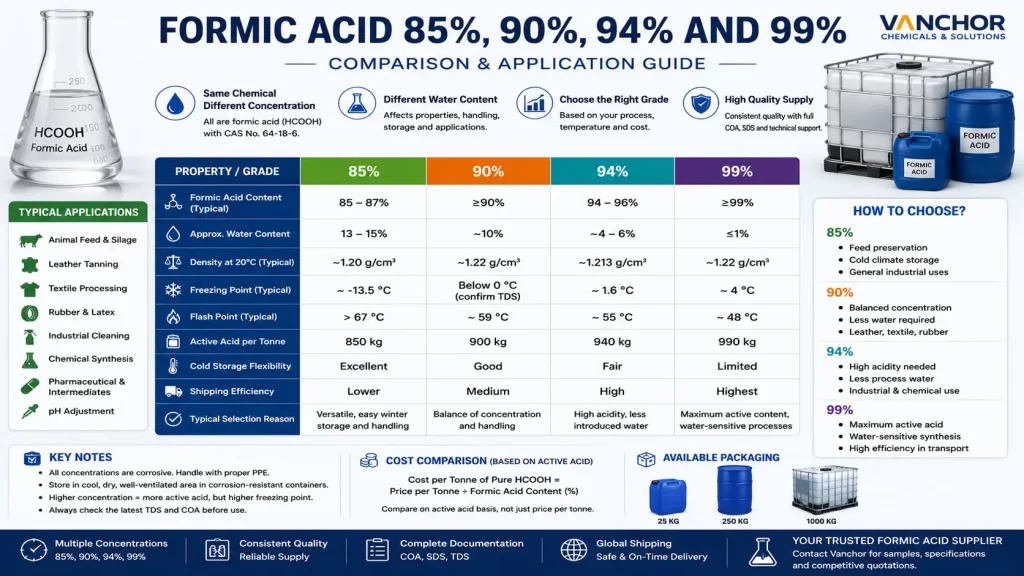
The difference between Formic Acid 85%, 90%, 94% and 99% is primarily the proportion of active formic acid relative to water. All four products contain the same chemical compound—formic acid, or HCOOH—but their concentration affects active-acid content, freezing point, flash point, handling, storage and transportation efficiency.
As a general selection guide:
- Formic Acid 85% offers easier low-temperature storage and is widely used in feed preservation, leather, textiles, rubber and general industrial processing.
- Formic Acid 90% provides a higher active content while retaining some resistance to crystallization in cool conditions.
- Formic Acid 94% is suited to processes requiring greater acidity and less introduced water.
- Formic Acid 99% offers the highest active content and is selected for chemical synthesis and water-sensitive production, but it requires closer temperature and safety control.
The highest concentration is not automatically the best option. Buyers should consider the production process, allowed water content, winter temperature, storage system, regulatory grade and total cost per kilogram of active acid.
What Do the Formic Acid Percentages Mean?
Commercial formic acid is normally supplied as an aqueous solution. The percentage indicates the approximate weight of formic acid in 100 kg of product.
For example:
| Commercial Concentration | Formic Acid in 1,000 kg | Approximate Water and Other Allowances |
|---|---|---|
| Formic Acid 85% | 850 kg | 150 kg |
| Formic Acid 90% | 900 kg | 100 kg |
| Formic Acid 94% | 940 kg | 60 kg |
| Formic Acid 99% | 990 kg | 10 kg |
All concentrations share the same basic chemical identity:
| Property | Information |
|---|---|
| Chemical name | Formic acid |
| Alternative name | Methanoic acid |
| Formula | HCOOH or CH₂O₂ |
| CAS number | 64-18-6 |
| Molecular weight | 46.025 g/mol |
| Appearance | Clear, colorless liquid |
| Solubility | Miscible with water |
| Main function | Acidifier, pH-control agent, preservative or chemical intermediate |
Formic acid is one of the strongest commonly used simple organic acids and has a pKa of approximately 3.7.
Formic Acid 85%, 90%, 94% and 99% Comparison
| Property | 85% | 90% | 94% | 99% |
|---|---|---|---|---|
| Typical active content | 85%–87% | ≥90% | 94%–96% | ≥99% |
| Approximate water content | 13%–15% | Around 10% | Around 4%–6% | 1% or less |
| Typical density at 20°C | About 1.20 g/cm³ | About 1.22 g/cm³ | About 1.213 g/cm³ | About 1.22 g/cm³ |
| Typical freezing behavior | Approximately −13.5°C | Usually below 0°C; confirm supplier data | Approximately 1.6°C | Approximately 4°C for 99.7% material |
| Typical flash point | Above 67°C | Around 59°C | Around 55°C | Around 48°C |
| Active acid per tonne | 850 kg | 900 kg | 940 kg | 990 kg |
| Cold-storage flexibility | Highest of these grades | Moderate | Lower | Lowest |
| Freight efficiency | Lowest | Moderate | High | Highest |
| Typical selection reason | Versatile and easier winter handling | Balance of concentration and handling | Less process water | Maximum active content |
These are representative values, not universal specifications. Eastman lists a freezing point of −13.5°C for its 85% grade, 1.6°C for its 94% grade and 4°C for its 99.7% grade. Density, assay and freezing behavior may vary slightly by manufacturer and specification.
What Is Formic Acid 85%?
Formic Acid 85% contains approximately 85 parts formic acid and 15 parts water by weight. It is one of the most widely used commercial concentrations because it combines strong acidification with relatively practical storage and handling.
Its lower freezing point is an important advantage in cooler regions. Eastman reports a typical freezing point of −13.5°C for its 85% product, compared with temperatures above 0°C for more concentrated grades.
Typical Applications
Formic Acid 85% is commonly considered for:
- Animal feed preservation
- Silage treatment
- Leather tanning
- Textile dyeing and finishing
- Natural rubber processing
- Industrial cleaning products
- pH adjustment
- Chemical synthesis
- Pharmaceutical and detergent intermediates
Eastman identifies textile, tannery, industrial-cleaning and hard-surface-care applications for its 85% material. It also supplies a separate 85% feed-grade product for preserving feed against microbial deterioration.
An industrial 85% product should not automatically be used in animal feed. Feed applications require an appropriately authorized grade, suitable manufacturing controls and market-specific documentation.
What Is Formic Acid 90%?
Formic Acid 90% offers a middle position between the versatile 85% grade and higher-concentration 94% or 99% material.
Compared with 85%, it delivers:
- Approximately 5.9% more active acid per tonne
- Less water introduced into the process
- Improved shipping efficiency
- Stronger acidification per unit of product
- Potentially lower consumption for the same acid requirement
It is often considered for leather processing, textiles, rubber coagulation, industrial cleaning and chemical manufacturing where 85% introduces more water than desired but 94% or 99% is unnecessary.
Published commercial data list a density of approximately 1.220 g/cm³ and a flash point near 59°C for a 90% product. Freezing-point figures vary between technical documents, so the supplier’s current TDS should be used when planning winter storage.
What Is Formic Acid 94%?
Formic Acid 94% contains only about 4%–6% water. It is chosen when a production process requires high acid activity while still accepting a small amount of water.
Typical Applications
- Leather and tannery chemicals
- Textile processing
- Industrial and institutional cleaning
- Chemical synthesis
- Pharmaceutical intermediates
- Rubber and latex processing
- pH control
- Specialty formulations
Eastman lists tannery, textile, hard-surface-care, industrial-cleaner and pharmaceutical-processing applications for its 94% grade. Its published typical properties include a density of 1.2133 g/cm³ at 20°C and a freezing point of 1.6°C.
The positive freezing point means that 94% formic acid can crystallize during winter transport or storage. Heated storage, insulated pipelines or controlled indoor conditions may therefore be necessary in colder climates.
What Is Formic Acid 99%?
Formic Acid 99% is a highly concentrated grade containing very little water. It provides up to 990 kg of formic acid in every tonne of product.
It is generally selected when:
- Water must be minimized.
- High acid activity is required.
- The product is used as a synthesis intermediate.
- Transport efficiency is a priority.
- Precise reaction conditions must be maintained.
- Downstream drying costs need to be reduced.
A commercial 99.7% grade has a reported density of approximately 1.22 g/cm³, freezing point of 4°C and flash point of 48°C. Nearly pure formic acid has an even higher melting point, commonly reported near 8.4°C.
This creates an important procurement trade-off: 99% provides the greatest active-acid content, but it may require more careful temperature control than 85% or 90%.
Which Concentration Is Best for Leather Processing?
Formic acid is used in leather production for pH adjustment during pickling, tanning and dyeing operations.
Both 85% and 90% grades are widely practical because they provide:
- Effective acidity control
- Convenient dilution
- Good distribution in aqueous processing
- More manageable winter storage
- Competitive active-acid cost
A 94% grade may be selected when the tannery wants to reduce added water or storage volume. The final choice should consider dosing equipment, recipe calculations, local climate and material compatibility.
Formic acid should be added according to the established tannery process and never based solely on concentration.
Which Concentration Is Best for Animal Feed?
Formic Acid 85% is commonly used in feed and silage applications because it is easier to dose and has favorable low-temperature properties.
However, concentration is only one requirement. The product must also be:
- Approved for the intended feed application
- Produced under suitable feed-safety controls
- Supported by the required regulatory documents
- Properly labeled
- Traceable by batch
- Used within the applicable legal inclusion limits
Eastman describes its 85% feed-grade formic acid as a liquid preservative used to protect feed materials against microbial deterioration.
Industrial Formic Acid 85% should not be assumed to have the same regulatory status.
Which Grade Is Best for Rubber Coagulation?
Formic acid is used to lower the pH of natural rubber latex and support controlled coagulation.
An 85% or 90% grade is often practical because both can be diluted and distributed efficiently in the processing system. Higher concentrations may reduce transportation and storage volume, but they also require more careful dilution and dosing control.
The ideal grade depends on:
- Latex concentration
- Required coagulation speed
- Water quality
- Dosing system
- Storage temperature
- Local safety requirements
- Cost per kilogram of active acid
Production trials should confirm the concentration and dosing rate that provide consistent coagulation without negatively affecting rubber quality.
Active-Acid Cost vs Price per Tonne
Comparing only the purchase price per tonne can produce a misleading result.
Suppose two products have the following prices:
- Formic Acid 85%: lower price per tonne
- Formic Acid 99%: higher price per tonne
The 99% material still provides 140 kg more active formic acid in each tonne.
A more meaningful calculation is:
Cost per tonne ÷ active-acid percentage = cost per tonne of pure HCOOH equivalent
Buyers should also include:
- Freight per tonne of active acid
- Heating or insulation costs
- Dilution requirements
- Storage capacity
- Packaging cost
- Process-water limits
- Product loss
- Handling and safety controls
A lower-concentration grade may offer the best total cost in a cold climate, while a higher concentration may be more economical for long-distance shipping or water-sensitive chemical synthesis.
Freezing Point and Winter Storage
The freezing behavior of formic acid does not change in a simple straight line with concentration because formic acid and water form a complex binary system.
In commercial practice:
- 85% offers the best low-temperature flexibility among the four grades.
- 90% normally remains liquid below 0°C, but the exact point should be confirmed.
- 94% may crystallize around 1.6°C.
- 99% may begin freezing at several degrees above 0°C.
If concentrated formic acid crystallizes, the composition of the remaining liquid may no longer be uniform. The product should be restored according to the supplier’s approved heating and mixing procedure before use.
Safety and Handling Considerations
All commercial concentrations of formic acid are corrosive and require controlled industrial handling.
NIOSH identifies inhalation, ingestion, skin contact and eye contact as exposure routes. Potential effects include irritation, chemical burns, coughing and breathing difficulty. Formic acid can also be corrosive to metals and is incompatible with strong oxidizers and strong caustic materials.
Industrial users should provide:
- Closed transfer systems where practical
- Effective local ventilation
- Chemical-resistant gloves and clothing
- Eye and face protection
- Emergency eyewash and safety showers
- Suitable secondary containment
- Compatible tanks, pumps, seals and pipelines
- Employee training and spill-response procedures
The current supplier SDS and local regulations must take priority over general handling guidance.
How to Select the Correct Formic Acid Grade
Choose Formic Acid 85% When:
- Feed- or silage-grade material is required.
- The facility operates in a cold climate.
- Some process water is acceptable.
- General leather, textile or rubber use is intended.
- Easier handling is more important than maximum concentration.
Choose Formic Acid 90% When:
- A balance between active content and storage performance is needed.
- Less water is preferred than with 85%.
- The process involves leather, textiles, rubber or general chemical production.
- The storage system is suitable for a stronger concentration.
Choose Formic Acid 94% When:
- High acid content is required.
- Added water must be reduced.
- Chemical, cleaning, textile or tannery processes need concentrated material.
- The facility can manage freezing temperatures above 0°C.
Choose Formic Acid 99% When:
- Water-sensitive chemical synthesis is involved.
- Maximum active acid per shipment is required.
- Storage and transfer systems support highly concentrated acid.
- Heating or temperature-controlled storage is available.
- A specific high-purity grade is required.
Quality Factors Buyers Should Check
| Parameter | Why It Matters |
|---|---|
| Formic acid assay | Confirms active concentration |
| Color | Indicates general appearance and possible contamination |
| Chloride | Important for corrosion-sensitive processes |
| Sulphate | May affect downstream production |
| Iron | Important for color-sensitive applications |
| Evaporation residue | Indicates non-volatile impurities |
| Feed or industrial grade | Determines intended regulatory use |
| Freezing point | Affects winter storage and transportation |
| Packaging material | Protects product quality and handling safety |
| COA and SDS | Confirm batch quality and hazards |
The concentration should be confirmed by a batch-specific Certificate of Analysis rather than only by the commercial product name.
Formic Acid Supply from Vanchor
Vanchor supplies Formic Acid 85%, 90%, 94% and 99% for leather, textiles, rubber, agriculture, feed, chemical synthesis and other qualified industrial applications.
Supply support can include:
- Multiple concentration options
- Industrial and application-specific grades
- Batch-specific Certificates of Analysis
- SDS and technical documentation
- Drums, IBCs and bulk supply
- Customized packaging and labeling
- Samples for customer evaluation
- International logistics coordination
When requesting a quotation, provide the required concentration, grade, application, quantity, packaging, destination port and expected winter storage temperature.
Frequently Asked Questions
What is the most common concentration of formic acid?
Formic Acid 85% is one of the most widely used grades because it balances acid activity, dilution flexibility and low-temperature storage.
Is Formic Acid 99% always better than 85%?
No. The 99% grade provides more active acid but has a higher freezing point and requires stricter storage and handling controls.
Which grade freezes most easily?
Formic Acid 99% generally has the greatest crystallization risk at ordinary winter temperatures, followed by 94%.
Which concentration is best for feed?
An authorized feed-grade Formic Acid 85% is commonly used, but local feed regulations and supplier documentation must be verified.
Can industrial-grade formic acid be used in animal feed?
Not automatically. Industrial material should not be used unless it meets all applicable feed-safety and regulatory requirements.
Which grade is best for leather tanning?
Formic Acid 85% and 90% are common practical choices. The exact concentration depends on the tannery process and dosing system.
Which grade has the lowest transportation cost?
The 99% grade provides the most active acid per tonne, but temperature control and handling costs must also be considered.
Can 99% formic acid be diluted to 85%?
It can be formulated to a lower concentration in a suitably designed industrial system, but dilution is exothermic and must follow an approved engineering and safety procedure.
Does concentration change the CAS number?
No. All four concentrations use CAS number 64-18-6 for formic acid, although the product is supplied with different amounts of water.
What documents should a supplier provide?
Buyers should request a batch COA, SDS, Technical Data Sheet, packing information and applicable regulatory or grade-specific documents.
Choose Concentration Based on the Complete Process
The comparison of Formic Acid 85%, 90%, 94% and 99% shows that concentration affects far more than acid strength.
Formic Acid 85% offers broad application flexibility and better cold-weather handling. The 90% grade provides a balance between concentration and storage. Formic Acid 94% reduces introduced water, while 99% maximizes active acid and freight efficiency.
The correct choice depends on application, regulatory grade, water tolerance, winter temperature, storage equipment and total active-acid cost.
Contact Vanchor for formic acid specifications, samples, packaging options, technical documents and an export quotation.


Contact Us
Related Posts
Custom Packaging Solutions from an Anhydrous Sodium Acetate Supplier in China
2026-09-23
Application Trends in Anhydrous Sodium Acetate for Special Chemical Manufacturing
2026-09-23
Anhydrous Sodium Acetate for Leather Tanning: Improve Dyeing Uniformity
2026-09-22
Formic Acid 85% for Textile Dyeing: Industrial Applications, Technical Benefits and Future Trends
2026-09-22


