



Calcium Formate for Cement: How It Affects Setting and Early Strength
By vanchor
2026-07-17Related Posts

Custom Packaging Solutions from an Anhydrous Sodium Acetate Supplier in China
2026-09-23

Application Trends in Anhydrous Sodium Acetate for Special Chemical Manufacturing
2026-09-23

Anhydrous Sodium Acetate for Leather Tanning: Improve Dyeing Uniformity
2026-09-22

Formic Acid 85% for Textile Dyeing: Industrial Applications, Technical Benefits and Future Trends
2026-09-22
Cement performance is influenced by raw-material composition, water content, temperature, curing conditions, and chemical additives. When a cement-based product needs faster setting or earlier strength development, formulators may consider Calcium Formate for Cement as a powdered accelerator.
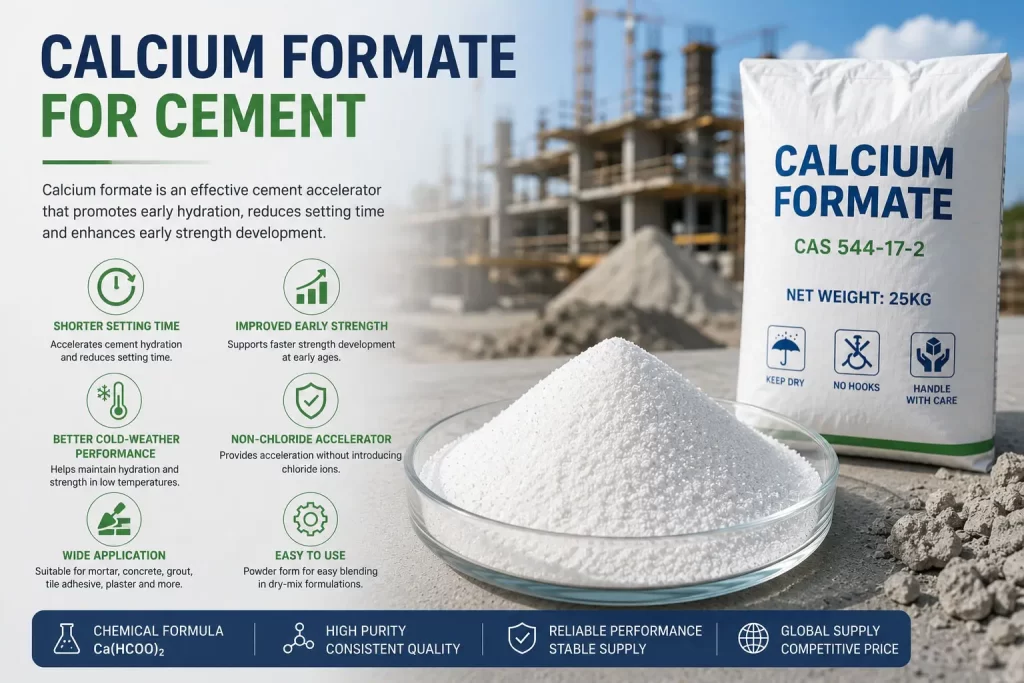
Calcium formate is commonly used in dry-mix mortar, tile adhesive, repair mortar, plaster, grout, and selected concrete formulations. Its main purpose is to influence early cement hydration rather than replace binders, polymers, water-retention agents, or other functional additives.
Understanding how Calcium Formate for Cement works can help manufacturers determine when it is appropriate and how it should be tested.
What Is Calcium Formate?
Calcium formate is the calcium salt of formic acid. It is generally supplied as a white crystalline powder.
| Property | Basic Information |
|---|---|
| Chemical name | Calcium formate |
| Chemical formula | Ca(HCOO)₂ |
| CAS number | 544-17-2 |
| Appearance | White crystalline powder |
| Main construction role | Cement hydration accelerator |
| Common systems | Mortar, tile adhesive, grout, plaster and concrete |
Construction-grade calcium formate should provide controlled purity, moisture content, particle properties, and batch consistency. These characteristics affect powder handling, dosing accuracy, and formulation repeatability.
How Does Calcium Formate Affect Cement?
Cement develops strength through hydration. After water is added, cement compounds react and form hydration products that gradually create a hardened structure.
Calcium Formate for Cement may accelerate some of these early reactions. Depending on the cement chemistry and dosage, this can result in:
- Shorter Setting Time: The cementitious material may begin hardening earlier.
- Faster Early Strength Development: One-day or three-day strength may increase under suitable conditions.
- Improved Cold-Condition Response: Calcium formate may help compensate for the slower hydration normally observed at lower temperatures.
- Earlier Construction Progress: Faster hardening may reduce waiting time before finishing, demolding, repair reopening, or subsequent installation.
The results are not identical in every formulation. Cement type, supplementary cementitious materials, water-to-cement ratio, and other admixtures can change the response.
Calcium Formate Compared with Calcium Chloride
Calcium chloride is also used as a cement accelerator, but it introduces chloride ions. Chloride content may be restricted in reinforced concrete or other applications where corrosion risk must be controlled.
Calcium Formate for Cement is commonly described as a non-chloride alternative. However, this does not mean it is automatically suitable for every structural application. Compliance should be assessed against local standards, project specifications, and the complete admixture system.
| Comparison Factor | Calcium Formate | Calcium Chloride |
|---|---|---|
| Main function | Setting and early-strength acceleration | Strong setting acceleration |
| Chloride introduction | No direct chloride addition | Introduces chloride ions |
| Powder use in dry mix | Generally suitable | Application-dependent |
| Reinforced systems | Requires specification review | Often restricted |
| Dosage response | Depends strongly on cement | Can produce strong acceleration |
Common Applications
Dry-Mix Mortar
Calcium Formate for Cement can be blended directly with other dry ingredients, making it practical for factory-produced mortar.
Typical products include:
- Masonry mortar
- Rendering mortar
- Repair mortar
- Waterproof mortar
- Floor compounds
- Cement-based plaster
Its main role is usually to support earlier setting and strength rather than improve all mortar properties.
Tile Adhesive
In cement-based tile adhesive, calcium formate may help develop earlier bonding strength. This can be useful in fast-setting products or cool construction environments.
However, excessive acceleration may reduce open time and tile-adjustment time. The dosage must therefore be balanced with cellulose ether, redispersible polymer powder, cement type, and ambient temperature.
Repair Mortar
Repair materials often require rapid strength development so that damaged surfaces can return to service sooner. Calcium Formate for Cement may be considered in patching mortar, floor repair products, and rapid-maintenance systems.
Substrate condition, curing, application thickness, and polymer modification remain essential to final performance.
Precast and Concrete Products
Calcium formate may also be evaluated in precast concrete, grout, and selected concrete formulations where early strength is important.
These systems require broader compatibility testing because water reducers, retarders, air-entraining agents, fly ash, slag, and other materials can influence the accelerator response.
What Determines the Required Dosage?
There is no universal dosage for Calcium Formate for Cement. A suitable addition level should be established through controlled testing.
| Formulation Variable | Why It Matters |
|---|---|
| Cement composition | Different clinker phases respond differently |
| Cement fineness | Finer cement may hydrate more rapidly |
| Temperature | Cold conditions slow hydration |
| Water-to-cement ratio | Influences reaction rate and strength |
| Mineral additions | Fly ash, slag and fillers can alter setting |
| Other admixtures | Retarders and water reducers may interact |
| Required working time | Excess acceleration may shorten application time |
| Early-strength target | Determines the required level of acceleration |
Manufacturers should compare several calcium formate dosages against a control sample without the additive.
Which Performance Tests Are Important?
Calcium Formate for Cement should be evaluated within the complete formulation rather than tested as an isolated raw material.
Recommended tests include:
- Initial and Final Setting Time: Confirms the actual acceleration level.
- One-Day and Three-Day Strength: Measures early compressive or flexural performance.
- Later-Age Strength: Checks whether acceleration affects longer-term development.
- Workability: Evaluates spreading, pumping, leveling, or finishing behavior.
- Open Time: Particularly important for tile adhesive and manually applied mortar.
- Shrinkage and Cracking: Determines whether faster hydration affects dimensional stability.
- Low-Temperature Testing: Simulates realistic winter application conditions.
- Compatibility Testing: Checks interaction with polymers, cellulose ethers, retarders, and water reducers.
Testing conditions should reflect the intended manufacturing process and construction environment.
How to Evaluate Calcium Formate Quality
A calcium formate product should not be selected on assay alone. Physical consistency and supplier quality control are also important.
Key purchasing considerations include:
- Assay: Confirms the calcium formate content.
- Moisture: Excess moisture may cause caking and dosing problems.
- Water-Insoluble Matter: High levels may affect dispersion.
- Particle Size: Consistent particles support uniform dry mixing.
- Batch Stability: Reduces variation between production runs.
- Packaging: Moisture-resistant bags help protect the powder.
- Documentation: A COA, TDS, SDS, and batch traceability records should be available.
- Application Support: Samples and technical communication help formulators conduct comparative trials.
Storage and Handling
Calcium Formate for Cement should be stored in sealed packaging in a dry, ventilated warehouse. Bags should be protected from water, humid floors, and damaged pallets.
During handling:
- Use suitable dust-control measures.
- Follow the supplier’s safety data sheet.
- Reseal opened bags.
- Apply first-in, first-out inventory control.
- Record batch numbers for production traceability.
Improper storage can reduce powder flow and affect dosing accuracy.
Conclusion
Calcium Formate for Cement is primarily used to accelerate early hydration, shorten setting time, and support early strength development. It can be applied in dry-mix mortar, tile adhesive, repair products, plaster, grout, and selected concrete systems.
Its effectiveness depends on cement chemistry, temperature, dosage, water content, mineral additions, and other admixtures. Excessive acceleration may also reduce working or open time.
For this reason, Vanchor recommends evaluating Calcium Formate for Cement through controlled laboratory trials and realistic application testing. Stable purity, low moisture, consistent particle properties, appropriate packaging, and batch traceability are important for achieving predictable cement-based formulation performance.


Contact Us
In This Article
Related Posts
Custom Packaging Solutions from an Anhydrous Sodium Acetate Supplier in China
2026-09-23
Application Trends in Anhydrous Sodium Acetate for Special Chemical Manufacturing
2026-09-23
Anhydrous Sodium Acetate for Leather Tanning: Improve Dyeing Uniformity
2026-09-22
Formic Acid 85% for Textile Dyeing: Industrial Applications, Technical Benefits and Future Trends
2026-09-22


