



Construction Grade Calcium Formate: Functions, Applications, and Quality Considerations
By vanchor
2026-07-17Related Posts

How to Choose a Reliable 2-Ethylhexanol (2-EH) Supplier in China: Quality, Packaging and Shipping
2026-10-22

Natural vs Synthetic Sodium Sulfate Anhydrous: Which Is Better for Industrial Applications?
2026-10-22

Isobutanol 99.3% Price and Supply in 2026: A Guide for Chemical Importers
2026-10-22

Sodium Sulfate Anhydrous 99% for Detergent Manufacturing: Benefits, Specifications and Bulk Supply
2026-10-22
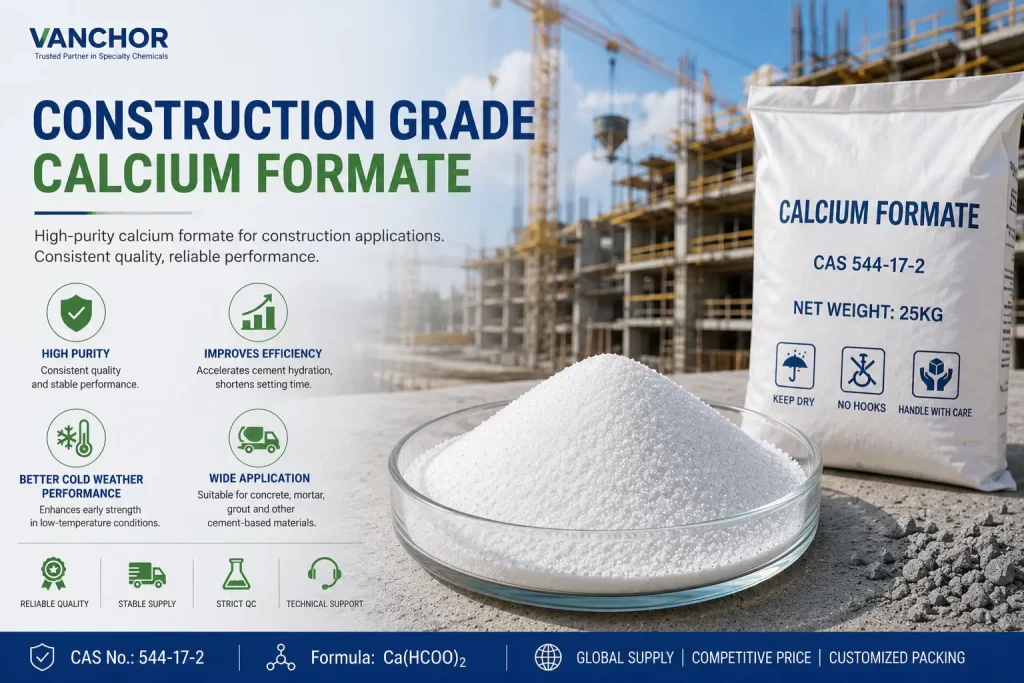
Construction chemicals are often added in small quantities, but their influence on cement hydration, setting behavior, early strength, and production consistency can be significant. One commonly used additive is Construction Grade Calcium Formate, a white crystalline powder applied in dry-mix mortar, tile adhesive, cement-based repair products, plaster, and selected concrete formulations.
Construction Grade Calcium Formate is mainly used as a non-chloride accelerator. It may help promote early cement hydration and support strength development, particularly when low temperatures or short construction schedules slow normal hardening.
However, its performance depends on more than product purity. Cement composition, dosage, temperature, water content, polymer additives, and the required working time must be assessed together.
What Is Construction Grade Calcium Formate?
Calcium formate is the calcium salt of formic acid. Its chemical formula is Ca(HCOO)₂, and its CAS number is 544-17-2.
Construction Grade Calcium Formate is manufactured and controlled for use in cementitious building materials. Compared with grades intended for unrelated industrial applications, construction grade material should provide suitable purity, moisture control, powder flow, particle consistency, and batch stability.
Typical characteristics include:
- Appearance: White crystalline powder
- Chemical formula: Ca(HCOO)₂
- CAS number: 544-17-2
- Primary role: Cement hydration and setting accelerator
- Common applications: Dry-mix mortar, tile adhesive, repair mortar, plaster, grout, and cement-based compounds
The term “construction grade” does not refer to one universal specification. Buyers should confirm the actual technical data supplied by the manufacturer.
How Does It Affect Cement Hydration?
Cement develops strength through hydration reactions after water is added. The speed of these reactions is influenced by cement chemistry, temperature, particle size, water-to-cement ratio, and chemical admixtures.
Construction Grade Calcium Formate may accelerate certain early hydration processes. Depending on the formulation, this can contribute to:
- Shorter initial or final setting time
- Faster early strength development
- Earlier handling or finishing
- Improved performance under cool conditions
- More predictable production cycles
These effects are formulation-dependent. The same dosage may produce different results when used with different cement sources.
Main Construction Applications
Dry-Mix Mortar
Construction Grade Calcium Formate is frequently incorporated into factory-produced dry mortar. Because the additive is supplied as a powder, it can be dosed and blended with cement, sand, cellulose ether, polymer powder, and other dry ingredients.
Possible applications include:
- Masonry mortar
- Rendering mortar
- Repair mortar
- Waterproof mortar
- Self-leveling compounds
- Cement-based plaster
In these systems, calcium formate is generally selected to support early hardening rather than to improve every mortar property.
Tile Adhesive
In cement-based tile adhesive, Construction Grade Calcium Formate may help develop early strength and reduce waiting time before subsequent construction work.
Its dosage must be balanced carefully because excessive acceleration may shorten open time or tile-adjustment time. Cellulose ether, redispersible polymer powder, cement type, and environmental temperature must therefore be considered together.
Repair Mortar
Fast-setting repair materials often require earlier strength development so that repaired areas can return to service more quickly.
Construction Grade Calcium Formate may be considered in formulations for:
- Concrete surface repair
- Patch mortar
- Crack repair compounds
- Rapid maintenance products
- Floor restoration systems
The final repair performance still depends on substrate preparation, polymer modification, curing, and application thickness.
Plaster and Rendering Products
In cement-based plaster and rendering mortar, calcium formate can influence setting and early hardness. This may be useful in cooler working environments or in systems requiring faster finishing.
The formulation must retain sufficient application time to allow spreading, leveling, and surface finishing.
Concrete and Cement-Based Grout
Construction Grade Calcium Formate may also be evaluated in selected concrete, precast, and grout formulations. However, concrete admixture design can be more complex than dry-mix mortar design.
Compatibility with water reducers, retarders, air entrainers, supplementary cementitious materials, and curing conditions should be tested before commercial use.
Construction Grade Calcium Formate Compared with Other Additives
Calcium formate performs a specific role and should not be treated as a replacement for all other construction chemicals.
| Additive | Primary Function | Main Formulation Consideration |
|---|---|---|
| Calcium formate | Accelerates hydration and early strength | May shorten working time |
| Calcium chloride | Strong setting accelerator | Chloride content may limit use |
| Cellulose ether | Water retention and rheology control | Influences workability and open time |
| Redispersible polymer powder | Improves adhesion and flexibility | Adds cost and affects water demand |
| Retarder | Extends setting or working time | Excess dosage may delay strength |
| Superplasticizer | Reduces water demand | Compatibility with cement must be verified |
One advantage of Construction Grade Calcium Formate is that it does not introduce chloride in the same way as calcium chloride. This can make it suitable for formulations where chloride-related concerns must be controlled. Nevertheless, suitability should be confirmed against local standards and project specifications.
Factors That Influence Dosage
There is no single dosage suitable for every formulation. The required addition level depends on several variables.
| Factor | Possible Influence |
|---|---|
| Cement composition | Changes accelerator response |
| Ambient temperature | Lower temperatures may slow hydration |
| Water-to-cement ratio | Affects reaction rate and strength |
| Polymer content | May alter setting and adhesion behavior |
| Cellulose ether | Influences water retention and working time |
| Required open time | Excess acceleration may reduce application time |
| Early-strength target | Determines the required acceleration level |
| Product purity | Affects consistency and effective dosage |
Laboratory trials should begin at a controlled low dosage and increase gradually. Each trial should be compared against a reference formulation without calcium formate.
What Should Be Tested?
Before using Construction Grade Calcium Formate in commercial production, manufacturers should evaluate the complete formulation.
Recommended tests include:
- Setting Time: Measure initial and final setting behavior.
- Early Strength: Test compressive or flexural strength after one, two, and three days.
- Later Strength: Confirm that acceleration does not negatively affect longer-term performance.
- Open Time: Important for tile adhesive, plaster, and manually applied mortars.
- Workability: Evaluate mixing, spreading, pumping, leveling, and finishing.
- Adhesion Strength: Required for tile adhesive, repair mortar, and rendering systems.
- Shrinkage and Cracking: Check whether faster hardening changes dimensional stability.
- Low-Temperature Performance: Conduct trials under realistic cold-weather conditions.
- Storage Stability: Confirm that the dry powder remains free flowing during storage.
Testing should follow the standards applicable to the target product and market.
How to Evaluate Product Quality
Construction Grade Calcium Formate should be evaluated through both chemical analysis and application testing.
Important purchasing factors include:
- Assay: Indicates the measured calcium formate content.
- Moisture Content: Excess moisture may cause caking and inconsistent dosing.
- Insoluble Matter: High levels may affect dispersion or introduce unwanted residue.
- Particle Size: Influences mixing uniformity and powder flow.
- Batch Consistency: Stable batches help maintain predictable production results.
- Packaging: Moisture-resistant bags protect the material during transport and storage.
- Documentation: The supplier should provide a COA, TDS, SDS, and relevant compliance information.
- Traceability: Batch numbers should link the shipment to quality-control records.
A high assay alone does not guarantee the best formulation result. Consistent physical properties and reliable quality control are equally important.
Storage and Handling
Construction Grade Calcium Formate should be stored in a cool, dry, and ventilated warehouse. Bags should remain sealed and protected from moisture.
Recommended practices include:
- Keep bags away from wet floors and walls
- Store pallets under covered conditions
- Reseal opened packaging
- Use appropriate dust-control measures
- Follow the supplier’s SDS
- Apply first-in, first-out inventory management
- Record production and batch information
Improper storage can cause caking, reduced flowability, and inaccurate dosing.
Selecting a Construction Grade Calcium Formate Supplier
A suitable supplier should support more than product delivery. Construction-material manufacturers may also require consistent documentation, stable specifications, packaging options, and technical communication.
Vanchor supplies Construction Grade Calcium Formate for applications such as dry-mix mortar, tile adhesive, cement-based repair products, and related building materials. Available documentation and specifications should be reviewed against the requirements of each formulation before purchase.
Buyers should ask the following questions:
- What assay and moisture limits are guaranteed?
- Is a batch-specific COA available?
- Can the particle size be controlled?
- What packaging formats are offered?
- How is batch consistency monitored?
- Are representative samples available for testing?
- What is the expected production and delivery schedule?
Conclusion
Construction Grade Calcium Formate is mainly used as a cement accelerator to support faster setting and early strength development. It can be applied in dry-mix mortar, tile adhesive, repair mortar, plaster, grout, and selected concrete systems.
Its effectiveness depends on cement chemistry, dosage, temperature, water content, polymers, cellulose ethers, and other admixtures. For this reason, Construction Grade Calcium Formate should be selected through controlled laboratory testing rather than purity comparison alone.
A suitable product should combine stable chemical composition, controlled moisture, consistent particle properties, reliable packaging, and batch traceability. When these factors are evaluated together, manufacturers can achieve more predictable performance in cement-based construction formulations.


Contact Us
In This Article
Related Posts
How to Choose a Reliable 2-Ethylhexanol (2-EH) Supplier in China: Quality, Packaging and Shipping
2026-10-22
Natural vs Synthetic Sodium Sulfate Anhydrous: Which Is Better for Industrial Applications?
2026-10-22
Isobutanol 99.3% Price and Supply in 2026: A Guide for Chemical Importers
2026-10-22
Sodium Sulfate Anhydrous 99% for Detergent Manufacturing: Benefits, Specifications and Bulk Supply
2026-10-22


