



Calcium Formate for Tile Adhesive: Functions, Dosage Factors, and Formulation Considerations
By vanchor
2026-07-17Related Posts

Custom Packaging Solutions from an Anhydrous Sodium Acetate Supplier in China
2026-09-23

Application Trends in Anhydrous Sodium Acetate for Special Chemical Manufacturing
2026-09-23

Anhydrous Sodium Acetate for Leather Tanning: Improve Dyeing Uniformity
2026-09-22

Formic Acid 85% for Textile Dyeing: Industrial Applications, Technical Benefits and Future Trends
2026-09-22
Tile adhesive must develop sufficient early strength while maintaining workable application properties. Cement type, aggregate grading, redispersible polymer powder, cellulose ether, temperature, water dosage, and chemical additives can all influence the setting and hardening process.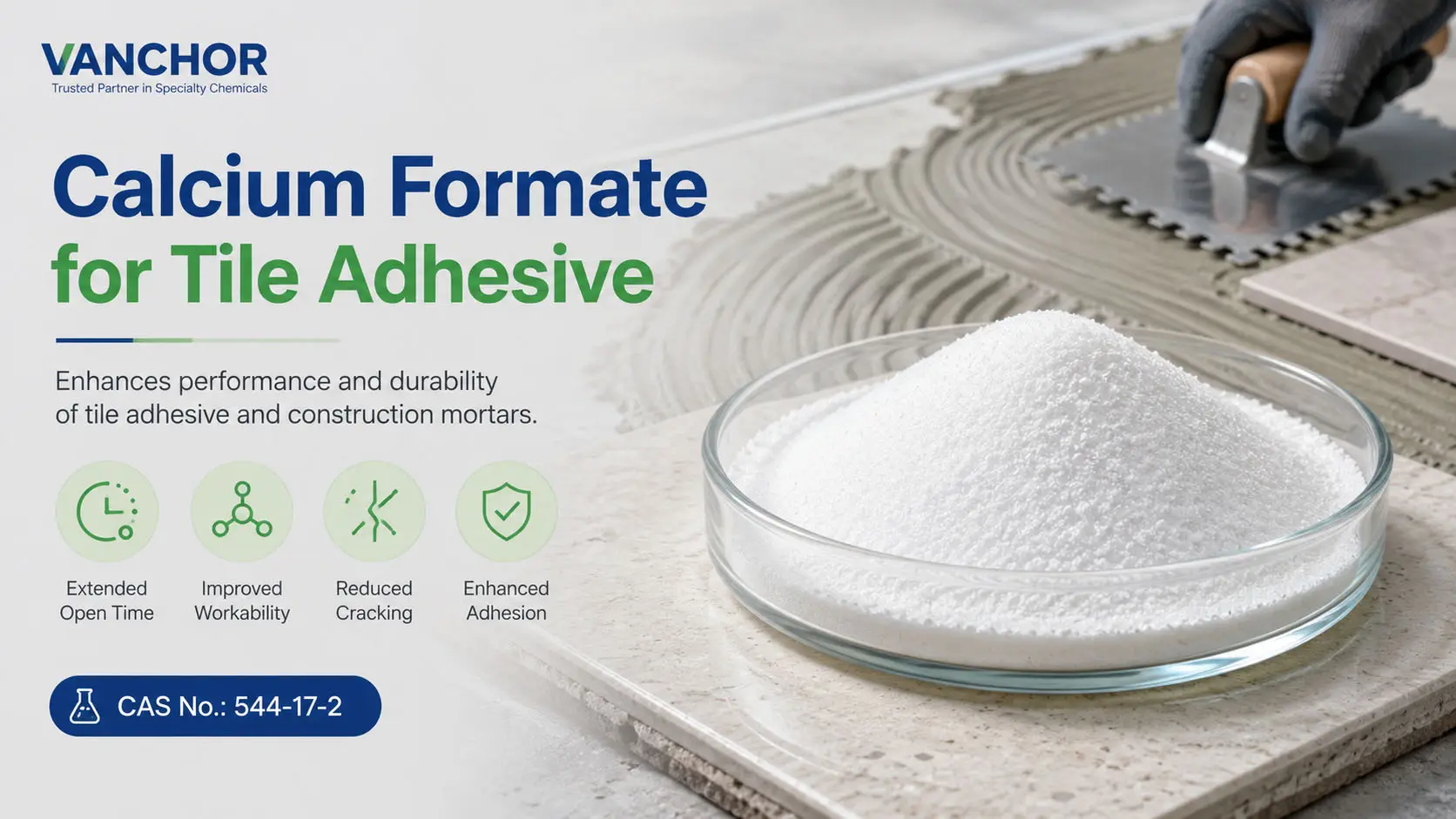
Calcium Formate for Tile Adhesive is commonly used as a cement hydration accelerator in dry-mix mortar formulations. It may help shorten setting time and support early strength development, particularly under cool or humid construction conditions. However, its performance depends on the complete formulation rather than the additive alone.
From Vanchor’s perspective, selecting Calcium Formate for Tile Adhesive should involve dosage testing, raw-material compatibility evaluation, and performance verification under realistic application conditions.
What Is Calcium Formate?
Calcium formate is a white crystalline powder with the chemical formula Ca(HCOO)₂ and CAS number 544-17-2. It is used in several construction-material applications, including tile adhesive, repair mortar, cement-based plaster, self-leveling compounds, and other dry-mix mortar products.
In cementitious formulations, Calcium Formate for Tile Adhesive can influence the early hydration process of cement. This may allow the adhesive layer to develop mechanical strength more quickly after application.
Its role should not be confused with that of cellulose ether or redispersible polymer powder. Each additive performs a different function within the formulation.
| Formulation Component | Main Function in Tile Adhesive | Typical Performance Influence |
|---|---|---|
| Cement | Primary hydraulic binder | Strength development and setting |
| Calcium formate | Hydration accelerator | Earlier setting and early strength |
| Cellulose ether | Water retention and rheology control | Workability, open time, and sag resistance |
| Redispersible polymer powder | Polymer modification | Adhesion, flexibility, and durability |
| Graded sand | Aggregate structure | Dimensional stability and application texture |
| Starch ether | Rheology adjustment | Anti-slip and handling properties |
How Does Calcium Formate Work in Tile Adhesive?
The performance of Calcium Formate for Tile Adhesive is mainly related to cement hydration. When cement reacts with water, hydration products gradually form and create the hardened structure of the mortar.
Calcium formate may support this process by accelerating certain early hydration reactions. Depending on the cement composition and formulation, this can affect initial setting, final setting, and early compressive or adhesive strength.
Several practical effects may be observed:
-
Earlier Setting: Calcium formate may reduce the time required for cement-based tile adhesive to begin hardening.
-
Early Strength Development: Faster hydration may help the mortar develop handling and bonding strength at an earlier stage.
-
Cold-Condition Support: The additive can be useful when low temperatures slow cement hydration.
-
Construction Efficiency: Earlier hardening may allow subsequent installation steps to begin sooner, depending on the system.
These effects should be confirmed through laboratory testing because different cement sources can respond differently to the same dosage.
Does Calcium Formate Increase Open Time?
Calcium Formate for Tile Adhesive is generally used as an accelerator rather than an open-time extender.
In some formulations, excessive acceleration may reduce workable time or shorten open time. For this reason, calcium formate should be balanced with cellulose ether, polymer powder, retarders, and other formulation components.
Open time is influenced by several factors:
-
Cellulose Ether Type: Water-retention performance can influence surface drying and workable time.
-
Ambient Temperature: Higher temperatures generally accelerate moisture loss and cement reaction.
-
Substrate Absorption: Porous substrates can draw water away from the adhesive layer.
-
Layer Thickness: Thin adhesive layers may lose moisture faster than thicker layers.
-
Calcium Formate Dosage: Higher addition levels may increase acceleration but can also reduce application time.
A successful formulation should therefore balance early strength with sufficient working and adjustment time.
Typical Dosage Considerations
There is no universal dosage for Calcium Formate for Tile Adhesive. The suitable level depends on the cement, application class, climate, polymer content, and required setting profile.
In many dry-mix mortar formulations, calcium formate may be evaluated at relatively low percentages of the total dry mix. Trial formulations should begin conservatively and be adjusted according to test results.
| Evaluation Factor | Why It Matters |
|---|---|
| Cement chemistry | Different clinker compositions respond differently to accelerators |
| Calcium formate purity | Impurities and moisture can affect dosage consistency |
| Application temperature | Low temperatures may require a different acceleration level |
| Polymer powder content | Polymer modification can change strength and setting behavior |
| Cellulose ether dosage | Rheology and water retention must remain balanced |
| Required open time | Excess acceleration may shorten installation time |
| Tile type | Ceramic, porcelain, and large-format tiles create different demands |
| Standard requirements | Adhesive performance must meet the target market classification |
Manufacturers should avoid selecting dosage based only on supplier recommendations. Laboratory tests and site simulations provide more reliable guidance.
Performance Tests to Conduct
Before commercial production, Calcium Formate for Tile Adhesive should be tested within the complete mortar formulation.
Recommended evaluation items include:
-
Initial and Final Setting Time: Determines whether the adhesive hardens within the intended construction schedule.
-
Open Time: Measures how long the applied adhesive remains suitable for tile installation.
-
Slip Resistance: Evaluates whether wall tiles remain in position after placement.
-
Tensile Adhesion Strength: Tests bonding performance under dry, wet, heat-aging, and freeze-thaw conditions where relevant.
-
Early Compressive Strength: Assesses strength development during the first one to three days.
-
Water Demand: Checks whether the additive changes the mixing-water requirement.
-
Workability: Confirms that spreading, combing, and tile adjustment remain practical.
-
Storage Stability: Evaluates whether the dry mix remains free flowing and consistent during storage.
Testing should follow the standards applicable to the intended sales market, such as EN, ISO, ANSI, or local construction-material requirements.
Factors Affecting Product Selection
The quality of Calcium Formate for Tile Adhesive is not determined by purity alone. Consistency between production batches is also important for dry-mix mortar manufacturers.
Purchasers may consider:
-
Chemical Purity: Stable composition supports predictable formulation behavior.
-
Moisture Content: Excess moisture may affect storage, flowability, and dosing accuracy.
-
Particle Size: Uniform powder can support easier dispersion in dry-mix production.
-
Batch Consistency: Variations between shipments can change setting and strength results.
-
Packaging Protection: Moisture-resistant packaging helps reduce caking during transport and storage.
-
Technical Documentation: COA, TDS, SDS, and application guidance support procurement and quality control.
-
Supply Reliability: Consistent availability is important for continuous mortar production.
Common Formulation Problems
Calcium Formate for Tile Adhesive may contribute to formulation problems when used without adequate testing.
Setting Is Too Fast
The dosage may be too high, or the cement may already have a rapid hydration profile. Reducing the addition level and reassessing the retarder system may help.
Open Time Is Too Short
The formulation may require adjustment of cellulose ether, water retention, or accelerator dosage. Environmental temperature should also be considered.
Early Strength Does Not Improve
The cement type, additive purity, mixing uniformity, or polymer system may limit the expected effect. Comparative laboratory trials are needed.
Adhesion Is Inconsistent
Calcium formate cannot replace polymer modification, correct substrate preparation, or suitable water dosage. Adhesion depends on the entire formulation and installation process.
Powder Caking Occurs
High humidity, unsuitable packaging, or storage conditions may affect powder flow. Materials should be stored in a dry and ventilated environment.
Calcium Formate for Different Tile Adhesive Formulations
Calcium Formate for Tile Adhesive may be used differently depending on the intended application.
| Tile Adhesive Type | Possible Reason for Using Calcium Formate | Key Formulation Concern |
|---|---|---|
| Standard cement-based adhesive | Support early hardening | Maintain practical open time |
| Fast-setting tile adhesive | Accelerate return-to-service time | Avoid excessively short working time |
| Cold-weather formulation | Compensate for slower hydration | Test at realistic low temperatures |
| Large-format tile adhesive | Support early mechanical stability | Maintain flexibility and adhesion |
| Wall tile adhesive | Assist early setting | Balance acceleration with anti-slip |
| Repair and renovation adhesive | Shorten project waiting periods | Confirm substrate compatibility |
The additive should be selected according to performance objectives rather than applied at the same dosage across all products.
Storage and Handling
Calcium formate should be stored in sealed packaging in a dry environment. Exposure to moisture may cause caking and reduce dosing consistency.
Basic handling practices include:
-
Keep Packaging Closed: Open bags should be resealed or used promptly.
-
Avoid Moisture Exposure: Store materials away from water and high-humidity areas.
-
Use Dust Control: Operators should follow suitable industrial hygiene procedures during powder handling.
-
Review the SDS: Personal protection and handling requirements should follow the supplier’s safety documentation.
-
Apply Batch Control: Record batch numbers to support traceability and formulation troubleshooting.
Conclusion
Calcium Formate for Tile Adhesive is primarily used to accelerate cement hydration and support early strength development. It may be particularly useful in fast-setting systems, low-temperature applications, and formulations that require earlier handling strength.
However, calcium formate does not independently determine tile adhesive performance. Dosage, cement chemistry, cellulose ether, polymer powder, aggregate grading, water demand, temperature, and installation conditions must be evaluated together.
Vanchor recommends testing Calcium Formate for Tile Adhesive within the complete formulation before commercial use. A controlled testing process can help manufacturers balance setting time, open time, workability, adhesion, and early strength while maintaining consistent production quality.


Contact Us
In This Article
Related Posts
Custom Packaging Solutions from an Anhydrous Sodium Acetate Supplier in China
2026-09-23
Application Trends in Anhydrous Sodium Acetate for Special Chemical Manufacturing
2026-09-23
Anhydrous Sodium Acetate for Leather Tanning: Improve Dyeing Uniformity
2026-09-22
Formic Acid 85% for Textile Dyeing: Industrial Applications, Technical Benefits and Future Trends
2026-09-22


