



Calcium Formate for Tile Adhesive in Low-Carbon Cement Systems
By Vanchorsc
2026-09-19Related Posts
Custom Packaging Solutions from an Anhydrous Sodium Acetate Supplier in China
2026-09-23

Application Trends in Anhydrous Sodium Acetate for Special Chemical Manufacturing
2026-09-23
Anhydrous Sodium Acetate for Leather Tanning: Improve Dyeing Uniformity
2026-09-22

Formic Acid 85% for Textile Dyeing: Industrial Applications, Technical Benefits and Future Trends
2026-09-22
Lower-clinker binders are increasingly used to reduce the cement-related carbon footprint of dry-mix mortars. For tile adhesive formulators, however, replacing Portland cement with GGBFS, fly ash, limestone or combined SCM systems changes more than carbon intensity. It can alter early hydration, setting behavior, water demand and early mechanical development.
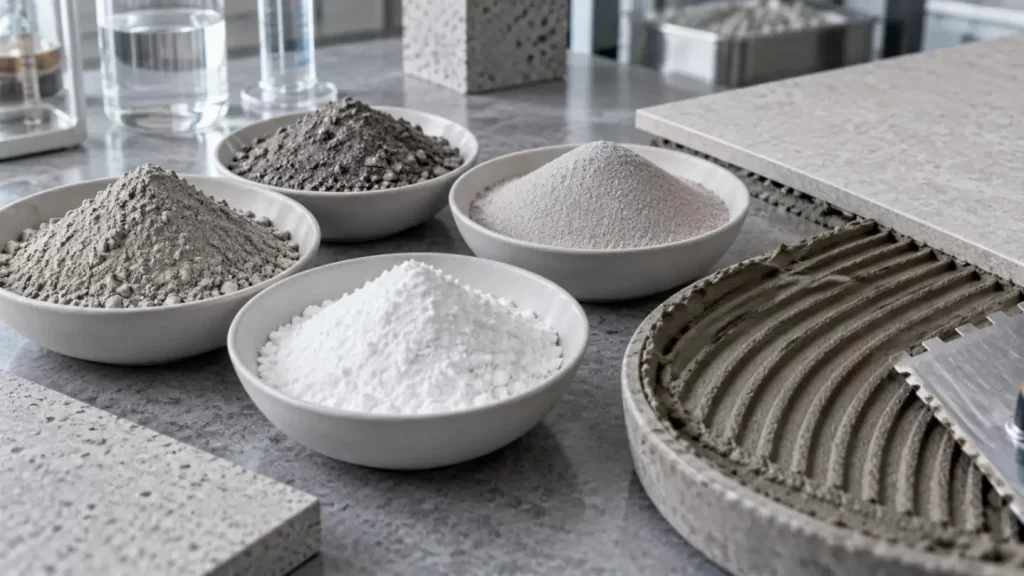
This is where Calcium Formate for Tile Adhesive becomes technically relevant. The objective is not simply faster setting. A workable formulation must recover sufficient early structure while retaining open time, tile adjustability and final adhesion.
Why SCM-Rich Tile Adhesive Behaves Differently
Reducing Portland clinker reduces the amount of highly reactive cement phases available during the first hours of hydration. The result depends strongly on the SCM chemistry.
| Binder System | Typical Early-Age Issue | Main Formulation Focus |
| OPC-rich cement | Faster hydration | Avoid excessive acceleration |
| GGBFS-rich binder | Slower early structure formation | Activation and 1-day strength |
| Fly-ash blend | Delayed early reaction | Setting and early adhesion |
| Limestone-SCM blend | Dilution plus aluminate interaction | Sulfate balance and workability |
| Ternary binder | Multiple interactions | Full compatibility testing |
The important point is that SCM percentage alone cannot determine the dosage of Calcium Formate for Tile Adhesive.
Formulators also need to consider:
•Sulfate availability and gypsum balance;
•SCM fineness and reactivity;
•Water-to-binder ratio;
•Ambient temperature;
•HPMC grade and dosage;
•Redispersible polymer powder (RDP).
A calcium formate level that works with one cement source may therefore produce a different result after changing the cement or SCM supplier.
How Calcium Formate Changes the Early Hydration Window
Calcium Formate for Tile Adhesive is used to modify early cement hydration and accelerate structural development in the mortar matrix.
In practical terms, the design logic is:
Lower Clinker Content → Reduced Early Reactivity → Slower Structure Formation → Calcium Formate Optimization → Improved Early Hydration
But this relationship is not linear.
Increasing calcium formate may accelerate early hydration, while excessive acceleration can create other problems:
•Shortened working time;
•Reduced practical open time;
•Less time for tile adjustment;
•Difficult rheology control;
•Imbalance with cellulose ether;
•Inconsistent adhesion if the complete formulation is not re-optimized.
For this reason, Vanchor recommends treating Calcium Formate for Tile Adhesive as part of the binder system rather than as an isolated accelerator.
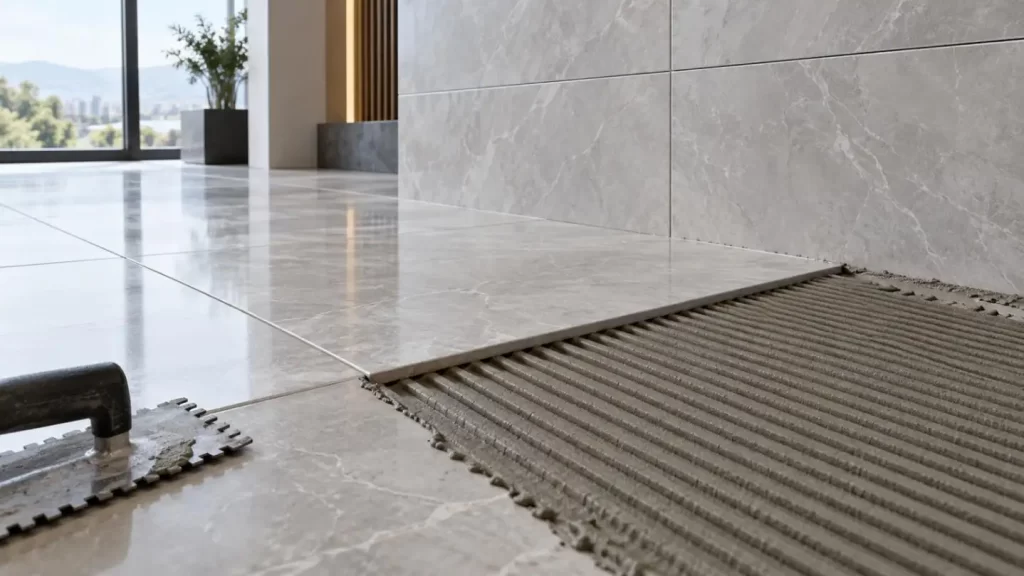
Compare Early-Strength Routes Before Changing the Formula
When a low-carbon formulation loses early strength, adding more accelerator is only one option.
| Technical Route | Early Performance | Key Advantage | Main Risk |
| Increase Portland cement | Usually faster | Simple formulation route | Higher clinker content |
| Optimize calcium formate | Dosage-dependent | Retains lower-clinker design | Open-time sensitivity |
| Adjust SCM proportion | System-dependent | Changes binder reactivity | May affect cost/durability |
| Alternative activation | Can be strong | Suitable for some SCM systems | pH and additive compatibility |
The correct target is therefore performance balance, not maximum acceleration.
Match Calcium Formate to the SCM Chemistry
Slag-Rich Systems
GGBFS has latent hydraulic activity but normally depends on the surrounding cement chemistry for activation. In a slag-rich tile adhesive, Calcium Formate for Tile Adhesive may be evaluated where early structure formation is insufficient.
Key variables include:
•Slag replacement level;
•Slag fineness;
•Portland cement composition;
•Sulfate balance;
•Curing temperature.
Fly-Ash-Containing Systems
Fly ash generally reacts more slowly at early ages than Portland cement. Consequently, a calcium formate dosage developed for a slag formulation should not automatically be transferred to a fly-ash system.
The practical question is not simply "Does calcium formate accelerate?" but:
"Does the chosen dosage improve useful early performance without damaging application time?"
Limestone and Ternary Binders
Limestone-SCM systems can involve clinker dilution, nucleation effects and aluminate-carbonate-sulfate interactions. These systems should be screened through laboratory trials rather than controlled by a fixed calcium formate percentage.
Rebalance HPMC, RDP and Water Demand Together
A polymer-modified tile adhesive is a multi-component system.
HPMC primarily supports:
•Water retention
•Rheology
•Application consistency
•Open time
RDP contributes to:
•Tensile adhesion
•Flexibility
•Deformation capacity
•Performance at the tile–mortar interface
Therefore:
Higher 1-day compressive strength does not automatically mean higher tile adhesion.
When the binder changes, formulators should evaluate Calcium Formate for Tile Adhesive together with HPMC, RDP and mixing water rather than changing one additive independently.
A practical screening matrix can use several calcium formate levels:
| Trial | Setting | Open Time | 1-Day Strength | Tensile Adhesion |
| 0% reference | Measure | Measure | Measure | Measure |
| Low dosage | Measure | Measure | Measure | Measure |
| Medium dosage | Measure | Measure | Measure | Measure |
| Higher dosage | Measure | Measure | Measure | Measure |
The purpose is to locate a stable formulation window—not simply the dosage producing the shortest setting time.
Check What Installers Actually Experience
Laboratory acceleration has limited value if the adhesive becomes difficult to apply.
During formulation validation, check:
•Mixing-water tolerance;
•Mortar consistency after mixing;
•Pot life;
•Practical open time;
•Tile adjustment time;
•Low-temperature behavior;
•Curing time before grouting or service.
Storage also matters. Calcium formate and finished dry-mix products should be protected from moisture to reduce caking and dosing variation.
Validate the Finished Adhesive to the Target Standard
Do not approve an SCM-based formula based only on cement setting time or cube strength.
ISO 13007-2 includes methods for evaluating properties such as open time, slip, shear adhesion, tensile adhesion and transverse deformation. The selected tests should reflect the intended product classification and market.
This distinction is critical:
•Setting time describes binder stiffening;
•Pot life describes usable mixed mortar;
•Open time describes how long applied adhesive can still bond effectively;
•Early strength describes structural development;
•Tensile adhesion evaluates the actual tile bonding system.
These parameters must not be treated as interchangeable.
Specify Calcium Formate for Stable Dry-Mix Production
When the formulation window is set, the challenge is the consistency of raw materials.
Vanchor provides industrial grade Calcium Formate for Tile Adhesive with the following specifications
| Quality Parameter | Vanchor Specification |
| Purity | ≥98% |
| Calcium Content | ≥30.1% |
| Insoluble Matter | ≤1.0% |
| Moisture Loss | ≤0.3% |
| pH, 10% Solution | 6–8 |
COA and SDS are available upon request and 25 kg moisture resistant bags and bulk packaging support logistics for dry mix production.
For low-carbon tile adhesive, the most reliable purchasing sequence is:
Identify SCM Chemistry → Run Dosage Trials → Rebalance HPMC/RDP → Verify Application Properties → Test Final Adhesion → Approve Raw-Material Specification → Scale Up Production.
Vanchor supplies Calcium Formate for Tile Adhesive for construction formulations with consistent product specifications and flexible supply options. Manufacturers developing slag-, fly-ash- or other SCM-based tile adhesives can use Vanchor material samples and technical documentation as part of their own compatibility and scale-up testing.
FAQs
Q1. What type of Calcium Formate for Tile Adhesive does Vanchor supply?
Vanchor supplies industrial-grade calcium formate for dry-mix mortar and tile adhesive formulations, including systems using Portland cement and supplementary cementitious materials such as slag or fly ash.
Q2. What is the purity of Vanchor Calcium Formate for Tile Adhesive?
Vanchor specifies a calcium formate purity of ≥98%, supporting consistent dosing and formulation control in industrial dry-mix production.
Q3. What is the calcium content of Vanchor calcium formate?
Vanchor specifies a calcium content of ≥30.1%. Calcium content is one parameter manufacturers can include when establishing incoming raw-material quality controls.
Q4. Can Vanchor Calcium Formate for Tile Adhesive be used with slag cement?
It can be evaluated in slag-containing tile adhesive formulations. The optimum dosage should be confirmed through trials because slag replacement level, fineness, cement chemistry, sulfate balance and curing temperature can all influence performance.
Q5. Can Vanchor calcium formate be used with fly-ash-based tile adhesive?
Yes, it can be tested in fly-ash-containing formulations, but the dosage should not simply be copied from a slag or OPC formulation. Fly ash generally has different early-age reactivity and requires formulation-specific compatibility testing.


Contact Us
In This Article
Related Posts
Custom Packaging Solutions from an Anhydrous Sodium Acetate Supplier in China
2026-09-23
Application Trends in Anhydrous Sodium Acetate for Special Chemical Manufacturing
2026-09-23
Anhydrous Sodium Acetate for Leather Tanning: Improve Dyeing Uniformity
2026-09-22
Formic Acid 85% for Textile Dyeing: Industrial Applications, Technical Benefits and Future Trends
2026-09-22


